
Pink Fairy Armadillo
Chlamyphorus truncatus
Red List assessment
Data Deficienton the IUCN Red List
- EXExtinct
- EWExtinct in the Wild
- CRCritically Endangered
- ENEndangered
- VUVulnerable
- NTNear Threatened
- LCLeast Concern
Data Deficient has no position on the scale above — it records the absence of an assessment, not a degree of risk.
The Pink Fairy Armadillo is recorded in one country, Argentina across South America. The IUCN Red List records the Pink Fairy Armadillo as Data Deficient. No reliable population estimate exists due to its fossorial and secretive nature; anecdotal evidence suggests it may be uncommon to rare in parts of its range.
- Family
- Chlamyphoridae
- Order
- Cingulata
- Genus
- Chlamyphorus
- Countries recorded
- 1
- Continents
- South America
- Red List category
- Data Deficient
- Data updated
- August 9, 2026
What is the Pink Fairy Armadillo?
The pink fairy armadillo is the smallest species of armadillo in the world, native to the arid sandy plains of central Argentina. It is remarkable for its pale pink shell, silky white fur, and highly fossorial lifestyle spent almost entirely underground. Due to its elusive nocturnal and subterranean habits, it is rarely observed and remains one of the least studied mammals on Earth.
Where does the Pink Fairy Armadillo live?
Central Argentina, primarily Mendoza, San Luis, and La Pampa provinces
Endemic to central Argentina, found mainly in the provinces of Mendoza, San Luis, and La Pampa, within the Monte desert ecoregion.
Altitude and depth
Lives at low to moderate elevations, roughly 500-1500m, spending most time a few centimeters to half a meter below the sand surface.
Seasonal movements
No true hibernation or long-distance migration; may adjust digging depth and surface activity seasonally to avoid temperature extremes.
Habitat of the Pink Fairy Armadillo
Inhabits arid and semi-arid sandy plains, dunes, and scrubland with loose, sandy soil suitable for digging. Vegetation is typically sparse, dominated by xerophytic shrubs and grasses.
Adaptations to its environment
Possesses powerful front claws and a shovel-like tail plate for rapid burrowing, plus a dorsal shell that can seal burrow entrances to reduce predation and moisture loss. Its thin, sparse fur and specialized skin help regulate body temperature underground.
Conservation status and numbers
Listed as Data Deficient (DD) by the IUCN due to lack of sufficient population data, difficulty of study, and its cryptic underground lifestyle. Its actual population trend remains largely unknown.
Estimated population
No reliable population estimate exists due to its fossorial and secretive nature; anecdotal evidence suggests it may be uncommon to rare in parts of its range.
What threatens the Pink Fairy Armadillo?
Habitat degradation from agriculture and livestock grazing, off-road vehicle use, predation by domestic dogs, and illegal capture for the exotic pet trade are believed to be the main threats.
Diseases and parasites
Specific data on diseases or parasites is scarce, though like other armadillos it may host external parasites such as mites and ticks.
What is being done to protect it?
There are currently few dedicated conservation programs; some protection may be afforded incidentally through general habitat protections in Monte desert reserves in Argentina.
Recommended actions
Priority actions include systematic population surveys, habitat protection in the Monte desert, regulation of the pet trade, and public awareness campaigns to reduce accidental captures.
What the Pink Fairy Armadillo looks like
Has a pale pink to rose-colored dorsal shell loosely attached to the body, contrasting with dense, silky white to cream-colored fur covering the sides and underside. The shell is thin and flexible, unlike the rigid armor of larger armadillo species.
Size
Adults typically measure 9-11.5 cm in body length, with an additional short tail of about 2.5-3 cm.
Weight
Weighs approximately 90-150 grams, making it exceptionally small for an armadillo.
Distinctive features
Distinguished from other armadillos by its minute size, the loosely attached pink carapace, and a unique flattened, vertical rear end used to compact soil while burrowing.
Behaviour and diet of the Pink Fairy Armadillo
Solitary and rarely observed interacting with conspecifics except during mating; individuals maintain separate burrow systems.
When it is active
Primarily nocturnal or crepuscular, spending the vast majority of its life underground and surfacing briefly, usually at night, to forage.
Diet
Omnivorous, feeding mainly on ants, ant larvae, and other insects, along with worms, roots, and various plant matter found underground.
How it feeds and hunts
Uses strong claws to dig through loose sand in search of ants and insect larvae, often following underground insect tunnels; relies on smell and touch rather than sight due to poor vision.
Communication
Likely relies on scent marking and tactile cues within burrows rather than vocalizations, given its subterranean and solitary lifestyle; limited direct observation exists.
Interactions with other species
Preyed upon by domestic and feral dogs, birds of prey, and other native carnivores when above ground; competes little with other species due to its specialized fossorial niche.
Role in its ecosystem
Plays a role in soil aeration and turnover through its extensive digging, and helps control insect populations, particularly ants, within its arid ecosystem.
Reproduction and lifecycle
Breeding biology is poorly documented, but births are thought to occur in spring; litter size is typically one pup, with gestation estimated around 60 days.
Raising the young
Details are largely unknown, but as with other armadillos, the mother likely nurses and cares for the single pup in an underground burrow until it is independent.
Maturity and lifespan
Age of sexual maturity is not well documented; captive lifespan is thought to be very short (often less than a few years) due to high stress sensitivity, while wild lifespan remains unknown.
Taxonomy and naming of the Pink Fairy Armadillo
Classification
Mammalia > Cingulata > Chlamyphoridae > Chlamyphorus > Chlamyphorus truncatus
Scientific synonyms
Chlamyphorus minutus (sometimes used historically, though its validity is debated)
What research says
Recent studies
Recent research has focused on using camera traps and burrow surveys to better understand distribution and habitat use, though comprehensive studies remain rare due to the species' elusiveness.
Genome and DNA
Genetic studies are limited, but cytogenetic research places it within Cingulata with a chromosome number distinct from larger armadillo species; detailed genomic sequencing is lacking.
Compared with similar species
Compared to its closest relative, the Chacoan fairy armadillo (Calyptophractus retusus), the pink fairy armadillo is smaller, has a more loosely attached shell, and inhabits sandier, more arid environments.
The Pink Fairy Armadillo and people
It is often called the 'sand swimmer' because it can disappear into loose sand almost like swimming; it is one of the smallest armadillo species ever recorded, and its pink shell coloration comes from blood vessels visible through the thin carapace.
Where and how to see it
Extremely difficult to observe in the wild due to its subterranean, nocturnal habits; best chances involve guided nighttime surveys in sandy Monte desert habitats of Mendoza or San Luis with local researchers.
Risks to humans
No notable risk to humans; it is a small, non-aggressive animal with no venom or significant bite risk.
Human uses
Occasionally captured illegally for the exotic pet trade, though it fares very poorly in captivity and is not used in traditional medicine or commercial industries.
Myths and legends
While not tied to major indigenous myths, its fantastical pink appearance has inspired its popular 'fairy' name and made it a subject of internet folklore and misidentification as a fictional creature.
Countries where the Pink Fairy Armadillo is recorded
The 1 countries named in the range description of its IUCN Red List assessment.
Questions about the Pink Fairy Armadillo
Where does the Pink Fairy Armadillo live?
The Pink Fairy Armadillo is recorded in Argentina across South America. These countries come from the range description of its IUCN Red List assessment, and they are what place the species on the interactive map.
Is the Pink Fairy Armadillo endangered?
The IUCN Red List assesses the Pink Fairy Armadillo as Data Deficient. There is not enough information to judge the risk of extinction, usually because the species is rarely seen or has never been surveyed. It is not a reassuring category: several species were Data Deficient right up to the point they were found to be Critically Endangered.
How many are left in the wild?
No reliable population estimate exists due to its fossorial and secretive nature; anecdotal evidence suggests it may be uncommon to rare in parts of its range. This figure comes from the species assessment on the IUCN Red List; population estimates for wild mammals are ranges, not counts, and are revised at each assessment.
What habitat does the Pink Fairy Armadillo live in?
Inhabits arid and semi-arid sandy plains, dunes, and scrubland with loose, sandy soil suitable for digging.
What is the scientific name of the Pink Fairy Armadillo?
The Pink Fairy Armadillo is Chlamyphorus truncatus, in the family Chlamyphoridae, order Cingulata.
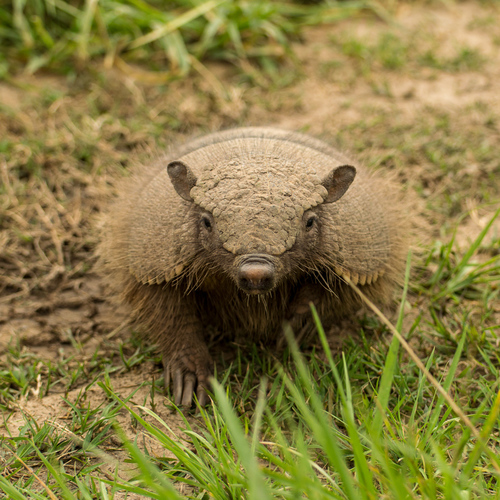
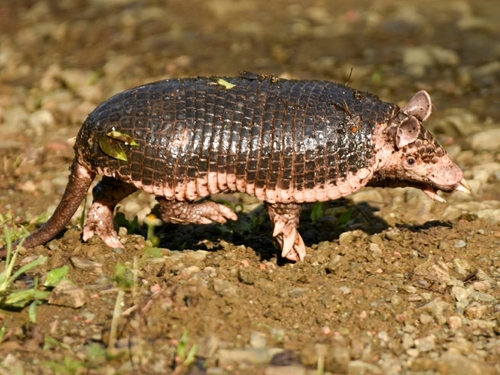
Other species in the family Chlamyphoridae
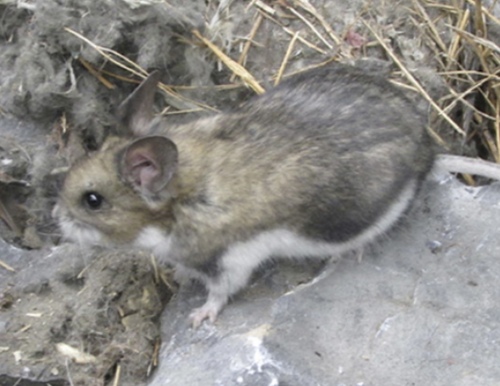
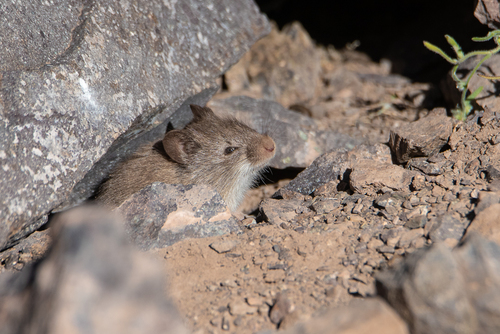
Species that share its range

Sources
Conservation status, range description and population estimate come from the IUCN Red List assessment for Chlamyphorus truncatus. Countries are derived from that range description, not from a mapped country list. Last refreshed on .
The distribution map is drawn from the IUCN Red List spatial data compiled in 2024. IUCN (International Union for Conservation of Nature)