
Giant Armadillo
Priodontes maximus
Red List assessment
Vulnerableon the IUCN Red List
- EXExtinct
- EWExtinct in the Wild
- CRCritically Endangered
- ENEndangered
- VUVulnerable
- NTNear Threatened
- LCLeast Concern
The Giant Armadillo is recorded in 5 countries across South America. The IUCN Red List assesses the Giant Armadillo as Vulnerable. Population size is unknown but believed to be declining; considered rare and elusive, making accurate estimates difficult.
- Family
- Chlamyphoridae
- Order
- Cingulata
- Genus
- Priodontes
- Countries recorded
- 5
- Continents
- South America
- Red List category
- Vulnerable
- Data updated
- August 9, 2026
What is the Giant Armadillo?
The Giant Armadillo is the largest living species of armadillo, native to South America, known for its powerful digging abilities and nocturnal lifestyle. It plays a crucial ecological role by creating burrows that many other species use for shelter. Despite its imposing size, it is elusive and rarely seen, contributing to limited scientific knowledge about its population and behavior. It is currently classified as Vulnerable due to habitat loss and hunting pressures.
Where does the Giant Armadillo live?
South America, primarily in the Amazon Basin and Pantanal wetlands, spanning Brazil, Argentina, Bolivia, Paraguay, and other neighboring countries
Found across the Amazon Basin and adjacent regions, including Brazil, Bolivia, Paraguay, Argentina, Venezuela, and parts of the Guianas. Its range is fragmented due to habitat destruction, with strongholds in protected areas like the Pantanal.
Altitude and depth
Primarily found at low elevations, from sea level up to about 1000 meters
Habitat of the Giant Armadillo
Inhabits a variety of habitats including tropical rainforests, savannas, and wetlands such as the Pantanal, favoring areas with abundant termite and ant colonies. Prefers regions with soft soil for burrowing and dense vegetation for cover.
Adaptations to its environment
Possesses powerful claws adapted for digging extensive burrows, which serve as shelter and protection from predators. Its tough, armored carapace provides defense against threats, while its keen sense of smell compensates for poor eyesight in locating food underground.
Conservation status and numbers
Vulnerable (VU) according to IUCN, primarily due to a population decline estimated at over 30% over the past three generations, driven by habitat loss and hunting.
Estimated population
Population size is unknown but believed to be declining; considered rare and elusive, making accurate estimates difficult.
What threatens the Giant Armadillo?
Major threats include deforestation for agriculture and urban development, hunting for bushmeat, and illegal wildlife trade. Habitat fragmentation also isolates populations, reducing genetic diversity.
What is being done to protect it?
Conservation efforts include habitat protection in reserves such as the Pantanal Matogrossense National Park, research initiatives to better understand population dynamics, and enforcement of hunting regulations. NGOs and governmental agencies collaborate on monitoring and habitat preservation programs.
Recommended actions
Strengthening protected area networks, enforcing anti-poaching laws, conducting further population surveys, and promoting habitat connectivity are key priorities. Public awareness campaigns can also help reduce hunting pressure.
What the Giant Armadillo looks like
Covered in a hard, bony carapace with a grayish-brown coloration, featuring overlapping scutes that provide protection. Its limbs are short and powerful, ending in large claws suited for digging.
Size
Body length ranges from 75 to 100 cm, with a tail adding an additional 50 cm, making the total length up to 1.5 meters.
Weight
Typically weighs between 18 to 32 kg, with males generally larger than females.
Distinctive features
Distinguished by its large size, the number of scutes on its carapace, and its long, curved claws used for digging burrows. Unlike other armadillo species, it has a more elongated snout and larger overall body size.
Behaviour and diet of the Giant Armadillo
Generally solitary, with minimal social interactions outside of mating season. Occasionally, individuals may share burrows temporarily.
When it is active
Nocturnal, primarily active during the night to forage and avoid predators, resting in burrows during the day.
Diet
Primarily an insectivore, feeding mainly on termites and ants, but can also consume other invertebrates and occasionally small vertebrates.
How it feeds and hunts
Uses its powerful claws to dig into termite mounds and ant nests, then employs its long, sticky tongue to extract insects.
Communication
Limited information exists; communication likely involves scent marking and possibly some vocalizations related to mating or territory.
Interactions with other species
Its burrows provide habitat for numerous other species, including insects, reptiles, and small mammals, highlighting its role as an ecosystem engineer.
Role in its ecosystem
Acts as an ecosystem engineer by creating burrows that offer shelter to a variety of other wildlife, thus playing a significant role in maintaining biodiversity within its habitat.
Reproduction and lifecycle
Breeding season is not well documented but is believed to occur year-round in some regions. Gestation lasts approximately 4 months, resulting in a litter of 1 to 2 offspring.
Raising the young
Details on parental care are scarce, but it is presumed that females care for the young until they are independent, which may take several months.
Maturity and lifespan
Reaches sexual maturity around 3 to 4 years of age; lifespan in the wild is estimated to be around 12 to 15 years, potentially longer in captivity.
Taxonomy and naming of the Giant Armadillo
Classification
Class Mammalia > Order Cingulata > Family Chlamyphoridae > Genus Priodontes > Species Priodontes maximus
Scientific synonyms
Priodon giganteus; Dasypus giganteus
What research says
Recent studies
Recent studies focus on understanding its burrowing behavior and ecological impact, as well as assessing population densities using camera traps and genetic analysis.
Compared with similar species
Compared to other armadillo species, the Giant Armadillo is notably larger and possesses more pronounced digging adaptations, making it a key species for ecological studies on burrowing animals.
The Giant Armadillo and people
The Giant Armadillo can dig a burrow large enough for a human to enter within minutes, showcasing its impressive digging capability. Additionally, its diet can include thousands of ants and termites in a single night, making it a natural pest controller.
Where and how to see it
Best observed during nighttime excursions in protected areas like the Pantanal, particularly around dusk when they emerge to forage. Patience and quiet movement are essential, as they are shy and elusive creatures.
Risks to humans
No notable risk to humans, as they are non-aggressive and primarily avoid contact.
Human uses
Historically hunted for bushmeat by local communities, and its shell has been used in traditional crafts, although this practice is declining due to conservation efforts.
Countries where the Giant Armadillo is recorded
The 5 countries named in the range description of its IUCN Red List assessment.
Questions about the Giant Armadillo
Where does the Giant Armadillo live?
The Giant Armadillo is recorded in Argentina, Bolivia, Brazil, Paraguay and Venezuela across South America. These countries come from the range description of its IUCN Red List assessment, and they are what place the species on the interactive map.
Is the Giant Armadillo endangered?
Yes. The IUCN Red List assesses the Giant Armadillo as Vulnerable, one of the three threatened categories. The species faces a high risk of extinction in the wild. It is the first of the three threatened categories: numbers are falling, the range is shrinking, or the population is small enough that a single bad event could do lasting damage.
How many are left in the wild?
Population size is unknown but believed to be declining; considered rare and elusive, making accurate estimates difficult. This figure comes from the species assessment on the IUCN Red List; population estimates for wild mammals are ranges, not counts, and are revised at each assessment.
What habitat does the Giant Armadillo live in?
Inhabits a variety of habitats including tropical rainforests, savannas, and wetlands such as the Pantanal, favoring areas with abundant termite and ant colonies.
What is the scientific name of the Giant Armadillo?
The Giant Armadillo is Priodontes maximus, in the family Chlamyphoridae, order Cingulata.
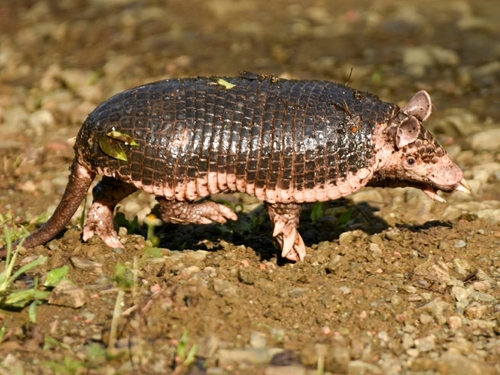
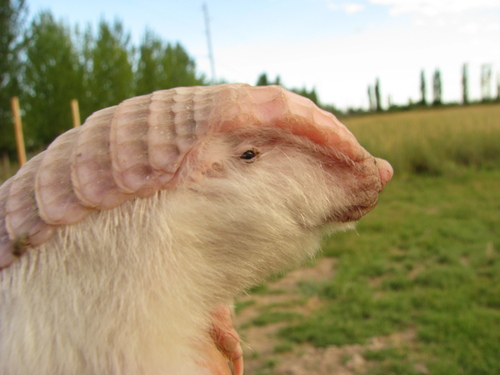
Other species in the family Chlamyphoridae
Species that share its range
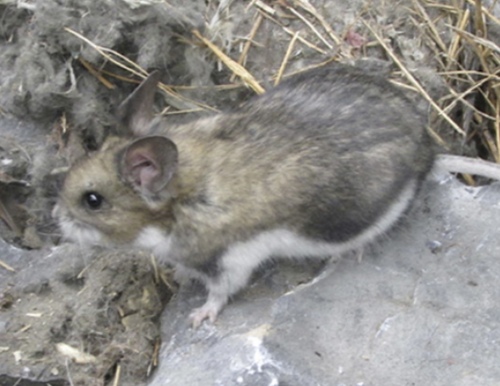
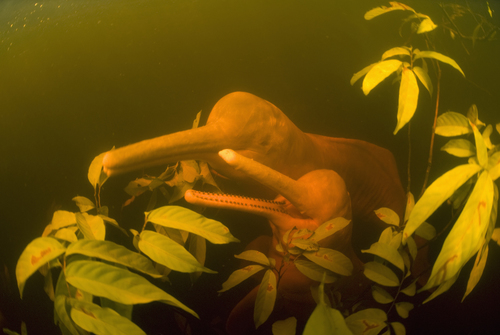
Sources
Conservation status, range description and population estimate come from the IUCN Red List assessment for Priodontes maximus. Countries are derived from that range description, not from a mapped country list. Last refreshed on .
The distribution map is drawn from the IUCN Red List spatial data compiled in 2024. IUCN (International Union for Conservation of Nature)