
Greater Naked-tailed Armadillo
Cabassous tatouay
Red List assessment
Least Concernon the IUCN Red List
- EXExtinct
- EWExtinct in the Wild
- CRCritically Endangered
- ENEndangered
- VUVulnerable
- NTNear Threatened
- LCLeast Concern
The Greater Naked-tailed Armadillo is recorded in 4 countries across South America. The IUCN Red List assesses the Greater Naked-tailed Armadillo as Least Concern. No precise population estimates exist due to its secretive and fossorial nature; the population trend is considered stable to possibly declining in areas with intense agricultural development
- Family
- Chlamyphoridae
- Order
- Cingulata
- Genus
- Cabassous
- Countries recorded
- 4
- Continents
- South America
- Red List category
- Least Concern
- Data updated
- August 9, 2026
What is the Greater Naked-tailed Armadillo?
The Greater Naked-tailed Armadillo is a medium-sized burrowing mammal native to the grasslands and forests of southeastern South America. It is named for its distinctive tail, which lacks the bony scutes found in most other armadillo species. This fossorial animal is rarely observed due to its nocturnal and highly secretive habits, spending much of its life underground in extensive burrow systems.
Where does the Greater Naked-tailed Armadillo live?
Southeastern South America, primarily Uruguay, southern Brazil, northeastern Argentina, and Paraguay
Found in Uruguay, southern and southeastern Brazil (Rio Grande do Sul, Santa Catarina), northeastern Argentina (Misiones, Corrientes), and eastern Paraguay. Its range is centered on the Pampas and adjacent subtropical regions.
Altitude and depth
Typically found at low to moderate elevations, generally below 1000m, with most populations in lowland grassland and forest habitats
Habitat of the Greater Naked-tailed Armadillo
Inhabits grasslands, savannas, gallery forests, and agricultural areas with soft, well-drained soils suitable for digging. Often found near riverbanks and in areas with dense vegetation cover that provides protection while foraging.
Adaptations to its environment
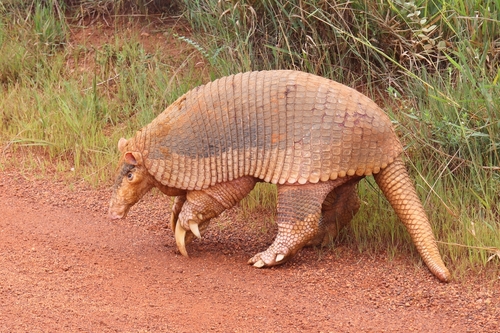
Possesses powerful forelimbs and enlarged, curved claws adapted for rapid digging and excavating termite and ant nests. The naked tail may aid in sensing vibrations or navigating burrows, while its armored carapace provides protection from predators while foraging above ground.
Conservation status and numbers
Listed as Least Concern by IUCN due to its relatively wide distribution and presumed stable population, though it is poorly studied and locally may face pressure from habitat conversion
Estimated population
No precise population estimates exist due to its secretive and fossorial nature; the population trend is considered stable to possibly declining in areas with intense agricultural development
What threatens the Greater Naked-tailed Armadillo?
Habitat loss from agricultural expansion and land conversion, incidental killing by farmers who consider them pests, and roadkill mortality are the primary threats to local populations
Diseases and parasites
Susceptible to various ectoparasites including ticks and mites; may also carry Trypanosoma cruzi, the parasite responsible for Chagas disease, similar to other armadillo species
What is being done to protect it?
Protected in some national parks and reserves within its range, including areas in Uruguay and southern Brazil; however, specific conservation programs targeting this species are limited
Recommended actions
Increased research into population status and ecology, habitat protection in agricultural landscapes, and public education to reduce persecution by farmers who view them as pests
What the Greater Naked-tailed Armadillo looks like
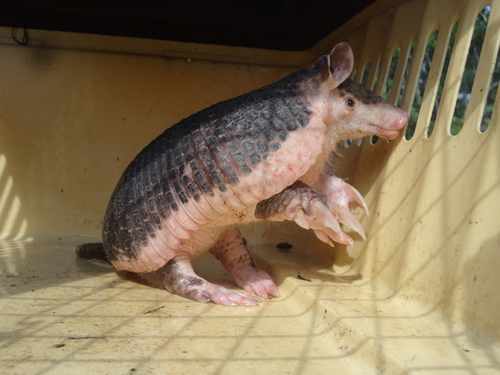
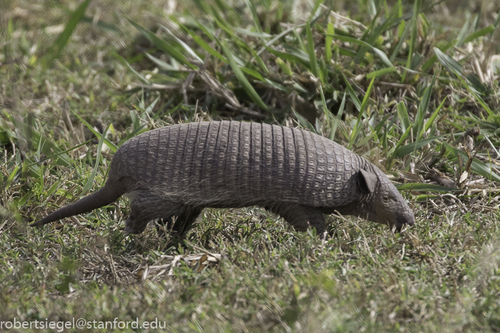
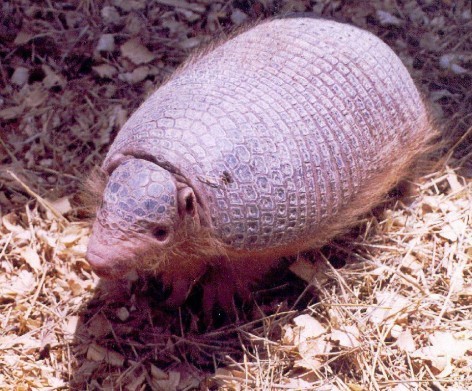
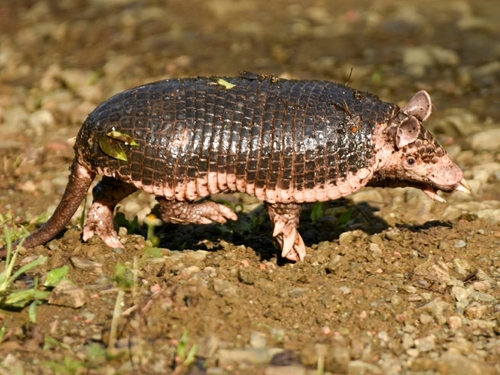
Covered in a brownish to grayish-brown bony carapace composed of movable bands, with sparse hair between the scutes. The tail is notably naked and pinkish-gray, distinguishing it sharply from the armored body.
Size
Body length ranges from 40 to 50 cm, with an additional tail length of approximately 15-20 cm
Weight
Adults typically weigh between 3.5 and 7 kg, with males and females showing minimal size difference
Distinctive features
Distinguished from other Cabassous species primarily by size (largest in the genus) and specific carapace band count; the completely naked, non-armored tail is a key diagnostic feature shared within the genus but this species is notably larger than C. unicinctus
Behaviour and diet of the Greater Naked-tailed Armadillo
Solitary and territorial, rarely interacting with conspecifics except during breeding season. Individuals maintain separate burrow systems and forage independently.
When it is active
Primarily nocturnal, emerging after dusk to forage and remaining in burrows during daylight hours to avoid heat and predators
Diet
Insectivorous, feeding predominantly on ants, termites, and their larvae, occasionally supplementing diet with other invertebrates like beetles and worms
How it feeds and hunts
Uses powerful claws to break open termite mounds and ant nests, then extracts insects using a long, sticky tongue; relies heavily on smell and hearing rather than vision to locate prey underground
Communication
Communication is poorly studied but likely involves scent marking of territories and burrows, along with limited vocalizations during aggressive encounters or mating
Interactions with other species
Preyed upon by large carnivores such as pumas and ocelots, though its burrowing and armor provide significant protection; may compete with other armadillo species for food resources in overlapping habitats
Role in its ecosystem
Plays an important ecological role as an insectivore, helping control ant and termite populations, and its extensive burrowing activity aerates soil and creates shelter used by other species
Reproduction and lifecycle
Breeding season and specifics are poorly documented, but gestation is estimated at around 60-120 days, with females typically giving birth to a single offspring per litter
Raising the young
Limited data available, but as with other armadillos, the mother likely provides sole care, nursing and protecting the young within the burrow for several weeks before independence
Maturity and lifespan
Sexual maturity is reached at approximately 1 year of age; lifespan in the wild is estimated at 8-10 years, potentially longer in captivity
Taxonomy and naming of the Greater Naked-tailed Armadillo
Classification
Class Mammalia > Order Cingulata > Family Chlamyphoridae > Genus Cabassous > Species Cabassous tatouay
Scientific synonyms
Dasypus tatouay, Cabassous unicinctus tatouay (formerly considered a subspecies of C. unicinctus by some authors)
What research says
Recent studies
Recent genetic studies have helped clarify taxonomic relationships within the genus Cabassous, confirming C. tatouay as a distinct species separate from C. unicinctus
Compared with similar species
Larger than the closely related Cabassous unicinctus (Southern Naked-tailed Armadillo) and has a more restricted southern range; shares the naked tail trait with all Cabassous species but differs in body size and specific morphological measurements
The Greater Naked-tailed Armadillo and people
Despite being one of the larger armadillo species in its genus, it remains one of the least studied due to its elusive, burrowing lifestyle. Its naked tail is so distinctive that it gives the entire genus its common name 'naked-tailed armadillos.' It can dig itself completely underground in a matter of minutes when threatened.
Where and how to see it
Best observed at dusk or during night hours in grassland and forest edge habitats in Uruguay or southern Brazil; using a spotlight and moving quietly near burrow entrances increases chances of sighting, though observations remain rare
Risks to humans
No notable risk to humans; however, like other armadillos, it may potentially carry Trypanosoma cruzi, so direct handling should be avoided to minimize any zoonotic disease transmission risk
Human uses
Not commonly hunted for meat or hide compared to other armadillo species, though it is occasionally killed by farmers as an agricultural pest due to its burrowing activity
Countries where the Greater Naked-tailed Armadillo is recorded
The 4 countries named in the range description of its IUCN Red List assessment.
Questions about the Greater Naked-tailed Armadillo
Where does the Greater Naked-tailed Armadillo live?
The Greater Naked-tailed Armadillo is recorded in Argentina, Brazil, Paraguay and Uruguay across South America. These countries come from the range description of its IUCN Red List assessment, and they are what place the species on the interactive map.
Is the Greater Naked-tailed Armadillo endangered?
The IUCN Red List assesses the Greater Naked-tailed Armadillo as Least Concern. The species is widespread and abundant enough not to qualify for any threatened category. It does not mean the species is safe forever, only that nothing in the current data raises an alarm.
How many are left in the wild?
No precise population estimates exist due to its secretive and fossorial nature; the population trend is considered stable to possibly declining in areas with intense agricultural development This figure comes from the species assessment on the IUCN Red List; population estimates for wild mammals are ranges, not counts, and are revised at each assessment.
What habitat does the Greater Naked-tailed Armadillo live in?
Inhabits grasslands, savannas, gallery forests, and agricultural areas with soft, well-drained soils suitable for digging.
What is the scientific name of the Greater Naked-tailed Armadillo?
The Greater Naked-tailed Armadillo is Cabassous tatouay, in the family Chlamyphoridae, order Cingulata.
Other species in the genus Cabassous
Other species in the family Chlamyphoridae
Species that share its range
Sources
Conservation status, range description and population estimate come from the IUCN Red List assessment for Cabassous tatouay. Countries are derived from that range description, not from a mapped country list. Last refreshed on .
The distribution map is drawn from the IUCN Red List spatial data compiled in 2024. IUCN (International Union for Conservation of Nature)