
Chacoan Naked-tailed Armadillo
Cabassous chacoensis
Red List assessment
Near Threatenedon the IUCN Red List
- EXExtinct
- EWExtinct in the Wild
- CRCritically Endangered
- ENEndangered
- VUVulnerable
- NTNear Threatened
- LCLeast Concern
The Chacoan Naked-tailed Armadillo is recorded in 3 countries across South America. The IUCN Red List assesses the Chacoan Naked-tailed Armadillo as Near Threatened. No precise population estimate exists due to the species' cryptic and fossorial nature; the population is presumed to be declining in line with ongoing Chaco habitat loss.
- Family
- Chlamyphoridae
- Order
- Cingulata
- Genus
- Cabassous
- Countries recorded
- 3
- Continents
- South America
- Red List category
- Near Threatened
- Data updated
- August 9, 2026
What is the Chacoan Naked-tailed Armadillo?
The Chacoan Naked-tailed Armadillo is a small, secretive burrowing armadillo endemic to the semi-arid Gran Chaco ecosystem of South America. It is one of the least studied armadillo species due to its fossorial and nocturnal habits. Notable for its nearly hairless, scaleless tail which distinguishes the genus Cabassous from other armadillos, it plays an important ecological role as an insectivore in dry forest and scrub habitats.
Where does the Chacoan Naked-tailed Armadillo live?
Gran Chaco region of South America, primarily Argentina, Paraguay, and Bolivia
Endemic to the Gran Chaco region, spanning parts of northern Argentina, western Paraguay, and southeastern Bolivia. Its range is relatively restricted compared to other Cabassous species, closely tied to the specific dry Chaco biome.
Altitude and depth
Generally found at low elevations, typically between 100-500 meters above sea level, consistent with the lowland Chaco plains.
Seasonal movements
No true hibernation or migration; activity levels may decrease during extreme heat or cold periods, with animals retreating to burrows during unfavorable conditions.
Habitat of the Chacoan Naked-tailed Armadillo
Inhabits dry Chaco forests, thorn scrub, and semi-arid savanna woodlands with sandy or loose soils suitable for digging burrows. Prefers areas with sparse vegetation cover that still provide some shade and protection from predators.
Adaptations to its environment
Possesses strong, clawed forelimbs adapted for rapid digging into sandy Chaco soils to create burrows and access underground insect prey. Its naked tail and reduced dorsal armor allow for greater flexibility in tight burrow spaces compared to more heavily armored armadillo species.
Conservation status and numbers
Listed as Near Threatened (NT) by IUCN due to habitat loss from agricultural expansion and deforestation across the Gran Chaco, one of the most rapidly deforested biomes in the world. Population trends are believed to be declining though precise data remains limited.
Estimated population
No precise population estimate exists due to the species' cryptic and fossorial nature; the population is presumed to be declining in line with ongoing Chaco habitat loss.
What threatens the Chacoan Naked-tailed Armadillo?
Primary threats include large-scale deforestation for soybean cultivation and cattle ranching, habitat fragmentation, and to a lesser extent, incidental capture or hunting by local communities.
Diseases and parasites
Specific disease and parasite data for this species is scarce, though armadillos in general can carry ectoparasites like ticks and mites, and some species are known reservoirs for Trypanosoma cruzi (Chagas disease) and Mycobacterium leprae (leprosy).
What is being done to protect it?
Some populations occur within protected areas in Argentina and Paraguay's Gran Chaco region, though enforcement and coverage remain limited. It is included in broader Chaco biodiversity conservation initiatives and is protected under national wildlife laws in range countries.
Recommended actions
Priority actions include expanding protected area coverage within the Chaco, conducting population surveys using camera traps and burrow surveys, and promoting sustainable land-use practices to slow deforestation rates.
What the Chacoan Naked-tailed Armadillo looks like
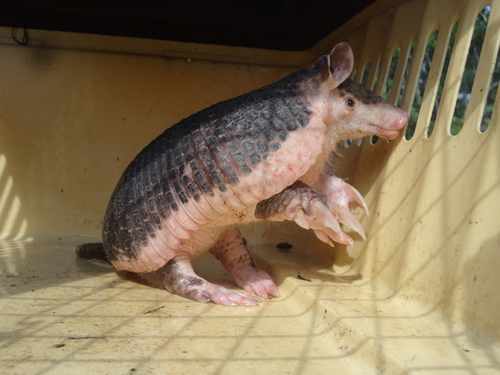
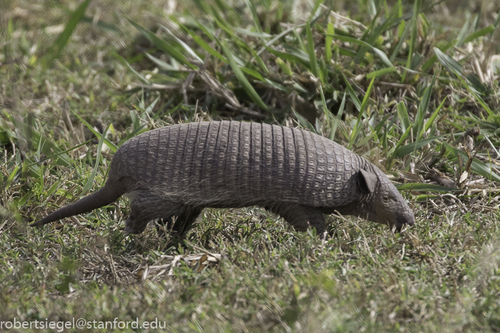
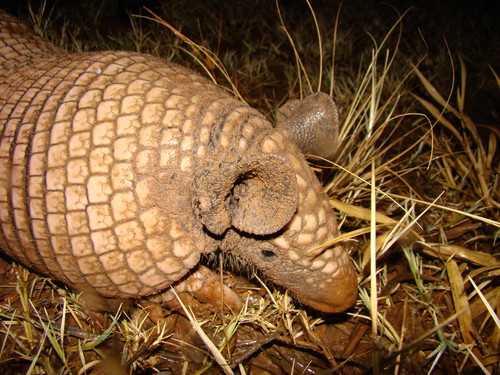
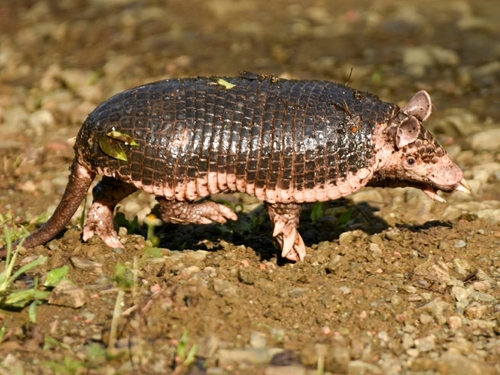
Covered in a brownish to yellowish-brown bony carapace composed of movable bands, with a paler underside covered in sparse hair. Its most distinctive feature is the nearly naked, scale-free tail, unlike the fully armored tails of most other armadillo genera.
Size
Body length typically ranges from 30 to 40 cm, with an additional short tail of about 6-9 cm.
Weight
Weighs approximately 1.5 to 3 kg, with limited data available on sexual size differences.
Distinctive features
Distinguished from other Cabassous species by subtle differences in carapace band count, skull morphology, and its smaller overall size; distinguished from other armadillo genera by its naked tail and large, shovel-like third claw used for digging.
Behaviour and diet of the Chacoan Naked-tailed Armadillo
Solitary and rarely observed interacting with conspecifics outside of mating encounters; individuals maintain and defend their own burrow systems.
When it is active
Primarily nocturnal and fossorial, spending most daylight hours underground in burrows and emerging at night to forage.
Diet
Insectivorous, feeding mainly on ants, termites, and other soil-dwelling invertebrates and their larvae.
How it feeds and hunts
Uses powerful foreclaws to break into ant and termite nests, then extracts prey using a long, sticky tongue; relies heavily on smell rather than sight to locate underground insect colonies.
Communication
Communication is poorly studied but likely involves scent marking of burrows and territories, as is typical for solitary, fossorial mammals.
Interactions with other species
Preyed upon by large carnivores and birds of prey when above ground; burrows may be used secondarily by other small Chaco wildlife species once abandoned.
Role in its ecosystem
Functions as an insectivorous predator controlling ant and termite populations, and its burrowing activity contributes to soil aeration and nutrient cycling within the Chaco ecosystem.
Reproduction and lifecycle
Reproductive biology is poorly documented, but presumed similar to related Cabassous species with a gestation period of approximately 60-120 days and typically a single offspring per litter.
Raising the young
Limited data exists, but as with other armadillos, the mother is likely solely responsible for nursing and protecting the young in the burrow until weaning.
Maturity and lifespan
Exact age of sexual maturity is unknown; related armadillo species typically mature within 1-2 years, with wild lifespans estimated around 8-12 years.
Taxonomy and naming of the Chacoan Naked-tailed Armadillo
Classification
Class Mammalia > Order Cingulata > Family Chlamyphoridae > Genus Cabassous > Species Cabassous chacoensis
Scientific synonyms
Tatusia chacoensis (original combination)
What research says
Recent studies
Recent research has focused primarily on Chaco deforestation impacts on regional biodiversity, with this species used as an indicator of dry forest ecosystem health, though species-specific genetic or behavioral studies remain rare.
Compared with similar species
Smaller and more range-restricted than its close relative Cabassous tatouay (Greater Naked-tailed Armadillo), and distinguished from the Southern Naked-tailed Armadillo by its Chaco-specific habitat preference and slightly different carapace structure.
The Chacoan Naked-tailed Armadillo and people
Despite being called 'naked-tailed,' its tail is not entirely bare but covered in small, sparse scales rather than the thick bony plates seen in other armadillos. It can dig itself completely underground in under a minute when threatened, using its shovel-like claws.
Where and how to see it
Best observed at night in remote areas of the Argentine or Paraguayan Chaco using red-light spotlighting or camera traps near burrow entrances, though sightings are rare due to its elusive, fossorial lifestyle.
Risks to humans
No notable risk; the species is shy, non-aggressive, and avoids human contact.
Human uses
Not significantly used by humans, though like other armadillos it may occasionally be hunted opportunistically for bushmeat by local rural communities in parts of its range.
Countries where the Chacoan Naked-tailed Armadillo is recorded
The 3 countries named in the range description of its IUCN Red List assessment.
Questions about the Chacoan Naked-tailed Armadillo
Where does the Chacoan Naked-tailed Armadillo live?
The Chacoan Naked-tailed Armadillo is recorded in Argentina, Bolivia and Paraguay across South America. These countries come from the range description of its IUCN Red List assessment, and they are what place the species on the interactive map.
Is the Chacoan Naked-tailed Armadillo endangered?
The IUCN Red List assesses the Chacoan Naked-tailed Armadillo as Near Threatened. The species does not qualify as threatened today, but it is close to the thresholds and likely to cross them soon. It is the category that most often changes at the next assessment.
How many are left in the wild?
No precise population estimate exists due to the species' cryptic and fossorial nature; the population is presumed to be declining in line with ongoing Chaco habitat loss. This figure comes from the species assessment on the IUCN Red List; population estimates for wild mammals are ranges, not counts, and are revised at each assessment.
What habitat does the Chacoan Naked-tailed Armadillo live in?
Inhabits dry Chaco forests, thorn scrub, and semi-arid savanna woodlands with sandy or loose soils suitable for digging burrows.
What is the scientific name of the Chacoan Naked-tailed Armadillo?
The Chacoan Naked-tailed Armadillo is Cabassous chacoensis, in the family Chlamyphoridae, order Cingulata.
Other species in the genus Cabassous
Other species in the family Chlamyphoridae
Species that share its range
Sources
Conservation status, range description and population estimate come from the IUCN Red List assessment for Cabassous chacoensis. Countries are derived from that range description, not from a mapped country list. Last refreshed on .
The distribution map is drawn from the IUCN Red List spatial data compiled in 2024. IUCN (International Union for Conservation of Nature)