
Large Hairy Armadillo
Chaetophractus villosus
Red List assessment
Least Concernon the IUCN Red List
- EXExtinct
- EWExtinct in the Wild
- CRCritically Endangered
- ENEndangered
- VUVulnerable
- NTNear Threatened
- LCLeast Concern
The Large Hairy Armadillo is recorded in 5 countries across South America. The IUCN Red List assesses the Large Hairy Armadillo as Least Concern. No precise global population estimate exists, but the species is considered abundant and stable across most of its range; local declines occur near urban and heavily hunted areas
- Family
- Chlamyphoridae
- Order
- Cingulata
- Genus
- Chaetophractus
- Countries recorded
- 5
- Continents
- South America
- Red List category
- Least Concern
- Data updated
- August 9, 2026
What is the Large Hairy Armadillo?
The Large Hairy Armadillo is a medium-sized armadillo native to the temperate and arid regions of southern South America, particularly the Pampas and Patagonian steppe of Argentina. It is notable for its dense covering of coarse hair between its bony scutes, giving it a distinctly shaggy appearance compared to other armadillo species. This adaptable and opportunistic omnivore is one of the most widespread and commonly encountered armadillos in its range, often seen foraging in agricultural areas.
Where does the Large Hairy Armadillo live?
Southern South America, primarily Argentina, with range extending into Bolivia, Paraguay, Uruguay, and Chile
Found throughout central and southern Argentina including the Pampas and Patagonia, extending into southern Bolivia, western Paraguay, Uruguay, and parts of Chile. It has one of the broadest ranges among South American armadillo species.
Altitude and depth
Typically found from sea level up to about 1,500 meters elevation
Seasonal movements
No true hibernation, but activity patterns shift seasonally; individuals become more diurnal in cold winter months and more nocturnal during hot summers to avoid temperature extremes
Habitat of the Large Hairy Armadillo
Inhabits grasslands, pampas, scrublands, and semi-arid steppe habitats. Also found in agricultural fields, pastures, and areas with sandy or loose soils suitable for digging burrows. Tolerates a wide range of open and semi-open habitats.
Adaptations to its environment
Possesses powerful claws and forelimbs adapted for rapid digging of burrows used for shelter and thermoregulation. Its bony dermal armor (carapace) provides protection from predators, while dense body hair helps insulate against temperature extremes in open habitats. Can also curl partially to protect vulnerable areas when threatened.
Conservation status and numbers
Listed as Least Concern (LC) by the IUCN due to its wide distribution, adaptability to human-modified landscapes, and presumed large population size, though some regional declines have been noted due to hunting and habitat conversion.
Estimated population
No precise global population estimate exists, but the species is considered abundant and stable across most of its range; local declines occur near urban and heavily hunted areas
What threatens the Large Hairy Armadillo?
Hunted for meat by local communities in parts of its range; considered an agricultural pest in some areas leading to persecution; habitat conversion for farming; occasional roadkill mortality; predation by domestic dogs.
Diseases and parasites
Known to harbor ticks, mites, and intestinal parasites; can be a reservoir for Trypanosoma cruzi (Chagas disease agent) in some regions, similar to other armadillo species.
What is being done to protect it?
Protected in some Argentine national parks and reserves; included in general wildlife protection legislation in Argentina; no species-specific conservation programs currently exist due to its non-threatened status
Recommended actions
Monitor population trends in areas of high hunting pressure; regulate hunting for bushmeat where unsustainable; promote coexistence strategies with agricultural communities; further research into population dynamics across its range.
What the Large Hairy Armadillo looks like
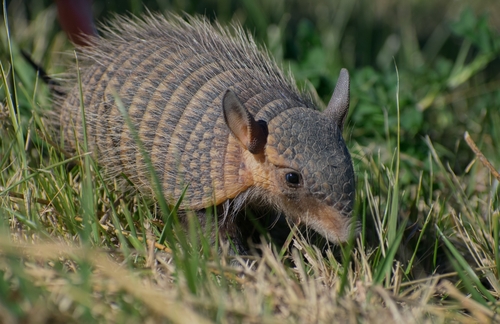
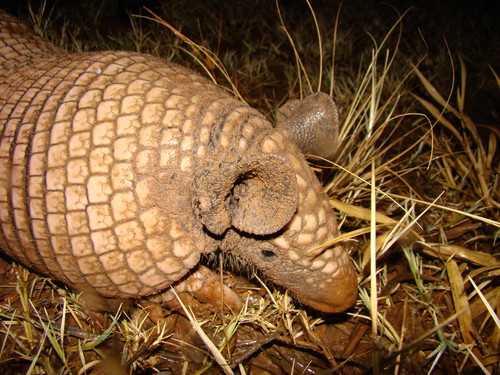
Covered in a bony carapace divided into movable bands, overlaid with long, coarse, yellowish-brown to dark brown hair protruding between the scutes. The head is small and elongated with a pointed snout, and the ears are relatively large and rounded. Legs are short and powerful, ending in strong claws.
Size
Body length (head and body) ranges from 30 to 50 cm, with an additional tail length of about 12-16 cm
Weight
Adults typically weigh between 2 and 6.5 kg, with males generally slightly larger than females
Distinctive features
Distinguished from related species by its notably dense and long body hair (hence 'hairy' armadillo), larger overall size compared to the Screaming Hairy Armadillo, and a broader, more robust build with 6-8 movable bands on its carapace.
Differences between males and females
Minimal sexual dimorphism; males are on average slightly heavier and larger than females, but external differences are not pronounced
Behaviour and diet of the Large Hairy Armadillo
Primarily solitary animals, coming together only briefly for mating; individuals maintain and defend burrow systems and forage independently.
When it is active
Primarily nocturnal and crepuscular, though can be active during the day in cooler seasons or in undisturbed areas
Diet
Omnivorous generalist feeding on insects, larvae, earthworms, small vertebrates (including carrion), eggs, and plant material such as roots, fruits, and seeds. Highly opportunistic and adapts diet to local food availability.
How it feeds and hunts
Uses strong sense of smell to locate buried invertebrates and small prey, digging rapidly with forelimbs to excavate food from soil; will also scavenge carrion and raid bird nests when available.
Communication
Communicates primarily through scent marking of territory and burrows using scent glands; limited vocalizations include grunts and hissing sounds, especially when threatened or during aggressive encounters.
Interactions with other species
Preyed upon by large birds of prey, foxes, and domestic dogs, especially as juveniles; competes with other burrowing animals for den sites; burrows are sometimes used by other species after abandonment.
Role in its ecosystem
Plays an important ecological role as a soil aerator through its digging activity and as a natural pest controller by consuming large quantities of insects and larvae; its burrows also provide shelter for various other small animals.
Reproduction and lifecycle
Breeding can occur year-round but peaks in spring and summer; gestation lasts approximately 60-75 days; typically gives birth to 1-2 (occasionally up to 4) young per litter.
Raising the young
Females provide all parental care, nursing and protecting young in the burrow for several weeks until they are weaned and able to forage independently; juveniles reach independence within a few months.
Maturity and lifespan
Reaches sexual maturity around 9 months to 1 year of age; lifespan in the wild is approximately 8-10 years, while captive individuals have been recorded living up to 15-18 years.
Taxonomy and naming of the Large Hairy Armadillo
Classification
Class Mammalia > Order Cingulata > Family Chlamyphoridae > Genus Chaetophractus > Species Chaetophractus villosus
Scientific synonyms
Dasypus villosus (original combination); Euphractus villosus
What research says
Recent studies
Recent studies have focused on its role as a Trypanosoma cruzi reservoir relevant to Chagas disease epidemiology, as well as investigations into its burrowing ecology and impacts on soil health in agricultural landscapes.
Genome and DNA
Diploid chromosome number reported as 2n=60-62 in some cytogenetic studies of the genus, though detailed genomic studies remain limited compared to other mammals.
Compared with similar species
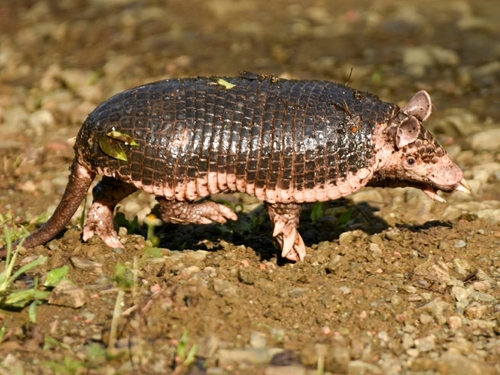
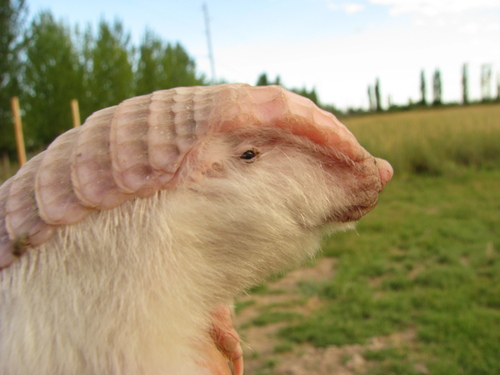
Similar to the Screaming Hairy Armadillo (Chaetophractus vellerosus) but larger in size with denser hair; distinguished from the Six-banded Armadillo (Euphractus sexcinctus) by its longer fur and different band count and body proportions.
The Large Hairy Armadillo and people
Despite its armored appearance, this armadillo can dig a burrow to escape a predator in under two minutes; it is capable swimmer and can hold its breath for several minutes while crossing water bodies; some individuals have been observed to partially inflate their intestines to help them float.
Where and how to see it
Best observed at dusk or dawn in open pampas or scrubland areas of central Argentina, particularly around burrow entrances; using a red-filtered flashlight at night in rural or protected areas increases chances of sighting without disturbing the animal.
Risks to humans
No notable risk to humans in terms of aggression, though it can carry parasites and pathogens (such as Trypanosoma cruzi) that pose indirect health risks if handled improperly.
Human uses
Hunted locally for its meat, which is considered a traditional food source in parts of rural Argentina; its shell has occasionally been used to make traditional handicrafts or musical instruments in some communities.
Myths and legends
In some rural South American folklore, armadillos are associated with the underworld and earth due to their burrowing habits, though no widespread specific legends are attributed uniquely to this species.
Countries where the Large Hairy Armadillo is recorded
The 5 countries named in the range description of its IUCN Red List assessment.
Questions about the Large Hairy Armadillo
Where does the Large Hairy Armadillo live?
The Large Hairy Armadillo is recorded in Argentina, Bolivia, Chile, Paraguay and Uruguay across South America. These countries come from the range description of its IUCN Red List assessment, and they are what place the species on the interactive map.
Is the Large Hairy Armadillo endangered?
The IUCN Red List assesses the Large Hairy Armadillo as Least Concern. The species is widespread and abundant enough not to qualify for any threatened category. It does not mean the species is safe forever, only that nothing in the current data raises an alarm.
How many are left in the wild?
No precise global population estimate exists, but the species is considered abundant and stable across most of its range; local declines occur near urban and heavily hunted areas This figure comes from the species assessment on the IUCN Red List; population estimates for wild mammals are ranges, not counts, and are revised at each assessment.
What habitat does the Large Hairy Armadillo live in?
Inhabits grasslands, pampas, scrublands, and semi-arid steppe habitats.
What is the scientific name of the Large Hairy Armadillo?
The Large Hairy Armadillo is Chaetophractus villosus, in the family Chlamyphoridae, order Cingulata.
Other species in the genus Chaetophractus
Other species in the family Chlamyphoridae
Species that share its range


Sources
Conservation status, range description and population estimate come from the IUCN Red List assessment for Chaetophractus villosus. Countries are derived from that range description, not from a mapped country list. Last refreshed on .
The distribution map is drawn from the IUCN Red List spatial data compiled in 2024. IUCN (International Union for Conservation of Nature)