
Marbled Cat
Pardofelis marmorata
Red List assessment
Near Threatenedon the IUCN Red List
- EXExtinct
- EWExtinct in the Wild
- CRCritically Endangered
- ENEndangered
- VUVulnerable
- NTNear Threatened
- LCLeast Concern
The Marbled Cat is recorded in 10 countries across Asia. The IUCN Red List assesses the Marbled Cat as Near Threatened. Global population is unknown but believed to be declining; density estimates suggest fewer than 10,000 mature individuals remain, with population trend assessed as decreasing
- Family
- Felidae
- Order
- Carnivora
- Genus
- Pardofelis
- Countries recorded
- 10
- Continents
- Asia
- Red List category
- Near Threatened
- Data updated
- August 9, 2026
What is the Marbled Cat?
The Marbled Cat is a small, elusive wild cat native to the dense forests of Southeast Asia, notable for its strikingly patterned coat resembling a miniature clouded leopard. It is highly arboreal, with adaptations that make it one of the most tree-adapted felids in the world. Despite its wide range, it remains one of the least studied wild cat species due to its secretive nature and low population density.
Where does the Marbled Cat live?
Southeast Asia, including parts of the Himalayas, Indochina, and the Sundaic region (Borneo, Sumatra)
Found across Southeast Asia including Nepal, northeastern India, Bhutan, Myanmar, Thailand, Laos, Cambodia, Vietnam, peninsular Malaysia, Borneo, and Sumatra. Population is fragmented across this range due to habitat loss.
Altitude and depth
0-2,500 meters above sea level, though most records come from lowland and hill forests below 1,500m
Habitat of the Marbled Cat
Primarily inhabits tropical and subtropical evergreen forests, including primary and secondary lowland and montane forests. Also found in logged forests with sufficient canopy cover, though it avoids heavily degraded or open habitats.
Adaptations to its environment
Exceptional arboreal adaptations including a long tail for balance (often longer than body length), flexible ankle joints allowing headfirst descent from trees, and large paws with sharp retractable claws for gripping branches. Its marbled coat pattern provides camouflage in dappled forest light.
Conservation status and numbers
Listed as Near Threatened by IUCN due to ongoing population decline estimated at over 20% over the past three generations, primarily driven by habitat loss and fragmentation across its range. The species was previously classified as Vulnerable but was downlisted as more range countries provided population data.
Estimated population
Global population is unknown but believed to be declining; density estimates suggest fewer than 10,000 mature individuals remain, with population trend assessed as decreasing
What threatens the Marbled Cat?
Deforestation and habitat fragmentation from logging, agricultural expansion (especially palm oil plantations), and infrastructure development are the primary threats. Additional pressures include hunting for fur and bushmeat, and incidental capture in snares set for other species.
Diseases and parasites
Specific disease and parasite data for wild populations is limited, though as with other felids it is likely susceptible to feline-specific viruses and common ectoparasites such as ticks and fleas
What is being done to protect it?
Protected under CITES Appendix I, prohibiting international commercial trade. The species occurs in numerous protected areas across its range including national parks in Thailand, Malaysia, and Indonesia, though enforcement varies significantly.
Recommended actions
Priority actions include expanding camera-trap monitoring to better estimate population trends, strengthening anti-poaching and anti-snaring enforcement, and protecting remaining contiguous forest habitat through improved land-use planning and connectivity corridors between protected areas.
What the Marbled Cat looks like
Thick, soft fur displays a distinctive marbled or blotched pattern in shades of grey, brown, and black, resembling a small clouded leopard. The coat features large irregular dark-edged blotches on a lighter background, with spots on the legs and rings on the long bushy tail.
Size
Head-body length of 45-62 cm, with an exceptionally long tail measuring 35-55 cm, nearly equal to or exceeding body length
Weight
Typically weighs between 2-5 kg, making it one of the smallest wild cat species; limited sexual dimorphism in body size has been documented
Distinctive features
Distinguished from similar-sized cats by its unusually long, thick tail and marbled (rather than rosette or spotted) coat pattern. Its exceptionally large canine teeth relative to skull size are proportionally among the largest of any living cat species.
Differences between males and females
Minimal sexual dimorphism observed; males and females are similar in size and coat pattern, making visual sex determination difficult in the field
Behaviour and diet of the Marbled Cat
Predominantly solitary, as is typical for most small felids, with individuals maintaining home ranges that may overlap between sexes. Social interactions are largely limited to mating encounters and mother-offspring relationships.
When it is active
Considered primarily nocturnal to crepuscular, though camera trap studies have documented significant diurnal activity in some populations, suggesting more flexible activity patterns than previously thought
Diet
Carnivorous diet consisting of small mammals such as squirrels and rats, birds, lizards, frogs, and insects. Its arboreal hunting ability allows it to exploit prey in the forest canopy that ground-dwelling cats cannot access.
How it feeds and hunts
Hunts using stealth and ambush tactics, stalking prey both on the ground and in trees. Its exceptional climbing ability and long tail for balance allow it to pursue arboreal prey like squirrels and birds directly in the canopy.
Communication
Communicates through vocalizations including mews, hisses, and growls similar to other small cats, along with scent marking via urine spraying and cheek rubbing to establish territory boundaries. Body language and tail position likely play a role in intraspecific signaling.
Interactions with other species
Potential competitors include other small to medium forest felids such as leopard cats and Asian golden cats, with which it may share prey resources and habitat. Larger predators like clouded leopards may pose occasional predation risk to marbled cats.
Role in its ecosystem
Functions as a mesopredator within Southeast Asian forest ecosystems, helping regulate populations of small mammals and birds. Its presence and health can serve as an indicator of intact forest habitat quality.
Reproduction and lifecycle
Breeding season appears not strictly defined in the wild; gestation lasts approximately 66-82 days based on captive observations. Litter size is typically 1-4 kittens, most commonly 2.
Raising the young
Females provide sole parental care, nursing and raising kittens in a den typically located in a hollow tree or dense vegetation. Kittens are altricial at birth and remain dependent on the mother for several months before becoming independent.
Maturity and lifespan
Sexual maturity is reached around 21-24 months based on captive data. Lifespan in the wild is poorly documented but estimated at 10-12 years, while captive individuals have lived up to 12-17 years.
Taxonomy and naming of the Marbled Cat
Classification
Class Mammalia > Order Carnivora > Family Felidae > Genus Pardofelis > Species Pardofelis marmorata
Subspecies
Two subspecies recognized: Pardofelis marmorata marmorata (mainland Southeast Asia and Himalayan foothills) and Pardofelis marmorata charltoni (Borneo and Sumatra), though taxonomic status is debated.
Scientific synonyms
Felis marmorata (original classification), Pardofelis marmorata was formerly placed in genus Felis before being reclassified
What research says
Recent studies
Recent camera-trap studies across Borneo and mainland Southeast Asia have provided new insights into activity patterns, revealing more diurnal behavior than previously assumed, and have helped refine distribution and density estimates in previously unsurveyed areas.
Genome and DNA
Diploid chromosome number of 2n=38, consistent with most felid species; genetic studies have helped clarify its phylogenetic placement within the Felidae family as a distinct lineage related to the Bay Cat and Asian Golden Cat
Compared with similar species
Often compared to the clouded leopard due to similar coat patterning, though the Marbled Cat is significantly smaller and has a proportionally longer tail. It is more closely related to the Asian Golden Cat and Bay Cat within the Felidae phylogeny than to the clouded leopard.
The Marbled Cat and people
The Marbled Cat has one of the longest tails relative to body size of any cat species, aiding its exceptional tree-climbing abilities. It can rotate its hind ankles nearly 180 degrees, allowing it to climb down trees headfirst like a squirrel, a rare trait among cats.
Where and how to see it
Best observed through camera-trap monitoring programs in protected forests of Borneo, Sumatra, or mainland Southeast Asia such as Khao Yai National Park in Thailand, as direct sightings in the wild are extremely rare due to its elusive and largely arboreal nature. Night surveys with thermal imaging in undisturbed forest have yielded occasional sightings.
Risks to humans
No notable risk to humans; the species is shy, avoids human contact, and poses no known threat
Human uses
Historically hunted in some areas for its fur, though this practice has significantly declined. There is no significant traditional medicine trade or commercial use documented for this species.
Countries where the Marbled Cat is recorded
The 10 countries named in the range description of its IUCN Red List assessment.
Questions about the Marbled Cat
Where does the Marbled Cat live?
The Marbled Cat is recorded in Bhutan, Cambodia, India, Indonesia and Laos, among 10 countries in total across Asia. These countries come from the range description of its IUCN Red List assessment, and they are what place the species on the interactive map.
Is the Marbled Cat endangered?
The IUCN Red List assesses the Marbled Cat as Near Threatened. The species does not qualify as threatened today, but it is close to the thresholds and likely to cross them soon. It is the category that most often changes at the next assessment.
How many are left in the wild?
Global population is unknown but believed to be declining; density estimates suggest fewer than 10,000 mature individuals remain, with population trend assessed as decreasing This figure comes from the species assessment on the IUCN Red List; population estimates for wild mammals are ranges, not counts, and are revised at each assessment.
What habitat does the Marbled Cat live in?
Primarily inhabits tropical and subtropical evergreen forests, including primary and secondary lowland and montane forests.
What is the scientific name of the Marbled Cat?
The Marbled Cat is Pardofelis marmorata, in the family Felidae, order Carnivora.
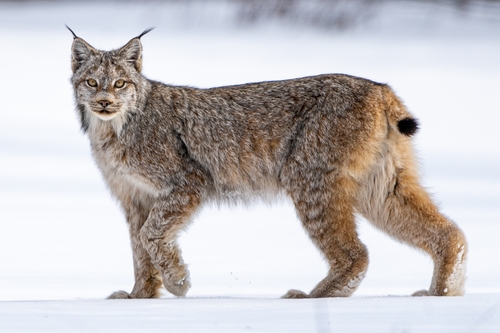
Other species in the family Felidae
Species that share its range
Sources
Conservation status, range description and population estimate come from the IUCN Red List assessment for Pardofelis marmorata. Countries are derived from that range description, not from a mapped country list. Last refreshed on .
The distribution map is drawn from the IUCN Red List spatial data compiled in 2015. IUCN (International Union for Conservation of Nature)