
Mainland Leopard Cat
Prionailurus bengalensis
Red List assessment
Least Concernon the IUCN Red List
- EXExtinct
- EWExtinct in the Wild
- CRCritically Endangered
- ENEndangered
- VUVulnerable
- NTNear Threatened
- LCLeast Concern
The Mainland Leopard Cat is recorded in 11 countries across Asia. The IUCN Red List assesses the Mainland Leopard Cat as Least Concern. No precise global population estimate exists, but the species is considered common across much of its range; overall trend is stable to locally declining depending on region.
- Family
- Felidae
- Order
- Carnivora
- Genus
- Prionailurus
- Countries recorded
- 11
- Continents
- Asia
- Red List category
- Least Concern
- Data updated
- August 9, 2026
What is the Mainland Leopard Cat?
The Mainland Leopard Cat is a small, spotted wild cat native to continental Asia, resembling a domestic cat but with a more slender body and striking leopard-like markings. It is highly adaptable, occupying a wide range of habitats from tropical forests to agricultural edges near human settlements. It is the most widely distributed small wild cat in Asia and the wild ancestor of the domestic Bengal cat breed. Its adaptability and broad diet make it a resilient species compared to many other Asian felids.
Where does the Mainland Leopard Cat live?
Mainland Asia, including China, Indochina, the Korean Peninsula, and parts of South and Southeast Asia
Found across mainland Asia from Pakistan and India through Nepal, Bhutan, Bangladesh, Myanmar, Thailand, Laos, Vietnam, Cambodia, China, the Korean Peninsula, and into the Russian Far East. It is absent from most Indonesian and Philippine islands, which host the related Sunda leopard cat.
Altitude and depth
Typically found from sea level up to around 3000 meters, with some populations recorded at higher elevations in the Himalayas.
Seasonal movements
No true migration or hibernation; in colder northern parts of its range (e.g., Russian Far East, Korea) it shows increased winter activity near human settlements to find food and shelter.
Habitat of the Mainland Leopard Cat
Occupies a wide variety of habitats including tropical and subtropical forests, scrublands, agricultural mosaics, and forest edges near villages. It prefers areas with dense cover for hunting and denning but tolerates disturbed and fragmented landscapes better than most wild cats.
Adaptations to its environment
Possesses excellent night vision, retractable claws, and a lean, agile body suited for climbing and swimming. Its dense fur provides insulation in colder subspecies like P. b. euptilurus, while its adaptable diet allows survival in fragmented and human-altered habitats.
Conservation status and numbers
Listed as Least Concern by the IUCN due to its wide distribution and relatively stable overall population, though some regional populations are declining due to habitat loss and hunting.
Estimated population
No precise global population estimate exists, but the species is considered common across much of its range; overall trend is stable to locally declining depending on region.
What threatens the Mainland Leopard Cat?
Main threats include deforestation and habitat fragmentation, hunting for fur and traditional medicine, retaliatory killing for poultry predation, and roadkill in areas with expanding infrastructure.
Diseases and parasites
Susceptible to feline diseases such as feline leukemia virus and various endoparasites including intestinal worms; can also carry ticks and fleas common to wild felids.
What is being done to protect it?
Protected under national wildlife laws in most range countries and listed on CITES Appendix II (Appendix I for some populations like Bangladesh, India, Thailand). Conservation efforts include protected area management and community-based anti-poaching initiatives.
Recommended actions
Recommended actions include strengthening enforcement against illegal fur and pet trade, maintaining forest corridors between fragmented habitats, and promoting coexistence programs to reduce human-wildlife conflict near farms.
What the Mainland Leopard Cat looks like
Fur is yellowish to golden-brown with black spots and streaks, and the underside is white; facial markings include distinctive white stripes and dark streaks running from the eyes to the ears.
Size
Body length ranges from about 45 to 75 cm, with a tail length of 20 to 35 cm; shoulder height is roughly 20 cm.
Weight
Typically weighs between 3 and 7 kg, with males generally slightly larger than females.
Distinctive features
Distinguished from the Sunda leopard cat by generally larger body size, denser fur in northern populations, and subtle skull and genetic differences; overall pattern is similar to a small domestic cat with leopard-like rosettes.
Differences between males and females
Minimal sexual dimorphism; males are slightly larger and heavier than females but coloration and markings are similar.
Behaviour and diet of the Mainland Leopard Cat
Primarily solitary, with individuals maintaining home ranges that may overlap slightly between sexes; social interactions mainly occur during mating season.
When it is active
Mostly nocturnal and crepuscular, being most active during dawn, dusk, and nighttime hours to avoid human activity and larger predators.
Diet
Carnivorous diet consisting mainly of small rodents, birds, insects, reptiles, and occasionally fish; will also opportunistically eat carrion and small domestic poultry.
How it feeds and hunts
Hunts primarily by stalking and pouncing on prey using stealth and keen night vision; also known to wait in ambush near rodent burrows and hunt along water edges for fish or amphibians.
Communication
Communicates through vocalizations such as meows, hisses, and growls, along with scent marking via urine spraying and scratching to establish territory boundaries.
Interactions with other species
Faces competition and occasional predation from larger carnivores such as leopards, dholes, and large raptors; may also compete with civets and other small carnivores for similar prey.
Role in its ecosystem
Functions as a mesopredator helping control rodent and small mammal populations, contributing to ecosystem balance in forest and agricultural landscapes.
Reproduction and lifecycle
Breeding season varies by region but often peaks in late winter to spring; gestation lasts about 60-70 days, resulting in litters of 2-4 kittens.
Raising the young
Females raise kittens alone in a den, nursing them for about 3-4 months, after which juveniles gradually become independent by around 8-10 months of age.
Maturity and lifespan
Reaches sexual maturity around 8-18 months; lifespan is typically 10-13 years in the wild and up to 20 years in captivity.
Taxonomy and naming of the Mainland Leopard Cat
Classification
Class Mammalia > Order Carnivora > Family Felidae > Genus Prionailurus > Species Prionailurus bengalensis
Subspecies
Several subspecies recognized including P. b. bengalensis (South Asia), P. b. chinensis (China), P. b. euptilurus (Russian Far East, Korea, Northeast China), and P. b. horsfieldii (Himalayan foothills); taxonomy remains debated with ongoing genetic revisions.
Scientific synonyms
Felis bengalensis; formerly the Sunda leopard cat (Prionailurus javanensis) was considered part of this species until recent taxonomic splitting.
What research says
Recent studies
Recent genetic research using mitochondrial and nuclear DNA has confirmed the split between mainland and Sunda leopard cat populations as distinct species, refining conservation and taxonomic classifications.
Genome and DNA
Has a diploid chromosome number of 2n=38, similar to other Felidae species; genetic studies have helped clarify its taxonomic separation from the Sunda leopard cat.
Compared with similar species
Closely resembles the Sunda leopard cat (Prionailurus javanensis) but is generally larger with denser fur; it is also the wild progenitor of the domestic Bengal cat breed through hybridization with domestic cats.
The Mainland Leopard Cat and people
The leopard cat is the ancestor of the popular Bengal cat breed; it is an excellent swimmer and has been observed hunting fish; despite its small size, its range is the largest of any wild cat species in Asia.
Where and how to see it
Best observed in protected forest reserves in Thailand, Vietnam, or China during dusk or nighttime using camera traps or guided night safaris, as the species is elusive and rarely seen in daylight.
Risks to humans
No notable risk to humans; it is a shy, non-aggressive species that avoids human contact and poses no direct threat.
Human uses
Historically hunted for its fur and used in traditional medicine in parts of Asia; today it is also significant in the pet trade as the wild ancestor used to create the domestic Bengal cat breed.
Myths and legends
In some East Asian folklore, small spotted wild cats like the leopard cat have been associated with protective or mischievous spirit figures, though specific legends vary by region and are not well documented globally.
Countries where the Mainland Leopard Cat is recorded
The 11 countries named in the range description of its IUCN Red List assessment.
Questions about the Mainland Leopard Cat
Where does the Mainland Leopard Cat live?
The Mainland Leopard Cat is recorded in Bangladesh, Bhutan, Cambodia, China and India, among 11 countries in total across Asia. These countries come from the range description of its IUCN Red List assessment, and they are what place the species on the interactive map.
Is the Mainland Leopard Cat endangered?
The IUCN Red List assesses the Mainland Leopard Cat as Least Concern. The species is widespread and abundant enough not to qualify for any threatened category. It does not mean the species is safe forever, only that nothing in the current data raises an alarm.
How many are left in the wild?
No precise global population estimate exists, but the species is considered common across much of its range; overall trend is stable to locally declining depending on region. This figure comes from the species assessment on the IUCN Red List; population estimates for wild mammals are ranges, not counts, and are revised at each assessment.
What habitat does the Mainland Leopard Cat live in?
Occupies a wide variety of habitats including tropical and subtropical forests, scrublands, agricultural mosaics, and forest edges near villages.
What is the scientific name of the Mainland Leopard Cat?
The Mainland Leopard Cat is Prionailurus bengalensis, in the family Felidae, order Carnivora.
Other species in the genus Prionailurus
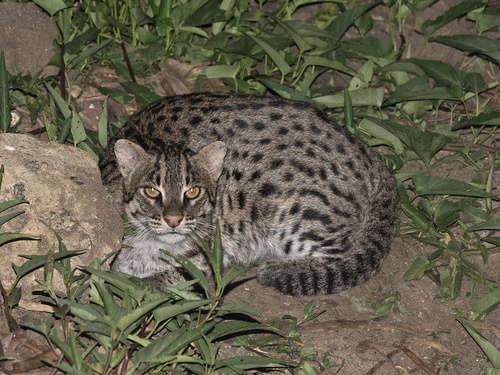
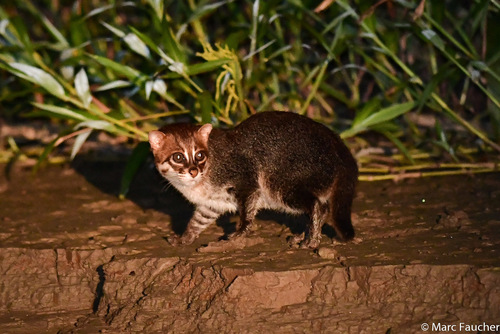
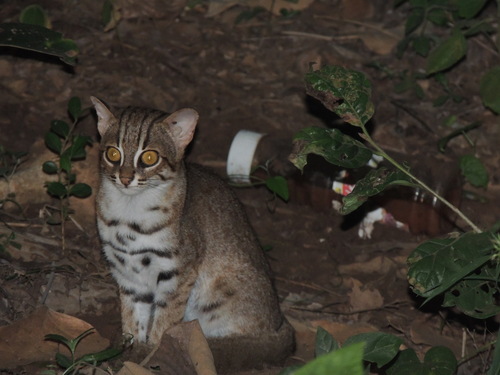
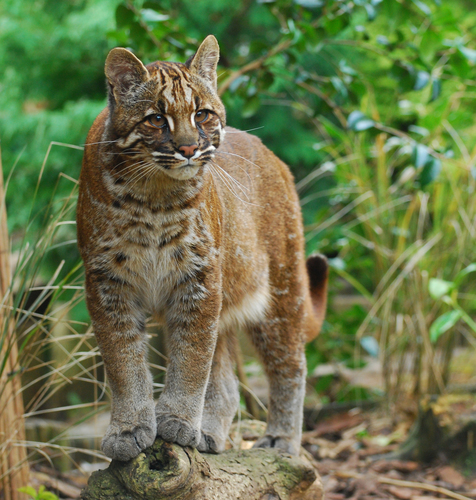
Other species in the family Felidae
Species that share its range
Sources
Conservation status, range description and population estimate come from the IUCN Red List assessment for Prionailurus bengalensis. Countries are derived from that range description, not from a mapped country list. Last refreshed on .
The distribution map is drawn from the IUCN Red List spatial data compiled in 2022. IUCN (International Union for Conservation of Nature)