
Fishing Cat
Prionailurus viverrinus
Red List assessment
Vulnerableon the IUCN Red List
- EXExtinct
- EWExtinct in the Wild
- CRCritically Endangered
- ENEndangered
- VUVulnerable
- NTNear Threatened
- LCLeast Concern
The Fishing Cat is recorded in 9 countries across Asia. The IUCN Red List assesses the Fishing Cat as Vulnerable. Global population estimated at fewer than 10,000 mature individuals, with a declining trend due to continued habitat degradation.
- Family
- Felidae
- Order
- Carnivora
- Genus
- Prionailurus
- Countries recorded
- 9
- Continents
- Asia
- Red List category
- Vulnerable
- Data updated
- August 9, 2026
What is the Fishing Cat?
The Fishing Cat is a medium-sized wild cat uniquely adapted to a semi-aquatic lifestyle, found in wetlands, marshes, and mangroves across South and Southeast Asia. It is one of the few cat species that actively swims and hunts fish in water. This remarkable specialist plays a key role in wetland ecosystems but faces severe habitat loss.
Where does the Fishing Cat live?
South and Southeast Asia, primarily India, Sri Lanka, Bangladesh, Nepal, and parts of Southeast Asia including Thailand and Cambodia
Found in India, Sri Lanka, Bangladesh, Nepal, Myanmar, Thailand, Cambodia, and Vietnam, with fragmented populations; historically present in Java (Indonesia) but status there is uncertain or possibly extirpated.
Altitude and depth
Typically found at low elevations, from sea level up to about 1500m, closely tied to wetland habitats.
Seasonal movements
No major migratory behavior; activity patterns may shift seasonally with water levels and monsoon flooding affecting prey availability.
Habitat of the Fishing Cat
Wetlands, marshes, mangrove forests, reed beds, and areas near rivers, streams, and oxbow lakes; strongly associated with dense vegetation near water bodies.
Adaptations to its environment
Partially webbed feet aid swimming, a double-layered water-resistant coat provides insulation, and a short, sturdy tail helps with underwater navigation. Their elongated body and flattened skull assist in aquatic hunting.
Conservation status and numbers
Classified as Vulnerable (VU) by IUCN due to ongoing habitat loss, particularly wetland conversion to agriculture and aquaculture, resulting in significant population declines across its range.
Estimated population
Global population estimated at fewer than 10,000 mature individuals, with a declining trend due to continued habitat degradation.
What threatens the Fishing Cat?
Wetland drainage and conversion for agriculture/aquaculture, pollution, hunting and poaching, human-wildlife conflict, and habitat fragmentation.
Diseases and parasites
Susceptible to feline diseases such as feline leukemia virus and various internal/external parasites, though specific studies are limited.
What is being done to protect it?
Protected under national wildlife laws in most range countries; conservation programs include the Fishing Cat Conservation Alliance, protected wetland reserves, and community-based conservation initiatives in India and Sri Lanka.
Recommended actions
Protect and restore critical wetland habitats, strengthen anti-poaching enforcement, engage local communities in conservation, and conduct further population surveys to inform management.
What the Fishing Cat looks like
Grayish-brown fur covered in dark, elongated spots and stripes that form lines along the body, with a robust, muscular build adapted for swimming.
Size
Head-body length 57-78 cm, with a tail length of 20-33 cm; shoulder height approximately 38-40 cm.
Weight
Males typically weigh 8-16 kg, while females are smaller, weighing 5-9 kg.
Distinctive features
Distinguished by its stocky, elongated body, short legs, partially webbed paws, and short tail compared to other small Asian cats like the Leopard Cat.
Differences between males and females
Males are notably larger and heavier than females, sometimes up to nearly twice the body weight.
Behaviour and diet of the Fishing Cat
Generally solitary, except for females with kittens; territories may overlap slightly but individuals largely avoid direct interaction outside breeding season.
When it is active
Primarily nocturnal and crepuscular, with peak activity during dawn, dusk, and nighttime hours.
Diet
Primarily piscivorous, feeding on fish, but also consumes crustaceans, mollusks, small mammals, birds, reptiles, and amphibians.
How it feeds and hunts
Hunts by waiting at water's edge and scooping fish with a paw, or by diving and swimming to catch prey underwater; also known to tap the water surface to attract fish.
Communication
Communicates through vocalizations such as hisses, growls, and chuckling sounds, as well as scent marking via urine and glandular secretions to establish territory.
Interactions with other species
Occasionally preyed upon by larger predators like leopards; competes with other small wild cats and mongooses for similar prey resources in wetland habitats.
Role in its ecosystem
Acts as a mesopredator in wetland ecosystems, helping regulate fish, small mammal, and amphibian populations, contributing to the overall balance of aquatic and semi-aquatic food webs.
Reproduction and lifecycle
Breeding can occur year-round in some regions but often peaks between December and March; gestation lasts approximately 63-70 days, producing litters of 1-4 kittens.
Raising the young
Females raise kittens alone, nursing and caring for them in a den (often in dense vegetation or hollow) until they are weaned around 4-6 months; young become independent around 8-10 months.
Maturity and lifespan
Reaches sexual maturity around 15-18 months; lifespan in the wild is estimated at 10-12 years, while captive individuals can live up to 15 years or more.
Taxonomy and naming of the Fishing Cat
Classification
Class Mammalia > Order Carnivora > Family Felidae > Genus Prionailurus > Species Prionailurus viverrinus
Subspecies
Two subspecies are sometimes recognized: P. v. viverrinus (mainland South Asia) and P. v. rhizophoreus (Java, though possibly extinct on this island), though taxonomic validity of subspecies is debated.
Scientific synonyms
Felis viverrina (original name), Viverriceps viverrinus
What research says
Recent studies
Recent research has focused on habitat connectivity, camera-trap population monitoring in India and Sri Lanka, and genetic diversity studies to inform conservation strategies for isolated populations.
Genome and DNA
Diploid chromosome number is 2n=38, consistent with other Felidae species; genetic studies have helped clarify phylogenetic relationships within the Prionailurus genus.
Compared with similar species
Similar in size to the Leopard Cat (Prionailurus bengalensis) but distinguished by a stockier build, shorter tail, partially webbed feet, and strong association with aquatic habitats.
The Fishing Cat and people
Fishing Cats are excellent swimmers and have been observed diving completely underwater to catch fish; they are one of the few cat species that seem to genuinely enjoy water rather than avoid it.
Where and how to see it
Best observed in protected wetland reserves such as Chitwan National Park in Nepal or Sundarbans in India/Bangladesh, during early morning or nighttime hours with the aid of camera traps or guided night safaris.
Risks to humans
No notable risk to humans; the Fishing Cat is shy and avoids human contact, though it may raid fish farms leading to occasional human-wildlife conflict.
Human uses
Not widely used commercially, though historically hunted for fur in some regions; today it is primarily valued for ecotourism and conservation research.
Myths and legends
In some local South Asian folklore, the Fishing Cat is regarded as a mysterious creature associated with water spirits due to its elusive, aquatic hunting behavior.
Countries where the Fishing Cat is recorded
The 9 countries named in the range description of its IUCN Red List assessment.
Questions about the Fishing Cat
Where does the Fishing Cat live?
The Fishing Cat is recorded in Bangladesh, Cambodia, India, Indonesia and Myanmar, among 9 countries in total across Asia. These countries come from the range description of its IUCN Red List assessment, and they are what place the species on the interactive map.
Is the Fishing Cat endangered?
Yes. The IUCN Red List assesses the Fishing Cat as Vulnerable, one of the three threatened categories. The species faces a high risk of extinction in the wild. It is the first of the three threatened categories: numbers are falling, the range is shrinking, or the population is small enough that a single bad event could do lasting damage.
How many are left in the wild?
Global population estimated at fewer than 10,000 mature individuals, with a declining trend due to continued habitat degradation. This figure comes from the species assessment on the IUCN Red List; population estimates for wild mammals are ranges, not counts, and are revised at each assessment.
What habitat does the Fishing Cat live in?
Wetlands, marshes, mangrove forests, reed beds, and areas near rivers, streams, and oxbow lakes; strongly associated with dense vegetation near water bodies.
What is the scientific name of the Fishing Cat?
The Fishing Cat is Prionailurus viverrinus, in the family Felidae, order Carnivora.
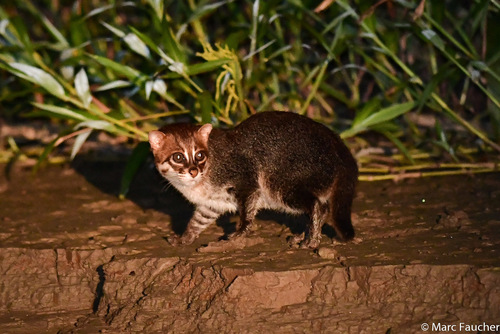
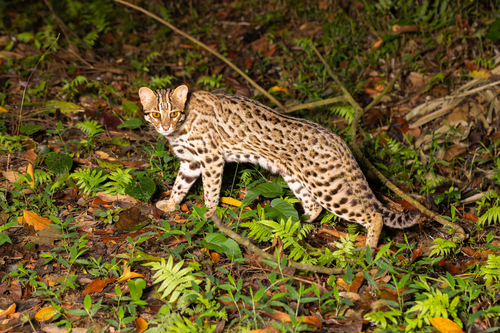
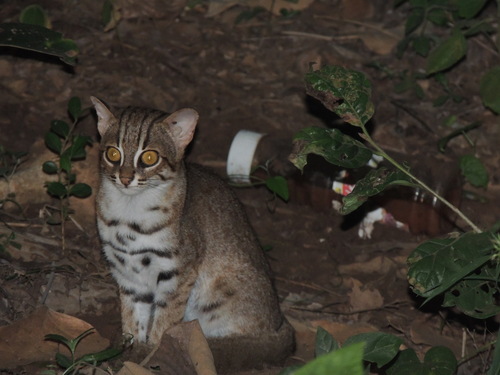
Other species in the genus Prionailurus
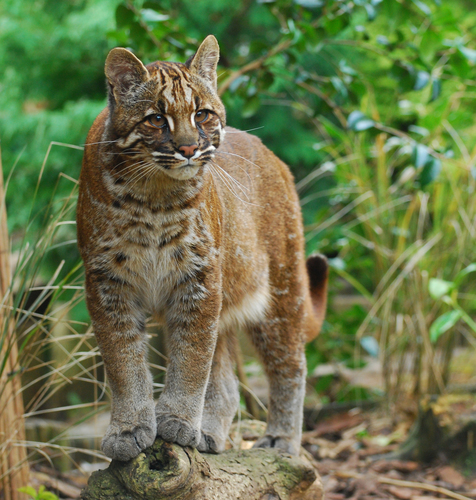
Other species in the family Felidae
Species that share its range
Sources
Conservation status, range description and population estimate come from the IUCN Red List assessment for Prionailurus viverrinus. Countries are derived from that range description, not from a mapped country list. Last refreshed on .
The distribution map is drawn from the IUCN Red List spatial data compiled in 2024. Mukherjee, S. et al.