
Andean White-fronted Capuchin
Cebus yuracus
Red List assessment
Near Threatenedon the IUCN Red List
- EXExtinct
- EWExtinct in the Wild
- CRCritically Endangered
- ENEndangered
- VUVulnerable
- NTNear Threatened
- LCLeast Concern
The Andean White-fronted Capuchin is recorded in 3 countries across South America. The IUCN Red List assesses the Andean White-fronted Capuchin as Near Threatened. No precise global population estimate exists, but the population is considered to be declining due to continued habitat destruction across its range.
- Family
- Cebidae
- Order
- Primates
- Genus
- Cebus
- Countries recorded
- 3
- Continents
- South America
- Red List category
- Near Threatened
- Data updated
- August 9, 2026
What is the Andean White-fronted Capuchin?
The Andean White-fronted Capuchin is a medium-sized New World monkey found in the western Amazon basin, particularly along the Andean foothills of Ecuador and Peru. It is recognized for its pale, cream-colored face and forehead contrasting with darker fur, and its high intelligence and dexterous use of hands for foraging. This species plays an important ecological role as a seed disperser in tropical forest ecosystems. It was only recently distinguished as a separate species from the broader Cebus albifrons complex.
Where does the Andean White-fronted Capuchin live?
Ecuador, Peru, and Colombia, primarily in the western Amazon basin and Andean foothills
Found in the upper Amazon basin, spanning eastern Ecuador, northeastern Peru, and possibly southern Colombia, with its range closely tied to the Andean foothill forests.
Altitude and depth
0-2000m, though most commonly found between 200-1500m in foothill and lowland forests
Seasonal movements
No true migration or hibernation; activity and ranging patterns may shift seasonally in response to fruit availability during wet and dry seasons
Habitat of the Andean White-fronted Capuchin
Primarily found in humid tropical and subtropical lowland forests, as well as premontane and montane forests along the eastern Andean slopes; also inhabits secondary forests and forest edges.
Adaptations to its environment
Prehensile-tipped tails aid in balance and grasping while foraging in the forest canopy; strong hands with opposable thumbs allow manipulation of tools and extraction of embedded food items; a varied omnivorous diet allows adaptability to seasonal food scarcity.
Conservation status and numbers
Near Threatened (NT) according to IUCN, due to ongoing habitat loss and fragmentation from deforestation, agricultural expansion, and hunting pressure across its range.
Estimated population
No precise global population estimate exists, but the population is considered to be declining due to continued habitat destruction across its range.
What threatens the Andean White-fronted Capuchin?
Deforestation for agriculture and cattle ranching, oil extraction infrastructure in the Amazon, illegal logging, and hunting for bushmeat or the pet trade.
Diseases and parasites
Susceptible to various intestinal parasites and can carry pathogens transmissible to humans, though specific studies on this species are limited.
What is being done to protect it?
Protected in several national parks and reserves within its range, including areas in Ecuador's Amazon region; included in CITES Appendix II regulating international trade.
Recommended actions
Expand protected area coverage and connectivity, enforce anti-poaching and anti-logging laws, conduct population surveys to better estimate numbers, and promote sustainable land-use practices in buffer zones.
What the Andean White-fronted Capuchin looks like
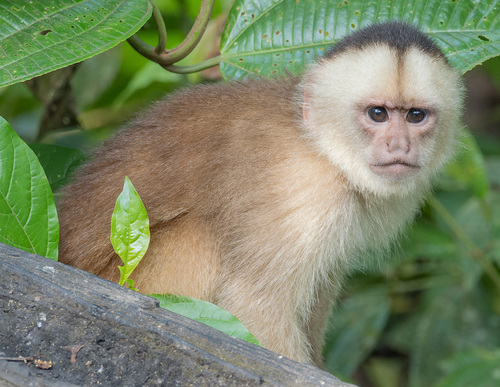
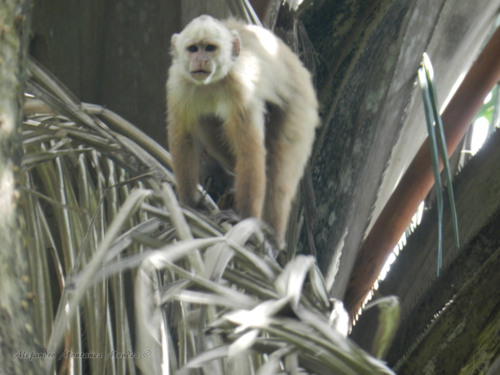
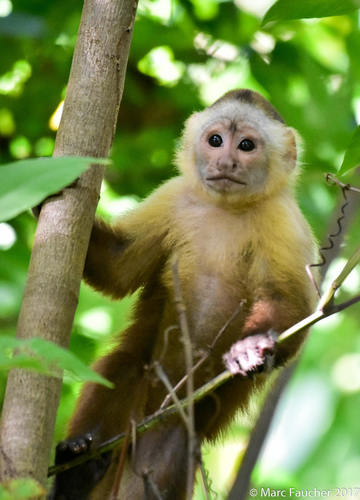
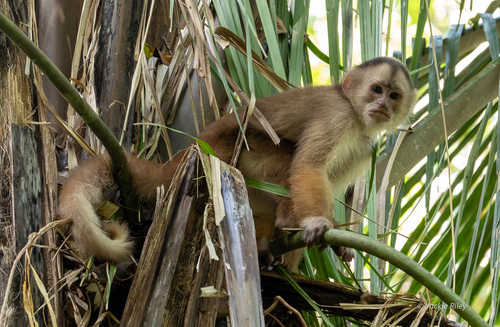
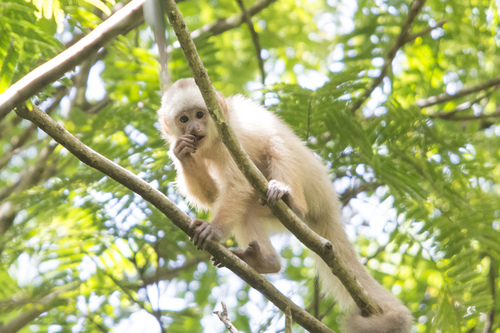
Fur is generally brownish to grayish-brown on the body with a distinctive pale cream to yellowish-white face, forehead, and throat; the crown often has darker fur forming a cap-like pattern.
Size
Body length approximately 35-48 cm, with a tail of similar or greater length (40-55 cm), used for balance and grasping.
Weight
Adults typically weigh between 2.5-3.9 kg, with males generally slightly larger than females.
Distinctive features
Distinguished from other Cebus albifrons complex species by subtle differences in fur coloration patterns, facial markings, and genetic divergence confirmed through molecular studies.
Differences between males and females
Males are slightly larger and heavier than females, though the difference is modest compared to some other primate species.
Behaviour and diet of the Andean White-fronted Capuchin
Highly social, living in multi-male, multi-female groups typically ranging from 10-30 individuals with a linear dominance hierarchy among both sexes.
When it is active
Diurnal, with activity peaks in early morning and late afternoon; rests during midday heat.
Diet
Omnivorous diet consisting of fruits, seeds, nuts, insects, small vertebrates, bird eggs, and occasionally plant matter such as leaves and flowers.
How it feeds and hunts
Uses manual dexterity to extract insects and larvae from bark, tree crevices, and leaf litter; may use tools such as stones to crack open hard-shelled nuts or fruits.
Communication
Uses a range of vocalizations including alarm calls, contact calls, and threat vocalizations; also communicates through facial expressions, body postures, and scent marking with urine.
Interactions with other species
Preyed upon by large raptors, wild cats such as ocelots and jaguars, and snakes; sometimes forms mixed-species associations with squirrel monkeys for foraging and predator vigilance benefits.
Role in its ecosystem
Acts as an important seed disperser for numerous plant species in tropical forests, contributing to forest regeneration and plant diversity maintenance.
Reproduction and lifecycle
Breeding can occur year-round with possible peaks tied to food abundance; gestation lasts approximately 150-160 days, typically resulting in a single offspring.
Raising the young
Mothers provide primary care, nursing and carrying infants for several months; other group members, including juvenile females, may assist in alloparental care.
Maturity and lifespan
Sexual maturity reached around 4-6 years; lifespan in the wild is approximately 15-25 years, while captive individuals may live up to 40 years.
Taxonomy and naming of the Andean White-fronted Capuchin
Classification
Mammalia > Primates > Cebidae > Cebus > Cebus yuracus
Scientific synonyms
Previously classified as a subspecies of Cebus albifrons (Cebus albifrons yuracus); elevated to full species status based on genetic and morphological studies
What research says
Recent studies
Recent molecular phylogenetic studies have clarified the taxonomic boundaries within the Cebus albifrons species complex, leading to the recognition of Cebus yuracus as a distinct species.
Genome and DNA
Diploid chromosome number similar to related Cebus species (2n=54); genetic studies have been key in distinguishing this species from Cebus albifrons.
Compared with similar species
Closely related to Cebus albifrons but distinguished by genetic markers and subtle differences in facial coloration; both species share similar body plans and behaviors typical of capuchin monkeys.
The Andean White-fronted Capuchin and people
Capuchins are among the most intelligent New World monkeys and have been observed using tools like stones and sticks to access food; they are also known for rubbing plants or insects on their fur, possibly for medicinal or insect-repellent purposes.
Where and how to see it
Best observed in early morning hours in protected forest reserves of the Ecuadorian and Peruvian Amazon foothills, particularly in areas like Yasuní National Park; look for groups moving through the mid-to-upper canopy.
Risks to humans
No notable risk to humans under normal circumstances, though wild individuals may bite if threatened or cornered.
Human uses
Occasionally captured for the illegal pet trade; historically some capuchin species have been used in research due to their intelligence, though this is not specifically documented for C. yuracus.
Countries where the Andean White-fronted Capuchin is recorded
The 3 countries named in the range description of its IUCN Red List assessment.
Questions about the Andean White-fronted Capuchin
Where does the Andean White-fronted Capuchin live?
The Andean White-fronted Capuchin is recorded in Colombia, Ecuador and Peru across South America. These countries come from the range description of its IUCN Red List assessment, and they are what place the species on the interactive map.
Is the Andean White-fronted Capuchin endangered?
The IUCN Red List assesses the Andean White-fronted Capuchin as Near Threatened. The species does not qualify as threatened today, but it is close to the thresholds and likely to cross them soon. It is the category that most often changes at the next assessment.
How many are left in the wild?
No precise global population estimate exists, but the population is considered to be declining due to continued habitat destruction across its range. This figure comes from the species assessment on the IUCN Red List; population estimates for wild mammals are ranges, not counts, and are revised at each assessment.
What habitat does the Andean White-fronted Capuchin live in?
Primarily found in humid tropical and subtropical lowland forests, as well as premontane and montane forests along the eastern Andean slopes; also inhabits secondary forests and forest edges.
What is the scientific name of the Andean White-fronted Capuchin?
The Andean White-fronted Capuchin is Cebus yuracus, in the family Cebidae, order Primates.
Other species in the genus Cebus
Other species in the family Cebidae
Sources
Conservation status, range description and population estimate come from the IUCN Red List assessment for Cebus yuracus. Countries are derived from that range description, not from a mapped country list. Last refreshed on .
The distribution map is drawn from the IUCN Red List spatial data compiled in 2020. IUCN (International Union for Conservation of Nature)