
Great Fruit-eating Bat
Artibeus lituratus
Red List assessment
Least Concernon the IUCN Red List
- EXExtinct
- EWExtinct in the Wild
- CRCritically Endangered
- ENEndangered
- VUVulnerable
- NTNear Threatened
- LCLeast Concern
The Great Fruit-eating Bat is recorded in 16 countries across North America and South America. The IUCN Red List assesses the Great Fruit-eating Bat as Least Concern. No precise global population estimate exists; the species is considered locally abundant throughout much of its range.
- Family
- Phyllostomidae
- Order
- Chiroptera
- Genus
- Artibeus
- Countries recorded
- 16
- Continents
- North America and South America
- Red List category
- Least Concern
- Data updated
- August 9, 2026
What is the Great Fruit-eating Bat?
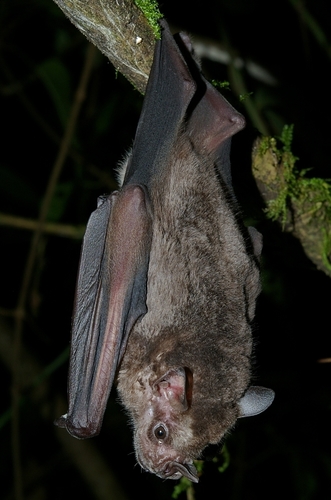
Artibeus lituratus, the Great Fruit-eating Bat, is the largest species in the genus Artibeus and one of the largest members of the family Phyllostomidae in the Neotropical region. It inhabits tropical and subtropical forests from Mexico to Argentina, showing a remarkable tolerance for disturbed habitats and urban environments. The species is ecologically critical as a major seed disperser, particularly of fig trees (Ficus spp.), making it a keystone species in Neotropical forest regeneration. Its distinctive white facial stripes and robust build make it one of the most recognizable fruit bats of the Americas.
Where does the Great Fruit-eating Bat live?
Mexico, Central America, and throughout South America including Colombia, Venezuela, Brazil, Bolivia, Peru, Ecuador, Paraguay, and northern Argentina; also Trinidad and Tobago
Ranges from southern Mexico (Oaxaca, Veracruz) through Guatemala, Belize, Honduras, Nicaragua, Costa Rica, Panama, and across nearly all of tropical South America. Found in Colombia, Venezuela, Trinidad and Tobago, the Guianas, Brazil (virtually throughout), Ecuador, Peru, Bolivia, Paraguay, and northwestern Argentina. Absent from the high Andes and Patagonia.
Altitude and depth
Typically found from sea level up to approximately 1,800–2,000 m elevation, with most records below 1,500 m; occasionally recorded up to 2,500 m in suitable Andean foothill habitats.
Seasonal movements
Non-migratory but shows some seasonal variation in foraging behavior tied to fruit availability. Reproductive activity is synchronized with fruiting seasons; no true hibernation occurs. In some parts of its range, individuals may shift roost sites between wet and dry seasons.
Habitat of the Great Fruit-eating Bat
Primarily occupies lowland tropical moist forests, gallery forests, forest edges, and secondary vegetation; also found in tropical dry forests, plantations, urban parks, and gardens. It tolerates a high degree of habitat disturbance and frequently forages in fragmented landscapes. Roosts are typically found in tree cavities, dense foliage, or constructed 'tents' in large palm or Heliconia leaves.
Adaptations to its environment
Possesses a robust skull and powerful jaw musculature adapted for processing large, hard-skinned fruits. The reduced uropatagium (tail membrane) and broad wings with a high aspect ratio enhance maneuverability in cluttered forest environments. White facial stripes may serve as disruptive camouflage while roosting. Echolocation calls are relatively low-intensity (whispering bat), compensated by highly developed visual and olfactory senses for locating ripe fruit.
Conservation status and numbers
Least Concern (LC) on the IUCN Red List, last assessed in 2016. The species has a very wide geographic range, large estimated population, and significant tolerance for habitat disturbance, so it does not approach the thresholds for a more threatened category.
Estimated population
No precise global population estimate exists; the species is considered locally abundant throughout much of its range. Population trend is thought to be stable overall, though locally declining in heavily deforested areas.
What threatens the Great Fruit-eating Bat?
Large-scale deforestation and agricultural expansion remain the primary long-term threats, particularly in the Amazon Basin and Central American forests. Roost disturbance and destruction of large trees reduce available shelter. Indiscriminate killing by humans due to misconceptions about bats is locally significant. Climate change may alter fruiting phenology, potentially affecting food availability.
Diseases and parasites
Known to harbor rabies virus (seropositive individuals detected; rarely transmits to humans). Host to several bat flies (Streblidae: Trichobius spp., Megistopoda spp.) and mites (Spinturnix spp.). Internal parasites include trypanosomes and helminths. Can carry histoplasmosis-causing fungi in roost guano.
What is being done to protect it?
Protected indirectly through the existence of numerous Neotropical national parks and biological reserves (e.g., Barro Colorado Island, Panama; Amazonian reserves in Brazil). Listed under CITES Appendix III in some national jurisdictions. Regional bat conservation networks such as RELCOM (Latin American and Caribbean Network for Bat Conservation) monitor populations and promote education.
Recommended actions
Maintain and expand forest corridors to preserve foraging networks; protect large emergent trees used as roost sites. Promote public education to reduce persecution. Implement long-term population monitoring using standardized mist-netting protocols. Include bat-friendly practices in agroforestry and urban planning policies.
What the Great Fruit-eating Bat looks like
Fur is dark brownish-gray to blackish-brown on the dorsum and slightly paler grayish-brown ventrally. The face bears two pairs of conspicuous whitish stripes: one running above each eye (supraorbital) and one below each eye (suborbital). The nose-leaf is well-developed but short and triangular. Ears are short and rounded; wing membranes are dark.
Size
Body length (head-body): 85–105 mm; forearm length: 63–70 mm; wingspan: approximately 450–500 mm. No functional external tail.
Weight
Typically 55–85 g; females tend to be slightly heavier than males, particularly during pregnancy. Exceptionally robust individuals may reach 90 g.
Distinctive features
Distinguished from the closely related Artibeus jamaicensis by its significantly larger size (forearm >63 mm vs. <60 mm) and heavier build. The facial stripes are generally more pronounced than in A. jamaicensis. Compared to A. obscurus, A. lituratus has more conspicuous facial striping and a longer forearm. The large body size alone is often sufficient for field identification within the genus.
Differences between males and females
Sexual size dimorphism is mild but consistent: females are on average slightly larger and heavier than males, particularly during lactation. No differences in pelage coloration between sexes. Males possess well-developed throat glands used in scent marking.
Behaviour and diet of the Great Fruit-eating Bat
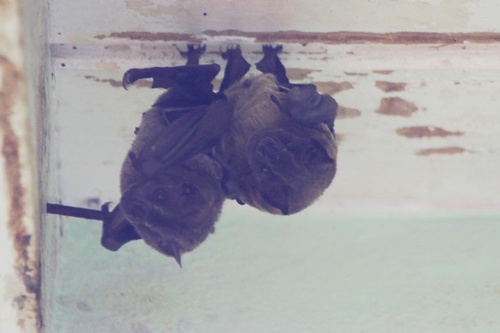
Lives in small harem-based groups typically consisting of one dominant male, 1–8 females, and their dependent young. Subordinate males form bachelor groups or roost separately. Colony sizes at roost sites can reach several dozen individuals in favorable conditions. Social hierarchies are maintained by the dominant male through vocalizations and scent marking.
When it is active
Strictly nocturnal; emerges shortly after dusk to forage. Activity peaks in the first 2–3 hours after sunset and again around midnight. Returns to roost before dawn. Daytime is spent roosting in groups within foliage tents or tree cavities.
Diet
Strongly frugivorous; figs (Ficus spp.) constitute the dietary staple and may represent over 60% of food intake. Also consumes a wide variety of other fleshy fruits including those of Cecropia, Piper, Solanum, and Musa. Occasionally supplements diet with nectar, pollen, and arthropods, particularly when fruit is scarce.
How it feeds and hunts
Locates ripe fruit primarily using olfaction and low-frequency echolocation. Plucks fruit in flight or while clinging to fruiting branches, often carrying large fruits to a feeding roost ('commuting foraging'). Fruit is masticated and juice extracted; fibrous pulp and large seeds are typically dropped below the feeding roost, aiding seed dispersal.
Communication
Uses ultrasonic echolocation calls (frequency-modulated, 40–60 kHz) primarily for navigation rather than prey detection. Social vocalizations include low-frequency audible calls used in harem interactions and mother-pup recognition. Males use chest and throat gland secretions for scent marking of roost sites and females. Wing postures are used in threat and submission displays.
Interactions with other species
Predated upon by owls (e.g., Tyto alba, Asio stygius), snakes, and occasionally ocelots near roost sites. Competes with other frugivorous bats (e.g., Artibeus jamaicensis, Carollia perspicillata) and birds (toucans, parrots) for fruit resources. Serves as a host for various ectoparasites and is an important mutualistic partner with Ficus trees and other fruit-bearing plants requiring seed dispersal.
Role in its ecosystem
A keystone seed disperser in Neotropical ecosystems, capable of transporting seeds hundreds of meters from parent trees, facilitating forest regeneration and connectivity. Its preference for pioneer plant species such as Cecropia and Piper makes it particularly important in secondary forest succession. Also contributes to pollination when consuming nectar and pollen.
Reproduction and lifecycle
Exhibits bimodal polyestry in most of its range, with two birth peaks annually corresponding to periods of fruit abundance (typically April–June and August–October in equatorial regions). Gestation lasts approximately 115–120 days. Litter size is almost always one pup. Weaning occurs at approximately 2–3 months of age.
Raising the young
Maternal care is the norm; the single pup is carried by the mother for the first few weeks of life and left at the roost during foraging thereafter. Pups are nursed until capable of flight and independent foraging. The dominant male provides indirect protection to the harem group. Young females may remain associated with the natal group.
Maturity and lifespan
Sexual maturity is reached at approximately 8–12 months of age. Lifespan in the wild is estimated at 7–10 years; captive individuals have survived over 12 years. Banding studies in the field confirm multi-year survival in wild populations.
Taxonomy and naming of the Great Fruit-eating Bat
Classification
Mammalia > Chiroptera > Phyllostomidae > Artibeus > Artibeus lituratus (Olfers, 1818)
Subspecies
Three subspecies are generally recognized: A. l. lituratus (Brazil, Bolivia, Paraguay, Argentina — nominate form); A. l. palmarum (Trinidad, Venezuela, Guianas — coastal northern South America); A. l. intermedius (Mexico through Central America to northwestern South America, sometimes elevated to full species status).
Scientific synonyms
Phyllostoma lituratum Olfers, 1818; Artibeus jamaicensis lituratus; Artibeus perspicillatus (in part, misidentification); Artibeus lituratus palmarum J.A. Allen & Chapman, 1897.
What research says
Recent studies
Recent studies have highlighted its critical role in urban seed dispersal ecology, demonstrating that it maintains seed dispersal services even in heavily fragmented and urbanized landscapes. Research published in the 2010s confirmed that A. intermedius is likely a distinct species from A. lituratus based on morphological and molecular evidence. Stable isotope analyses have refined understanding of its dietary flexibility across habitat types.
Genome and DNA
Diploid chromosome number 2n = 30 or 31 (variation linked to sex chromosomes). Phylogenomic studies have confirmed its placement within the 'big-bodied' Artibeus clade distinct from A. jamaicensis. Mitochondrial DNA analyses reveal moderate genetic structure across its range, consistent with limited gene flow across the Andes.
Compared with similar species
Closely related to Artibeus jamaicensis (Jamaican Fruit-eating Bat), which is smaller (forearm <60 mm) and more widespread in the Caribbean. A. obscurus (Dark Fruit-eating Bat) is similar in coloration but smaller and lacks prominent facial stripes. A. planirostris is also large but has a flatter snout and different distribution in South America. Artibeus lituratus is generally the largest Artibeus encountered in any given locality.
The Great Fruit-eating Bat and people
Despite being a frugivore, A. lituratus has such powerful jaw muscles that it can crack open hard-skinned fruits that most other bats cannot access. It constructs elaborate 'tents' by biting through the midrib of large palm fronds, causing the leaf to fold into a protective shelter — demonstrating remarkable tool-like behavioral modification of its environment. A single individual can disperse the seeds of hundreds of figs in a single night, making it one of the most prolific seed dispersers per individual in the Neotropics.
Where and how to see it
Best observed at dusk near fruiting fig trees or Cecropia stands in forest edges; observers can watch individuals making repeated foraging flights. Barro Colorado Island (Panama), Monteverde (Costa Rica), and the Atlantic Forest reserves of Brazil offer excellent observation opportunities. Mist-netting with appropriate permits near forest water sources is the standard method used by researchers. Individuals are commonly captured in standard scientific surveys throughout their range.
Risks to humans
Low risk to humans; bats are not aggressive unless handled. As with all bats, there is a theoretical risk of rabies virus transmission if bitten or scratched — handling should always be performed with appropriate protective gloves by trained professionals. Roost guano accumulation in buildings can present a respiratory risk (histoplasmosis) if disturbed.
Human uses
Not hunted or commercially exploited. Occasionally considered a nuisance when roosting in buildings or raiding fruit crops (bananas, mangoes). Highly valued ecologically as a seed disperser and used as a bioindicator of tropical forest health in ecological research and monitoring programs. Frequently captured and studied for rabies surveillance in public health programs across Latin America.
Myths and legends
Bats in general hold complex symbolism across Mesoamerican and Amazonian cultures. In Maya cosmology, the bat deity Camazotz was a fearsome creature of the underworld associated with death and sacrifice, though this mythology more commonly references smaller leaf-nosed bats. In some Amazonian indigenous traditions, large fruit bats are associated with forest spirits and the protection of fruit trees, reflecting their observed ecological role as seed carriers.
Countries where the Great Fruit-eating Bat is recorded
The 16 countries named in the range description of its IUCN Red List assessment.
Questions about the Great Fruit-eating Bat
Where does the Great Fruit-eating Bat live?
The Great Fruit-eating Bat is recorded in Argentina, Belize, Bolivia, Brazil and Colombia, among 16 countries in total across North America and South America. These countries come from the range description of its IUCN Red List assessment, and they are what place the species on the interactive map.
Is the Great Fruit-eating Bat endangered?
The IUCN Red List assesses the Great Fruit-eating Bat as Least Concern. The species is widespread and abundant enough not to qualify for any threatened category. It does not mean the species is safe forever, only that nothing in the current data raises an alarm.
How many are left in the wild?
No precise global population estimate exists; the species is considered locally abundant throughout much of its range. This figure comes from the species assessment on the IUCN Red List; population estimates for wild mammals are ranges, not counts, and are revised at each assessment.
What habitat does the Great Fruit-eating Bat live in?
Primarily occupies lowland tropical moist forests, gallery forests, forest edges, and secondary vegetation; also found in tropical dry forests, plantations, urban parks, and gardens.
What is the scientific name of the Great Fruit-eating Bat?
The Great Fruit-eating Bat is Artibeus lituratus, in the family Phyllostomidae, order Chiroptera.
Other species in the genus Artibeus
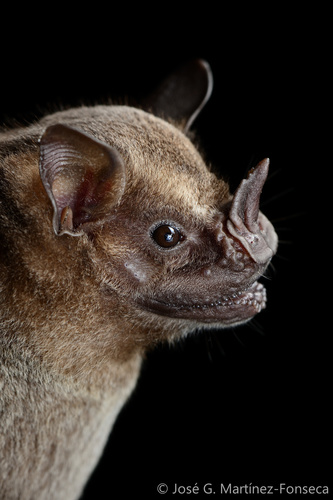
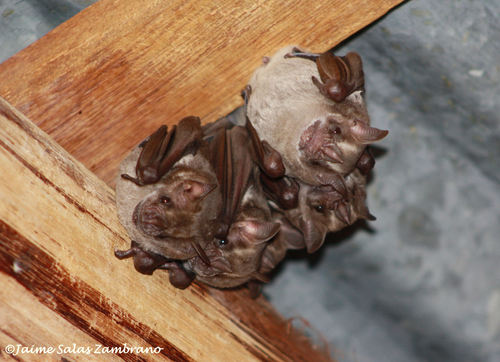
Other species in the family Phyllostomidae
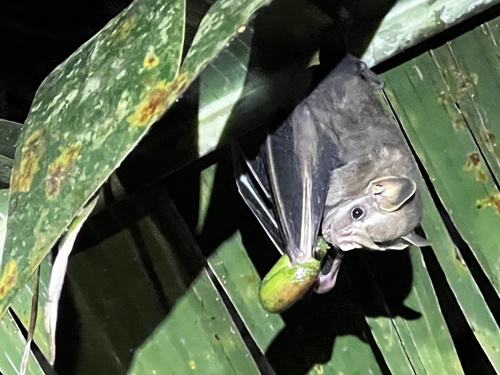
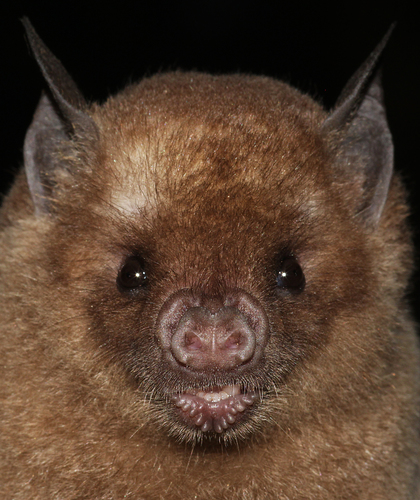
Sources
Conservation status, range description and population estimate come from the IUCN Red List assessment for Artibeus lituratus. Countries are derived from that range description, not from a mapped country list. Last refreshed on .
The distribution map is drawn from the IUCN Red List spatial data compiled in 2008. IUCN (International Union for Conservation of Nature)