
Flat-faced Fruit-eating Bat
Artibeus planirostris
Red List assessment
Least Concernon the IUCN Red List
- EXExtinct
- EWExtinct in the Wild
- CRCritically Endangered
- ENEndangered
- VUVulnerable
- NTNear Threatened
- LCLeast Concern
The Flat-faced Fruit-eating Bat is recorded in 12 countries across North America and South America. The IUCN Red List assesses the Flat-faced Fruit-eating Bat as Least Concern. No precise global population estimate exists; the species is considered abundant and widespread, with a population trend assessed as stable overall, though locally declining in heavily deforested regions.
- Family
- Phyllostomidae
- Order
- Chiroptera
- Genus
- Artibeus
- Countries recorded
- 12
- Continents
- North America and South America
- Red List category
- Least Concern
- Data updated
- August 9, 2026
What is the Flat-faced Fruit-eating Bat?
Artibeus planirostris, the Flat-faced Fruit-eating Bat, is a medium-to-large phyllostomid bat native to South America, named for its notably flattened facial profile and reduced noseleaf. It is one of the most ecologically important frugivorous bats in Neotropical ecosystems, acting as a major seed disperser for dozens of plant species. It inhabits a wide range of forested environments, from pristine Amazonian rainforest to secondary growth and urban forest patches. Its remarkable adaptability makes it one of the most widespread and abundant bats in South America.
Where does the Flat-faced Fruit-eating Bat live?
South America: Brazil, Venezuela, Colombia, Peru, Bolivia, Ecuador, Paraguay, northern Argentina, Trinidad and Tobago, Suriname, Guyana, French Guiana
Broadly distributed across South America east of the Andes, ranging from Venezuela, Colombia, Trinidad, and the Guianas southward through Brazil (including the Amazon basin and Atlantic Forest), Ecuador, Peru, Bolivia, Paraguay, and into northern Argentina. It is absent from the high Andes and the arid Chaco interior.
Altitude and depth
Primarily a lowland species, found from sea level up to approximately 1,500–2,000 m elevation; most abundant below 1,000 m.
Seasonal movements
No true hibernation or long-distance migration. Individuals may shift local movements seasonally in response to the fruiting phenology of key tree species such as Ficus. Reproductive timing is often synchronized with peaks in fruit availability.
Habitat of the Flat-faced Fruit-eating Bat
Primarily tropical and subtropical moist broadleaf forests, including Amazonian terra firme and várzea forests, Atlantic Forest remnants, gallery forests, and forest edges. It also tolerates secondary forests, agroforestry systems, and fragmented habitats near human settlements, provided fruiting trees are available.
Adaptations to its environment
The flattened face and robust, broad teeth are adapted for biting through tough fruit rinds and husks. Its large eyes and advanced echolocation allow efficient foraging in dense, dark forest canopies at night. Like other Artibeus, it is capable of constructing 'tent roosts' by biting leaf veins of large-leaved plants (e.g., Heliconia, palms), creating sheltered retreats that protect against rain and predators.
Conservation status and numbers
Least Concern (LC) on the IUCN Red List. The species has a broad distribution, large estimated population, and high tolerance for habitat disturbance, with no evidence of rapid population decline sufficient to warrant a more threatened category.
Estimated population
No precise global population estimate exists; the species is considered abundant and widespread, with a population trend assessed as stable overall, though locally declining in heavily deforested regions.
What threatens the Flat-faced Fruit-eating Bat?
Large-scale deforestation and forest fragmentation across Amazonia and the Atlantic Forest are the primary long-term threats. Agricultural intensification and pesticide use reduce insect and fruit availability. Hunting pressure is locally significant in some communities. Wind farms pose an emerging threat to low-flying bats.
Diseases and parasites
Known to harbor rabies virus at low prevalence; generally not considered a high-risk reservoir compared to hematophagous bats. Hosts a rich ectoparasite fauna including bat flies (Streblidae: Trichobius spp., Aspidoptera spp.) and mites. Internal parasites include intestinal helminths and trypanosomes.
What is being done to protect it?
Protected within numerous national parks and biological reserves across its range, including Amazonia National Park (Brazil) and various Venezuelan and Colombian protected areas. It benefits from general legislation protecting bat species in Brazil (IBAMA) and international frameworks such as CITES Appendix III (where applicable). Research programs on seed dispersal ecology indirectly support recognition of its conservation value.
Recommended actions
Maintain and restore riparian and forest corridor connectivity to preserve foraging networks. Enforce deforestation moratoriums in critical Amazon and Atlantic Forest zones. Conduct long-term population monitoring using standardized mist-net surveys. Promote public education on the ecological services provided by frugivorous bats to reduce persecution.
What the Flat-faced Fruit-eating Bat looks like
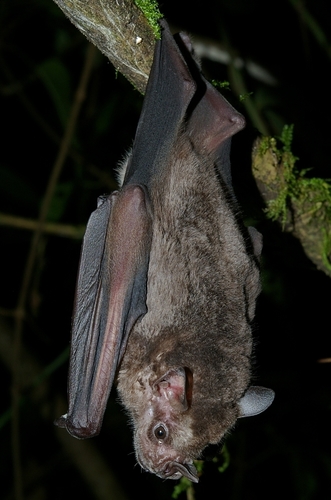
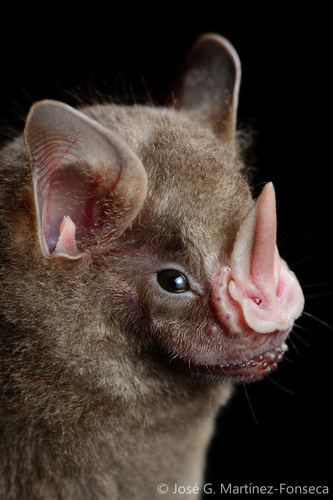
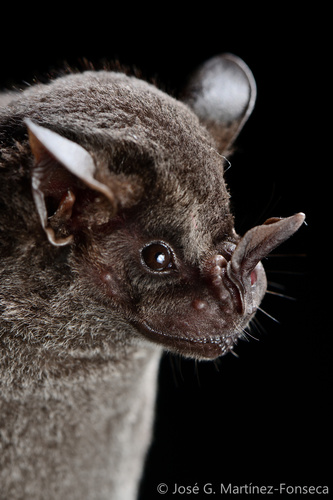
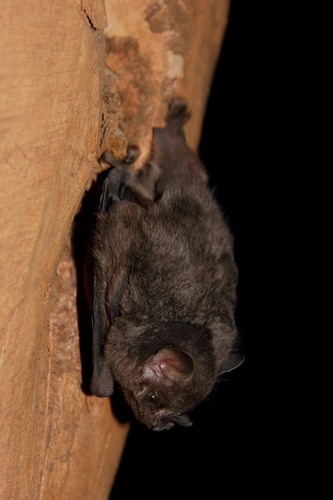
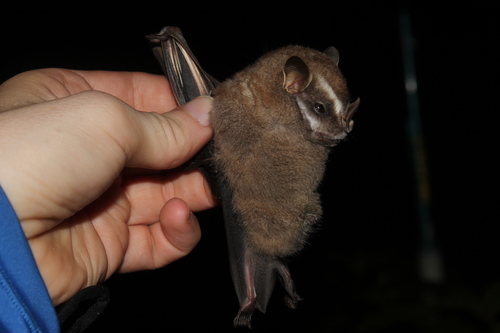
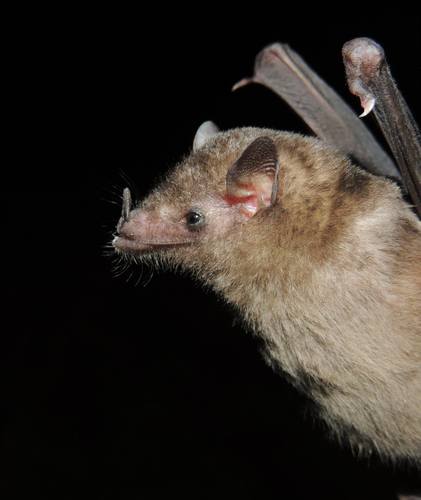
Dorsal fur is medium to dark brown or grayish-brown, with a paler, often buffy or grayish underside. The face is notably flat with a short, reduced noseleaf. Like most Artibeus, it bears two white facial stripes on each side: one above and one below the eye (supraorbital and infraorbital). Ears are relatively short and triangular. The uropatagium (tail membrane) is narrow, with no visible external tail.
Size
Forearm length 55–68 mm; total body length approximately 80–100 mm; no visible external tail. Wingspan approximately 35–42 cm.
Weight
Typically 40–75 g; males and females are broadly similar in mass, though females may be heavier during pregnancy or lactation.
Distinctive features
Distinguished from the closely related Artibeus jamaicensis by its larger size and notably flatter facial profile. Compared to A. lituratus (Great Fruit-eating Bat), it is smaller and has less distinct facial stripes. The combination of flat face, white facial striping, robust build, and no visible tail is characteristic of the species.
Differences between males and females
Sexual dimorphism is minimal in external morphology. Females may be slightly heavier than males during reproductive periods. Males possess a small glandular throat patch used in social scent communication.
Behaviour and diet of the Flat-faced Fruit-eating Bat
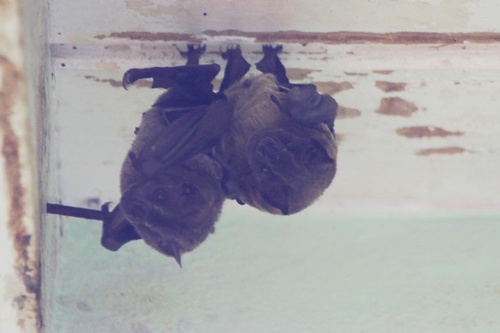
Forms harem-based polygynous groups consisting of one dominant male and 2–14 females, along with their dependent offspring. Subordinate males are excluded and form bachelor groups nearby. Colony sizes at roost sites range from a few individuals to several dozen.
When it is active
Strictly nocturnal. Foraging activity peaks in the first half of the night, shortly after sunset, with a secondary peak before dawn. Individuals return to diurnal roosts (tent roosts or tree cavities) during daylight hours.
Diet
Predominantly frugivorous, with a strong preference for figs (Ficus spp.), which may constitute the majority of the diet. Also consumes a wide variety of other soft fruits, as well as flowers, pollen, and nectar. Occasional consumption of insects, particularly during the dry season when fruits are scarce.
How it feeds and hunts
Locates ripe fruits primarily through olfaction (detecting volatile fruit odors) and low-duty-cycle echolocation for obstacle avoidance during flight. Once a fruit is detected and plucked in flight or from a perch, it is typically carried to a separate feeding roost to be consumed, reducing predation risk.
Communication
Uses frequency-modulated (FM) echolocation calls for orientation and obstacle avoidance, typically emitted as short, broadband pulses. Produces a variety of social vocalizations including contact calls, isolation calls from pups, and male advertisement calls. The male's throat gland is used for scent marking within the harem roost.
Interactions with other species
Key predators include barn owls (Tyto alba), other raptors, arboreal snakes, and small carnivores such as opossums. Competes for fruit resources with other frugivorous bats (e.g., A. lituratus, Carollia spp.) and with birds such as toucans and parrots. Acts as a mutualist with many trees through seed dispersal, particularly for pioneer and early-successional species.
Role in its ecosystem
One of the most important seed dispersers in Neotropical forests, capable of transporting seeds of dozens of plant species, including those of canopy trees (Ficus, Cecropia, Piper). By dispersing seeds away from parent trees, it promotes forest regeneration and diversity. Also contributes to pollination when consuming flowers.
Reproduction and lifecycle
Exhibits bimodal polyestry, with two birth peaks per year typically aligned with periods of high fruit availability. Gestation lasts approximately 100–120 days. Litter size is almost invariably one pup. Birth weight is approximately 10–15 g.
Raising the young
Maternal care is primary: the mother nurses and carries the pup for the first few weeks, initially transporting it during foraging flights. Pups are left in the roost cluster once large enough. Weaning occurs at approximately 1.5–2 months, and juveniles reach adult size by 3–4 months.
Maturity and lifespan
Sexual maturity is reached at approximately 9–12 months of age. Wild lifespan is estimated at 5–10 years, though captive individuals of closely related species have survived longer. Mortality is highest in the first year of life.
Taxonomy and naming of the Flat-faced Fruit-eating Bat
Classification
Mammalia > Chiroptera > Phyllostomidae > Artibeus > Artibeus planirostris
Subspecies
Several subspecies have been proposed, including A. p. planirostris (central and eastern Brazil), A. p. fallax (northern South America), A. p. trinitatis (Trinidad), and A. p. intermedius; however, the taxonomy remains debated and some populations previously assigned here have been elevated to full species.
Scientific synonyms
Artibeus fallax Peters, 1865; Artibeus planirostris was described by Spix in 1823. Artibeus obscurus was formerly treated as a subspecies but is now regarded as a separate species.
What research says
Recent studies
Recent studies (2010s–2020s) have used stable isotopes and GPS telemetry to quantify seed dispersal distances, demonstrating that A. planirostris can disperse seeds up to 500–1,000 m from the parent plant, far exceeding most terrestrial dispersers. Genomic studies have clarified the phylogeographic structure across its broad South American range, revealing distinct genetic clusters in Amazonia, Atlantic Forest, and the Llanos region.
Genome and DNA
Diploid chromosome number is 2n = 30 (FN = 56), consistent with other members of the Artibeus jamaicensis species complex. Phylogenomic studies have confirmed the distinctness of A. planirostris from A. jamaicensis and highlighted gene flow dynamics across the Andes and Amazonia.
Compared with similar species
Artibeus planirostris is closely related to A. jamaicensis (Jamaican Fruit-eating Bat), which has a wider range including Central America and the Caribbean. It is generally larger and flatter-faced than A. jamaicensis and has historically been confused with it. Compared to A. lituratus, A. planirostris is smaller with less pronounced facial stripes. Within Artibeus, it belongs to the 'large Artibeus' group alongside A. lituratus and A. obscurus.
The Flat-faced Fruit-eating Bat and people
Artibeus planirostris is one of the few mammals in the world that constructs its own shelter: it bites through the midrib and lateral veins of large leaves (e.g., Heliconia, banana, palm fronds), causing them to fold into a 'tent' that provides rain protection and camouflage. Despite being entirely frugivorous as adults, single pups can consume more than half their body weight in milk per day. A single individual can disperse the seeds of over 30 different plant species in a single night of foraging.
Where and how to see it
Best observed at dusk near large fruiting fig trees (Ficus spp.) or Cecropia trees at the edges of tropical forests in Brazil, Venezuela, and the Guianas. Mist-netting surveys at forest-stream interfaces are the most effective scientific method. Tent roosts can sometimes be found in large-leaved plants in forest understories and garden plantations. The months of highest fruiting activity (which vary regionally) coincide with peak bat foraging activity.
Risks to humans
Low risk to humans; not aggressive and rarely encountered directly. As with all wild bats, handling should be avoided without proper protective equipment due to the theoretical risk of rabies transmission. No venomous structures. Post-exposure prophylaxis is recommended after any direct contact.
Human uses
Not commercially exploited. Occasionally consumed as bushmeat by some Amazonian indigenous communities. Widely studied for its critical ecosystem services as a seed disperser, making it of considerable interest in tropical forest restoration science. Its role in regenerating deforested areas is increasingly recognized in applied conservation and reforestation programs.
Myths and legends
In various Amazonian indigenous cultures, bats are ambivalent figures associated with the transition between day and night, and with the realm of the dead or the underworld. In some South American traditions, bats entering a home are seen as omens of either good or bad fortune. Frugivorous bats specifically are sometimes regarded as forest guardians because of their role in regenerating vegetation.
Countries where the Flat-faced Fruit-eating Bat is recorded
The 12 countries named in the range description of its IUCN Red List assessment.
Questions about the Flat-faced Fruit-eating Bat
Where does the Flat-faced Fruit-eating Bat live?
The Flat-faced Fruit-eating Bat is recorded in Argentina, Bolivia, Brazil, Colombia and Ecuador, among 12 countries in total across North America and South America. These countries come from the range description of its IUCN Red List assessment, and they are what place the species on the interactive map.
Is the Flat-faced Fruit-eating Bat endangered?
The IUCN Red List assesses the Flat-faced Fruit-eating Bat as Least Concern. The species is widespread and abundant enough not to qualify for any threatened category. It does not mean the species is safe forever, only that nothing in the current data raises an alarm.
How many are left in the wild?
No precise global population estimate exists; the species is considered abundant and widespread, with a population trend assessed as stable overall, though locally declining in heavily deforested regions. This figure comes from the species assessment on the IUCN Red List; population estimates for wild mammals are ranges, not counts, and are revised at each assessment.
What habitat does the Flat-faced Fruit-eating Bat live in?
Primarily tropical and subtropical moist broadleaf forests, including Amazonian terra firme and várzea forests, Atlantic Forest remnants, gallery forests, and forest edges.
What is the scientific name of the Flat-faced Fruit-eating Bat?
The Flat-faced Fruit-eating Bat is Artibeus planirostris, in the family Phyllostomidae, order Chiroptera.
Other species in the genus Artibeus
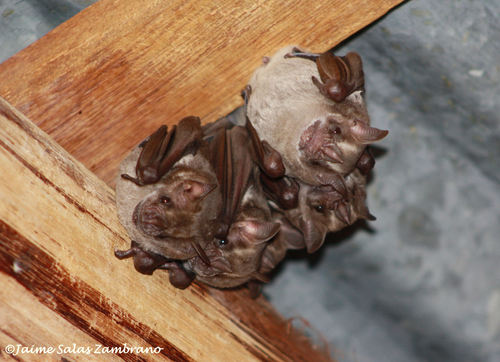
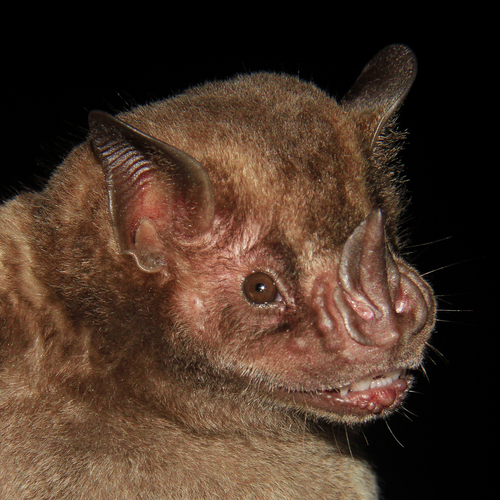
Other species in the family Phyllostomidae
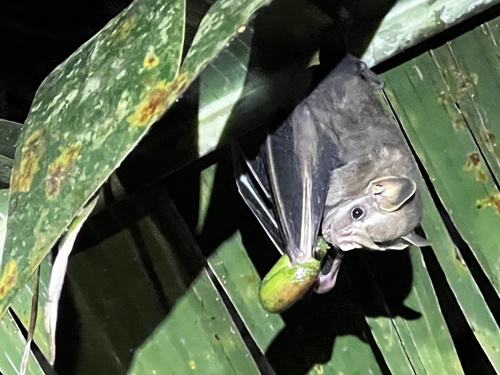
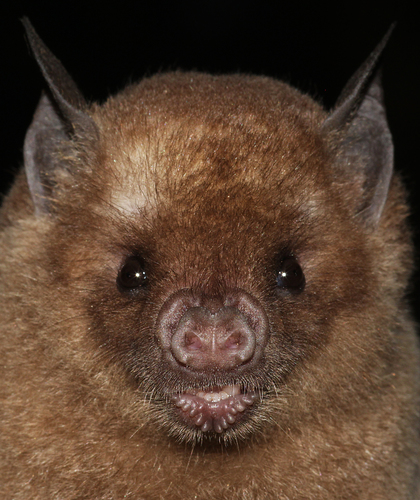
Sources
Conservation status, range description and population estimate come from the IUCN Red List assessment for Artibeus planirostris. Countries are derived from that range description, not from a mapped country list. Last refreshed on .
The distribution map is drawn from the IUCN Red List spatial data compiled in 2008. IUCN (International Union for Conservation of Nature)