
Fraternal Fruit-eating Bat
Artibeus fraterculus
Red List assessment
Least Concernon the IUCN Red List
- EXExtinct
- EWExtinct in the Wild
- CRCritically Endangered
- ENEndangered
- VUVulnerable
- NTNear Threatened
- LCLeast Concern
The Fraternal Fruit-eating Bat is recorded in 2 countries across South America. The IUCN Red List assesses the Fraternal Fruit-eating Bat as Least Concern. No precise global population estimate exists.
- Family
- Phyllostomidae
- Order
- Chiroptera
- Genus
- Artibeus
- Countries recorded
- 2
- Continents
- South America
- Red List category
- Least Concern
- Data updated
- August 9, 2026
What is the Fraternal Fruit-eating Bat?
Artibeus fraterculus is a medium-sized Neotropical fruit bat belonging to the family Phyllostomidae (leaf-nosed bats), first described by Harold E. Anthony in 1924. It is largely restricted to Pacific-slope tropical forests of western Ecuador and northwestern Peru, making it a near-endemic of the Tumbesino dry forest bioregion. Like other Artibeus, it is a highly effective frugivore and seed disperser critical to forest regeneration. Its facial stripe pattern, robust build, and short noseleaf are hallmarks of the genus.
Where does the Fraternal Fruit-eating Bat live?
Western Ecuador and northwestern Peru, along the Pacific coastal lowlands and adjacent foothills
Distributed along the Pacific coastal corridor of northwestern South America: western Ecuador (Manabí, Guayas, El Oro, Esmeraldas provinces) and northwestern Peru (Tumbes, Piura, and Lambayeque departments). Its range largely coincides with the Tumbesian Endemic Bird Area.
Altitude and depth
Typically recorded from sea level to approximately 1,500 m elevation, with highest abundance reported below 1,000 m in lowland and foothill forest zones.
Seasonal movements
No seasonal migration documented. Foraging activity and reproductive cycles likely track the availability of ripe fruit across wet (December–May) and dry (June–November) seasons in the Ecuadorian and Peruvian Pacific lowlands.
Habitat of the Fraternal Fruit-eating Bat
Primarily inhabits tropical dry forests and tropical moist (humid) forests along the Pacific coastal lowlands. Also tolerates secondary vegetation, forest edges, and disturbed habitats containing abundant fruit-bearing trees, making it moderately resilient to moderate habitat modification.
Adaptations to its environment
Possesses a well-developed noseleaf that focuses echolocation signals for precise navigation in dense forest. Strong zygomatic arches and robust molars allow it to pierce and consume hard-skinned fruits. Its broad, rounded wing shape facilitates slow, maneuverable flight within cluttered forest understory.
Conservation status and numbers
Least Concern (LC) on the IUCN Red List. The species meets no thresholds for a threatened category due to its relatively wide distribution and occurrence in multiple protected areas. However, ongoing deforestation in its restricted Pacific-slope range warrants continued monitoring.
Estimated population
No precise global population estimate exists. Based on encounter rates in field surveys and its LC status, the population is considered stable, though local declines may occur in heavily deforested areas.
What threatens the Fraternal Fruit-eating Bat?
Primary threats include deforestation for agriculture (banana, sugarcane, and oil palm plantations), cattle ranching, and urban expansion along the Ecuadorian and Peruvian Pacific coast. Fragmentation of dry and moist forest corridors reduces gene flow and foraging connectivity between roost sites.
Diseases and parasites
Susceptible to bat flies (family Streblidae) and mites, which are common ectoparasites of Neotropical phyllostomid bats. May harbor bat-associated coronaviruses and other RNA viruses typical of the family. Specific parasitological studies on this species are limited.
What is being done to protect it?
The species occurs within several protected areas, including Machalilla National Park and the Manglares-Churute Ecological Reserve in Ecuador, and the Tumbes National Reserve in Peru. Both countries maintain general wildlife protection laws covering native bat species.
Recommended actions
Priority actions include preservation and reforestation of Pacific dry and moist forest corridors; regular bat community monitoring using standardized mist-netting surveys; public education on bats as seed dispersers; and strengthened enforcement within existing protected areas.
What the Fraternal Fruit-eating Bat looks like
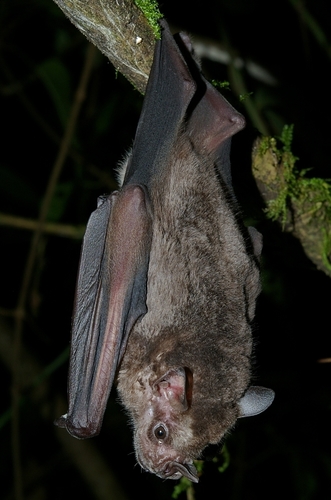
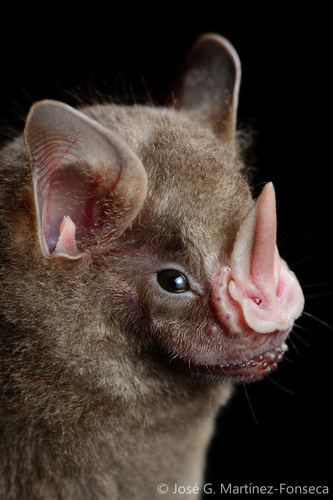
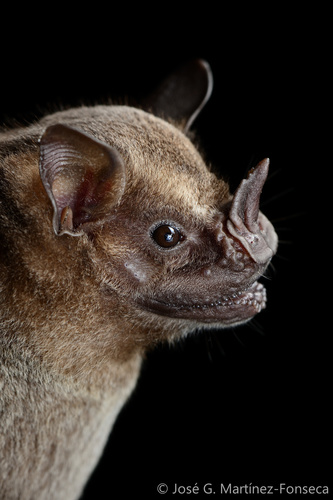
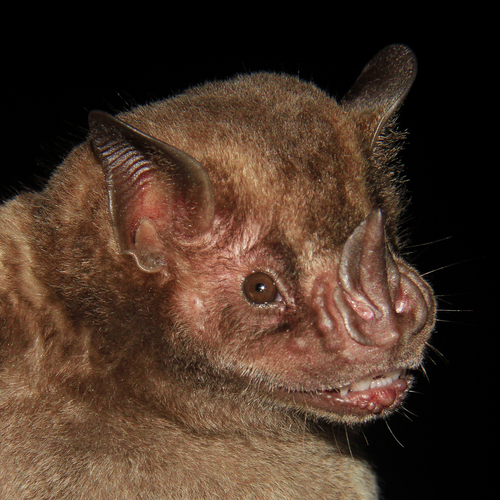
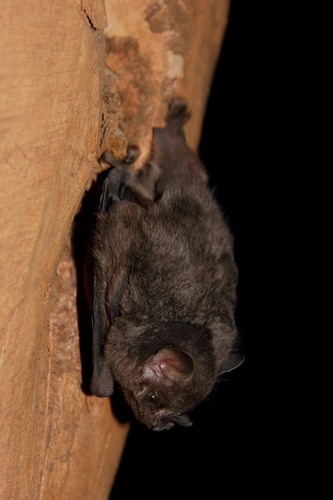
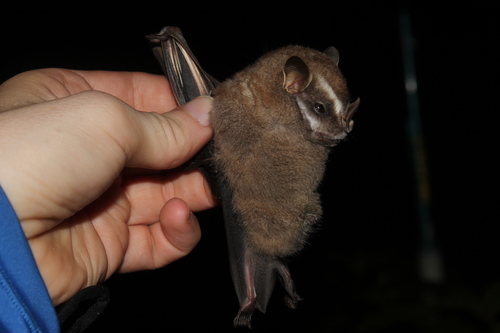
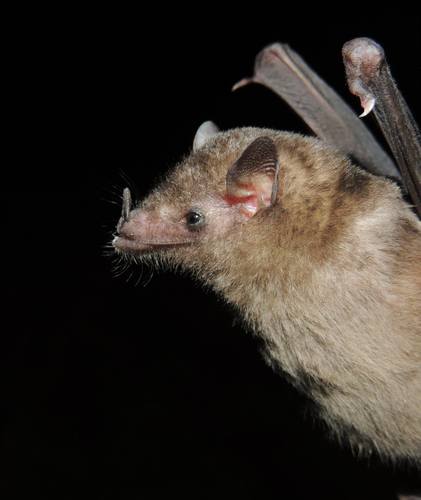
Medium-sized bat with brownish-gray to dark brown dorsal pelage and paler grayish-buff underparts. The face features two pale stripes above and below each eye, a characteristic of the genus Artibeus. The noseleaf is short and triangular, and the ears are short and rounded with a simple tragus.
Size
Forearm length approximately 56–65 mm; total body length roughly 70–88 mm. No external tail (uropatagium greatly reduced). Estimated wingspan 35–42 cm.
Weight
Approximately 30–55 g. No strongly marked sexual size dimorphism has been reported, though females may be marginally heavier when gravid or lactating.
Distinctive features
Distinguished from the closely related Artibeus jamaicensis by its smaller overall body size and shorter forearm, and by its geographic restriction to Pacific-slope lowlands. The combination of forearm length, skull measurements, and restricted Pacific range is the most reliable suite of identification characters.
Differences between males and females
Minimal; females may be slightly heavier than males due to reproductive condition (pregnancy, lactation), a pattern common in Phyllostomidae. No notable differences in coloration or external morphology between sexes.
Behaviour and diet of the Fraternal Fruit-eating Bat
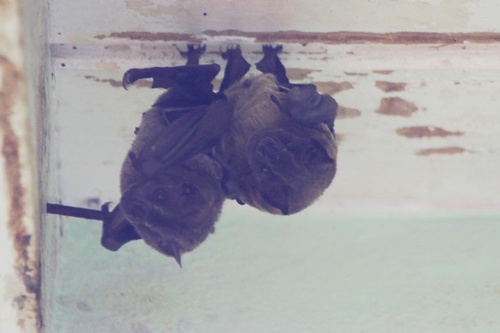
Likely forms small harem roost groups (one adult male, several females, and offspring) typical of many Artibeus species. Roosts are established in hollow trees, dense foliage clusters, or under large palm fronds, with group sizes generally ranging from 3 to 15 individuals.
When it is active
Strictly nocturnal. Primary foraging bouts occur shortly after dusk; a secondary foraging period may occur before dawn. Daytime is spent roosting communally in sheltered sites.
Diet
Predominantly frugivorous, with figs (Ficus spp.) likely forming a core dietary component, consistent with other Artibeus. Also consumes other soft tropical fruits; diet is occasionally supplemented with pollen, nectar, and invertebrates during periods of fruit scarcity.
How it feeds and hunts
Locates fruiting trees using a combination of echolocation and olfaction. Fruit is typically plucked in brief hovering flight or while clinging to vegetation, then transported to a nearby feeding roost (a branch or leaf away from the source) to be consumed, reducing predation risk.
Communication
Uses frequency-modulated (FM) ultrasonic echolocation for navigation and spatial awareness. Social communication includes audible high-pitched chirps and squeaks within roost groups. Scent produced by gular and dorsal glands may facilitate individual and colony-mate recognition.
Interactions with other species
Predated by owls (Tyto alba, Glaucidium spp.) and arboreal snakes. Competes for fruit resources with other frugivorous bats (e.g., Carollia, Sturnira species) and frugivorous birds. Maintains a mutualistic relationship with numerous plant species through seed dispersal, including pioneer trees important for forest recovery.
Role in its ecosystem
Plays a pivotal ecological role as a seed disperser of dozens of plant species, contributing significantly to forest regeneration and structural diversity in Pacific coastal forests. Its nightly foraging movements over large areas make it an efficient long-distance disperser relative to many other frugivores.
Reproduction and lifecycle
Likely exhibits bimodal polyestry (two birth peaks annually), timed to coincide with peaks in fruit abundance, as documented in most tropical Artibeus populations. Gestation lasts approximately 3–4 months, and litter size is one pup per birth event.
Raising the young
Females provide all direct parental care. Young pups are initially carried clinging to the mother's chest during foraging, then cached at the roost as they develop. Weaning is estimated to occur within 4–8 weeks of birth.
Maturity and lifespan
Sexual maturity is likely attained at approximately 6–12 months of age, consistent with other Artibeus species. Wild lifespan is estimated at 5–10 years; captive longevity data specific to A. fraterculus are unavailable.
Taxonomy and naming of the Fraternal Fruit-eating Bat
Classification
Mammalia > Chiroptera > Phyllostomidae > Artibeus > Artibeus fraterculus
Scientific synonyms
Historically treated as a subspecies under Artibeus jamaicensis fraterculus (Anthony, 1924) before being elevated to full species status based on morphological and molecular evidence. Placed within the Artibeus jamaicensis species complex.
What research says
Recent studies
Molecular phylogenetic and morphometric analyses conducted in the 2000s–2010s helped confirm A. fraterculus as a species distinct from A. jamaicensis, clarifying long-standing taxonomic uncertainty. Bioacoustic surveys along the Ecuadorian coast have begun characterizing its echolocation call parameters.
Genome and DNA
Specific karyotype data for A. fraterculus are not well established in the literature; related Artibeus species typically possess 2n = 30–31 chromosomes. Molecular phylogenetic studies of the A. jamaicensis complex have confirmed fraterculus as a valid, distinct species.
Compared with similar species
Most similar to Artibeus jamaicensis (Jamaican Fruit-eating Bat), which overlaps in some morphological characters but has a much broader distribution across the Neotropics. Artibeus lituratus (Great Fruit-eating Bat) is considerably larger. Artibeus obscurus (Dark Fruit-eating Bat) occupies Amazonian rather than Pacific-slope habitats and lacks prominent facial stripes.
The Fraternal Fruit-eating Bat and people
As one of the most effective 'flying gardeners' of the Ecuadorian coastal forests, a single individual may disperse seeds of dozens of plant species in a single night, traveling several kilometers from a fruiting tree. Its robust jaw muscles generate bite forces disproportionately large for its size, allowing it to process fruit that most smaller bats cannot access. Despite being a strict seed disperser by night, its role in regenerating deforested land makes it arguably more important to Pacific coastal forest recovery than many better-known wildlife species.
Where and how to see it
Best observed at dusk near fruiting fig trees or other fruit-laden vegetation in tropical dry forest of the Manabí coast of Ecuador or around Tumbes, Peru. Machalilla National Park (Ecuador) is a recommended site. Mist-netting surveys along forest-edge streams at night, conducted by licensed researchers, provide the most reliable encounters.
Risks to humans
No notable direct risk to humans under normal conditions. As with all wild bats, direct handling should be strictly avoided due to the theoretical risk of rabies transmission; contact should only be undertaken by trained researchers equipped with appropriate personal protective equipment.
Countries where the Fraternal Fruit-eating Bat is recorded
The 2 countries named in the range description of its IUCN Red List assessment.
Questions about the Fraternal Fruit-eating Bat
Where does the Fraternal Fruit-eating Bat live?
The Fraternal Fruit-eating Bat is recorded in Ecuador and Peru across South America. These countries come from the range description of its IUCN Red List assessment, and they are what place the species on the interactive map.
Is the Fraternal Fruit-eating Bat endangered?
The IUCN Red List assesses the Fraternal Fruit-eating Bat as Least Concern. The species is widespread and abundant enough not to qualify for any threatened category. It does not mean the species is safe forever, only that nothing in the current data raises an alarm.
How many are left in the wild?
No precise global population estimate exists. This figure comes from the species assessment on the IUCN Red List; population estimates for wild mammals are ranges, not counts, and are revised at each assessment.
What habitat does the Fraternal Fruit-eating Bat live in?
Primarily inhabits tropical dry forests and tropical moist (humid) forests along the Pacific coastal lowlands.
What is the scientific name of the Fraternal Fruit-eating Bat?
The Fraternal Fruit-eating Bat is Artibeus fraterculus, in the family Phyllostomidae, order Chiroptera.
Other species in the genus Artibeus
Other species in the family Phyllostomidae
Sources
Conservation status, range description and population estimate come from the IUCN Red List assessment for Artibeus fraterculus. Countries are derived from that range description, not from a mapped country list. Last refreshed on .
The distribution map is drawn from the IUCN Red List spatial data compiled in 2008. IUCN (International Union for Conservation of Nature)