
Central American Spider Monkey
Ateles geoffroyi
Red List assessment
Endangeredon the IUCN Red List
- EXExtinct
- EWExtinct in the Wild
- CRCritically Endangered
- ENEndangered
- VUVulnerable
- NTNear Threatened
- LCLeast Concern
The Central American Spider Monkey is recorded in 9 countries across North America and South America. The IUCN Red List assesses the Central American Spider Monkey as Endangered. No precise global census exists; estimates suggest fewer than 50,000 individuals remain across the entire range, with the population in continuous decline.
- Family
- Atelidae
- Order
- Primates
- Genus
- Ateles
- Countries recorded
- 9
- Continents
- North America and South America
- Red List category
- Endangered
- Data updated
- August 9, 2026
What is the Central American Spider Monkey?
The Central American Spider Monkey is a large New World primate inhabiting tropical and subtropical forests from southern Mexico to Panama. It is renowned for its extraordinarily long limbs and fully prehensile tail, which functions as a powerful fifth limb allowing near-acrobatic movement through the forest canopy. It lives in fission-fusion societies and is among the most frugivorous of all primates, playing a critical ecological role as a major seed disperser. Its charismatic nature and sensitivity to habitat disturbance make it a flagship species for tropical forest conservation.
Where does the Central American Spider Monkey live?
Southern Mexico, Guatemala, Belize, Honduras, El Salvador, Nicaragua, Costa Rica, Panama
Range extends from the states of Veracruz, Oaxaca, Chiapas, and the Yucatán Peninsula in southern Mexico through Guatemala, Belize, Honduras, El Salvador, Nicaragua, Costa Rica, and Panama. The species reaches its southernmost limit in northwestern Colombia in some classifications. Populations are now increasingly fragmented due to deforestation.
Altitude and depth
Typically found from sea level up to approximately 2,500 m elevation, though most populations inhabit lowland forests below 1,000 m. Higher-altitude populations exist in cloud forest remnants in Costa Rica and Guatemala.
Seasonal movements
No true migration or hibernation, but foraging ranges and group movements shift seasonally with fruit availability. During dry seasons or periods of fruit scarcity, individuals may travel farther and increase consumption of leaves, flowers, and bark. Activity patterns can also shift slightly with seasonal temperature changes.
Habitat of the Central American Spider Monkey
Primarily inhabits tall, undisturbed primary tropical rainforests and semi-evergreen forests; also found in dry deciduous forests and cloud forests. Strongly prefers intact forest with a continuous canopy and large fruiting trees. Highly sensitive to habitat fragmentation and avoids degraded or secondary forests when possible.
Adaptations to its environment
Possesses a fully prehensile tail with a naked, grip-sensitive underside that acts as a fifth limb, enabling suspension and brachiation at great heights. Extremely long, hook-like fingers (with vestigial or absent thumbs) are perfectly adapted for swinging between branches. Its large home range and frugivorous diet are matched by an enlarged brain region associated with spatial memory, helping it locate scattered fruit trees efficiently.
Conservation status and numbers
Listed as Endangered (EN) on the IUCN Red List since 2008. The species has undergone a population reduction estimated at over 50% during the past 45 years (approximately three generations) driven primarily by deforestation and hunting. Several subspecies are considered Critically Endangered individually, and the overall population trend is strongly declining.
Estimated population
No precise global census exists; estimates suggest fewer than 50,000 individuals remain across the entire range, with the population in continuous decline. Some individual subspecies, such as A. g. azuerensis and A. g. frontatus, may number only in the hundreds or low thousands.
What threatens the Central American Spider Monkey?
Massive and ongoing deforestation and forest fragmentation for cattle ranching, agriculture, and urban expansion are the primary threats. Hunting for bushmeat and the illegal pet trade (juveniles are captured by killing their mothers) constitute significant pressures. Low reproductive rate makes populations extremely vulnerable to any increase in adult mortality.
Diseases and parasites
Susceptible to various intestinal helminths (nematodes, cestodes) and ectoparasites (ticks, lice, bot flies). Yellow fever outbreaks (Flavivirus) have caused significant mortality in Neotropical primate populations including spider monkeys. Respiratory infections and parasitic protozoa (e.g., Trypanosoma) have been reported in both wild and captive individuals.
What is being done to protect it?
Protected within numerous national parks and reserves including Braulio Carrillo (Costa Rica), Montes Azules Biosphere Reserve (Mexico), Tikal National Park (Guatemala), and Cockscomb Basin (Belize). Listed under CITES Appendix II, restricting international trade. Several NGOs (e.g., Mesoamerican Biological Corridor project) work on habitat connectivity and local community education programs.
Recommended actions
Priority actions include expanding and connecting protected forest corridors across national borders to allow population exchange. Strict enforcement of hunting bans and anti-pet trade legislation is essential. Community-based ecotourism programs can provide economic alternatives to forest clearing. Long-term population monitoring and genetic diversity assessments across subspecies are urgently needed.
What the Central American Spider Monkey looks like
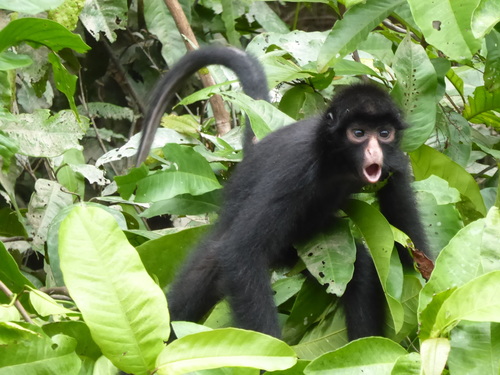
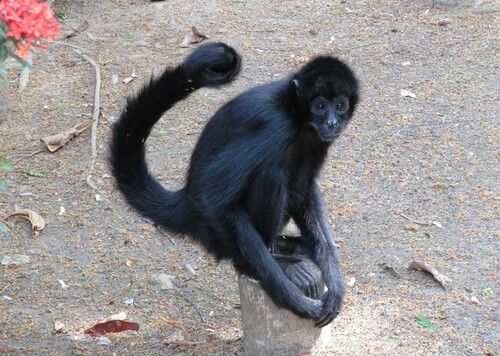
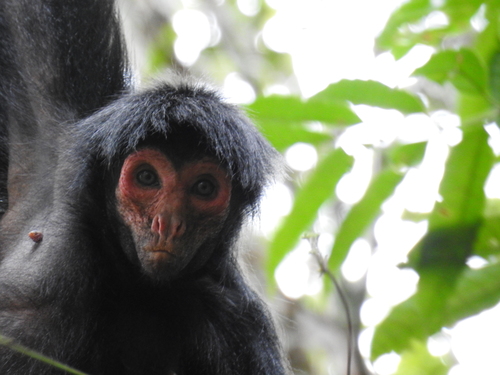
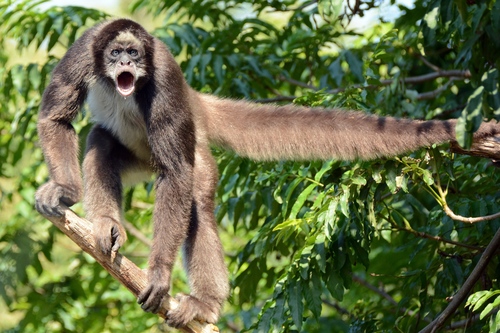
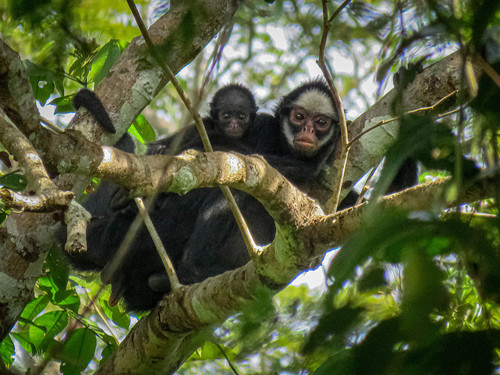
Fur coloration varies considerably among subspecies, ranging from black to dark brown, reddish-brown, or buff. The face is often pale, pink, or mottled with sparse dark hair, giving a distinctive bare-faced appearance. The limbs and tail are strikingly long and slender, giving the animal a spider-like silhouette when viewed hanging in the canopy.
Size
Head-body length: 38–63 cm; prehensile tail length: 63–85 cm, typically longer than the body. Standing height approximately 40–50 cm. Spider monkeys rank among the largest New World primates.
Weight
Adults typically weigh between 6 and 9 kg. Females average slightly lighter (around 6–7.5 kg) than males (around 7–9 kg), though sexual size dimorphism is modest.
Distinctive features
Distinguished from other Ateles species by geographic range (Central America) and by inter-subspecific variation in pelage color. Compared to the closely related Black Spider Monkey (A. paniscus), A. geoffroyi is smaller, has more variable coloration, and possesses a characteristically pale or mottled face. The near-absence of a thumb is a hallmark of the genus.
Differences between males and females
Sexual dimorphism is subtle; males are slightly heavier on average. Females possess an elongated clitoris that is often mistaken for a penis, making field sex determination challenging without behavioral observation. No significant differences in coloration or pelage between sexes.
Behaviour and diet of the Central American Spider Monkey
Lives in fission-fusion communities of 20–35 individuals that split into smaller foraging subgroups of 2–8 animals daily, rejoining at sleeping sites. Social bonds are flexible but females tend to be more solitary while males form coalitions. Dominance hierarchies exist but are relatively fluid compared to other primates.
When it is active
Strictly diurnal, with peak activity in the morning (foraging) and a rest period during midday heat. Animals spend the vast majority of their time in the upper and middle forest canopy. Sleeping sites are typically tall emergent trees used communally.
Diet
Highly frugivorous: ripe fruit constitutes approximately 70–90% of the diet. Supplements with young leaves, flowers, seeds, bark, and occasionally insects or small invertebrates. Favors large-seeded, fleshy fruits and can consume unripe or secondary compounds-rich fruits that other species avoid, thanks to specialized digestive physiology.
How it feeds and hunts
Not a hunter; foraging involves systematic traversal of large home ranges (up to 900 ha) using spatial memory to locate widely dispersed fruiting trees. Individuals may hang by the tail alone to access terminal branches too slender to support their weight, using freed hands and feet to harvest fruit simultaneously.
Communication
Repertoire includes a loud, far-carrying 'whiny' or scream used for long-distance group cohesion and alarm calls audible over 1 km. Chest-shaking branch displays and bark-dropping are used as threat signals. Scent glands on the chest are rubbed on branches to mark presence; facial expressions and embracing behaviors reinforce social bonds.
Interactions with other species
Main predators include harpy eagles (Harpia harpyja), ocelots (Leopardus pardalis), pumas (Puma concolor), and jaguars (Panthera onca). They produce distinctive alarm calls upon detecting raptors. They may compete for fruit resources with howler monkeys (Alouatta spp.) and white-faced capuchins (Cebus capucinus). Serve as important mutualists for large-seeded trees through endozoochorous seed dispersal.
Role in its ecosystem
Considered a keystone species and 'gardener of the forest' owing to their critical role as long-distance seed dispersers for large-seeded tropical trees. Their large home ranges mean seeds can be deposited far from parent trees, promoting forest regeneration and genetic diversity in plant populations. Local extinction of spider monkeys has been shown to alter forest structure and tree community composition.
Reproduction and lifecycle
No strict breeding season; births can occur throughout the year with a gestation period of approximately 226–232 days (~7.5 months). Females give birth to a single infant every 2.5–4 years, one of the lowest reproductive rates among primates. Births at night are most common.
Raising the young
The mother provides all direct care; infants cling ventrally for the first months and are carried dorsally as they grow. Nursing continues for up to 2 years and the mother-offspring bond remains strong for several years post-weaning. Fathers and other group members show little direct involvement in infant care.
Maturity and lifespan
Females reach sexual maturity at approximately 4–5 years and males at 4–5 years, though first successful reproduction typically occurs later. Lifespan in the wild is estimated at 25–30 years; individuals in captivity have lived up to 40 years or more.
Taxonomy and naming of the Central American Spider Monkey
Classification
Mammalia > Primates > Atelidae > Ateles > Ateles geoffroyi
Subspecies
Up to 8 subspecies recognized: A. g. geoffroyi (southern Mexico to Honduras), A. g. vellerosus (eastern Mexico), A. g. yucatanensis (Yucatán Peninsula), A. g. frontatus (Nicaragua, Costa Rica), A. g. ornatus (Costa Rica, southern range), A. g. azuerensis (Azuero Peninsula, Panama), A. g. panamensis (Panama, NW Colombia), A. g. grisescens (Panama). Taxonomy remains debated.
Scientific synonyms
Ateles pan (Schinz, 1821); Ateles vellerosus (Gray, 1866); Ateles frontatus (Gray, 1842); Ateles ornatus (Gray, 1870). Several subspecies have been elevated to or reduced from full species status in different classifications.
What research says
Recent studies
Recent studies using long-term field data from Costa Rica and Mexico have demonstrated that spider monkey seed dispersal is irreplaceable for certain large-seeded tree species. Research published in the 2010s–2020s has documented cultural transmission of foraging techniques between individuals. GPS-collar studies have revealed surprisingly large daily travel distances of up to 5 km and sophisticated spatial cognition in route planning.
Genome and DNA
Diploid chromosome number: 2n = 34. Phylogenomic studies have confirmed Atelidae as a monophyletic group within platyrrhines. Genetic analyses have highlighted significant divergence between subspecies, supporting arguments for treating some as distinct species and underlining the conservation urgency of protecting individual populations.
Compared with similar species
Closely related to the Black Spider Monkey (A. paniscus) of South America, which is larger and uniformly black. The White-bellied Spider Monkey (A. belzebuth) also shares the long prehensile tail but has distinctive pale underparts and occupies Amazonian forests. Compared to Howler Monkeys (Alouatta), spider monkeys are faster, more agile, less folivorous, and require larger, intact forest areas.
The Central American Spider Monkey and people
Spider monkeys can hang by their prehensile tail alone—strong enough to support their full body weight—leaving all four limbs free to grasp food, an ability almost unmatched among primates. Despite having only four functional fingers per hand (the thumb is vestigial or absent), they are among the most acrobatic and swift-moving primates in the canopy. When a spider monkey detects a predator, it may deliberately drop or shake heavy branches onto the intruder below as an active defensive tactic.
Where and how to see it
Best observed in Braulio Carrillo National Park, Corcovado National Park, and Tortuguero (Costa Rica), Tikal National Park (Guatemala), and the Lacandon Jungle (Chiapas, Mexico). Early mornings (6:00–9:00 AM) are optimal when animals are actively foraging in the upper canopy. A skilled local guide and patience are essential, as groups can be heard calling from a distance before being spotted; binoculars and a wide-angle scope are recommended.
Risks to humans
No notable risk to humans under normal circumstances. When cornered or stressed, individuals may bite or scratch, and captive animals can be unpredictable. Wild spider monkeys sometimes drop branches on perceived threats below, but direct attacks on humans are extremely rare.
Human uses
Historically and in some rural areas still today, hunted for bushmeat, representing a significant source of protein for indigenous and local communities. Juveniles are frequently captured for the illegal pet trade across Central America. Subject of ecotourism, contributing economically to local communities in protected areas. Featured in biomedical research (historical) and studied extensively for insights into primate cognition and forest ecology.
Myths and legends
In ancient Maya cosmology, spider monkeys (often depicted alongside howler monkeys) were associated with writing, arts, and the arts of creation; the Hero Twin Hunahpu is transformed into a spider monkey in the Popol Vuh. In many indigenous Mesoamerican communities, spider monkeys are considered forest spirits or guardians of the jungle canopy. Their haunting vocalizations at dawn have contributed to various local legends of forest spirits.
Countries where the Central American Spider Monkey is recorded
The 9 countries named in the range description of its IUCN Red List assessment.
Questions about the Central American Spider Monkey
Where does the Central American Spider Monkey live?
The Central American Spider Monkey is recorded in Belize, Colombia, Costa Rica, El Salvador and Guatemala, among 9 countries in total across North America and South America. These countries come from the range description of its IUCN Red List assessment, and they are what place the species on the interactive map.
Is the Central American Spider Monkey endangered?
Yes. The IUCN Red List assesses the Central American Spider Monkey as Endangered, one of the three threatened categories. The species faces a very high risk of extinction in the wild — a step below Critically Endangered, but still on a trajectory that ends badly without intervention.
How many are left in the wild?
No precise global census exists; estimates suggest fewer than 50,000 individuals remain across the entire range, with the population in continuous decline. This figure comes from the species assessment on the IUCN Red List; population estimates for wild mammals are ranges, not counts, and are revised at each assessment.
What habitat does the Central American Spider Monkey live in?
Primarily inhabits tall, undisturbed primary tropical rainforests and semi-evergreen forests; also found in dry deciduous forests and cloud forests.
What is the scientific name of the Central American Spider Monkey?
The Central American Spider Monkey is Ateles geoffroyi, in the family Atelidae, order Primates.
Other species in the genus Ateles
Other species in the family Atelidae
Sources
Conservation status, range description and population estimate come from the IUCN Red List assessment for Ateles geoffroyi. Countries are derived from that range description, not from a mapped country list. Last refreshed on .
The distribution map is drawn from the IUCN Red List spatial data compiled in 2020. IUCN (International Union for Conservation of Nature)