
Southern Muriqui
Brachyteles arachnoides
Red List assessment
Critically Endangeredon the IUCN Red List
- EXExtinct
- EWExtinct in the Wild
- CRCritically Endangered
- ENEndangered
- VUVulnerable
- NTNear Threatened
- LCLeast Concern
The Southern Muriqui is recorded in one country, Brazil across South America. The IUCN Red List assesses the Southern Muriqui as Critically Endangered. Fewer than 1,000 individuals remain in the wild, with a continuing declining trend across most fragmented populations.
- Family
- Atelidae
- Order
- Primates
- Genus
- Brachyteles
- Countries recorded
- 1
- Continents
- South America
- Red List category
- Critically Endangered
- Data updated
- August 9, 2026
What is the Southern Muriqui?
The Southern Muriqui is the largest primate native to the Americas and one of the most endangered, endemic to the highly fragmented Atlantic Forest of southeastern Brazil. Known for its slender spider-monkey-like build and remarkably peaceful, egalitarian social structure, it is considered a flagship species for Atlantic Forest conservation. Its prehensile tail and long limbs make it a highly specialized arboreal frugivore. It is critically endangered due to massive habitat loss.
Where does the Southern Muriqui live?
Brazil (Atlantic Forest of São Paulo, Paraná, and Rio de Janeiro states)
Restricted to remnant fragments of the Atlantic Forest in southeastern Brazil, primarily in São Paulo, Paraná, and parts of Rio de Janeiro states; historically ranged more broadly but now occurs in isolated, disjunct populations.
Altitude and depth
0-1200 m above sea level
Seasonal movements
No true migration or hibernation; exhibits seasonal shifts in diet according to fruit and leaf availability, with increased leaf consumption during fruit-scarce months.
Habitat of the Southern Muriqui
Primary and secondary tropical/subtropical humid Atlantic Forest with continuous canopy cover; also found in semi-deciduous forest fragments. Requires large tracts of undisturbed forest with diverse fruiting tree species for survival.
Adaptations to its environment
Highly prehensile tail acts as a fifth limb for suspensory locomotion and feeding in the forest canopy; long arms and reduced thumb aid arboreal movement; digestive system adapted to process both ripe fruit and mature leaves.
Conservation status and numbers
Critically Endangered (IUCN) due to a population decline exceeding 80% over the past three generations, driven primarily by habitat destruction and historical hunting; listed on CITES Appendix I.
Estimated population
Fewer than 1,000 individuals remain in the wild, with a continuing declining trend across most fragmented populations.
What threatens the Southern Muriqui?
Severe habitat loss and fragmentation from agriculture, urban expansion, and logging; poaching for bushmeat; small, isolated population sizes leading to genetic bottlenecks; low reproductive rate limiting recovery.
Diseases and parasites
Susceptible to gastrointestinal parasites and yellow fever outbreaks, which have caused notable population declines in affected fragments.
What is being done to protect it?
Protected under Brazilian federal law; conservation efforts include the Muriqui Preservation Program, habitat corridors linking forest fragments, and protected areas such as Carlos Botelho State Park and Serra do Mar State Park; captive breeding and reintroduction programs are also underway.
Recommended actions
Expand and connect protected forest fragments via ecological corridors; strengthen anti-poaching enforcement; support long-term population monitoring; engage local communities in forest restoration and ecotourism initiatives.
What the Southern Muriqui looks like
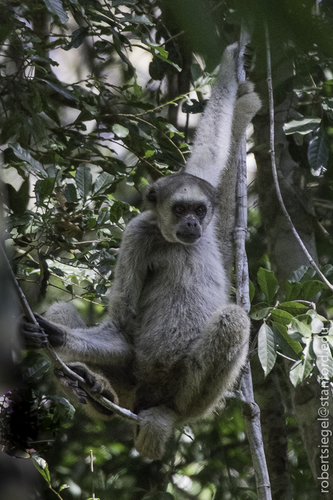
Fur is thick and typically gray to golden-brown, sometimes with a reddish or blackish face; the face may show pigmented blotches that vary between individuals. Limbs and tail are long and slender, adapted for suspensory locomotion.
Size
Body length (head to rump) 46-63 cm, with tail length of 70-80 cm, making total length up to 1.4 m.
Weight
Adults typically weigh 9-15 kg, with males generally slightly heavier than females.
Distinctive features
Distinguished from the Northern Muriqui (Brachyteles hypoxanthus) by generally darker coloring and different genital pigmentation patterns; lacks the thumb reduction seen in some other atelids to a lesser degree than spider monkeys.
Differences between males and females
Minimal sexual dimorphism in size and coloration; males are only slightly larger than females, consistent with the species' low level of intrasexual competition.
Behaviour and diet of the Southern Muriqui
Lives in large, cohesive multi-male/multi-female groups of up to 80 individuals, though subgroups often forage separately; social structure is notably egalitarian with low aggression and female philopatry-based bonding is rare, as males tend to remain in natal groups.
When it is active
Diurnal, with activity concentrated in daytime hours; spends significant time resting and socializing during midday heat, most active in early morning and late afternoon.
Diet
Primarily frugivorous, supplemented by young leaves, flowers, and occasionally bark; diet shifts toward leaves when fruit is scarce, making it a flexible folivore-frugivore.
Communication
Communicates through a variety of vocalizations including whinnies, barks, and long calls used for group coordination and contact over distance; also uses body postures and physical contact such as embracing.
Interactions with other species
Few natural predators remain due to loss of large forest carnivores, though birds of prey and occasionally large snakes may threaten infants; competes minimally with other primates due to specialized diet and habitat use.
Role in its ecosystem
Plays a crucial ecological role as a seed disperser for large-seeded Atlantic Forest tree species, contributing significantly to forest regeneration and plant diversity.
Reproduction and lifecycle
Breeding is not strictly seasonal but may peak during certain months; gestation lasts about 7.5 months, producing a single offspring; females experience long inter-birth intervals of 2-3 years.
Raising the young
Mothers provide extensive, prolonged care, carrying infants continuously for the first few months and nursing for over a year; alloparental behavior and cooperative interactions within the group support infant development.
Maturity and lifespan
Females reach sexual maturity around 6-8 years, males slightly later; lifespan in the wild is estimated at 20-25 years, with captive individuals occasionally living longer.
Taxonomy and naming of the Southern Muriqui
Classification
Class Mammalia > Order Primates > Family Atelidae > Genus Brachyteles > Species Brachyteles arachnoides
Scientific synonyms
Ateles arachnoides; Brachyteles arachnoides arachnoides
What research says
Recent studies
Recent research has focused on population genetics across fragmented habitats, revealing significant genetic differentiation and informing corridor-based conservation strategies; behavioral studies continue to document the species' unusually peaceful social system.
Genome and DNA
Diploid chromosome number is 2n=48; genetic studies have revealed low genetic diversity in several isolated populations, raising concerns about inbreeding depression.
Compared with similar species
Closely related to the Northern Muriqui, from which it was only formally split as a distinct species in the 1990s based on morphological and genetic differences; both species share the unique egalitarian social system rare among primates, contrasting with more hierarchical New World monkeys like capuchins.
The Southern Muriqui and people
Muriquis are sometimes called 'gentle giants' of the New World primates due to their large size and notably low levels of aggression; they engage in frequent embracing behavior as a form of social bonding; males in this species lack the typical primate pattern of male dominance hierarchies.
Where and how to see it
Best observed in protected reserves such as Carlos Botelho State Park or Legado das Águas in São Paulo state, particularly in early morning hours during guided ecotourism tours with local conservation organizations.
Risks to humans
No notable risk to humans; the species is shy and avoids human contact, posing no threat of aggression or disease transmission under normal circumstances.
Human uses
Historically hunted for bushmeat by local communities, though this practice has significantly declined due to conservation awareness and legal protections; currently valued mainly for ecotourism and scientific research.
Myths and legends
Considered a symbol of the Atlantic Forest's biodiversity in Brazilian conservation culture, though it lacks widespread indigenous mythology compared to other Neotropical primates.
Countries where the Southern Muriqui is recorded
The 1 countries named in the range description of its IUCN Red List assessment.
Questions about the Southern Muriqui
Where does the Southern Muriqui live?
The Southern Muriqui is recorded in Brazil across South America. These countries come from the range description of its IUCN Red List assessment, and they are what place the species on the interactive map.
Is the Southern Muriqui endangered?
Yes. The IUCN Red List assesses the Southern Muriqui as Critically Endangered, one of the three threatened categories. The species faces an extremely high risk of extinction in the wild. This is the last category before extinction, and it is reached through a very small or steeply declining population, a tiny range, or both.
How many are left in the wild?
Fewer than 1,000 individuals remain in the wild, with a continuing declining trend across most fragmented populations. This figure comes from the species assessment on the IUCN Red List; population estimates for wild mammals are ranges, not counts, and are revised at each assessment.
What habitat does the Southern Muriqui live in?
Primary and secondary tropical/subtropical humid Atlantic Forest with continuous canopy cover; also found in semi-deciduous forest fragments.
What is the scientific name of the Southern Muriqui?
The Southern Muriqui is Brachyteles arachnoides, in the family Atelidae, order Primates.
Other species in the genus Brachyteles
Other species in the family Atelidae
Species that share its range
Sources
Conservation status, range description and population estimate come from the IUCN Red List assessment for Brachyteles arachnoides. Countries are derived from that range description, not from a mapped country list. Last refreshed on .
The distribution map is drawn from the IUCN Red List spatial data compiled in 2019. IUCN (International Union for Conservation of Nature)