
White-bellied Spider Monkey
Ateles belzebuth
Red List assessment
Endangeredon the IUCN Red List
- EXExtinct
- EWExtinct in the Wild
- CRCritically Endangered
- ENEndangered
- VUVulnerable
- NTNear Threatened
- LCLeast Concern
The White-bellied Spider Monkey is recorded in 5 countries across South America. The IUCN Red List assesses the White-bellied Spider Monkey as Endangered. No precise global population estimate is available; the population trend is clearly and continuously declining.
- Family
- Atelidae
- Order
- Primates
- Genus
- Ateles
- Countries recorded
- 5
- Continents
- South America
- Red List category
- Endangered
- Data updated
- August 9, 2026
What is the White-bellied Spider Monkey?
The White-bellied Spider Monkey (Ateles belzebuth) is a large New World primate endemic to the tropical rainforests of northern South America. It is named for its distinctive pale or whitish ventral surface contrasting with its dark dorsal fur, and bears a pale triangular forehead patch. The species possesses extremely long limbs and a powerful, bare-tipped prehensile tail that functions as a fifth limb, enabling spectacular acrobatic brachiation through the forest canopy. It is considered a keystone frugivore and one of the most critical seed dispersers in Amazonian and Andean foothill ecosystems.
Where does the White-bellied Spider Monkey live?
Northern South America: eastern Colombia, southern Venezuela, eastern Ecuador, northeastern Peru, and northwestern Brazil (Amazonas and Roraima states)
Eastern and southeastern Colombia (Orinoco and upper Amazon basins), southern and southeastern Venezuela (Bolívar, Amazonas states), eastern Ecuador (Amazon lowlands), northeastern Peru, and the northwestern Brazilian Amazon north and south of the Amazon River in parts of Amazonas and Roraima states.
Altitude and depth
Primarily found from sea level to approximately 1,500 m elevation; occasionally reported up to 2,500 m in montane forest margins along Andean foothills.
Seasonal movements
No true seasonal migration; however, home range usage and subgroup composition shift seasonally in response to fruit availability. During periods of fruit scarcity, individuals expand their ranging areas and increase consumption of leaves, flowers, and bark as fallback foods.
Habitat of the White-bellied Spider Monkey
Primary and mature secondary tropical rainforests, including lowland Amazonian terra firme forest, várzea (seasonally flooded forest), and submontane forests up to mid-elevation. The species is highly sensitive to habitat disturbance and fragmentation, requiring large, contiguous forest tracts to maintain viable home ranges.
Adaptations to its environment
Functional thumbs are vestigial or absent, creating a hook-like hand ideal for high-speed brachiation. The prehensile tail has a bare, friction-padded ventral surface capable of supporting the entire body weight, effectively acting as a fifth limb. Exceptionally long arms and legs (limb-to-body ratio among the highest of any primate) facilitate rapid canopy movement. Advanced spatial memory and color vision aid in locating ripe fruit across vast home ranges.
Conservation status and numbers
Endangered (EN) on the IUCN Red List. The species qualifies as Endangered due to an estimated population decline exceeding 50% over the past three generations (approximately 45 years), driven primarily by large-scale habitat destruction and sustained hunting pressure throughout its range.
Estimated population
No precise global population estimate is available; the population trend is clearly and continuously declining. Significant local extinctions have been recorded across Colombia and Venezuela, and remaining populations are highly fragmented.
What threatens the White-bellied Spider Monkey?
Primary threats include large-scale deforestation for cattle ranching, coca cultivation, oil palm expansion, and illegal logging. Infrastructure development (roads, pipelines) opens previously inaccessible forest. Hunting for bushmeat and capture of infants for the illegal pet trade (often requiring killing the mother) further reduce populations. Habitat fragmentation isolates populations and suppresses gene flow.
Diseases and parasites
Susceptible to yellow fever virus, which has caused significant mass mortality events in some populations. Known to harbor intestinal parasites including nematodes (Trichospirura sp., Prosthenorchis elegans) and protozoa. Human-associated diseases including measles, herpesvirus infections, and respiratory pathogens represent growing anthropogenic health risks due to increased forest-human contact.
What is being done to protect it?
Protected within several national parks and reserves including Yasuní National Park (Ecuador), Serranía de la Macarena National Park (Colombia), and various Amazonian protected areas in Venezuela and Brazil. Listed on CITES Appendix II, regulating international trade. Community-based conservation and monitoring programs operate in Ecuador and parts of Colombia.
Recommended actions
Priority actions include expanding and enforcing protected area networks, establishing wildlife corridors between fragmented habitat patches, implementing and enforcing anti-poaching laws, reducing deforestation through sustainable land-use policies and payments for ecosystem services, and conducting regular population and genetic monitoring.
What the White-bellied Spider Monkey looks like
The dorsal pelage is dark brown to black, while the ventral surface (belly, inner limbs, and chest) is pale cream, buff, or white — the trait giving the species its common name. A pale or white triangular patch is typically present on the forehead. The face is bare with pinkish to dark brownish skin, and the eyes are large, dark, and forward-facing. The limbs are slender and elongated, and the long prehensile tail has a hairless, callused ventral patch near the tip.
Size
Head-body length: 34–59 cm; tail length: 63–92 cm (consistently exceeds body length). Total length including tail can reach 150 cm. Limbs are disproportionately long relative to body size.
Weight
Adults typically weigh 6–9 kg; slight sexual dimorphism with males averaging marginally heavier than females, though overlap is substantial.
Distinctive features
Distinguished from Ateles paniscus (Red-faced Spider Monkey) by the pale belly and absence of the intensely red facial skin. Distinguished from Ateles chamek (Black-faced Black Spider Monkey) by the pale ventral coloration; A. chamek is entirely black. Distinguished from Ateles hybridus by range overlap and more consistent pale belly without the brown-headed coloration typical of hybridus.
Differences between males and females
Sexual dimorphism in size is minimal; males are only slightly larger on average. The clitoris of females is notably elongated and pendulous, superficially resembling a penis — a characteristic shared across all Ateles species that can cause confusion in field sex identification.
Behaviour and diet of the White-bellied Spider Monkey
Lives in fission-fusion societies with large communities typically comprising 20–35 individuals that regularly partition into flexible foraging subgroups of 2–8 animals. Social bonds are complex, with females often dispersing between groups while males maintain stronger within-group associations. Community cohesion is maintained through long-range vocalizations.
When it is active
Strictly diurnal. Peak activity occurs in the early morning (06:00–10:00) for feeding and again in the late afternoon (15:00–18:00). A midday resting period is typical. Groups return to favored sleeping trees at dusk, often congregating in larger aggregations overnight.
Diet
Predominantly frugivorous; ripe, fleshy fruits constitute 60–90% of the diet depending on season. The diet is supplemented with young leaves, flowers, seeds, bark, and occasionally insects or small vertebrates. The species preferentially consumes large, rare, or high-quality fruits that many smaller primates cannot process.
How it feeds and hunts
As a primarily frugivorous species, A. belzebuth forages rather than hunts. It exploits an extensive spatial memory to locate and revisit known fruit trees across large home ranges (often 200–400 ha), and uses fission-fusion subgrouping to efficiently exploit patchily distributed and ephemeral fruit resources.
Communication
Possesses a rich vocal repertoire including loud, far-carrying 'whinny' screams used for long-distance group coordination, barks, and alarm calls responding to aerial and terrestrial predators. Scent glands on the sternum and anogenital region are used in social communication and territory advertisement. Body postures, embracing, and facial expressions supplement acoustic signals.
Interactions with other species
Principal predators include the harpy eagle (Harpia harpyja), jaguar (Panthera onca), puma (Puma concolor), and large constrictors such as the green anaconda. May compete for fruit resources with woolly monkeys (Lagothrix spp.), tapirs, and large parrots. Acts as a critical mutualistic seed disperser for large-seeded Amazonian trees, transporting seeds far from parent trees in an intact digestive system.
Role in its ecosystem
Considered a keystone species in tropical forest ecosystems due to its role as a megafaunal seed disperser. The loss of spider monkeys contributes directly to 'empty forest syndrome,' in which large-seeded, ecologically dominant tree species fail to regenerate, altering forest composition and reducing long-term carbon storage capacity.
Reproduction and lifecycle
Births can occur year-round with potential seasonal peaks linked to fruit availability. Gestation lasts approximately 226–232 days (about 7.5 months). Females bear a single offspring per birth. Inter-birth intervals are typically 2.5–3.5 years, yielding a very low reproductive rate characteristic of the genus.
Raising the young
Maternal care is the sole parental investment. Infants cling to the mother's ventrum for the first few months and transition to dorsal riding. Nursing continues for 12–20 months. Young individuals remain closely associated with the mother for several years, learning foraging routes, social interactions, and spatial knowledge of the home range.
Maturity and lifespan
Females reach sexual maturity at approximately 4–5 years; males at 4–6 years. In the wild, individuals may live 20–27 years; captive specimens have survived up to 33 years, with longevity supported by controlled diet and absence of predation.
Taxonomy and naming of the White-bellied Spider Monkey
Classification
Mammalia > Primates > Atelidae > Ateles > Ateles belzebuth
Subspecies
Ateles belzebuth is currently treated as monotypic following taxonomic revisions; former subspecies A. b. hybridus (Variegated Spider Monkey) and A. b. chamek (Black-faced Black Spider Monkey) have been elevated to full species status.
Scientific synonyms
Simia belzebuth É. Geoffroy Saint-Hilaire, 1806; Ateles variegatus; previously synonymized with Ateles hybridus in some earlier classifications.
What research says
Recent studies
Recent ecological modeling studies (2018–2023) have quantified A. belzebuth's irreplaceable role in dispersing large-seeded, high-biomass tree species, demonstrating that its local extinction reduces forest carbon capture potential significantly. Population genetics research has revealed critically low genetic diversity and strong fragmentation effects in Colombian and Venezuelan populations.
Genome and DNA
Diploid chromosome number: 2n = 34, one of the lowest chromosome counts among New World primates. Molecular phylogenetic studies confirm A. belzebuth as distinct from its congeners and support the current genus-level taxonomy of Ateles.
Compared with similar species
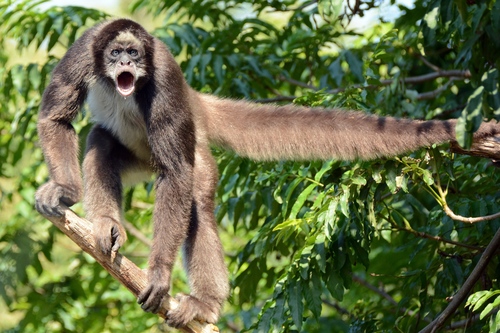
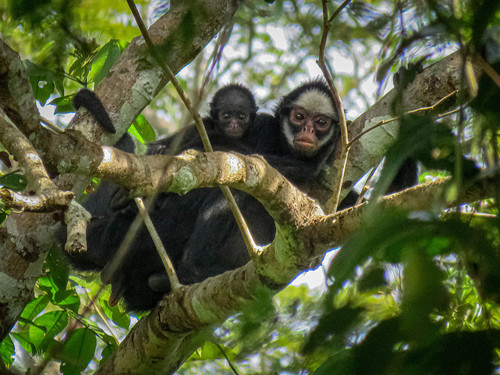
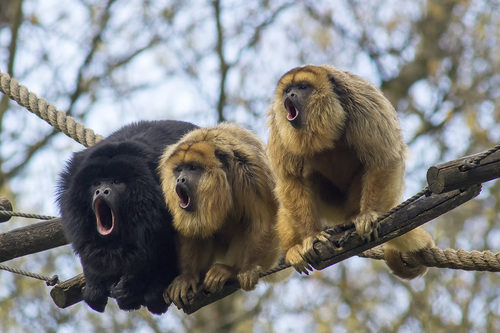
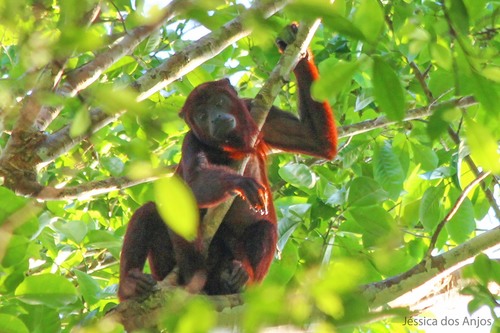
Most closely related to other members of genus Ateles: A. geoffroyi (Geoffroy's Spider Monkey, Central America), A. paniscus (Red-faced Spider Monkey, Guiana Shield), A. chamek (Black-faced Spider Monkey, central Amazon), A. hybridus (Variegated Spider Monkey, northern Colombia/Venezuela), and A. fusciceps (Brown-headed Spider Monkey, Pacific Colombia/Ecuador). Compared to woolly monkeys (Lagothrix spp.), spider monkeys are more slender, lack functional thumbs, and rely on brachiation rather than climbing. Compared to howler monkeys (Alouatta spp.), spider monkeys are considerably more agile and frugivorous.
The White-bellied Spider Monkey and people
Spider monkeys have no functional thumbs — an evolutionary trade-off that allows faster, more fluid brachiation by creating an unobstructed hook-like hand for swinging at high speed through the canopy. Their prehensile tail is so muscular and sensitive that it can independently support the full body weight, and the bare ventral tip has tactile sensitivity comparable to fingertips. Due to their exceptionally low reproductive rate, a wild female White-bellied Spider Monkey may produce as few as 4–6 surviving offspring over her entire lifetime — making every individual's survival critically important to population viability.
Where and how to see it
Best observed in Yasuní National Park (Ecuador), where population densities are relatively high and habitats remain intact — early morning visits (06:00–09:00) yield the highest encounter rates when animals are actively foraging in the upper canopy. The Serranía de la Macarena National Park in Colombia and the protected areas of the Venezuelan Amazon (Amazonas state) also offer opportunities. A local guide experienced in primate tracking and knowledge of seasonal fruiting patterns is strongly recommended for maximizing observations.
Risks to humans
No notable risk to humans under natural conditions. Bites may occur if individuals are handled or cornered. As with all non-human primates, there is a theoretical risk of zoonotic disease transmission (e.g., herpesvirus, yellow fever) upon close or direct contact.
Human uses
Historically and currently hunted for bushmeat by indigenous and rural communities across its range, representing one of the most significant local threats. Infants are frequently captured for the illegal pet trade, typically requiring the killing of the mother. Not substantially used in traditional medicine. Due to physiological and genetic proximity to humans, spider monkeys have occasionally been subjects of biomedical and neurological research, though this is less common than for Old World primates.
Myths and legends
Among various indigenous Amazonian and Orinoco basin peoples, spider monkeys are associated with agility, the forest canopy realm, and spiritual guardianship of the forest. Their humanlike hands, social complexity, and apparent intelligence have made them figures in local folklore about the boundary between human and animal worlds. In some traditions they are considered ancestors or transformational beings, and hunting them is subject to ritual restrictions.
Countries where the White-bellied Spider Monkey is recorded
The 5 countries named in the range description of its IUCN Red List assessment.
Questions about the White-bellied Spider Monkey
Where does the White-bellied Spider Monkey live?
The White-bellied Spider Monkey is recorded in Brazil, Colombia, Ecuador, Peru and Venezuela across South America. These countries come from the range description of its IUCN Red List assessment, and they are what place the species on the interactive map.
Is the White-bellied Spider Monkey endangered?
Yes. The IUCN Red List assesses the White-bellied Spider Monkey as Endangered, one of the three threatened categories. The species faces a very high risk of extinction in the wild — a step below Critically Endangered, but still on a trajectory that ends badly without intervention.
How many are left in the wild?
No precise global population estimate is available; the population trend is clearly and continuously declining. This figure comes from the species assessment on the IUCN Red List; population estimates for wild mammals are ranges, not counts, and are revised at each assessment.
What habitat does the White-bellied Spider Monkey live in?
Primary and mature secondary tropical rainforests, including lowland Amazonian terra firme forest, várzea (seasonally flooded forest), and submontane forests up to mid-elevation.
What is the scientific name of the White-bellied Spider Monkey?
The White-bellied Spider Monkey is Ateles belzebuth, in the family Atelidae, order Primates.
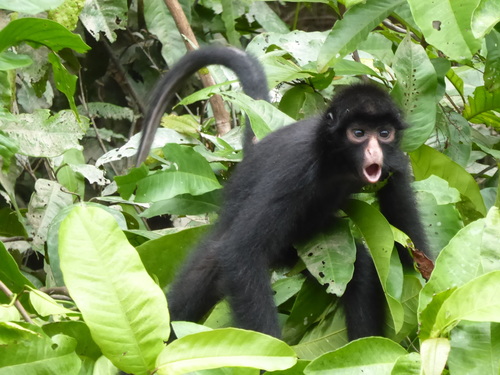
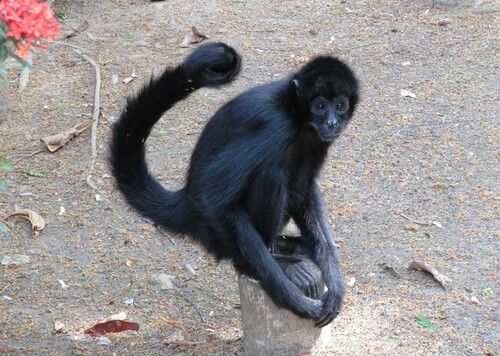
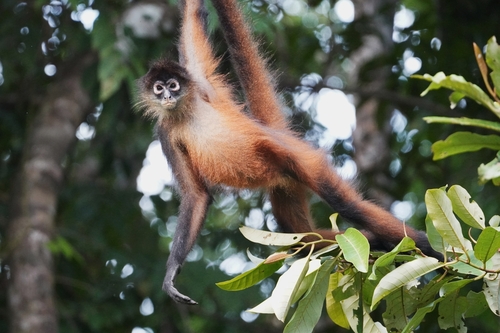
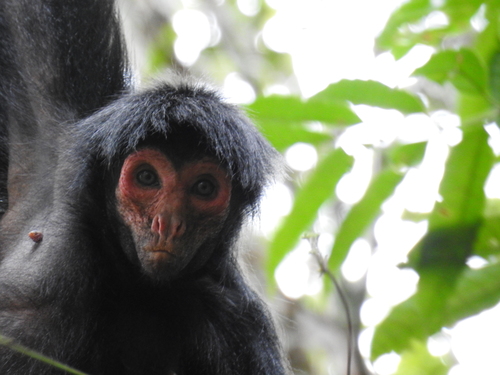
Other species in the genus Ateles
Other species in the family Atelidae
Sources
Conservation status, range description and population estimate come from the IUCN Red List assessment for Ateles belzebuth. Countries are derived from that range description, not from a mapped country list. Last refreshed on .
The distribution map is drawn from the IUCN Red List spatial data compiled in 2019. IUCN (International Union for Conservation of Nature)