
Juruá Red Howler Monkey
Alouatta juara
Red List assessment
Least Concernon the IUCN Red List
- EXExtinct
- EWExtinct in the Wild
- CRCritically Endangered
- ENEndangered
- VUVulnerable
- NTNear Threatened
- LCLeast Concern
The Juruá Red Howler Monkey is recorded in 3 countries across South America. The IUCN Red List assesses the Juruá Red Howler Monkey as Least Concern. No precise global population estimate is available for this species specifically.
- Family
- Atelidae
- Order
- Primates
- Genus
- Alouatta
- Countries recorded
- 3
- Continents
- South America
- Red List category
- Least Concern
- Data updated
- August 9, 2026
What is the Juruá Red Howler Monkey?
The Juruá Red Howler Monkey is a large Neotropical primate endemic to the western Amazon basin of Brazil, named after the Juruá River that defines much of its range. Like all howler monkeys, it is remarkable for its extraordinarily loud vocalizations produced by a greatly enlarged hyoid bone, which can be heard several kilometers through dense rainforest. It is primarily folivorous, playing a key ecological role in nutrient cycling and seed dispersal in Amazonian ecosystems. The species was recognized as taxonomically distinct from the broader Alouatta seniculus complex only in the early 2000s, and remains one of the less-studied members of its genus.
Where does the Juruá Red Howler Monkey live?
Western Brazilian Amazon, primarily in the Juruá River basin in Amazonas state, Brazil; possibly extending into adjacent areas of northeastern Peru and southeastern Colombia
Primarily distributed in Amazonas state, Brazil, within the interfluvial region between the Juruá and Solimões (upper Amazon) rivers. The range is thought to extend westward toward the Peruvian border. Its boundaries are largely defined by major Amazonian rivers, which act as natural biogeographic barriers typical for Alouatta species.
Altitude and depth
Typically found at low altitudes from near sea level up to approximately 500 m, consistent with the flat lowland terrain of the western Amazon basin.
Seasonal movements
No major seasonal migrations are documented. Dietary composition may shift slightly with seasonal availability of fruits versus leaves. Activity levels can vary with the wet and dry seasons of the Amazon, but the species is resident year-round in its range.
Habitat of the Juruá Red Howler Monkey
Occupies lowland tropical rainforest, seasonally flooded várzea forest, and terra firme (non-flooded upland) forest in the western Amazon basin. It is highly dependent on continuous forest cover and shows a preference for the forest canopy and subcanopy layers where foliage is abundant.
Adaptations to its environment
Possesses a massively enlarged hyoid bone forming a resonating chamber that amplifies vocalizations for long-distance communication through dense forest. The prehensile tail acts as a fifth limb for secure movement through the canopy. Its highly specialized gut with an enlarged cecum enables efficient fermentation and digestion of mature, often toxic, leaves that most animals cannot utilize.
Conservation status and numbers
Listed as Least Concern (LC) by the IUCN, reflecting a currently stable population with no detected rapid decline over three generations. However, the assessment notes that ongoing deforestation in the Brazilian Amazon poses a long-term risk, and the species' restricted range makes it potentially vulnerable to future habitat loss.
Estimated population
No precise global population estimate is available for this species specifically. The population is considered stable but potentially declining in areas subject to intense deforestation pressure.
What threatens the Juruá Red Howler Monkey?
Primary threats include deforestation and forest fragmentation for agriculture (particularly soy expansion and cattle ranching), illegal logging, and infrastructure development (roads, hydroelectric projects) in the Amazon. Hunting for bushmeat occurs locally. Habitat loss is accelerating due to fire and land conversion in the southern and eastern portions of the Amazon.
Diseases and parasites
Susceptible to yellow fever virus, which has caused mass mortality events in howler monkey populations across South America. Various gastrointestinal parasites (nematodes, protozoans) are documented in the genus Alouatta. Bot fly larvae (Cuterebra sp.) are also reported as parasites in howler monkeys.
What is being done to protect it?
The species benefits from its presence within Brazilian federal protected areas and indigenous territories in Amazonas state, including portions of the Juruá extractive reserves. Brazilian federal law (SNUC - National System of Conservation Units) provides a framework for habitat protection. Monitoring is partly covered under broader Amazon biodiversity surveillance programs.
Recommended actions
Priority actions include expanding and strengthening protected area networks in the Juruá River basin, conducting dedicated population surveys to refine range and abundance estimates, enforcing anti-deforestation legislation (Brazil's Forest Code), and supporting sustainable land-use practices in indigenous and riverine communities adjacent to its habitat.
What the Juruá Red Howler Monkey looks like
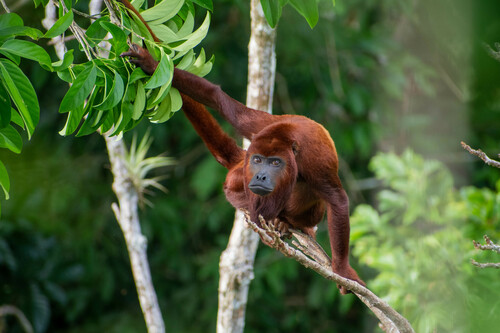
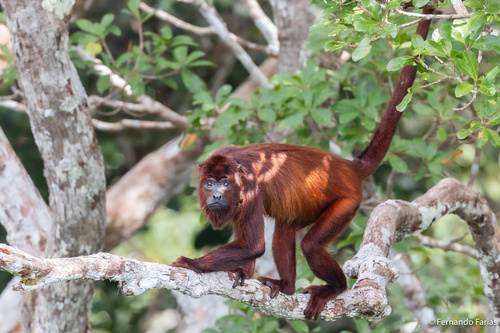
Adults display a reddish-brown to golden-rufous pelage characteristic of the red howler monkey group, with a slightly paler ventral surface. The face is bare and dark-skinned. The tail is long and fully prehensile with a naked gripping pad on its underside. The body is robust and stocky with a notably enlarged throat region housing the hyoid apparatus.
Size
Head-body length approximately 46–72 cm in adults; prehensile tail adds another 49–75 cm. Males are substantially larger than females.
Weight
Males typically weigh 6–9 kg; females typically weigh 4–6 kg, showing marked sexual dimorphism.
Distinctive features
Distinguished from other members of the Alouatta seniculus complex primarily by geographic range (bounded by the Juruá and Solimões rivers) and subtle differences in pelage coloration and cranial morphology identified by Gregorin (2006). It tends to be slightly more uniformly rufous compared to some neighboring taxa.
Differences between males and females
Pronounced sexual dimorphism in body size, with males significantly heavier and larger than females. Males also possess a more prominently developed hyoid bone and associated throat enlargement, as well as a larger beard. Coloration is broadly similar between sexes, though males may appear slightly deeper red.
Behaviour and diet of the Juruá Red Howler Monkey
Lives in multimale-multifemale or single-male groups of approximately 4–12 individuals, with one or two dominant adult males. Social structure involves a clear dominance hierarchy among males. Groups maintain exclusive home ranges defended primarily through vocalizations rather than physical aggression.
When it is active
Diurnal, with peak activity in the morning and late afternoon. Spends the majority of its time (often over 60%) resting to conserve energy, as its leafy diet is nutritionally poor and requires extensive digestion.
Diet
Primarily folivorous, consuming mature and young leaves as the dietary staple. Supplements diet with fruits, flowers, and seeds when available. The reliance on leaves — which are abundant year-round — makes it less vulnerable to seasonal food scarcity than frugivorous primates.
Communication
The species is famous for its deafening group choruses, performed especially at dawn and dusk, audible up to 5 km away. These howls serve to advertise group location, defend territory, and facilitate spacing between groups without direct confrontation. Scent marking and postural displays are also used in social and territorial contexts.
Interactions with other species
Natural predators likely include large raptors (e.g., Harpy Eagle, Morphnus guianensis), large felids (jaguar, ocelot), and large constrictors (anaconda, boa). Competes with other primate species for food resources. Acts as a seed disperser for various Amazonian tree species, particularly for large-seeded fruits. May share habitat and food resources with sympatric primates such as spider monkeys and capuchins.
Role in its ecosystem
Functions as an important seed disperser for large-seeded Amazonian plants and contributes to nutrient cycling through leaf consumption and defecation. Its habit of feeding on mature leaves that other animals avoid makes it a key consumer in lowland rainforest food webs.
Reproduction and lifecycle
No strict breeding season; births can occur throughout the year. Gestation lasts approximately 185–195 days, producing a single offspring. Interbirth interval is typically 16–24 months.
Raising the young
The mother provides primary parental care, carrying the infant clinging to her back or belly for several months. Males in the group may show tolerance toward infants. Weaning occurs gradually between 12 and 18 months of age, with young remaining in the natal group for an extended period.
Maturity and lifespan
Sexual maturity is reached at approximately 3–4 years in females and 4–5 years in males. Lifespan in the wild is estimated at 15–20 years; individuals in captivity may live up to 25 years under optimal conditions.
Taxonomy and naming of the Juruá Red Howler Monkey
Classification
Mammalia > Primates > Atelidae > Alouatta > Alouatta juara
Scientific synonyms
Previously considered a subspecies or population of Alouatta seniculus (the Venezuelan or Guianan red howler monkey); described as a distinct species by Gregorin in 2006 based on morphological and pelage differences.
What research says
Recent studies
The species was formally described and distinguished from A. seniculus by Gregorin in 2006 through a taxonomic revision of the red howler monkey group. Subsequent molecular studies on the A. seniculus species complex have continued to refine species boundaries within this group. Dedicated ecological or behavioral studies specifically on A. juara remain scarce, highlighting a significant gap in the literature.
Genome and DNA
Howler monkeys in the genus Alouatta typically have a diploid chromosome number of 2n = 52–56 depending on the species. Specific karyological data for A. juara are limited. Molecular phylogenetic studies of the A. seniculus complex, including Gregorin's 2006 revision, supported the recognition of A. juara as a distinct species based on morphological characters.
Compared with similar species
Most closely related to and formerly lumped with Alouatta seniculus (Venezuelan Red Howler Monkey) and other members of the seniculus complex including A. puruensis and A. macconnelli. Compared to A. seniculus, A. juara occupies a more restricted southwestern Amazonian range and may differ slightly in pelage tone. All members of this complex share the loud roaring vocalizations, prehensile tail, and folivorous diet characteristic of the genus Alouatta.
The Juruá Red Howler Monkey and people
The howls of male red howler monkeys are among the loudest sounds produced by any land animal on Earth, generated by a hollow resonating hyoid bone unique in its extreme development among primates. Despite spending most of the day resting, howler monkeys can navigate the canopy with surprising agility using their prehensile tail as an additional gripping limb. A group of howler monkeys is sometimes called a 'troop' or an 'army,' and their synchronized dawn choruses can involve every member of the group roaring simultaneously in an impressive acoustic display.
Where and how to see it
Best observed in the Juruá River basin of Amazonas state, Brazil, particularly in ecotourism areas and extractive reserves along the Juruá River. Dawn is the optimal time for observation, as groups vocalize loudly at sunrise, allowing listeners to locate them by sound. Moving quietly beneath the canopy and listening for the distinctive roaring chorus or rustling foliage is the most effective field method.
Risks to humans
No notable risk to humans under normal circumstances. Like all primates, individuals may bite if cornered, handled, or harassed. As a non-human primate, the species could theoretically harbor zoonotic pathogens, but documented transmission events are rare.
Human uses
Occasionally hunted for bushmeat by rural and indigenous communities along the Juruá River, though this is not a primary target species. Has been kept as a pet locally, though this is illegal under Brazilian wildlife protection law. No significant commercial use or traditional medicinal use is widely documented for this species specifically.
Myths and legends
Among various Amazonian indigenous peoples, the howler monkey's roar is often interpreted as a sign of approaching rain or storms, and the animals hold a place in local oral traditions as powerful forest spirits or ancestral beings. In some Amazonian cultures, howler monkeys are associated with shamanic practices and their vocalization is considered a bridge between the human and spirit worlds. Specific cultural associations for the Juruá region populations are not well documented in the scientific literature.
Countries where the Juruá Red Howler Monkey is recorded
The 3 countries named in the range description of its IUCN Red List assessment.
Questions about the Juruá Red Howler Monkey
Where does the Juruá Red Howler Monkey live?
The Juruá Red Howler Monkey is recorded in Brazil, Colombia and Peru across South America. These countries come from the range description of its IUCN Red List assessment, and they are what place the species on the interactive map.
Is the Juruá Red Howler Monkey endangered?
The IUCN Red List assesses the Juruá Red Howler Monkey as Least Concern. The species is widespread and abundant enough not to qualify for any threatened category. It does not mean the species is safe forever, only that nothing in the current data raises an alarm.
How many are left in the wild?
No precise global population estimate is available for this species specifically. This figure comes from the species assessment on the IUCN Red List; population estimates for wild mammals are ranges, not counts, and are revised at each assessment.
What habitat does the Juruá Red Howler Monkey live in?
Occupies lowland tropical rainforest, seasonally flooded várzea forest, and terra firme (non-flooded upland) forest in the western Amazon basin.
What is the scientific name of the Juruá Red Howler Monkey?
The Juruá Red Howler Monkey is Alouatta juara, in the family Atelidae, order Primates.
Other species in the genus Alouatta
Other species in the family Atelidae
Sources
Conservation status, range description and population estimate come from the IUCN Red List assessment for Alouatta juara. Countries are derived from that range description, not from a mapped country list. Last refreshed on .
The distribution map is drawn from the IUCN Red List spatial data compiled in 2020. IUCN (International Union for Conservation of Nature)