
White-whiskered Spider Monkey
Ateles marginatus
Red List assessment
Endangeredon the IUCN Red List
- EXExtinct
- EWExtinct in the Wild
- CRCritically Endangered
- ENEndangered
- VUVulnerable
- NTNear Threatened
- LCLeast Concern
The White-whiskered Spider Monkey is recorded in one country, Brazil across South America. The IUCN Red List assesses the White-whiskered Spider Monkey as Endangered. Estimated at fewer than 2,500 mature individuals, with a continuing declining trend.
- Family
- Atelidae
- Order
- Primates
- Genus
- Ateles
- Countries recorded
- 1
- Continents
- South America
- Red List category
- Endangered
- Data updated
- August 9, 2026
What is the White-whiskered Spider Monkey?
The White-whiskered Spider Monkey is a large, arboreal primate endemic to the Brazilian Amazon, distinguished by its jet-black body contrasted with striking white or pale-buff facial whiskers and a pale forehead patch. It inhabits primary and mature secondary tropical rainforests south of the Amazon River. It is one of the most range-restricted spider monkey species and is considered a key seed disperser in Amazonian ecosystems. Its remarkably long prehensile tail effectively functions as a fifth limb, enabling highly acrobatic locomotion through the forest canopy.
Where does the White-whiskered Spider Monkey live?
Brazil (state of Pará, eastern Amazonia), south of the Amazon River between the Tapajós and Tocantins rivers
Endemic to Brazil, restricted to the state of Pará in eastern Amazonia. The range is bounded to the north by the Amazon River, to the west by the Tapajós River, and to the east roughly by the Xingu and Tocantins rivers. This constitutes one of the smallest ranges of any spider monkey species.
Altitude and depth
Typically found from near sea level up to approximately 500 m elevation, consistent with the lowland Amazonian forest topography of its restricted range.
Seasonal movements
No long-distance migrations recorded. Seasonal fluctuations in fruit availability influence daily ranging patterns and diet composition, with groups expanding their home ranges during periods of fruit scarcity. No hibernation occurs.
Habitat of the White-whiskered Spider Monkey
Primary tropical rainforest and mature secondary tropical forest are the core habitats, including terra firme (non-flooded upland forest) and seasonally flooded várzea forests. The species depends heavily on large, continuous forest tracts with high fruit tree density and is intolerant of heavily degraded or fragmented landscapes.
Adaptations to its environment
The prehensile tail, among the most developed of any primate, acts as a fifth limb and allows brachiation with minimal energy expenditure across the canopy. Elongated, hook-like hands with reduced or vestigial thumbs maximize grip on branches during rapid locomotion. A large gut and specialized digestive system allows efficient processing of ripe fruit and leaves.
Conservation status and numbers
Endangered (EN) on the IUCN Red List. The species qualifies under criteria A2cd, reflecting an estimated population reduction exceeding 50% over three generations (approximately 45 years) due to ongoing habitat loss and hunting. The restricted endemic range makes recovery particularly vulnerable to localized threats.
Estimated population
Estimated at fewer than 2,500 mature individuals, with a continuing declining trend. No precise census data exist, but density surveys indicate very low numbers across much of the range.
What threatens the White-whiskered Spider Monkey?
Deforestation driven by agricultural expansion (cattle ranching, soy cultivation), illegal logging, and infrastructure projects (roads, dams such as the Belo Monte hydroelectric complex) are the primary threats. Hunting for bushmeat is also significant, as spider monkeys are large-bodied and thus high-value targets. Habitat fragmentation isolates populations and reduces genetic diversity.
Diseases and parasites
Susceptible to various intestinal parasites (nematodes, protozoa) common in Neotropical primates. Like other Ateles, it is vulnerable to yellow fever (arbovirus), which has caused documented population crashes in other spider monkey species. Herpesvirus infections have also been documented in captive atelids.
What is being done to protect it?
The species occurs within protected areas including the Tapajós National Forest and parts of the Kayapó Indigenous Territory. Brazilian federal law (Lei de Proteção da Fauna) prohibits hunting. It is listed on CITES Appendix II, restricting international trade. Several NGOs conduct monitoring and forest protection initiatives in the Tapajós region.
Recommended actions
Priority actions include expanding and enforcing protected area networks in the Pará interfluvium, combating illegal deforestation through satellite monitoring programs, enforcing anti-poaching legislation, restoring forest corridors between isolated populations, and conducting comprehensive population surveys to establish reliable baseline data.
What the White-whiskered Spider Monkey looks like
The body fur is uniformly jet black. The face is bare and dark-skinned, surrounded by conspicuous white or pale cream whiskers (vibrissae) and a white or pale-buff forehead patch. The limbs are notably long and slender, and the prehensile tail is also black, with a bare tactile pad on its underside near the tip.
Size
Head-body length: 34–59 cm; tail length: 63–85 cm. The species is among the larger spider monkeys, comparable to other Ateles species.
Weight
Typically 5.4–9.0 kg; males tend to be slightly larger than females, though sexual size dimorphism is modest.
Distinctive features
The white facial whiskers and pale forehead patch are diagnostic and immediately distinguish Ateles marginatus from its closest relative Ateles belzebuth (which has pale underparts rather than a fully black body) and from Ateles paniscus (which lacks white facial markings). The completely black dorsum combined with the white facial framing is unique within the genus.
Differences between males and females
Sexual dimorphism is minimal in coloration and markings. Males are slightly heavier on average. As in other Ateles species, females possess an elongated clitoris that superficially resembles a penis, making field-based sex determination difficult without close examination.
Behaviour and diet of the White-whiskered Spider Monkey
Lives in a fission-fusion social system: multi-male, multi-female communities of 15–40 individuals that regularly split into smaller, flexible subgroups of 2–8 for daily foraging. Community membership is relatively stable, but subgroup composition changes frequently. Dominance hierarchies exist, and females often emigrate between communities at maturity.
When it is active
Strictly diurnal. Activity peaks in the morning (foraging bouts) and late afternoon, with a midday resting period high in the canopy. Individuals travel up to several kilometers per day in search of fruiting trees.
Diet
Primarily frugivorous, with ripe fruit comprising up to 80–90% of the diet. Leaves (young and mature), flowers, bark, and occasionally insects or small invertebrates supplement the diet, particularly during periods of fruit scarcity. Highly selective for high-sugar, large-seeded fruits.
How it feeds and hunts
Not applicable as a primarily frugivorous species. Foraging involves extensive travel through the canopy to locate fruiting trees, often relying on spatial memory of known food sources. Small invertebrates may be opportunistically picked from bark or foliage.
Communication
Vocalizations are diverse and include loud, far-carrying whinny calls and barks used for group cohesion, alarm, and inter-group spacing. Scent marking via sternal gland rubbing on branches is used by both sexes. Body posturing, branch-shaking, and facial expressions also play roles in social communication.
Interactions with other species
Natural predators include harpy eagles (Harpia harpyja) and large felids such as jaguars (Panthera onca) and pumas (Puma concolor). Competes with other frugivores including howler monkeys (Alouatta spp.) and tapirs for fruit resources. As a major frugivore, it has mutualistic relationships with large-seeded tree species whose seeds it disperses intact across wide distances.
Role in its ecosystem
Functions as a critical large-seeded fruit disperser ('megafaunal frugivore'), capable of dispersing seeds of trees whose large fruits are ignored by smaller primates. Its loss from forests can cause regeneration failure of key timber and canopy tree species, fundamentally altering forest composition and structure over decades.
Reproduction and lifecycle
No strict breeding season; births can occur year-round. Gestation lasts approximately 226–232 days (~7.5 months). A single infant is born per birth; twins are extremely rare. The interbirth interval is long, typically 2.5–3 years, resulting in very low reproductive rates.
Raising the young
Mothers provide exclusive primary care; infants cling ventrally for the first months, then dorsally as they grow. Weaning occurs at approximately 18–24 months, but juveniles remain closely associated with their mothers for several years. Males provide no direct infant care. The extended developmental period contributes to the species' slow population recovery.
Maturity and lifespan
Sexual maturity is reached at approximately 4–5 years in females and slightly later in males. Wild lifespan is estimated at 20–25 years; captive individuals of related species have survived beyond 30 years.
Taxonomy and naming of the White-whiskered Spider Monkey
Classification
Mammalia > Primates > Atelidae > Ateles > Ateles marginatus
Subspecies
No recognized subspecies; Ateles marginatus is treated as monotypic.
Scientific synonyms
Previously treated as a subspecies of Ateles belzebuth (as Ateles belzebuth marginatus) and sometimes grouped with Ateles paniscus in older taxonomic arrangements.
What research says
Recent studies
Recent studies using camera traps and acoustic monitoring in the Tapajós basin have refined population density estimates and confirmed alarming contraction of the species' effective range. Phylogenomic analyses published in the 2010s–2020s have further supported the monotypic species status of A. marginatus and its divergence from A. belzebuth.
Genome and DNA
Ateles marginatus has a diploid chromosome number of 2n = 34, consistent with other members of the genus. Molecular phylogenetic studies using mitochondrial and nuclear DNA have confirmed its status as a distinct species and clarified its position within the Ateles clade.
Compared with similar species
Closely related to the White-bellied Spider Monkey (Ateles belzebuth) but differs in having a uniformly black body rather than pale underparts. Resembles the Red-faced Spider Monkey (Ateles paniscus) in overall body darkness but is uniquely identified by its white facial whiskers. All Ateles share the fission-fusion social system and prehensile tail, but A. marginatus has by far the most restricted natural range of the genus.
The White-whiskered Spider Monkey and people
The prehensile tail of spider monkeys is so sensitive and strong that it can support the animal's full body weight — effectively acting as a fifth hand when swinging or feeding. Despite being nearly thumbless, spider monkeys are among the fastest and most acrobatic primates in the world, capable of spanning gaps of over 9 meters in a single swing. The white whiskers that give this species its name are present from birth, making even newborn infants instantly recognizable.
Where and how to see it
The best opportunities to observe this species are in protected areas such as Tapajós National Forest (Flona do Tapajós) near Santarém, Pará. Early morning visits (06:00–10:00) to areas with high fruiting tree density offer the best sightings, as groups are most vocal and active then. A local experienced guide familiar with fruiting phenology greatly increases detection probability.
Risks to humans
No notable risk to humans. Spider monkeys are generally shy and will flee from human presence. If cornered or handled, they may bite defensively, but unprovoked attacks are not reported.
Human uses
Historically hunted by indigenous communities and local riverside populations (ribeirinhos) for bushmeat, as large body size makes it a valued food source. Occasionally captured for the illegal pet trade. There is no significant use in traditional medicine specifically documented for this species.
Myths and legends
No well-documented myths or legends specific to Ateles marginatus have been recorded in the literature. However, spider monkeys broadly hold cultural significance for many Amazonian indigenous peoples, who sometimes regard them as forest spirits or associate their loud calls with omens. They are featured in the cosmologies of several Tupian-speaking groups of the Pará region.
Countries where the White-whiskered Spider Monkey is recorded
The 1 countries named in the range description of its IUCN Red List assessment.
Questions about the White-whiskered Spider Monkey
Where does the White-whiskered Spider Monkey live?
The White-whiskered Spider Monkey is recorded in Brazil across South America. These countries come from the range description of its IUCN Red List assessment, and they are what place the species on the interactive map.
Is the White-whiskered Spider Monkey endangered?
Yes. The IUCN Red List assesses the White-whiskered Spider Monkey as Endangered, one of the three threatened categories. The species faces a very high risk of extinction in the wild — a step below Critically Endangered, but still on a trajectory that ends badly without intervention.
How many are left in the wild?
Estimated at fewer than 2,500 mature individuals, with a continuing declining trend. This figure comes from the species assessment on the IUCN Red List; population estimates for wild mammals are ranges, not counts, and are revised at each assessment.
What habitat does the White-whiskered Spider Monkey live in?
Primary tropical rainforest and mature secondary tropical forest are the core habitats, including terra firme (non-flooded upland forest) and seasonally flooded várzea forests.
What is the scientific name of the White-whiskered Spider Monkey?
The White-whiskered Spider Monkey is Ateles marginatus, in the family Atelidae, order Primates.
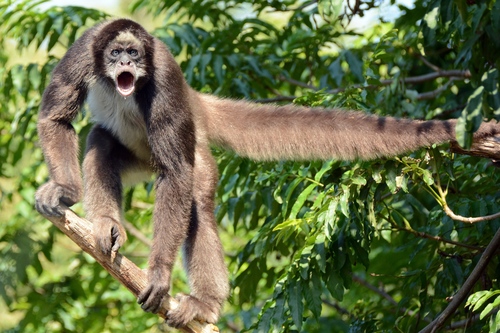
Other species in the genus Ateles
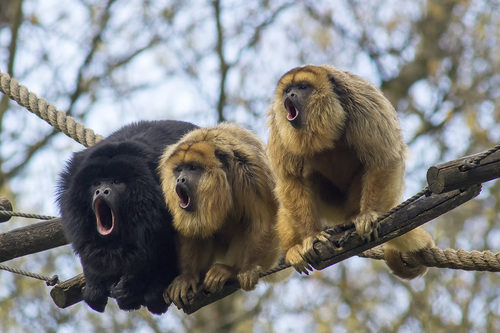
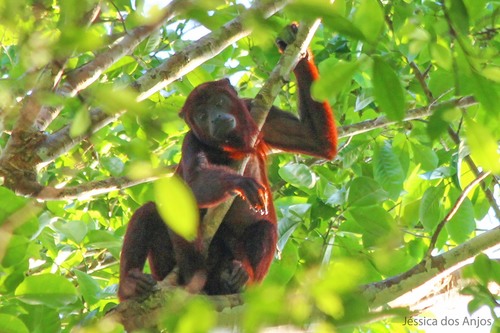
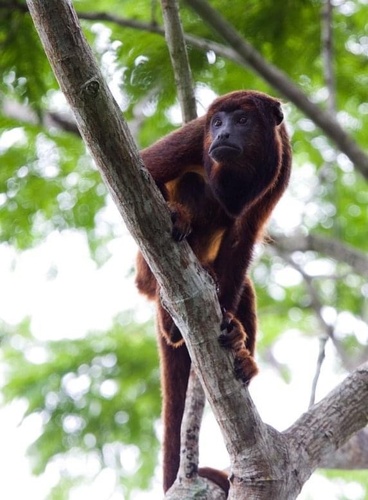
Other species in the family Atelidae
Sources
Conservation status, range description and population estimate come from the IUCN Red List assessment for Ateles marginatus. Countries are derived from that range description, not from a mapped country list. Last refreshed on .
The distribution map is drawn from the IUCN Red List spatial data compiled in 2008. IUCN (International Union for Conservation of Nature)