
Yucatán Black Howler Monkey
Alouatta pigra
Red List assessment
Endangeredon the IUCN Red List
- EXExtinct
- EWExtinct in the Wild
- CRCritically Endangered
- ENEndangered
- VUVulnerable
- NTNear Threatened
- LCLeast Concern
The Yucatán Black Howler Monkey is recorded in 3 countries across North America. The IUCN Red List assesses the Yucatán Black Howler Monkey as Endangered. No precise global census exists; the total wild population is estimated in the low tens of thousands and is considered declining.
- Family
- Atelidae
- Order
- Primates
- Genus
- Alouatta
- Countries recorded
- 3
- Continents
- North America
- Red List category
- Endangered
- Data updated
- August 9, 2026
What is the Yucatán Black Howler Monkey?
The Yucatán Black Howler Monkey is one of the largest primates in the Americas and the largest howler monkey species. It inhabits tropical and semi-deciduous forests of the Yucatán Peninsula, Belize, and the Petén region of Guatemala. It is renowned for its extraordinarily loud dawn chorus vocalizations, produced via an enlarged hyoid bone, which can be heard up to 5 km away. Classified as Endangered, it faces severe pressure from deforestation and hunting across its restricted range.
Where does the Yucatán Black Howler Monkey live?
Southeastern Mexico (Yucatán Peninsula, Chiapas, Tabasco, Campeche, Quintana Roo), all of Belize, and northern Guatemala (Petén region)
Endemic to a relatively small region of Mesoamerica: the Yucatán Peninsula (Mexico, including the states of Campeche, Quintana Roo, Yucatán, plus Chiapas and Tabasco), the entire country of Belize, and the northern lowlands of Guatemala (Petén department). Its range overlaps marginally with Alouatta palliata in parts of Chiapas and Guatemala, where hybrids have been documented.
Altitude and depth
Primarily a lowland species, typically found from sea level to approximately 600 m, occasionally recorded up to 1,000 m in foothill forests.
Seasonal movements
Non-migratory; groups maintain stable home ranges year-round. Dietary composition shifts seasonally, with increased fruit and flower consumption during rainy season and heavier reliance on mature leaves during the dry season. No hibernation.
Habitat of the Yucatán Black Howler Monkey
Primary and secondary tropical rainforests, semi-evergreen and semi-deciduous forests, gallery forests, and seasonally flooded forests. Strongly dependent on continuous forest canopy for foraging, travel, and shelter, and rarely descends to the ground.
Adaptations to its environment
Possesses a highly enlarged hyoid bone acting as a resonating chamber for loud vocalizations used in territory defense. Its specialized digestive system with a large cecum and extended gut allows efficient fermentation and detoxification of mature leaves, a low-quality food most primates avoid. The strong prehensile tail functions as a fifth limb, enabling secure suspension in the canopy. A low-energy lifestyle—resting up to 70% of the day—conserves calories derived from a foliage-heavy diet.
Conservation status and numbers
Endangered (EN) on the IUCN Red List (assessed 2020). The species has experienced a population reduction estimated to exceed 50% over three generations (approximately 30–40 years), driven primarily by habitat destruction and hunting. It is listed on CITES Appendix I, prohibiting commercial international trade.
Estimated population
No precise global census exists; the total wild population is estimated in the low tens of thousands and is considered declining. Local populations have been severely reduced, and many are small, isolated, and at risk of local extinction.
What threatens the Yucatán Black Howler Monkey?
Extensive deforestation for cattle ranching, subsistence agriculture, and infrastructure development is the primary threat. Illegal hunting for bushmeat and capture for the pet trade further reduce populations. Hurricane damage to forest habitat is a periodic but significant threat. Yellow fever epizootics have historically caused mass mortality events. Habitat fragmentation isolates populations and impedes gene flow.
Diseases and parasites
Susceptible to yellow fever virus, which has caused documented mass die-offs in Neotropical howler monkey populations. Internal parasites including nematodes, cestodes, and protozoans are commonly documented. Bot fly (Cuterebra sp.) larvae are known ectoparasites. May act as a reservoir for Trypanosoma cruzi (Chagas disease).
What is being done to protect it?
Protected under Mexican law (NOM-059-SEMARNAT) and by Belizean and Guatemalan wildlife legislation. Key protected areas include the Calakmul Biosphere Reserve (Mexico), the Community Baboon Sanctuary and Cockscomb Basin Wildlife Sanctuary (Belize), and the Maya Biosphere Reserve (Guatemala). The Community Baboon Sanctuary in Belize is a celebrated community-based conservation model specifically benefiting this species.
Recommended actions
Expansion and improved enforcement of protected areas; restoration of forest corridors to reconnect fragmented populations; community-based anti-poaching programs and alternative livelihood initiatives; rigorous monitoring of population trends; continued research on hybrid zones with A. palliata; and capacity building for local conservation organizations.
What the Yucatán Black Howler Monkey looks like
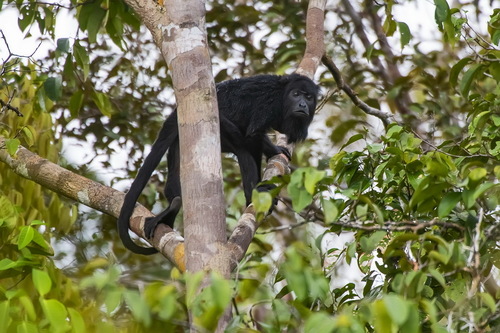
Males are uniformly jet black with a thick black beard and a conspicuous beard-like swelling around the throat caused by the enlarged hyoid bone. Females are brownish-olive to golden-brown overall. Both sexes have a long, muscular prehensile tail with a bare tactile pad on the underside near the tip. The face is black and largely naked.
Size
Head-body length: 52–67 cm; prehensile tail: 59–69 cm. Males are substantially larger than females.
Weight
Males: 10–12 kg; Females: 6–8 kg. This species is the heaviest howler monkey and among the largest Neotropical primates.
Distinctive features
Alouatta pigra is distinguished from the closely related mantled howler (A. palliata) by its entirely black pelage in both sexes (A. palliata females and some males have a golden-brown lateral mantle). A. pigra is also significantly larger and heavier. The male's hyoid apparatus is proportionally larger, producing a distinctively deeper, more resonant roar.
Differences between males and females
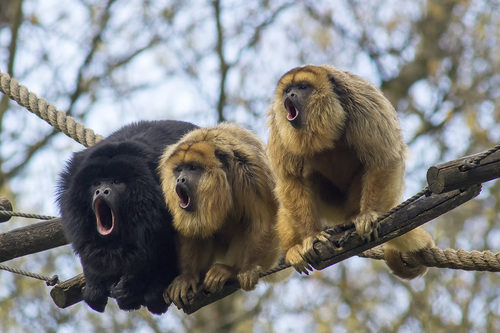
Pronounced sexual dimorphism: males are 30–50% heavier than females and entirely black, while females are brownish-olive. Males also have a notably larger hyoid bone and a more prominent throat pouch. Females develop a white patch around the genitalia.
Behaviour and diet of the Yucatán Black Howler Monkey
Lives in cohesive, mixed-sex groups typically comprising 2–10 individuals, usually with 1–3 adult males, 2–4 adult females, and their offspring. Polygynous social system. Groups maintain stable home ranges of 4–25 hectares and defend them acoustically rather than through physical confrontation.
When it is active
Strictly diurnal and arboreal. Peak activity occurs in early morning (including the famous dawn howling chorus) and again in late afternoon. The majority of the day (60–70%) is spent resting in the canopy to conserve energy, an adaptation to a low-calorie, leaf-heavy diet.
Diet
Primarily folivorous: mature and young leaves constitute the bulk of the diet, supplemented with fruits, flowers, and seeds when seasonally available. Unlike many primates, A. pigra is capable of digesting large quantities of mature leaves containing secondary plant compounds (tannins, alkaloids) thanks to its specialized gut flora.
How it feeds and hunts
Strictly herbivorous; no hunting behavior. Foraging is slow and deliberate, moving through the canopy to locate preferred leaf flushes, fruiting trees, and flowering plants within the group's home range.
Communication
The species is famous for its powerful roaring howl, produced by adult males and amplified by the enlarged hyoid bone; groups typically howl at dawn to advertise territory and avoid costly direct confrontations. Females also vocalize but less loudly. Additional communication includes tactile behaviors (grooming), visual signals (body postures), and scent marking via chest and chin glands on branches.
Interactions with other species
Natural predators include harpy eagles (Harpia harpyja), jaguars (Panthera onca), pumas (Puma concolor), and large constrictors. Where ranges overlap with A. palliata, hybridization occurs, offering insights into primate speciation. As a folivore and frugivore, the species plays an important role in the forest ecosystem as a seed disperser for some tree species.
Role in its ecosystem
Functions as an important seed disperser for mid-sized fruits and contributes to foliage regulation in tropical forests. Its large biomass makes it a significant prey item for apex predators, linking canopy vegetation to terrestrial food webs. The species serves as a flagship for conservation of Mesoamerican tropical forest ecosystems.
Reproduction and lifecycle
No strict breeding season; births occur year-round. Gestation period is approximately 180–194 days. Females typically give birth to a single infant. Inter-birth interval is around 22–24 months. Males may compete for mating access to females within the group.
Raising the young
The mother provides virtually all direct care: infants cling to the mother's ventrum for the first weeks, then transfer to her back. Weaning occurs at approximately 12–18 months. Subadults may remain in their natal group for extended periods before dispersing.
Maturity and lifespan
Females reach sexual maturity at approximately 3–4 years; males at 5–6 years. Lifespan in the wild is estimated at 15–20 years; individuals in captivity may live up to 25 years.
Taxonomy and naming of the Yucatán Black Howler Monkey
Classification
Mammalia > Primates > Atelidae > Alouatta > Alouatta pigra
Subspecies
No recognized subspecies; Alouatta pigra is treated as a monotypic species.
Scientific synonyms
Alouatta villosa pigra (Lawrence, 1933); formerly considered a subspecies of Alouatta villosa or Alouatta palliata before elevation to full species status.
What research says
Recent studies
Recent population genetic studies have confirmed significant fragmentation and reduced gene flow among isolated forest patches. Research in the hybrid zone between A. pigra and A. palliata has illuminated mechanisms of secondary contact and speciation. Studies using remote sensing have quantified catastrophic habitat loss within the species' range over the past two decades. Post-hurricane recovery studies in Belize highlighted the demographic vulnerability of small populations.
Genome and DNA
Alouatta species are notable for having one of the most variable karyotypes among primates; A. pigra is reported to have a diploid chromosome number of 2n = 52. Genetic studies have documented hybridization with A. palliata in contact zones in southern Mexico and Guatemala, providing a model system for studying primate speciation and reproductive isolation.
Compared with similar species
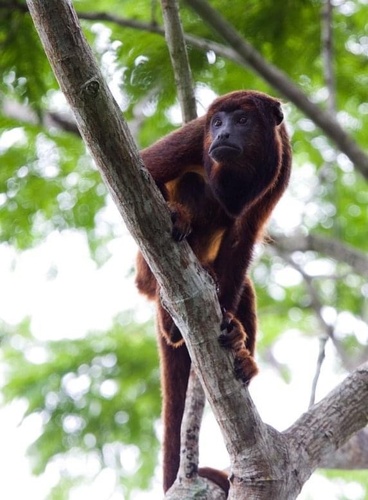
Among the nine recognized Alouatta species, A. pigra is the largest and heaviest. It is most closely related to A. palliata (mantled howler), from which it differs in larger body size, entirely black pelage in both sexes, and greater depth of vocalizations. The red howler (A. seniculus) of South America is comparably sized but brilliantly reddish-chestnut. Unlike the more adaptable A. palliata, A. pigra appears more sensitive to habitat degradation and shows lower tolerance for forest edges.
The Yucatán Black Howler Monkey and people
The howl of Alouatta pigra ranks among the loudest vocalizations of any land mammal on Earth, audible from distances exceeding 5 km through dense forest. Despite its impressive size, this monkey spends more than two-thirds of each day completely motionless—a remarkable energy-conservation strategy for surviving on a diet of tough, low-nutrient leaves. The enlarged hyoid bone of adult males is so massive it is visible as a prominent bulge beneath the chin, giving them the appearance of wearing a built-in drum.
Where and how to see it
The Community Baboon Sanctuary in the Belize River Valley (Bermudian Landing, Belize) offers one of the best and most reliable opportunities to observe wild groups at close range, with local guides providing excellent access. Tikal National Park and the Maya Biosphere Reserve in Guatemala's Petén are also productive sites. Early morning visits (6:00–9:00 AM) maximize chances of hearing and locating groups during their daily howling chorus.
Risks to humans
No notable venom or direct attack risk under normal circumstances. Wild individuals may bite if cornered or handled, and they may drop feces or debris when disturbed. There is a theoretical risk of zoonotic disease transmission (e.g., yellow fever, Chagas disease) through direct contact with wild individuals, so handling should be avoided.
Human uses
Historically hunted for bushmeat by indigenous and rural communities throughout its range. Occasionally captured illegally for the exotic pet trade, though survival rates in captivity without specialized care are poor. The species is a significant ecotourism asset, particularly at the Community Baboon Sanctuary in Belize, where it provides substantial income for local communities. It has been used as a study organism in primate behavioral ecology and conservation biology research.
Myths and legends
In ancient Maya cosmology, howler monkeys (sometimes referred to collectively with spider monkeys as 'bacabs') were associated with the arts, writing, and music and appear frequently in Maya codices and ceramic art as patron deities of scribes and craftsmen. Local communities throughout the Yucatán and Petén often refer to them as 'saraguatos' and consider their dawn howling a reliable natural alarm clock and weather indicator.
Countries where the Yucatán Black Howler Monkey is recorded
The 3 countries named in the range description of its IUCN Red List assessment.
Questions about the Yucatán Black Howler Monkey
Where does the Yucatán Black Howler Monkey live?
The Yucatán Black Howler Monkey is recorded in Belize, Guatemala and Mexico across North America. These countries come from the range description of its IUCN Red List assessment, and they are what place the species on the interactive map.
Is the Yucatán Black Howler Monkey endangered?
Yes. The IUCN Red List assesses the Yucatán Black Howler Monkey as Endangered, one of the three threatened categories. The species faces a very high risk of extinction in the wild — a step below Critically Endangered, but still on a trajectory that ends badly without intervention.
How many are left in the wild?
No precise global census exists; the total wild population is estimated in the low tens of thousands and is considered declining. This figure comes from the species assessment on the IUCN Red List; population estimates for wild mammals are ranges, not counts, and are revised at each assessment.
What habitat does the Yucatán Black Howler Monkey live in?
Primary and secondary tropical rainforests, semi-evergreen and semi-deciduous forests, gallery forests, and seasonally flooded forests.
What is the scientific name of the Yucatán Black Howler Monkey?
The Yucatán Black Howler Monkey is Alouatta pigra, in the family Atelidae, order Primates.
Other species in the genus Alouatta
Other species in the family Atelidae
Sources
Conservation status, range description and population estimate come from the IUCN Red List assessment for Alouatta pigra. Countries are derived from that range description, not from a mapped country list. Last refreshed on .
The distribution map is drawn from the IUCN Red List spatial data compiled in 2020. IUCN (International Union for Conservation of Nature)