
Red-faced Black Spider Monkey
Ateles paniscus
Red List assessment
Vulnerableon the IUCN Red List
- EXExtinct
- EWExtinct in the Wild
- CRCritically Endangered
- ENEndangered
- VUVulnerable
- NTNear Threatened
- LCLeast Concern
The Red-faced Black Spider Monkey is recorded in 5 countries across South America. The IUCN Red List assesses the Red-faced Black Spider Monkey as Vulnerable. No precise global population estimate exists; the population is considered declining.
- Family
- Atelidae
- Order
- Primates
- Genus
- Ateles
- Countries recorded
- 5
- Continents
- South America
- Red List category
- Vulnerable
- Data updated
- August 9, 2026
What is the Red-faced Black Spider Monkey?
The Red-faced Black Spider Monkey is one of the largest New World primates, recognized by its jet-black fur and strikingly bare, red to pink facial skin. It is a highly arboreal species inhabiting the upper canopy of primary tropical rainforests in the Guiana Shield region of South America. It possesses an exceptionally strong prehensile tail that functions as a fifth limb, enabling acrobatic locomotion through the forest canopy. This species is a critical seed disperser and is considered a keystone species in its ecosystem.
Where does the Red-faced Black Spider Monkey live?
Northern South America: Brazil (north of the Amazon River, states of Pará and Amazonas), Guyana, Suriname, French Guiana, and southern Venezuela
Found north of the Amazon and Solimões rivers in Brazil (Pará and Amazonas states), throughout Guyana, Suriname, and French Guiana, and in the Bolivar and Amazonas states of Venezuela. The Guiana Shield constitutes the core of its range.
Altitude and depth
Primarily found from sea level up to approximately 800 m, though occasionally recorded at higher elevations in foothill forests. Most commonly inhabits lowland tropical forests below 500 m.
Seasonal movements
No true migration, but frugivore-driven nomadic ranging within home territories increases during periods of fruit scarcity (dry season). Social group size and foraging party composition shift seasonally with fruit availability.
Habitat of the Red-faced Black Spider Monkey
Primary undisturbed tropical rainforest, including terra firme (non-flooded) upland forests and seasonally flooded várzea forests. It strongly prefers mature, tall-canopy primary forest and is highly sensitive to habitat disturbance, rarely adapting to secondary or fragmented forest.
Adaptations to its environment
The fully prehensile, hairless-tipped tail acts as a fifth limb, supporting the full body weight during brachiation. Elongated, hooklike fingers (reduced thumbs or absent) allow fast swinging locomotion (brachiation). A large body size and spacious home range allow exploitation of widely dispersed fruiting trees. Its digestive system handles large volumes of fruit and seeds efficiently.
Conservation status and numbers
Vulnerable (VU) on the IUCN Red List (assessed 2020). The species has experienced an estimated population decline exceeding 30% over three generations (approximately 45 years) due to ongoing hunting pressure and large-scale deforestation, especially along the southern Amazon frontier.
Estimated population
No precise global population estimate exists; the population is considered declining. Density estimates range from 1 to 10 individuals per km² depending on habitat quality. Population fragmentation is increasing across its range.
What threatens the Red-faced Black Spider Monkey?
Deforestation and forest fragmentation driven by agricultural expansion (soy, cattle ranching), logging, and infrastructure development are the primary threats. Subsistence and commercial hunting is significant, as the species is a large, slow-reproducing primate targeted for bushmeat. Its dependence on primary forest makes it especially vulnerable to habitat degradation.
Diseases and parasites
Susceptible to various intestinal parasites including nematodes (Trypanoxyuris spp.) and protozoans. Yellow fever (Flavivirus) outbreaks have caused significant mortality in wild spider monkey populations in South America. Susceptible to measles and other human respiratory diseases when in contact with people.
What is being done to protect it?
Protected within several large Amazonian reserves including the Tumucumaque Mountains National Park (Brazil), Iwokrama Forest Reserve (Guyana), and Central Suriname Nature Reserve. CITES Appendix II listing regulates international trade. Brazilian law (IBAMA) prohibits hunting. Various NGOs (WWF, WCS) support monitoring programs in the Guiana Shield.
Recommended actions
Expansion and enforcement of protected areas within the Guiana Shield. Strict anti-poaching measures and alternative livelihood programs for local communities. Long-term population monitoring using camera traps and transect surveys. Habitat corridor creation to connect fragmented forest patches. Captive breeding programs as insurance populations.
What the Red-faced Black Spider Monkey looks like
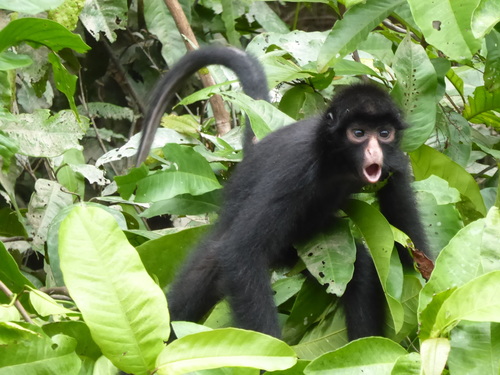
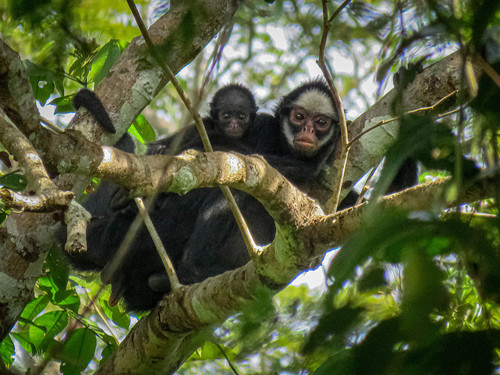
The entire body is covered in uniformly glossy jet-black fur. The face is bare and distinctively bright red to deep pink, with a black muzzle and dark eyes. The limbs are very long and slender relative to body size, and the prehensile tail tip has a naked tactile pad. The abdomen may show slightly faded coloration in some individuals.
Size
Head-body length: 40–62 cm; tail length: 70–92 cm (longer than body). Total length can exceed 150 cm including tail. Stands approximately 35–50 cm at the shoulder when quadrupedal.
Weight
Typically 6–9 kg; males average slightly heavier (7–9 kg) than females (6–8 kg). This is one of the heaviest spider monkey species.
Distinctive features
The combination of entirely black pelage with a vivid bare red/pink face distinguishes A. paniscus from all other spider monkeys. Ateles belzebuth has pale facial skin and a buff-colored belly. Ateles chamek (formerly a subspecies) also has a pink face but often has slightly paler fur on the face and belly and occurs south of the Amazon.
Differences between males and females
Sexual dimorphism is subtle; males are marginally larger and heavier than females. Both sexes are uniformly black. Females possess a pendulous, elongated clitoris that is often mistaken for a penis by casual observers, making sex determination difficult in the field.
Behaviour and diet of the Red-faced Black Spider Monkey
Lives in fission-fusion societies with stable community groups of 15–30 individuals that regularly subdivide into smaller foraging subgroups of 2–8. Adult males tend to form coalitions and defend the community range collectively. Females transfer between groups at sexual maturity.
When it is active
Strictly diurnal. Activity peaks in the early morning (feeding) and late afternoon (travel and social interactions). Resting periods occur in the midday heat. The species sleeps in the upper canopy in small, variable-composition parties.
Diet
Highly frugivorous; ripe fruit constitutes 80–90% of the diet. Supplements with young leaves, flowers, seeds, bark, and occasionally insects or small vertebrates. Favors large, ripe, fleshy fruits; capable of digesting unripe and slightly toxic fruits unavailable to smaller primates.
How it feeds and hunts
Not a hunter; primarily a fruit forager. Individuals locate ripe fruit through memory of fruit tree locations within their large home ranges (up to 4 km²). They may travel several kilometers daily between fruiting trees. Some opportunistic insectivory occurs.
Communication
Highly vocal; uses a diverse repertoire including loud 'whinny' contact calls, barks, screams, and distinctive long-distance calls audible over 1 km to coordinate subgroup movements. Body language includes embraces, genital inspections, and piloerection for social bonding and threat displays. Scent marking is minimal compared to other primates.
Interactions with other species
Primary predators include harpy eagles (Harpia harpyja), large felids (jaguar, puma), and large constrictors (anaconda). Competes with other large frugivores such as howler monkeys (Alouatta spp.) and woolly monkeys (Lagothrix spp.) for fruit resources. Acts as a major seed disperser for dozens of large-seeded tree species, maintaining forest composition.
Role in its ecosystem
Keystone frugivore and one of the most important seed dispersers in Amazonian and Guianan forests. It disperses large seeds that cannot be handled by smaller animals, making it essential for forest regeneration and tree species diversity. Its loss triggers cascading trophic effects on plant community structure.
Reproduction and lifecycle
No strict breeding season; births can occur year-round with a peak correlated to fruit abundance. Gestation lasts approximately 226–232 days (~7.5 months). Females give birth to a single offspring; inter-birth interval is very long, typically 2.5–3.5 years, resulting in extremely slow population recovery.
Raising the young
The mother is the sole provider of parental care. Infants cling to the mother's belly for the first 4–5 months, then transition to riding on her back. Weaning occurs gradually between 12–24 months. Young remain closely associated with the mother for up to 3–4 years. Males provide no direct care.
Maturity and lifespan
Sexual maturity is reached at approximately 4–5 years in females and 4–5 years in males (though males rarely breed until socially established, around 7–8 years). Wild lifespan is estimated at 20–25 years; captive individuals can live 30–35+ years.
Taxonomy and naming of the Red-faced Black Spider Monkey
Classification
Mammalia > Primates > Atelidae > Ateles > Ateles paniscus
Subspecies
Ateles paniscus is currently considered monotypic (no recognized subspecies). Historically, Ateles paniscus chamek was listed as a subspecies but is now elevated to full species status (Ateles chamek, the Peruvian Spider Monkey).
Scientific synonyms
Simia paniscus Linnaeus, 1758 (original description); Ateles ater (Geoffroy, 1806); sometimes confused historically with Ateles chamek.
What research says
Recent studies
Recent acoustic studies have demonstrated that A. paniscus whinnies encode individual identity information, suggesting sophisticated communication. Remote sensing studies (2019–2023) have documented increasing range fragmentation on the southern edge of its distribution. Research in Suriname has quantified its critical seed dispersal function for large-seeded canopy trees.
Genome and DNA
Karyotype: 2n = 34 chromosomes. Molecular phylogenetic studies confirm Ateles paniscus as the sister taxon to Ateles belzebuth within the genus. Genomic studies on Atelidae support the family's divergence from other New World monkeys approximately 20–25 million years ago.
Compared with similar species
Among the seven Ateles species, A. paniscus is most distinguished by its uniform black coat and red face. It is larger and more robust than the White-fronted Spider Monkey (A. belzebuth). Unlike the Black-handed Spider Monkey (A. geoffroyi) of Central America, it shows no facial hair patterns or pale patches. All spider monkeys share the same fission-fusion social system and prehensile tail morphology.
The Red-faced Black Spider Monkey and people
The spider monkey's prehensile tail is so sensitive and strong it can support the animal's entire body weight, effectively functioning as a fifth hand for picking fruit. Despite lacking a true thumb, spider monkeys are among the fastest brachiators in the primate world, capable of swinging at speeds exceeding 35 km/h. A female spider monkey's enlarged clitoris is so anatomically prominent that early naturalists frequently misidentified females as males.
Where and how to see it
Best observed in protected areas within the Guiana Shield such as the Iwokrama Forest (Guyana), Brownsberg Nature Reserve (Suriname), and Parc Amazonien de Guyane (French Guiana). Early mornings (6:00–9:00) are optimal when groups descend from sleeping sites to feed. Using local Indigenous guides and following river routes into primary forest increases encounter rates significantly.
Risks to humans
No notable risk under normal circumstances. If cornered or handled (e.g., injured individuals), they may bite or scratch. They are known to throw branches and urinate/defecate on perceived threats from the canopy. No venom or serious disease transmission risk to healthy humans under natural conditions.
Human uses
Historically and currently hunted by Indigenous and rural communities for bushmeat across its range; its large size makes it a high-value target. Occasionally captured for the illegal exotic pet trade, though CITES Appendix II listing restricts this. Not used significantly in traditional medicine. Has been kept in zoos globally as part of conservation education programs.
Myths and legends
Among several Amazonian indigenous peoples, including the Yanomami and Wayana, spider monkeys hold important cultural status as preferred bushmeat and are featured in oral traditions linking the forest and human ancestry. Some groups attribute special medicinal or spiritual properties to various monkey body parts. In certain indigenous cosmologies, monkeys represent transformed humans, complicating their hunting taboo status.
Countries where the Red-faced Black Spider Monkey is recorded
The 5 countries named in the range description of its IUCN Red List assessment.
Questions about the Red-faced Black Spider Monkey
Where does the Red-faced Black Spider Monkey live?
The Red-faced Black Spider Monkey is recorded in Brazil, French Guiana, Guyana, Suriname and Venezuela across South America. These countries come from the range description of its IUCN Red List assessment, and they are what place the species on the interactive map.
Is the Red-faced Black Spider Monkey endangered?
Yes. The IUCN Red List assesses the Red-faced Black Spider Monkey as Vulnerable, one of the three threatened categories. The species faces a high risk of extinction in the wild. It is the first of the three threatened categories: numbers are falling, the range is shrinking, or the population is small enough that a single bad event could do lasting damage.
How many are left in the wild?
No precise global population estimate exists; the population is considered declining. This figure comes from the species assessment on the IUCN Red List; population estimates for wild mammals are ranges, not counts, and are revised at each assessment.
What habitat does the Red-faced Black Spider Monkey live in?
Primary undisturbed tropical rainforest, including terra firme (non-flooded) upland forests and seasonally flooded várzea forests.
What is the scientific name of the Red-faced Black Spider Monkey?
The Red-faced Black Spider Monkey is Ateles paniscus, in the family Atelidae, order Primates.
Other species in the genus Ateles
Other species in the family Atelidae
Sources
Conservation status, range description and population estimate come from the IUCN Red List assessment for Ateles paniscus. Countries are derived from that range description, not from a mapped country list. Last refreshed on .
The distribution map is drawn from the IUCN Red List spatial data compiled in 2019. IUCN (International Union for Conservation of Nature)