
Black and Gold Howler Monkey
Alouatta caraya
Red List assessment
Near Threatenedon the IUCN Red List
- EXExtinct
- EWExtinct in the Wild
- CRCritically Endangered
- ENEndangered
- VUVulnerable
- NTNear Threatened
- LCLeast Concern
The Black and Gold Howler Monkey is recorded in 4 countries across South America. The IUCN Red List assesses the Black and Gold Howler Monkey as Near Threatened. Population size is not precisely quantified but is considered declining, with significant local extinctions following yellow fever epizootics in Argentina and Brazil in the 2000s-2010s.
- Family
- Atelidae
- Order
- Primates
- Genus
- Alouatta
- Countries recorded
- 4
- Continents
- South America
- Red List category
- Near Threatened
- Data updated
- August 9, 2026
What is the Black and Gold Howler Monkey?
The Black and Gold Howler Monkey is a large New World monkey notable for its striking sexual dichromatism, with males being entirely black and females golden-yellow to olive-brown. It inhabits forested regions of south-central South America and is renowned for its extremely loud howling vocalizations that can carry for several kilometers through dense forest. This species plays a key ecological role as a seed disperser in gallery and semi-deciduous forests. It is one of the most cold-tolerant howler species, surviving in subtropical forests with seasonal temperature drops.
Where does the Black and Gold Howler Monkey live?
Northern Argentina, Paraguay, Bolivia, and southern/central Brazil
Found in northern Argentina, Paraguay, southeastern Bolivia, and Brazil (Mato Grosso, Mato Grosso do Sul, and parts of the Pantanal and Cerrado biomes), primarily in the Gran Chaco and Pantanal regions.
Altitude and depth
0–500 m above sea level
Seasonal movements
No true migration, but activity levels and diet shift seasonally with dry and wet seasons; leaf consumption increases during fruit-scarce dry periods.
Habitat of the Black and Gold Howler Monkey
Gallery forests, semi-deciduous and deciduous forests, flooded forests, and forest fragments along rivers; also found in secondary growth and forest edges adapted to seasonal flooding and dry periods.
Adaptations to its environment
Possesses an enlarged hyoid bone that amplifies vocalizations for long-distance communication, reducing energetic costs of territorial defense. A slow metabolism and folivorous diet allow it to survive on lower-quality food resources, and a prehensile tail aids in arboreal locomotion and feeding stability.
Conservation status and numbers
Near Threatened (NT) according to IUCN, with populations declining due to habitat loss and fragmentation across its range, though it remains relatively widespread and adaptable compared to other howler species.
Estimated population
Population size is not precisely quantified but is considered declining, with significant local extinctions following yellow fever epizootics in Argentina and Brazil in the 2000s-2010s.
What threatens the Black and Gold Howler Monkey?
Deforestation for agriculture and cattle ranching, habitat fragmentation, yellow fever outbreaks causing mass mortality, hunting, and illegal pet trade.
Diseases and parasites
Highly susceptible to yellow fever, which has caused significant population crashes; also affected by various intestinal parasites and botflies (Cuterebra) common in Neotropical primates.
What is being done to protect it?
Protected under national wildlife laws in Argentina, Brazil, Paraguay, and Bolivia; present in several protected areas including El Rey National Park (Argentina) and various Pantanal reserves; some rehabilitation and reintroduction programs exist following disease outbreaks.
Recommended actions
Strengthen habitat corridors between forest fragments, implement yellow fever vaccination buffers for wildlife, enforce anti-deforestation laws, and monitor population health through long-term field studies.
What the Black and Gold Howler Monkey looks like
Males are entirely black with a shaggy coat, while females and juveniles are golden-yellow to pale brown; both sexes have a long prehensile tail with a bare, sensitive underside for gripping branches.
Size
Body length (head-body) 40–65 cm, with a prehensile tail of similar or greater length (55–70 cm).
Weight
Males typically weigh 5–7 kg; females are smaller, weighing 3.5–5 kg.
Distinctive features
Extreme sexual dichromatism (black males vs. golden females) is unique among howler monkeys and distinguishes this species from congeners like the red howler (Alouatta seniculus) or mantled howler (Alouatta palliata), which show little to no color difference between sexes.
Differences between males and females
Pronounced dichromatism: males are black, females are golden-yellow; males are also notably larger and possess a more developed hyoid bone for deeper howls.
Behaviour and diet of the Black and Gold Howler Monkey
Lives in cohesive social groups of 5–19 individuals, typically with multiple adult males and females; groups display a loose dominance hierarchy with minimal aggressive interactions compared to other primates.
When it is active
Diurnal, with peak activity in early morning and late afternoon; spends much of the day resting to conserve energy due to its leaf-heavy diet.
Diet
Primarily folivorous-frugivorous, feeding on young leaves, fruits, flowers, and occasionally bark; diet shifts seasonally based on resource availability, with leaves dominating during dry periods.
Communication
Famous for loud, resonant howls produced by an enlarged hyoid bone, used for territorial spacing and group coordination, especially at dawn and dusk; also uses facial expressions, body postures, and scent marking for social communication.
Interactions with other species
Predators include large birds of prey (harpy eagles), felids (jaguars, ocelots), and occasionally snakes; competes with other primates and frugivorous mammals for fruit resources but generally occupies a distinct dietary niche due to folivory.
Role in its ecosystem
Acts as an important seed disperser for various tree species in gallery and semi-deciduous forests, contributing to forest regeneration and plant diversity maintenance.
Reproduction and lifecycle
Breeding occurs year-round without a strict seasonal pattern; gestation lasts approximately 185–190 days, typically resulting in a single offspring; weaning occurs around 12–18 months.
Raising the young
Mothers provide primary care, carrying infants ventrally then dorsally as they grow; other group females may occasionally assist in alloparental care, and males show tolerance toward infants within the group.
Maturity and lifespan
Sexual maturity is reached around 3–5 years; lifespan in the wild is approximately 15–20 years, with captive individuals sometimes living over 20 years.
Taxonomy and naming of the Black and Gold Howler Monkey
Classification
Mammalia > Primates > Atelidae > Alouatta > Alouatta caraya
Scientific synonyms
Mycetes caraya (Humboldt, 1812); Stentor caraya
What research says
Recent studies
Recent research has focused on the demographic and genetic impacts of yellow fever epidemics on wild populations, revealing severe local population bottlenecks and slow recovery rates in affected regions of Argentina and Brazil.
Genome and DNA
Diploid chromosome number of 2n=52; genetic studies have been used to assess population structure and impacts of yellow fever outbreaks on genetic diversity.
Compared with similar species
Unlike the mantled howler (Alouatta palliata) or red howler (Alouatta seniculus), which show minimal sexual color dimorphism, Alouatta caraya exhibits striking black-vs-gold sexual dichromatism, making it visually distinct among howler species.
The Black and Gold Howler Monkey and people
Their howls are among the loudest calls of any land animal, audible up to 5 km away; males are born golden like females and only darken to black as they mature; they are one of the few New World primates capable of surviving subtropical winters with occasional frost.
Where and how to see it
Best observed at dawn or dusk in gallery forests of the Pantanal or northern Argentine provinces like Formosa and Chaco, where their loud howls make them easier to locate; guided ecotourism tours in Iberá Wetlands (Argentina) offer good sighting opportunities.
Risks to humans
No notable risk to humans; they are generally shy and avoid direct contact, though captive or habituated individuals may bite if provoked.
Human uses
Occasionally kept illegally as pets due to their striking appearance; historically hunted for bushmeat in some rural areas, though this practice has declined with conservation awareness.
Myths and legends
In some local folklore of the Gran Chaco and Pantanal regions, the howler monkey's calls are associated with impending rain or storms, and its haunting roar has inspired legends of forest spirits in indigenous Guaraní traditions.
Countries where the Black and Gold Howler Monkey is recorded
The 4 countries named in the range description of its IUCN Red List assessment.
Questions about the Black and Gold Howler Monkey
Where does the Black and Gold Howler Monkey live?
The Black and Gold Howler Monkey is recorded in Argentina, Bolivia, Brazil and Paraguay across South America. These countries come from the range description of its IUCN Red List assessment, and they are what place the species on the interactive map.
Is the Black and Gold Howler Monkey endangered?
The IUCN Red List assesses the Black and Gold Howler Monkey as Near Threatened. The species does not qualify as threatened today, but it is close to the thresholds and likely to cross them soon. It is the category that most often changes at the next assessment.
How many are left in the wild?
Population size is not precisely quantified but is considered declining, with significant local extinctions following yellow fever epizootics in Argentina and Brazil in the 2000s-2010s. This figure comes from the species assessment on the IUCN Red List; population estimates for wild mammals are ranges, not counts, and are revised at each assessment.
What habitat does the Black and Gold Howler Monkey live in?
Gallery forests, semi-deciduous and deciduous forests, flooded forests, and forest fragments along rivers; also found in secondary growth and forest edges adapted to seasonal flooding and dry periods.
What is the scientific name of the Black and Gold Howler Monkey?
The Black and Gold Howler Monkey is Alouatta caraya, in the family Atelidae, order Primates.
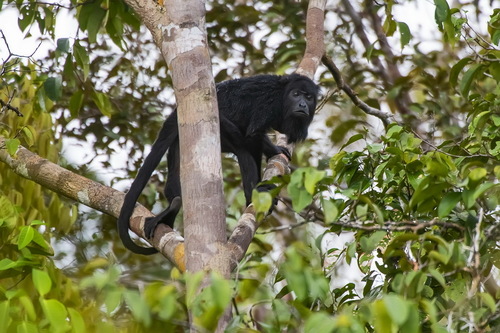
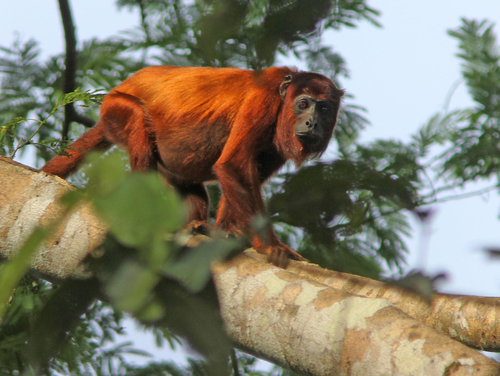
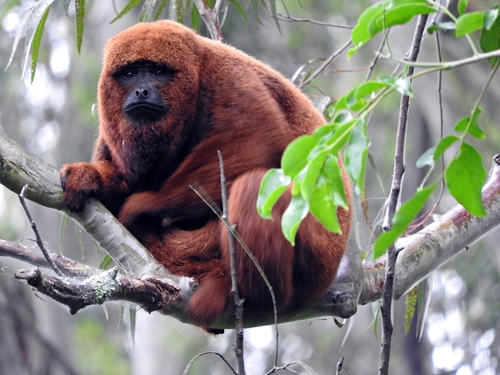
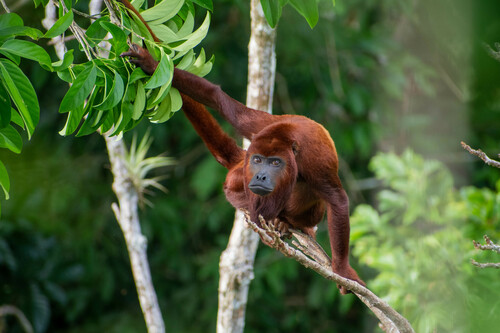
Other species in the genus Alouatta
Other species in the family Atelidae
Sources
Conservation status, range description and population estimate come from the IUCN Red List assessment for Alouatta caraya. Countries are derived from that range description, not from a mapped country list. Last refreshed on .
The distribution map is drawn from the IUCN Red List spatial data compiled in 2008. IUCN (International Union for Conservation of Nature)