
Woolly Grass Mouse
Abrothrix lanosus
Red List assessment
Least Concernon the IUCN Red List
- EXExtinct
- EWExtinct in the Wild
- CRCritically Endangered
- ENEndangered
- VUVulnerable
- NTNear Threatened
- LCLeast Concern
The Woolly Grass Mouse is recorded in 2 countries across South America. The IUCN Red List assesses the Woolly Grass Mouse as Least Concern. No precise global population estimate is available.
- Family
- Cricetidae
- Order
- Rodentia
- Genus
- Abrothrix
- Countries recorded
- 2
- Continents
- South America
- Red List category
- Least Concern
- Data updated
- August 9, 2026
What is the Woolly Grass Mouse?
Abrothrix lanosus is a small sigmodontine rodent endemic to the cold, windswept grasslands and shrublands of southern Patagonia and Tierra del Fuego. It is distinguished by its unusually dense, woolly pelage — reflected in its Latin epithet 'lanosus' meaning 'woolly' — which provides thermal insulation in one of the harshest climates inhabited by any South American rodent. It is one of the southernmost-ranging members of its genus, co-occurring with other Abrothrix species in subantarctic ecological communities. Its ecology is closely tied to Magellanic steppe and moorland habitats.
Where does the Woolly Grass Mouse live?
Southern Chile (Magallanes region) and adjacent southwestern Argentina (Patagonia)
Restricted to the extreme south of South America: southern Chile (Magallanes y Antártica Chilena Region, including the Última Esperanza Province and areas around Torres del Paine) and adjacent southwestern Argentina (Santa Cruz Province and parts of Tierra del Fuego). Its range is largely confined to the subantarctic zones south of approximately 48°S.
Altitude and depth
Primarily found from sea level up to approximately 1,200 m elevation, inhabiting lowland steppe and montane grasslands across its Patagonian range.
Seasonal movements
No known long-distance migrations or true hibernation. Activity levels may decrease during harsh winter conditions, and breeding is likely concentrated in the austral spring and summer (October–March). Individuals may reduce foraging activity during periods of heavy snowfall.
Habitat of the Woolly Grass Mouse
Primarily inhabits Magellanic grasslands (coiron steppe dominated by Festuca and Poa grasses), subantarctic shrublands, humid moorlands, and the ecotones of Nothofagus (southern beech) forest edges. It favors areas with dense ground-level vegetation cover that provides concealment and nesting sites.
Adaptations to its environment
The thick, woolly fur is a key adaptation to the cold, subantarctic climate, providing exceptional insulation against temperatures that can drop well below freezing. Small body size relative to heat loss is partially offset by this dense pelage. Behavioral flexibility in diet likely helps survival during seasonal food scarcity. Use of grass tussocks and dense vegetation for nesting provides additional protection from cold and predators.
Conservation status and numbers
Least Concern (LC) on the IUCN Red List. The species has a reasonably stable population with no evidence of major decline. Its remote, sparsely populated range limits direct human pressure, and large protected areas (e.g., Torres del Paine National Park) encompass significant portions of its habitat.
Estimated population
No precise global population estimate is available. The species is considered locally common within appropriate habitats across its range. Population trend is presumed stable.
What threatens the Woolly Grass Mouse?
Overgrazing by domestic sheep and cattle, which degrade the grassland and steppe habitats this species depends on. Introduction of invasive species (especially predators such as European mink, American mink, and domestic cats) poses a local threat. Climate change-driven shifts in precipitation and vegetation composition in Patagonia may alter habitat suitability over the long term.
Diseases and parasites
Likely hosts helminth parasites (nematodes, cestodes) and ectoparasites (fleas, mites, ticks) common to South American sigmodontine rodents. Potential reservoir host for hantaviruses, as documented in other Abrothrix species from the region, though this has not been specifically confirmed for A. lanosus.
What is being done to protect it?
Benefits from protection within Torres del Paine National Park (Chile) and Los Glaciares National Park (Argentina), which cover significant portions of its range. Chilean and Argentine national biodiversity laws provide general protection for native mammals. No species-specific conservation programs are currently in place.
Recommended actions
Continued monitoring of population densities across the range, particularly to detect any climate-driven shifts. Management of livestock grazing intensity in key grassland habitats. Control of invasive predators in core areas. Further taxonomic and ecological research to better define population structure.
What the Woolly Grass Mouse looks like
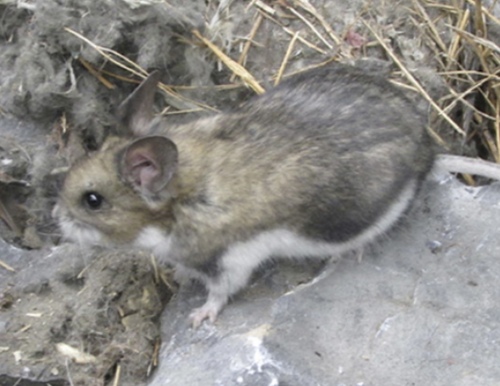
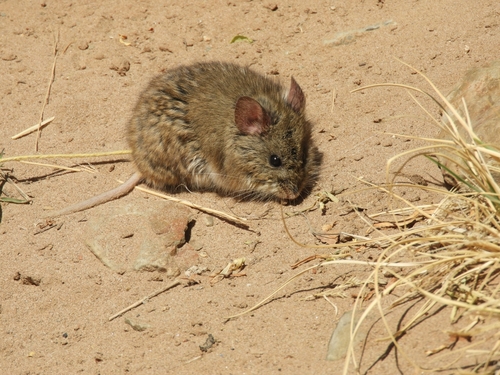
The dorsal pelage is dense, soft, and conspicuously woolly, dark grayish-brown to brownish-black in color with a slightly paler grizzled effect from bicolored hairs. The ventral surface is paler gray to whitish-gray. The tail is relatively short, bicolored (darker above, paler below), and lightly furred. Eyes are small and ears are short and rounded, largely concealed in the thick fur.
Size
Head-body length approximately 85–115 mm; tail length approximately 60–90 mm (notably shorter than head-body length). A small, compact rodent.
Weight
Approximately 15–30 grams; no marked sexual size dimorphism reported.
Distinctive features
Distinguished from its closest relative, Abrothrix longipilis, by its shorter, broader skull, denser and more uniformly woolly (rather than long and shaggy) fur, and more restricted southerly distribution. Compared to Abrothrix olivaceus, it is darker dorsally and has noticeably denser, woolier fur. The combination of very dense pelage and short tail is diagnostic.
Differences between males and females
Minimal sexual dimorphism reported. Males and females are similar in size and coloration.
Behaviour and diet of the Woolly Grass Mouse
Presumed to be largely solitary outside of the breeding season, as is typical for most Abrothrix species. May tolerate loose aggregations in areas of high resource concentration. No complex social hierarchy has been documented.
When it is active
Primarily nocturnal and crepuscular, with peak activity occurring shortly after dusk and before dawn. This pattern reduces exposure to diurnal avian predators. Some opportunistic daytime activity may occur, particularly in dense vegetation cover.
Diet
Omnivorous. Diet consists primarily of seeds, green plant material (leaves, stems, roots), fungi, and arthropods (insects, larvae). The relative proportion of animal versus plant material likely varies seasonally, with higher invertebrate consumption during summer when prey is abundant.
How it feeds and hunts
Forages opportunistically on the ground and among grass tussocks, gleaning seeds from plant stems and soil surface, and capturing invertebrates by active pursuit. Does not appear to cache food extensively, though this has not been rigorously studied.
Communication
Communicates primarily through ultrasonic vocalizations (as typical for sigmodontine rodents), scent marking via urine and glandular secretions to delineate home ranges, and tactile signals during social interactions. Audible squeaks may be produced during aggressive encounters or alarm situations.
Interactions with other species
Predated upon by raptors (e.g., Buteo polyosoma, Circus cinereus), owls (Bubo magellanicus, Tyto alba), Patagonian foxes (Lycalopex culpaeus, L. griseus), and introduced mustelids and felids. Shares grassland habitats with other small rodents including Abrothrix olivaceus and Reithrodon auritus, with whom it likely competes for food resources. May serve as an intermediate host for various endoparasites.
Role in its ecosystem
Functions as both prey and consumer in Patagonian grassland ecosystems. As a seed consumer and likely seed disperser (by caching or losing seeds), it may play a modest role in plant community dynamics. It is an important prey item for a range of predators, linking primary production to higher trophic levels.
Reproduction and lifecycle
Breeding is concentrated in the austral spring and summer (approximately October to March). Gestation period is estimated at around 19–24 days, consistent with other Abrothrix species. Litter size is typically 2–5 pups. Multiple litters per season are possible during favorable conditions.
Raising the young
The female provides primary parental care, nursing and protecting pups in a grass-lined nest within dense vegetation or a burrow. Young are altricial at birth (blind, hairless) and develop rapidly, reaching independence within approximately 3–4 weeks. The role of males in parental care is unknown but likely minimal.
Maturity and lifespan
Sexual maturity is likely reached at approximately 2–3 months of age, consistent with related Abrothrix species. Wild lifespan is estimated at 1–2 years; captive individuals of related species may survive up to 3 years.
Taxonomy and naming of the Woolly Grass Mouse
Classification
Mammalia > Rodentia > Cricetidae (subfamily Sigmodontinae) > Abrothrix > Abrothrix lanosus (Thomas, 1897)
Scientific synonyms
Akodon lanosus Thomas, 1897 (original description); previously placed in the genus Akodon before reclassification into Abrothrix.
What research says
Recent studies
Phylogeographic studies of the genus Abrothrix have helped clarify the species boundaries and evolutionary relationships of A. lanosus within the southern clade of the genus. Recent molecular work (D'Elía et al.) has supported the monophyly of Abrothrix and refined species delimitations in the longipilis–lanosus complex.
Genome and DNA
Chromosome number not definitively published for this species; closely related Abrothrix species (e.g., A. olivaceus, A. longipilis) typically have a diploid number of 2n = 52. Molecular phylogenetic studies have confirmed Abrothrix lanosus as a valid species distinct from A. longipilis.
Compared with similar species
Most closely related to Abrothrix longipilis (Long-haired Grass Mouse), which occupies a broader and more northerly range in Chile and Argentina. A. lanosus is more restricted to subantarctic conditions and has shorter, denser fur compared to the longer, shaggier coat of A. longipilis. Both species are ecologically similar but A. lanosus is better adapted to the coldest, most exposed Magellanic environments.
The Woolly Grass Mouse and people
The species' name 'lanosus' comes from the Latin for 'woolly' or 'full of wool' — an apt description for a mouse that essentially wears a natural sweater to survive Patagonian winters. Torres del Paine National Park, one of the most visited wilderness areas in South America, is home to this little-known rodent that most tourists walk past without noticing. Despite living in some of the windiest terrain on Earth, this tiny mouse weighs less than a AA battery.
Where and how to see it
Best observed at dawn or dusk in open grassland and shrubland areas within Torres del Paine National Park (Chile) or along roadsides through Magellanic steppe in Santa Cruz province (Argentina). Setting up small mammal live-traps baited with oats or seeds in grass tussocks near water is the most reliable method for researchers. Casual observers may spot them darting between tussocks during low-light periods.
Risks to humans
No notable risk. Not aggressive toward humans under normal circumstances. As with all wild rodents, handling should be avoided due to potential ectoparasite transmission and the theoretical risk of hantavirus exposure, though this species is not confirmed as a hantavirus reservoir.
Countries where the Woolly Grass Mouse is recorded
The 2 countries named in the range description of its IUCN Red List assessment.
Questions about the Woolly Grass Mouse
Where does the Woolly Grass Mouse live?
The Woolly Grass Mouse is recorded in Argentina and Chile across South America. These countries come from the range description of its IUCN Red List assessment, and they are what place the species on the interactive map.
Is the Woolly Grass Mouse endangered?
The IUCN Red List assesses the Woolly Grass Mouse as Least Concern. The species is widespread and abundant enough not to qualify for any threatened category. It does not mean the species is safe forever, only that nothing in the current data raises an alarm.
How many are left in the wild?
No precise global population estimate is available. This figure comes from the species assessment on the IUCN Red List; population estimates for wild mammals are ranges, not counts, and are revised at each assessment.
What habitat does the Woolly Grass Mouse live in?
Primarily inhabits Magellanic grasslands (coiron steppe dominated by Festuca and Poa grasses), subantarctic shrublands, humid moorlands, and the ecotones of Nothofagus (southern beech) forest edges.
What is the scientific name of the Woolly Grass Mouse?
The Woolly Grass Mouse is Abrothrix lanosus, in the family Cricetidae, order Rodentia.
Other species in the genus Abrothrix

Other species in the family Cricetidae
Sources
Conservation status, range description and population estimate come from the IUCN Red List assessment for Abrothrix lanosus. Countries are derived from that range description, not from a mapped country list. Last refreshed on .
The distribution map is drawn from the IUCN Red List spatial data compiled in 2008. IUCN (International Union for Conservation of Nature)