
Olive Grass Mouse
Abrothrix olivaceus
Red List assessment
Least Concernon the IUCN Red List
- EXExtinct
- EWExtinct in the Wild
- CRCritically Endangered
- ENEndangered
- VUVulnerable
- NTNear Threatened
- LCLeast Concern
The Olive Grass Mouse is recorded in 2 countries across South America. The IUCN Red List assesses the Olive Grass Mouse as Least Concern. No precise global census exists.
- Family
- Cricetidae
- Order
- Rodentia
- Genus
- Abrothrix
- Countries recorded
- 2
- Continents
- South America
- Red List category
- Least Concern
- Data updated
- August 9, 2026
What is the Olive Grass Mouse?
The Olive Grass Mouse is a small, ecologically versatile sigmodontine rodent endemic to the temperate and subantarctic zones of southern South America. It occupies an exceptionally wide latitudinal range, from semi-arid scrublands in northern Chile to the windswept grasslands of Tierra del Fuego, making it one of the southernmost wild rodents on Earth. It is notably abundant throughout its range and serves as a keystone prey species for raptors and carnivores. Its ecological success reflects a remarkable degree of habitat generalism rare among small mammals at such extreme latitudes.
Where does the Olive Grass Mouse live?
Chile (from ~28°S to Cape Horn) and adjacent western Argentina (Patagonia and Tierra del Fuego province)
Distributed throughout Chile from approximately 28°S in the Atacama transition zone southward to Cape Horn and Navarino Island. In Argentina, it occurs in western Patagonian provinces (Neuquén, Río Negro, Chubut, Santa Cruz) and Tierra del Fuego. It is among the most geographically widespread small mammals in the southern cone of South America.
Altitude and depth
Sea level to approximately 3,000 m in the Andes; most populations are found below 2,000 m. In Tierra del Fuego, populations are largely confined to low elevations due to local topography.
Seasonal movements
Active year-round without hibernation, even under sub-zero winter conditions in Patagonia and Tierra del Fuego. Breeding activity peaks in austral spring and summer (September–March) but may continue year-round in milder coastal areas. No seasonal migrations are documented.
Habitat of the Olive Grass Mouse
Highly versatile; inhabits Chilean matorral (shrubland), Valdivian and Magellanic temperate rainforests, Patagonian steppe grasslands, bog margins, subantarctic scrub, and forest-edge ecotones. Also found in agricultural margins and disturbed habitats. It thrives in both wet forest understories and open, wind-exposed steppe environments.
Adaptations to its environment
Dense, somewhat water-resistant olivaceous fur provides thermal insulation in cold, wet Patagonian climates. Omnivorous and highly flexible diet allows exploitation of seasonally shifting food resources. High reproductive turnover compensates for intense predation pressure. Its small body size enables movement through dense grass and shrub root systems.
Conservation status and numbers
Least Concern (LC) on the IUCN Red List. The species has a broad distribution spanning thousands of kilometers, a large and apparently stable population, and the ability to persist in human-modified landscapes. No range-wide population declines have been documented to date.
Estimated population
No precise global census exists. Considered abundant and common throughout its range, potentially numbering in the millions of individuals. Population trend is assessed as stable, with high local densities recorded in favorable Patagonian and Fuegian habitats.
What threatens the Olive Grass Mouse?
Localized habitat loss due to large-scale afforestation with exotic conifers (Pinus spp.) and eucalypts, which alter ground-layer structure. Invasive predators — particularly European mink (Neogale vison), feral cats, and rats — pose threats on islands within the range. Pesticide use in agricultural areas may cause localized mortality.
Diseases and parasites
Has been detected with antibodies to hantaviruses in serological surveys in Chile, though Oligoryzomys longicaudatus is the primary reservoir for Andes hantavirus in the region. Known to harbor various helminths (nematodes, cestodes) and ectoparasites including fleas (Siphonaptera) and mites. Used as a sentinel species in zoonotic disease surveillance programs in southern South America.
What is being done to protect it?
Protected indirectly within numerous national parks and reserves, including Torres del Paine (Chile), Tierra del Fuego National Park (Argentina), Los Glaciares National Park, and Cabo de Hornos Biosphere Reserve. No species-specific conservation programs exist, as its LC status does not necessitate targeted intervention.
Recommended actions
Ongoing control and monitoring of invasive predators (especially European mink and feral cats) on islands within the range. Long-term small-mammal monitoring in areas affected by large-scale commercial afforestation. Research into cumulative effects of pesticide use in the species' agricultural-edge habitats.
What the Olive Grass Mouse looks like
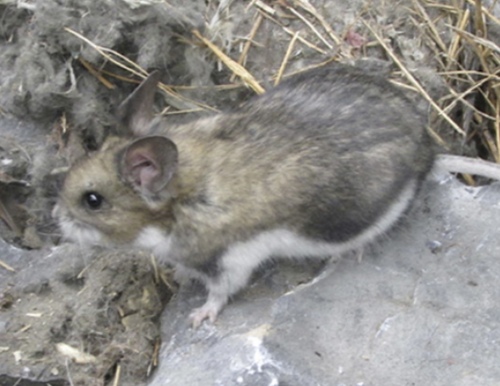
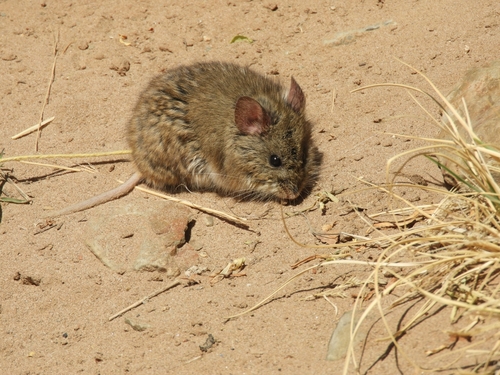
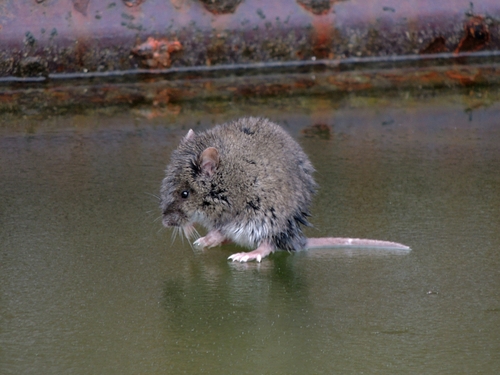
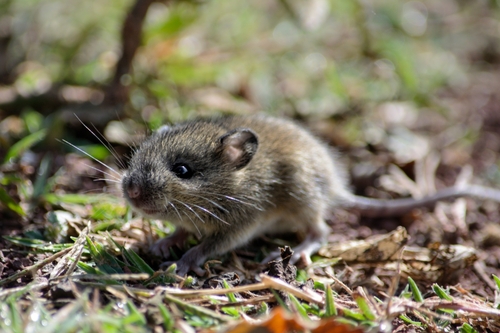
Dorsal pelage is olive-brown to grayish-brown, often with a slightly darker mid-dorsal stripe, giving the species its common name. The ventral surface is pale gray to whitish-gray. Ears are small and rounded, sparsely furred. The tail is moderately long, lightly bicolored (darker above, paler below), and covered in short hairs. Fur is dense and somewhat coarse.
Size
Head-body length: 80–115 mm; tail length: 55–92 mm. A small to medium-sized sigmodontine rodent, relatively compact in build.
Weight
Typically 15–32 g; most adults weigh 20–26 g. Sexual dimorphism in mass is minimal.
Distinctive features
Distinguished from the closely related Abrothrix longipilis by shorter, less lush fur and a slightly smaller average body size. Compared to Abrothrix andina, it is found at lower altitudes and has a more distinctly olive (rather than purely gray) dorsal pelage. Its more compact ears and less pronounced fur length separate it from sympatric congeners.
Differences between males and females
Minimal; males and females are similar in size, weight, and coloration. Males may be marginally heavier on average but the difference is not consistently significant.
Behaviour and diet of the Olive Grass Mouse
Largely solitary outside of reproductive interactions. Individuals maintain small, partially overlapping home ranges. Population densities can be locally high, but there is no evidence of structured social groups or cooperative behavior. Agonistic interactions between adults are likely near burrows or resource patches.
When it is active
Primarily nocturnal and crepuscular, with peak activity in the hours immediately after sunset and before sunrise. Some daytime surface activity has been recorded during overcast, cool, or moist weather conditions typical of southern Patagonia.
Diet
Omnivorous and opportunistic; diet includes seeds, green plant matter, underground fungi (hypogeous fungi), invertebrates (insects, larvae, earthworms), and occasionally small vertebrates or carrion. Diet composition shifts seasonally and geographically according to resource availability.
How it feeds and hunts
Forages on the ground and in low vegetation, using long vibrissae to detect food items under litter or in darkness. Invertebrates are captured by active pursuit, pouncing, or gleaning from substrate surfaces. No specialized or cooperative hunting behavior is known.
Communication
Produces ultrasonic vocalizations for mother-pup communication; adult interactions may also involve auditory signals. Scent marking via urine and possibly glandular secretions is presumed for territory delineation and reproductive signaling, consistent with other sigmodontines. Vibrissae play an important role in tactile orientation.
Interactions with other species
Key prey for Barn Owls (Tyto alba), Rufous-legged Owls (Strix rufipes), Culpeo Fox (Lycalopex culpaeus), South American Gray Fox (Lycalopex griseus), and various Buteo hawks. Competes for resources with other small rodents such as Oligoryzomys longicaudatus and Phyllotis darwini. Serves as host for ectoparasites (fleas, mites, lice) and endoparasites (helminths).
Role in its ecosystem
Functions as an important primary consumer linking plant production to higher trophic levels, and as a seed disperser for various plant species. Its high abundance makes it a cornerstone prey base for raptors and mammalian carnivores across Patagonia and Tierra del Fuego. It also contributes to soil aeration through burrowing activity.
Reproduction and lifecycle
Breeding peaks in austral spring and summer (September–March), though reproduction may occur year-round in coastal areas with mild winters. Gestation lasts approximately 20–23 days. Litter sizes range from 2 to 6 pups, with an average of 3–4. Multiple litters per season are possible.
Raising the young
Pups are altricial at birth — hairless, eyes closed, and dependent on maternal care. The female alone provides parental care, nursing pups in a grass- or fiber-lined nest within a burrow or dense vegetation. Weaning occurs at approximately 15–21 days, after which juveniles disperse rapidly.
Maturity and lifespan
Sexual maturity is reached at approximately 2–3 months of age, enabling rapid population recovery after crashes. Lifespan in the wild is typically under 12–18 months due to heavy predation pressure. Captive longevity data are limited but likely do not exceed 2–3 years.
Taxonomy and naming of the Olive Grass Mouse
Classification
Mammalia > Rodentia > Cricetidae (subfamily Sigmodontinae) > Abrothrix > Abrothrix olivaceus
Subspecies
Several subspecies have been proposed, including A. o. olivaceus (central Chile), A. o. brachiotis (southern Chile and Tierra del Fuego), A. o. canescens (more arid northern zones), and A. o. landbecki; subspecific limits remain under active taxonomic review and some forms may not be universally recognized.
Scientific synonyms
Originally described as Mus olivaceus Waterhouse, 1837; long classified as Akodon olivaceus before molecular and morphological studies confirmed its placement in the resurrected genus Abrothrix.
What research says
Recent studies
Phylogeographic analyses have demonstrated that populations in Tierra del Fuego carry signatures of post-glacial colonization from Patagonian refugia following the last glacial maximum. Studies have also examined the role of this species in hantavirus ecology and as a bioindicator of land-use change effects on small mammal communities in southern Chile.
Genome and DNA
The diploid chromosome number for Abrothrix olivaceus is reported as 2n = 44. Multilocus molecular phylogenetic studies (mitochondrial cytochrome b, nuclear IRBP) confirmed the genus Abrothrix as distinct from Akodon; phylogeographic studies have revealed significant genetic structuring across the species' range.
Compared with similar species
Most closely related to Abrothrix longipilis, which has distinctly longer and denser fur suited for wetter forest environments and generally lacks the olive tones. Abrothrix andina occupies higher Andean elevations and is grayer in coloration. Among the genus, A. olivaceus is the most ecologically generalist and geographically widespread species, contrasting with more habitat-specialist congeners.
The Olive Grass Mouse and people
The Olive Grass Mouse is one of the few mammals in the world that remains active year-round on the island of Tierra del Fuego, enduring some of the planet's most consistently harsh and windy conditions without hibernating. In Patagonian Barn Owl pellet studies, the remains of this single species often account for over 80% of all prey items identified, illustrating its extraordinary ecological dominance. Despite its small size, it can thrive at latitudes as far south as 56°S — farther south than any other native murid rodent in the Western Hemisphere.
Where and how to see it
Best observed at dusk and at night using a headlamp in open grasslands, shrubby ecotones, and forest edges within Tierra del Fuego National Park (Argentina) or the Magallanes Region (Chile). Standard Sherman live-traps baited with seeds and oats yield captures of this species in nearly any suitable Patagonian habitat. Look for runways and small burrow entrances at the base of tussock grasses and shrubs.
Risks to humans
Low but non-zero risk: may carry hantavirus antibodies and could theoretically transmit infection via contact with excreta, though documented transmission from this species specifically is not established. Bites can occur if the animal is handled without gloves. Standard precautions (gloves, masks) are recommended when handling wild individuals.
Human uses
Widely used as a study organism in ecological, parasitological, and zoonotic disease research across southern South America. Frequently captured in small-mammal monitoring programs used to assess ecosystem health and land-use change impacts. Not used in traditional medicine, the pet trade, or commercial harvesting.
Countries where the Olive Grass Mouse is recorded
The 2 countries named in the range description of its IUCN Red List assessment.
Questions about the Olive Grass Mouse
Where does the Olive Grass Mouse live?
The Olive Grass Mouse is recorded in Argentina and Chile across South America. These countries come from the range description of its IUCN Red List assessment, and they are what place the species on the interactive map.
Is the Olive Grass Mouse endangered?
The IUCN Red List assesses the Olive Grass Mouse as Least Concern. The species is widespread and abundant enough not to qualify for any threatened category. It does not mean the species is safe forever, only that nothing in the current data raises an alarm.
How many are left in the wild?
No precise global census exists. This figure comes from the species assessment on the IUCN Red List; population estimates for wild mammals are ranges, not counts, and are revised at each assessment.
What habitat does the Olive Grass Mouse live in?
Highly versatile; inhabits Chilean matorral (shrubland), Valdivian and Magellanic temperate rainforests, Patagonian steppe grasslands, bog margins, subantarctic scrub, and forest-edge ecotones.
What is the scientific name of the Olive Grass Mouse?
The Olive Grass Mouse is Abrothrix olivaceus, in the family Cricetidae, order Rodentia.
Other species in the genus Abrothrix
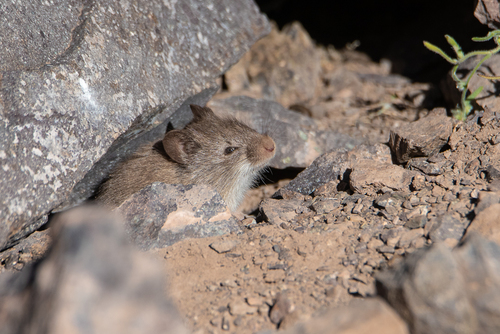

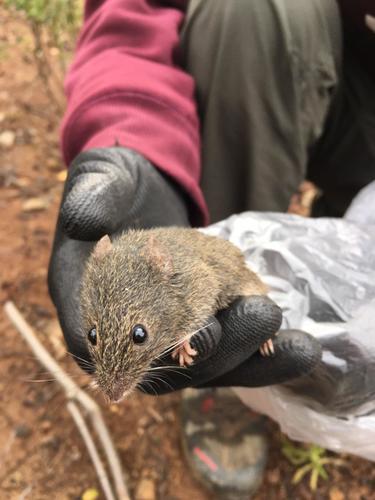
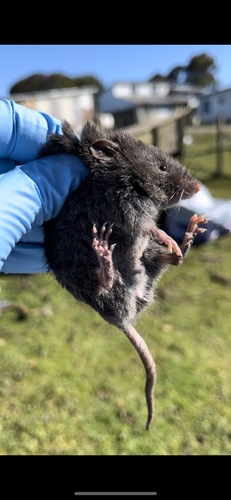
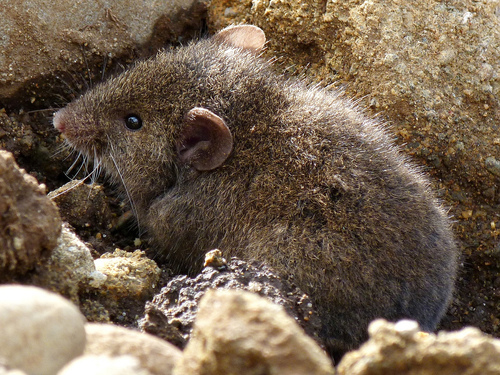
Other species in the family Cricetidae
Sources
Conservation status, range description and population estimate come from the IUCN Red List assessment for Abrothrix olivaceus. Countries are derived from that range description, not from a mapped country list. Last refreshed on .
The distribution map is drawn from the IUCN Red List spatial data compiled in 2017. IUCN (International Union for Conservation of Nature)