
Tuva Silver Vole
Alticola tuvinicus
Red List assessment
Least Concernon the IUCN Red List
- EXExtinct
- EWExtinct in the Wild
- CRCritically Endangered
- ENEndangered
- VUVulnerable
- NTNear Threatened
- LCLeast Concern
The Tuva Silver Vole is recorded in 2 countries across Asia and Europe. The IUCN Red List assesses the Tuva Silver Vole as Least Concern. No precise global population estimate is available.
- Family
- Cricetidae
- Order
- Rodentia
- Genus
- Alticola
- Countries recorded
- 2
- Continents
- Asia and Europe
- Red List category
- Least Concern
- Data updated
- August 9, 2026
What is the Tuva Silver Vole?
The Tuva Silver Vole (Alticola tuvinicus) is a small arvicoline rodent endemic to or centered on the Tyva Republic of Russia, nestled between the Western Sayan and Tannu-Ola mountain ranges in southern Siberia. It belongs to the 'silver voles' group of the genus Alticola, characterized by notably soft, dense, silvery-gray pelage and a strong association with rocky montane terrain. It is one of the least-studied members of its genus due to the remoteness and inaccessibility of its range. It is classified as Least Concern by the IUCN, reflecting a presumed stable population in a relatively undisturbed habitat.
Where does the Tuva Silver Vole live?
Russia (Tyva/Tuva Republic, southern Siberia) and possibly adjacent areas of northwestern Mongolia
The species is primarily distributed within the Tyva (Tuva) Republic of the Russian Federation in southern Siberia, within the mountain systems of the Western Sayan, the Tannu-Ola range, and associated highlands. Its range may marginally extend into the adjacent Mongolian Altai and northwestern Mongolia. The overall distribution is geographically restricted compared to other members of the Alticola genus.
Altitude and depth
Typically found at elevations between approximately 1,000 and 3,000 meters above sea level, consistent with other high-mountain members of the Alticola genus in the region.
Seasonal movements
Active year-round without true hibernation, though surface activity is likely reduced during the harshest winter periods with deep snow cover. Breeding peaks from late spring through early autumn. In late summer, the species likely engages in food-caching (haypiling) behavior to prepare for winter scarcity.
Habitat of the Tuva Silver Vole
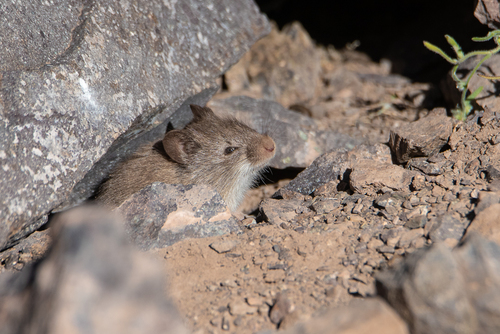
Rocky slopes, talus fields, boulder-strewn mountainsides, and alpine to subalpine meadows. The species shows a strong preference for areas with abundant rock crevices and outcrops that provide shelter from predators and harsh weather. Mountain steppes with rocky substrate also fall within its habitat range.
Adaptations to its environment
Dense, soft silvery fur provides excellent thermal insulation in cold montane environments. A compact, robust body form and strong claws aid navigation across rocky talus and boulder fields. The use of rock crevices for nesting provides protection from both predators and temperature extremes. Haypiling behavior, common to high-mountain voles, allows survival through long Siberian winters.
Conservation status and numbers
Least Concern (LC) on the IUCN Red List. The species is not considered at significant risk; its population is presumed stable and no major range-wide threats have been identified. Its remote, rugged mountain habitat provides natural insulation from large-scale anthropogenic disturbance.
Estimated population
No precise global population estimate is available. The population is presumed to be stable based on the Least Concern IUCN assessment and the relatively pristine condition of its montane range.
What threatens the Tuva Silver Vole?
Potential threats include overgrazing by livestock in mountain pastures, which can degrade alpine vegetation and alter rocky habitat. Long-term climate change poses a risk by shifting or contracting alpine and subalpine zones. No acute immediate threats are currently documented for this species.
Diseases and parasites
Like other Siberian small rodents, the Tuva Silver Vole likely harbors ectoparasites such as fleas, ticks, and mites, as well as endoparasitic helminths. It may potentially serve as a reservoir for zoonotic pathogens circulating among Siberian rodents, though no species-specific studies are available.
What is being done to protect it?
No species-specific conservation programs are known. The species may receive incidental protection within established protected areas in the Tyva Republic, notably the Ubsunur Hollow UNESCO World Heritage Site and Biosphere Reserve shared between Russia and Mongolia.
Recommended actions
Targeted field surveys to accurately delineate the species' range and assess population density. Monitoring of alpine habitat quality in the Tuva mountain region. Evaluation of the potential long-term effects of climate change on its subalpine and rocky-steppe ecosystems.
What the Tuva Silver Vole looks like
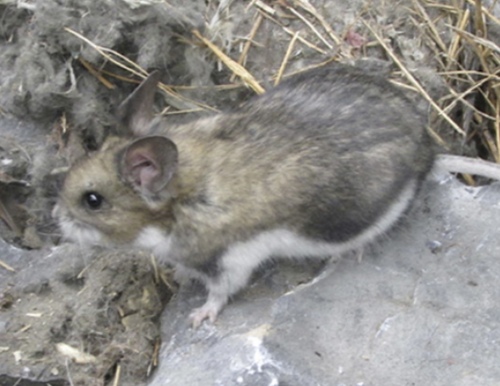
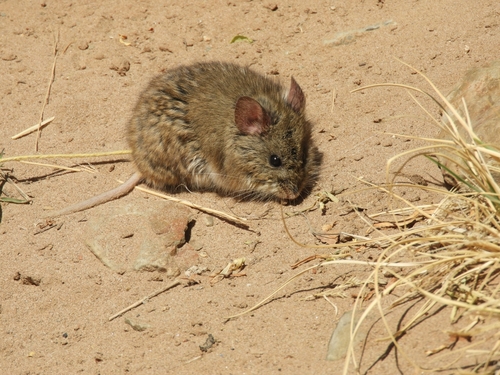
The dorsal fur is soft, dense, and silvery-gray to pale brownish-gray, giving the species and its congeners the 'silver vole' designation. The ventral surface is considerably paler, typically whitish or light gray. The ears are relatively large and prominent for a vole, and the tail is short and sparsely furred. The feet are broad and sturdy.
Size
Body length approximately 90–130 mm; tail length approximately 20–40 mm (relatively short, characteristic of the genus). Hindfoot length approximately 15–20 mm.
Weight
Typically between 20 and 50 grams; sexual dimorphism in weight is minimal.
Distinctive features
Distinguished from closely related species primarily by its restricted geographic range in the Tuva region and subtle differences in cranial morphology and karyotype. The very soft, silvery dorsal pelage is a hallmark of the Alticola genus as a whole, making external identification to species level difficult without geographic context or skull measurements.
Differences between males and females
Sexual dimorphism is minimal; males and females are similar in both body size and coloration, as is typical for the Arvicolinae subfamily.
Behaviour and diet of the Tuva Silver Vole
Likely semi-colonial or loosely social, consistent with related Alticola species. May form small family clusters occupying shared rocky crevice systems. Some territorial behavior around stored food caches is probable in autumn.
When it is active
Primarily diurnal or crepuscular, with activity peaks in the morning and late afternoon. Remains active year-round, with surface activity potentially curtailed during extreme cold snaps or heavy snowfall.
Diet
Strictly herbivorous; feeds on grasses, sedges, forbs, mosses, lichens, roots, and other available mountain vegetation. In late summer and early autumn, it likely gathers and dries plant material into stored 'hay piles' near rocky shelters as a winter food reserve.
Communication
Communication likely involves high-frequency vocalizations for alarm and social contact, as well as scent marking via urine and glandular secretions to delineate territories. Tactile communication is probable during social interactions and mating.
Interactions with other species
Natural predators likely include raptors such as eagles and buzzards, owls, mustelids (weasels, stoats), and foxes that inhabit the Tuva mountain region. As a herbivore, it contributes to plant community dynamics through selective grazing. It may compete with other small rodents and pikas (Ochotona spp.) for rocky habitat and food resources.
Role in its ecosystem
Functions as an important prey species in montane food webs, supporting populations of raptors and small carnivores. As a herbivore, it contributes to nutrient cycling and plant community structure in alpine ecosystems. Its food-caching behavior may incidentally disperse plant material.
Reproduction and lifecycle
Breeding season extends from approximately May to September. Gestation is estimated at 19–21 days, typical for arvicolines. Litter size is estimated at 3–8 young, with likely 2–4 litters per year during the active season.
Raising the young
The female provides primary parental care, nursing altricial young in a grass-lined nest located within a rock crevice or beneath boulders. Young develop rapidly and typically reach independence within 3–4 weeks, as is common in arvicoline rodents.
Maturity and lifespan
Sexual maturity is likely reached at 4–6 weeks of age, as is typical for arvicoline rodents. Wild lifespan is estimated at 1–2 years; no captive longevity data are available for this species specifically.
Taxonomy and naming of the Tuva Silver Vole
Classification
Mammalia > Rodentia > Cricetidae (subfamily Arvicolinae) > Alticola > Alticola tuvinicus
Scientific synonyms
Described by Ognev in 1950; previously considered by some authorities as a subspecies of Alticola argentatus. No widely used synonyms are recorded in current literature.
What research says
Recent studies
Scientific research on Alticola tuvinicus specifically is sparse. Broader molecular and phylogeographic studies of the Alticola genus, particularly those using mitochondrial and nuclear markers, have contributed to resolving species boundaries and confirming the validity of A. tuvinicus as a distinct species rather than a subspecies of A. argentatus.
Genome and DNA
Specific chromosome data for A. tuvinicus are not widely reported in accessible literature. Related Alticola species exhibit notable karyotypic variation within the genus, with diploid numbers (2n) ranging approximately from 38 to 54. Molecular phylogenetic studies of Alticola have helped clarify the taxonomic position of the species within the silver vole clade.
Compared with similar species
Alticola tuvinicus is most closely related to the Silver Mountain Vole (Alticola argentatus) and the Flat-headed Vole (Alticola strelzowi), all sharing rocky mountain habitats across Central Asia. It is distinguished from A. argentatus by its more restricted range and subtle cranial differences. Compared to Alticola macrotis, it has shorter ears. The genus as a whole converges ecologically with pikas (Ochotona) in rocky alpine habitats, though they are not closely related.
The Tuva Silver Vole and people
The Tyva Republic, home of the Tuva Silver Vole, is famous for being one of the geographical centers of the Asian continent — the animal literally lives near the heart of Asia. Like its pika neighbors, this tiny vole likely constructs 'haypiles' of dried vegetation — a sophisticated food-storage strategy that mimics miniature haystacks under the rocks. Despite thriving in one of Siberia's harshest mountain climates, it never hibernates, remaining active beneath snow throughout the brutal Tuvan winter.
Where and how to see it
Best observed in rocky, boulder-strewn slopes of the Sayan and Tannu-Ola mountain ranges within the Tyva Republic, Russia. Morning and late afternoon are the most productive times. The Ubsunur Hollow Biosphere Reserve and surrounding montane zones offer accessible habitat. Patience and stillness near rocky outcrops are key, as the voles are alert and quick to retreat into crevices.
Risks to humans
No notable risk. This small rodent poses no significant danger to humans. As with all wild Siberian rodents, caution is advisable when handling individuals due to the potential for ectoparasites and the theoretical risk of zoonotic pathogens.
Countries where the Tuva Silver Vole is recorded
The 2 countries named in the range description of its IUCN Red List assessment.
Questions about the Tuva Silver Vole
Where does the Tuva Silver Vole live?
The Tuva Silver Vole is recorded in Mongolia and Russia across Asia and Europe. These countries come from the range description of its IUCN Red List assessment, and they are what place the species on the interactive map.
Is the Tuva Silver Vole endangered?
The IUCN Red List assesses the Tuva Silver Vole as Least Concern. The species is widespread and abundant enough not to qualify for any threatened category. It does not mean the species is safe forever, only that nothing in the current data raises an alarm.
How many are left in the wild?
No precise global population estimate is available. This figure comes from the species assessment on the IUCN Red List; population estimates for wild mammals are ranges, not counts, and are revised at each assessment.
What habitat does the Tuva Silver Vole live in?
Rocky slopes, talus fields, boulder-strewn mountainsides, and alpine to subalpine meadows.
What is the scientific name of the Tuva Silver Vole?
The Tuva Silver Vole is Alticola tuvinicus, in the family Cricetidae, order Rodentia.
Other species in the genus Alticola

Other species in the family Cricetidae
Sources
Conservation status, range description and population estimate come from the IUCN Red List assessment for Alticola tuvinicus. Countries are derived from that range description, not from a mapped country list. Last refreshed on .
The distribution map is drawn from the IUCN Red List spatial data compiled in 2008. IUCN (International Union for Conservation of Nature)