
Spotted Paca
Cuniculus paca
Red List assessment
Least Concernon the IUCN Red List
- EXExtinct
- EWExtinct in the Wild
- CRCritically Endangered
- ENEndangered
- VUVulnerable
- NTNear Threatened
- LCLeast Concern
The Spotted Paca is recorded in 17 countries across North America and South America. The IUCN Red List assesses the Spotted Paca as Least Concern. No precise global population estimate exists.
- Family
- Cuniculidae
- Order
- Rodentia
- Genus
- Cuniculus
- Countries recorded
- 17
- Continents
- North America and South America
- Red List category
- Least Concern
- Data updated
- August 9, 2026
What is the Spotted Paca?
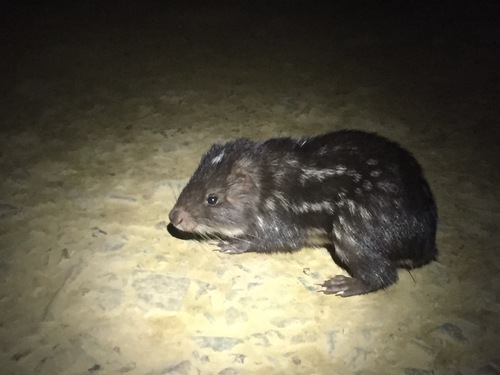
The Spotted Paca is a large, robust nocturnal rodent and one of the biggest in the Neotropical region, instantly recognizable by its rows of white spots on a dark brown coat. It inhabits tropical and subtropical moist forests, always in close proximity to rivers, streams, or other bodies of water. It is ecologically significant as both a seed predator and a key prey species for large felids and reptiles. Highly prized as bushmeat throughout its range, it is among the most heavily hunted mammals in Latin America.
Where does the Spotted Paca live?
Southern Mexico, Central America, and South America (from Veracruz and Oaxaca south to northern Argentina and southern Brazil)
Ranges from the Gulf Coast lowlands of Mexico (Veracruz, Tabasco, Chiapas) through all Central American countries (Belize, Guatemala, Honduras, El Salvador, Nicaragua, Costa Rica, Panama) and across most of South America east of the Andes, including Colombia, Venezuela, Trinidad and Tobago, the Guianas, Ecuador, Peru, Bolivia, Brazil, Paraguay, and northeastern Argentina.
Altitude and depth
Typically found from sea level to approximately 2,000 m elevation, though most abundant below 1,500 m. In Andean foothill zones it can occasionally be recorded up to 2,000 m where suitable forest and water sources exist.
Seasonal movements
Non-migratory; resident year-round within its territory. Seasonal variation in fruit availability may influence local movements and foraging intensity, with activity peaks coinciding with masting events of preferred tree species. No hibernation occurs.
Habitat of the Spotted Paca
Primarily lowland tropical and subtropical moist broadleaf forests, with a strong affinity for riparian corridors along streams and rivers. Also found in secondary forests, forest edges, and occasionally in agricultural areas bordering forest. Dense undergrowth and proximity to water are essential habitat requirements; it digs burrows in riverbanks or among tree roots.
Adaptations to its environment
Possesses highly enlarged zygomatic arches (cheekbones) that form resonating chambers, amplifying vocalizations for communication and possibly alarm. Its powerful, partially webbed hind feet make it an excellent swimmer, and it readily enters water to escape terrestrial predators. Nocturnal habits and cryptic spotted coloration provide camouflage in dappled forest light. Strong incisor teeth allow it to gnaw through very hard seeds that other species cannot access.
Conservation status and numbers
Least Concern (LC) on the IUCN Red List. Although populations are declining across much of the range due to hunting pressure and habitat loss, the species retains a broad distribution and adaptability to secondary habitats. It does not currently meet thresholds for a threatened category, though local extirpations are common near human settlements.
Estimated population
No precise global population estimate exists. The overall trend is considered declining, particularly in heavily hunted or deforested regions, though the species remains locally common in protected areas with limited human access.
What threatens the Spotted Paca?
Intensive bushmeat hunting is the primary threat, as the spotted paca is one of the most valued game animals in Neotropical rural communities. Habitat loss through deforestation, agricultural expansion, and dam construction (flooding riparian habitats) also significantly impacts populations. Fragmentation of forest prevents recolonization of depleted areas.
Diseases and parasites
Hosts various endoparasites including nematodes, cestodes, and protozoa. Ectoparasites such as ticks and bot fly larvae (Cuterebra spp.) are common. Can serve as a reservoir for Leishmania parasites and Trypanosoma cruzi (Chagas disease), making it of public health relevance in some regions. Susceptibility to leptospirosis has also been documented.
What is being done to protect it?
Protected within numerous national parks and nature reserves throughout its range (e.g., Calakmul Biosphere Reserve in Mexico, Barro Colorado Island in Panama, Amazon reserves in Brazil). Listed on CITES Appendix III (Honduras). Captive breeding and sustainable ranching programs have been trialed in Costa Rica, Panama, and Colombia as alternatives to wild hunting. Hunting regulations exist in most range countries but are rarely enforced.
Recommended actions
Strengthening enforcement of hunting regulations and establishing community-based wildlife management programs are priorities. Expanding and connecting forest reserves to allow population recovery in hunted areas is essential. Promoting and scaling sustainable paca farming as a protein alternative for rural communities could reduce pressure on wild populations. Long-term population monitoring across the range is needed.
What the Spotted Paca looks like
The dorsal coat is dark reddish-brown to dark grey-brown, adorned with 3–5 longitudinal rows of irregular white or pale yellowish spots on each flank — the species' most distinctive feature. The ventral surface is white to cream. The body is robust and barrel-shaped, the head large with notably pronounced cheekbones, ears small and rounded, and the legs relatively short with four digits on the forefeet and five on the hindfeet.
Size
Body length 60–82 cm; vestigial tail of 1–3 cm. Shoulder height approximately 30–35 cm. A stocky, compact animal with relatively short limbs.
Weight
Adults typically weigh 6–14 kg, with most individuals between 7 and 10 kg. Males and females are similar in size, though males may average slightly heavier.
Distinctive features
Easily distinguished from agoutis (Dasyprocta spp.) by its much larger size, spotted coat pattern, and lack of a visible tail. The closely related Mountain Paca (Cuniculus taczanowskii) of the Andes is darker, larger, and restricted to higher elevations. The extraordinary inflation of the cheekbone region, forming hollow resonating chambers, is unique among rodents.
Differences between males and females
Sexual dimorphism is minimal; males and females are of similar size and coloration. Males possess a pair of anal scent glands. No horn, crest, or striking color differences between sexes.
Behaviour and diet of the Spotted Paca
Largely solitary outside of breeding pairs. Adults are territorial and defend home ranges (typically 2–10 ha) from conspecifics of the same sex. Mated pairs may share overlapping ranges and occasionally rest in close proximity. Young remain with the mother until near independence.
When it is active
Strictly nocturnal, typically emerging from burrows after dusk and returning before dawn. Peak activity occurs in the first few hours after darkness. During the day it rests in burrows dug in earthen banks, under roots, or among boulders. It may occasionally be active on moonless nights or during overcast conditions.
Diet
Strict herbivore. Diet consists primarily of fallen fruits and seeds (especially hard-shelled seeds it can crack with powerful incisors), supplemented by roots, tubers, bulbs, stems, and leaves. Favored foods include palm nuts, mango, avocado, and various rainforest tree seeds. It occasionally caches food but is not considered a major long-distance seed disperser.
How it feeds and hunts
Not applicable; the spotted paca is a herbivore. It forages by moving slowly along the forest floor, using its keen sense of smell to locate fallen fruits and seeds. Hard seeds are cracked open with the robust incisors and strong jaw muscles.
Communication
Produces a variety of vocalizations including low grunts, rumbles, squeals, and tooth-chattering, amplified by the resonating cheekbone chambers. Scent marking with anal glands and urine is used to delineate territories. When alarmed, it stamps its hind feet on the ground and may emit a loud bark or grunt before fleeing, often into water.
Interactions with other species
Major prey for jaguar (Panthera onca), puma (Puma concolor), ocelot (Leopardus pardalis), spectacled caiman (Caiman crocodilus), boa constrictors, and anacondas. Competes with agoutis, collared peccaries, and other frugivores for fallen fruit. Its burrows may be secondarily occupied by other small mammals. Functions as a seed predator for hard-seeded trees.
Role in its ecosystem
Plays an important role as a seed predator, consuming and destroying large numbers of hard seeds that other species cannot process. Through scatter-hoarding behavior it may occasionally act as a short-distance seed disperser. As abundant prey, it is a critical link in the food chain supporting apex predators. Burrow construction contributes to soil aeration in forest habitats.
Reproduction and lifecycle
Breeding occurs year-round in tropical areas, with possible peaks tied to fruiting seasons. Gestation lasts approximately 114–119 days, producing 1 (rarely 2) precocial young per litter. Females may produce 1–2 litters per year. Neonates are born fully furred, eyes open, and are capable of running within hours.
Raising the young
The mother provides primary parental care. Young are kept in the burrow and nursed for approximately 90 days, though they begin sampling solid food at a few weeks of age. The male's role in parental care is minimal but pairs may maintain proximity. Juveniles disperse to establish independent territories at 3–4 months of age.
Maturity and lifespan
Sexual maturity is reached at approximately 6–12 months of age. In the wild, lifespan is typically 7–13 years, though heavy predation and hunting mean few individuals reach old age. In captivity, individuals have lived up to 16 years.
Taxonomy and naming of the Spotted Paca
Classification
Mammalia > Rodentia > Cuniculidae > Cuniculus > Cuniculus paca
Subspecies
Several subspecies are recognized: C. p. paca (Amazonian South America), C. p. virgatus (Mexico and Central America), C. p. nelsoni (Oaxaca, Mexico), C. p. guanta (Ecuador and Peru), C. p. costaricensis (Costa Rica). Taxonomic boundaries remain debated among researchers.
Scientific synonyms
Mus paca Linnaeus, 1766 (original description); Agouti paca (Linnaeus, 1766); Coelogenys paca; Cuniculus mexicanus. The genus was long placed in Agoutidae alongside true agoutis before being assigned to its own family Cuniculidae.
What research says
Recent studies
Recent studies using camera traps have refined understanding of its home range size and habitat requirements in fragmented landscapes. Research in Panama has quantified the impact of hunting on local population densities and recovery rates. Isotopic studies have documented its dietary flexibility across seasons and habitats.
Genome and DNA
Diploid chromosome count is 2n = 74. Molecular phylogenetic studies confirm that Cuniculus is distinct from agoutis (Dasyprocta) and other caviomorphs, supporting its placement in its own monotypic family Cuniculidae. Limited genomic studies have been conducted compared to other rodents.
Compared with similar species
The spotted paca is closely related to the Mountain Paca (Cuniculus taczanowskii), which is larger, darker, inhabits Andean cloud forests (1,200–3,800 m), and is assessed as Vulnerable. Despite superficial resemblance to agoutis (Dasyprocta spp.), the two groups diverged early in caviomorph evolution; pacas are heavier, spotted, nocturnal, and semi-aquatic, while agoutis are diurnal, unspotted, and slender.
The Spotted Paca and people
The spotted paca's inflated cheekbones are hollow resonating chambers unique among rodents, giving its calls a surprisingly deep, resonant quality for an animal its size. It is an excellent swimmer and diver, often escaping predators by plunging into water and remaining submerged for several minutes. Despite being one of the most hunted animals in Latin America, it is also successfully raised in small-scale farms ('pacarios') where it reproduces reliably in captivity.
Where and how to see it
Best observed on nocturnal walks along forest rivers and streams, particularly in protected areas with low hunting pressure such as Tortuguero National Park (Costa Rica), Barro Colorado Island (Panama), or the Lacandón forest (Mexico). A headlamp or red-filtered torch used quietly along riverbanks maximizes sighting chances. The dry season (Jan–May in many areas) is optimal as vegetation is less dense. It can also be detected by the sound of hard seeds being cracked in the undergrowth.
Risks to humans
No notable venom or aggressive threat to humans. May bite if cornered or handled. Of indirect public health concern as a reservoir for Leishmania and Trypanosoma cruzi in some regions, particularly relevant to hunters who handle carcasses.
Human uses
One of the most important bushmeat species in Latin America, consumed by both indigenous and rural populations from Mexico to Argentina; its meat is highly regarded for its flavor and nutritional value. Commercially farmed in small-scale operations ('pacarios') in Costa Rica, Panama, Colombia, and Venezuela as a sustainable protein source. Occasionally kept as a pet. Used in traditional medicine in some communities. Subject of ecotourism interest in certain protected areas.
Myths and legends
In many indigenous cultures of Mesoamerica and Amazonia, the spotted paca holds cultural significance as a prized and prestigious food associated with feasts and celebrations. Among some Mayan communities, it features in traditional oral stories as a clever, elusive forest creature. In parts of Colombia and Venezuela, it is believed that finding a paca burrow near a water source brings good luck to the hunter.
Countries where the Spotted Paca is recorded
The 17 countries named in the range description of its IUCN Red List assessment.
Questions about the Spotted Paca
Where does the Spotted Paca live?
The Spotted Paca is recorded in Argentina, Belize, Bolivia, Brazil and Colombia, among 17 countries in total across North America and South America. These countries come from the range description of its IUCN Red List assessment, and they are what place the species on the interactive map.
Is the Spotted Paca endangered?
The IUCN Red List assesses the Spotted Paca as Least Concern. The species is widespread and abundant enough not to qualify for any threatened category. It does not mean the species is safe forever, only that nothing in the current data raises an alarm.
How many are left in the wild?
No precise global population estimate exists. This figure comes from the species assessment on the IUCN Red List; population estimates for wild mammals are ranges, not counts, and are revised at each assessment.
What habitat does the Spotted Paca live in?
Primarily lowland tropical and subtropical moist broadleaf forests, with a strong affinity for riparian corridors along streams and rivers.
What is the scientific name of the Spotted Paca?
The Spotted Paca is Cuniculus paca, in the family Cuniculidae, order Rodentia.
Other species in the genus Cuniculus
Species that share its range


Sources
Conservation status, range description and population estimate come from the IUCN Red List assessment for Cuniculus paca. Countries are derived from that range description, not from a mapped country list. Last refreshed on .
The distribution map is drawn from the IUCN Red List spatial data compiled in 2016. IUCN SSC Small Mammal Specialist Group