
Mountain Paca
Cuniculus taczanowskii
Red List assessment
Near Threatenedon the IUCN Red List
- EXExtinct
- EWExtinct in the Wild
- CRCritically Endangered
- ENEndangered
- VUVulnerable
- NTNear Threatened
- LCLeast Concern
The Mountain Paca is recorded in 5 countries across South America. The IUCN Red List assesses the Mountain Paca as Near Threatened. No precise global population estimate exists.
- Family
- Cuniculidae
- Order
- Rodentia
- Genus
- Cuniculus
- Countries recorded
- 5
- Continents
- South America
- Red List category
- Near Threatened
- Data updated
- August 9, 2026
What is the Mountain Paca?
The Mountain Paca is a large, stocky Andean rodent and one of the biggest rodents found at high elevations in South America. It is closely related to the lowland paca (Cuniculus paca) but is adapted to cooler, montane cloud-forest environments along the Andean cordillera. It is notable for its striking spotted coat pattern and its importance as bushmeat in Andean communities. Named in honor of Polish zoologist Władysław Taczanowski, who collected specimens in Peru during the 19th century.
Where does the Mountain Paca live?
Andes mountains of South America: Venezuela, Colombia, Ecuador, Peru, and Bolivia
Distributed along the Andes from western Venezuela and Colombia south through Ecuador and Peru to central Bolivia. In Peru, it is found in departments such as Cusco, Puno, Junín, and Madre de Dios on the eastern Andean slopes. Its range broadly overlaps with cloud-forest zones along the Andean cordillera.
Altitude and depth
Typically found between 1,500 and 4,000 m above sea level, with core populations concentrated between 2,000 and 3,500 m; this higher-altitude preference clearly distinguishes it from the lowland paca.
Seasonal movements
No significant seasonal migrations are documented. Activity patterns may shift slightly with rainfall seasons, as fruit and seed availability fluctuates. No hibernation occurs, though individuals may be less active during cold, dry Andean winters.
Habitat of the Mountain Paca
Primarily montane and cloud forests of the Andes, frequently near streams, rivers, and other water bodies where dense vegetation provides cover. It inhabits humid to semi-humid forest understories and riparian corridors with abundant leaf litter and fallen logs. It occasionally ventures into forest edges and secondary vegetation but is closely tied to intact forest.
Adaptations to its environment
Possesses large, resonating cheek chambers (zygomatic arches) that amplify low-frequency vocalizations, useful in dense forest. Its robust, compact body and relatively short limbs are suited for burrowing in steep Andean terrain. Dense, dark fur provides insulation against cooler montane temperatures, and strong claws facilitate digging burrows into earthen banks near streams.
Conservation status and numbers
Near Threatened (NT) on the IUCN Red List. The species is not yet in immediate danger of extinction but faces a declining population trend due to sustained hunting pressure and progressive habitat loss across its Andean range. It does not yet qualify as Vulnerable but could do so if current trends continue.
Estimated population
No precise global population estimate exists. The overall trend is considered declining, driven mainly by overhunting and habitat reduction. Populations are suspected to be locally fragmented in heavily disturbed areas.
What threatens the Mountain Paca?
Intensive hunting for bushmeat represents the primary threat, as mountain pacas are highly valued for their meat in Andean rural communities. Deforestation and conversion of cloud forest for agriculture, cattle ranching, and coca cultivation are major drivers of habitat loss. Road construction opening previously inaccessible montane areas facilitates increased hunting pressure.
Diseases and parasites
Susceptible to various intestinal helminths (nematodes, cestodes) and ectoparasites (ticks, mites, lice) common to Neotropical rodents. It can harbor Leishmania parasites and leptospirosis-causing bacteria, making it a potential reservoir host of zoonotic disease, though data specific to this species remain limited.
What is being done to protect it?
The species benefits indirectly from protected areas within its range, including Manu National Park and Biosphere Reserve (Peru), Madidi National Park (Bolivia), and various cloud-forest reserves in Ecuador and Colombia. National wildlife protection laws in range countries formally prohibit or regulate hunting, though enforcement is often weak in remote areas.
Recommended actions
Strengthening anti-poaching enforcement within and around protected areas is a priority. Community-based wildlife management programs that offer alternative livelihoods to local hunters are recommended. Expanding habitat connectivity between fragmented Andean forest patches and conducting systematic population surveys to establish baseline data are also urgently needed.
What the Mountain Paca looks like
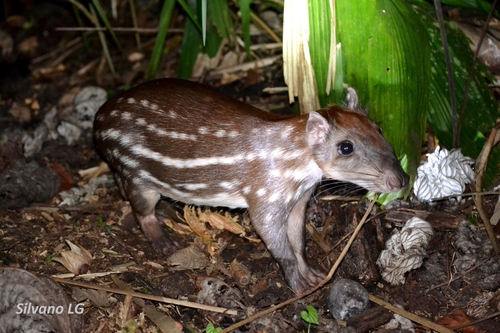
The Mountain Paca has a robust, barrel-shaped body with coarse, bristly fur that is dark brown to blackish-brown on the dorsum and sides. Three to five longitudinal rows of white or yellowish spots and streaks run along the flanks. The underparts are paler, creamy-white to buff. The head is large with prominent, bulging cheeks and small rounded ears.
Size
Body length approximately 50–75 cm; tail vestigial (2–3 cm); shoulder height roughly 25–35 cm.
Weight
Typically 6–12 kg; sexual size dimorphism is minimal, though males may be marginally heavier.
Distinctive features
Compared to the lowland paca (Cuniculus paca), the Mountain Paca tends to have darker, more uniformly blackish-brown dorsal pelage and is associated strictly with high-altitude cloud forests rather than lowland tropical rainforests. The two species are geographically separated by elevation, with the mountain paca occupying higher zones.
Differences between males and females
Sexual dimorphism is minimal; males and females are similar in size and coloration. Males may have slightly more developed jaw musculature associated with the resonating cheek bones.
Behaviour and diet of the Mountain Paca
Predominantly solitary outside the breeding season, with individuals maintaining exclusive or overlapping home ranges defended through scent marking and vocalizations. Mated pairs may share a burrow system temporarily. Population densities are generally low in montane habitats.
When it is active
Strictly nocturnal; individuals spend the day resting in burrows or dense vegetation and emerge after dusk to forage. Activity peaks in the first half of the night and again just before dawn.
Diet
Herbivorous; feeds on a variety of plant materials including fallen fruits, seeds, roots, tubers, bulbs, stems, and leaves. In montane habitats, it consumes a wide range of cloud-forest fruits and may cache hard seeds. It has been recorded gnawing on bark when preferred foods are scarce.
Communication
The Mountain Paca communicates through a range of low grunts, squeals, and tooth-chattering sounds amplified by its specialized resonating cheek chambers, producing surprisingly loud, deep calls. Scent marking with urine and glandular secretions is used to delineate territories. Tail-wagging and foot-stomping serve as alarm signals.
Interactions with other species
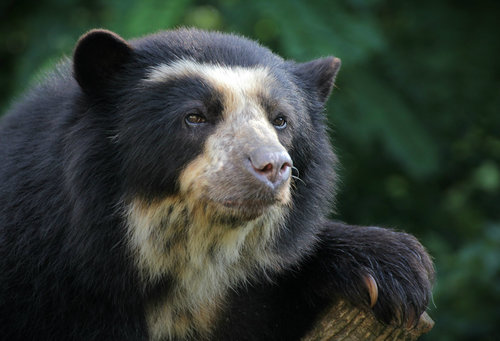
Natural predators include the puma (Puma concolor), ocelot (Leopardus pardalis), spectacled bear (Tremarctos ornatus), large constrictors such as Boa constrictor, and birds of prey such as the harpy eagle. It competes with mountain agoutis (Dasyprocta) and other rodents for similar plant resources. As a seed consumer and occasional scatterhoarder, it plays a role in seed dispersal for certain cloud-forest plants.
Role in its ecosystem
Functions as an important seed predator and secondary seed disperser in Andean cloud forests, influencing tree recruitment and forest composition. As a relatively large herbivore, it also serves as a key prey item for several apex and meso-predators, integrating it into montane food webs.
Reproduction and lifecycle
Breeding may occur year-round with peaks tied to seasonal fruit availability. Gestation lasts approximately 114–120 days (similar to the lowland paca). Litter size is typically one, rarely two, precocial young born with open eyes and a full coat. Females can produce two litters per year under favorable conditions.
Raising the young
The female is the primary caregiver; young are born in a grass-lined burrow and are highly precocial, able to follow the mother within days of birth. Weaning occurs at approximately 6–8 weeks, after which juveniles progressively become independent. Males do not provide direct parental care.
Maturity and lifespan
Sexual maturity is reached at approximately 9–12 months of age. Lifespan in the wild is estimated at 7–12 years; captive individuals of the related lowland paca have survived beyond 13 years.
Taxonomy and naming of the Mountain Paca
Classification
Mammalia > Rodentia > Cuniculidae > Cuniculus > Cuniculus taczanowskii
Scientific synonyms
Agouti taczanowskii (Stolzmann, 1865); Stictomys taczanowskii; formerly lumped with Cuniculus paca before genetic studies confirmed it as a distinct species.
What research says
Recent studies
Recent genetic studies have reinforced the separation of C. taczanowskii from C. paca and have helped delineate the altitudinal contact zones between the two species. Camera-trap surveys in Manu National Park and other Peruvian reserves have contributed new data on activity budgets, home range sizes, and habitat use in montane forest systems.
Genome and DNA
The chromosome number for the genus Cuniculus is 2n = 74, consistent with related family members. Molecular phylogenetic studies using mitochondrial and nuclear markers have confirmed the Mountain Paca as a species distinct from C. paca, with divergence likely occurring during Andean uplift and Pleistocene climate cycles.
Compared with similar species
The Mountain Paca is the high-altitude counterpart of the lowland paca (Cuniculus paca), which inhabits tropical lowland rainforests below ~1,500 m. The mountain species is generally darker in coloration, tolerant of cooler temperatures, and associated with cloud forests, while the lowland species is more broadly studied and more widespread. Both share the characteristic spotted flank pattern and large cheek resonators unique to the genus Cuniculus.
The Mountain Paca and people
The Mountain Paca's prominent zygomatic (cheek) arches act as natural resonating chambers, allowing it to produce booming, surprisingly loud calls that echo through the forest. Despite being hunted as one of the most prized bushmeat animals in Andean communities, pacas are excellent swimmers and will readily dive into streams to escape predators. The species was scientifically named in honor of Władysław Taczanowski, a Polish zoologist who described dozens of new Peruvian animal species in the 19th century and never personally set foot in Peru, collecting specimens entirely through correspondence.
Where and how to see it
Best observed at night along forest trails near streams and rivers in Manu National Park (Peru) or Madidi National Park (Bolivia) using spotlights or headlamps, as eye-shine is visible. Guided nocturnal walks with experienced local naturalist guides significantly increase detection probability. Dawn and dusk patrols near burrow entrances in undisturbed cloud-forest zones can also yield sightings.
Risks to humans
No notable direct risk to humans; the Mountain Paca is non-aggressive and flees when encountered. As a potential reservoir of Leishmania and leptospirosis, contact with blood during hunting or butchering presents minor zoonotic risk to hunters.
Human uses
Widely hunted for bushmeat throughout its range; its meat is highly prized and considered a delicacy in Andean rural and indigenous communities, representing an important source of protein and income. Subsistence and commercial hunting significantly impact local populations. It is occasionally kept in semi-captivity for meat production in some communities, though formal farming programs are not well established for this species compared to the lowland paca.
Myths and legends
In many Andean indigenous communities, the paca (known locally as 'majas' or 'picuro') holds cultural significance as a prized and prestigious game animal, associated with forest abundance and hunting skill. Its meat is considered a delicacy and is traditionally served at community feasts and celebrations. Some Amazonian groups attribute spiritual significance to certain large forest animals including the paca, associating their presence with healthy forests.
Countries where the Mountain Paca is recorded
The 5 countries named in the range description of its IUCN Red List assessment.
Questions about the Mountain Paca
Where does the Mountain Paca live?
The Mountain Paca is recorded in Bolivia, Colombia, Ecuador, Peru and Venezuela across South America. These countries come from the range description of its IUCN Red List assessment, and they are what place the species on the interactive map.
Is the Mountain Paca endangered?
The IUCN Red List assesses the Mountain Paca as Near Threatened. The species does not qualify as threatened today, but it is close to the thresholds and likely to cross them soon. It is the category that most often changes at the next assessment.
How many are left in the wild?
No precise global population estimate exists. This figure comes from the species assessment on the IUCN Red List; population estimates for wild mammals are ranges, not counts, and are revised at each assessment.
What habitat does the Mountain Paca live in?
Primarily montane and cloud forests of the Andes, frequently near streams, rivers, and other water bodies where dense vegetation provides cover.
What is the scientific name of the Mountain Paca?
The Mountain Paca is Cuniculus taczanowskii, in the family Cuniculidae, order Rodentia.
Other species in the genus Cuniculus
Species that share its range


Sources
Conservation status, range description and population estimate come from the IUCN Red List assessment for Cuniculus taczanowskii. Countries are derived from that range description, not from a mapped country list. Last refreshed on .
The distribution map is drawn from the IUCN Red List spatial data compiled in 2016. IUCN SSC Small Mammal Specialist Group