
Southern Pericote
Loxodontomys micropus
Red List assessment
Least Concernon the IUCN Red List
- EXExtinct
- EWExtinct in the Wild
- CRCritically Endangered
- ENEndangered
- VUVulnerable
- NTNear Threatened
- LCLeast Concern
The Southern Pericote is recorded in 2 countries across South America. The IUCN Red List assesses the Southern Pericote as Least Concern. No formal global population estimate exists.
- Family
- Cricetidae
- Order
- Rodentia
- Genus
- Loxodontomys
- Countries recorded
- 2
- Continents
- South America
- Red List category
- Least Concern
- Data updated
- August 9, 2026
What is the Southern Pericote?
Loxodontomys micropus is a medium-to-large sigmodontine rodent and the type species of the monotypic (or near-monotypic) genus Loxodontomys. It inhabits temperate Nothofagus forests, Andean shrublands, and rocky slopes in the southern Andes of Argentina and Chile. It is notable for being one of the larger phyllotine rodents, with a robust body and relatively short hindlimbs. First collected during Charles Darwin's Beagle voyage and described by George Waterhouse in 1837, it represents an important element of Patagonian montane rodent communities.
Where does the Southern Pericote live?
Southern Andes of Argentina (Neuquén, Río Negro, Chubut, Mendoza provinces) and adjacent regions of Chile
Restricted to southern South America: in Argentina it occurs throughout the Andean and pre-Andean zones of Mendoza, Neuquén, Río Negro, and Chubut provinces; in Chile it is found in the central-south and southern Andean slopes, roughly from about 35°S to 50°S.
Altitude and depth
Typically found from approximately 500 m to 2,200 m above sea level, with the highest densities recorded between 800 m and 1,800 m in the Andean cordillera.
Seasonal movements
No long-distance migration is known. Activity may be reduced in winter due to snow cover at higher elevations, but true hibernation has not been documented; individuals likely remain active in subnivean spaces or descend to lower elevations seasonally.
Habitat of the Southern Pericote
Primary habitats include temperate Nothofagus (southern beech) forests, Andean and pre-Andean shrublands (matorral), rocky outcrops, and grasslands with dense ground cover. It favors areas with abundant leaf litter and rocky crevices that provide shelter and foraging opportunities.
Adaptations to its environment
Its relatively robust body reduces surface-area-to-volume ratio, aiding thermoregulation in cold Andean environments. Dense, soft pelage provides insulation. Short hindlimbs compared to other phyllotines may be an adaptation for moving through dense understory and rocky terrain rather than open sandy substrates.
Conservation status and numbers
Least Concern (LC) on the IUCN Red List. The species has a broad distribution, is relatively tolerant of habitat variation, and no major population declines have been detected. Population trend is considered stable.
Estimated population
No formal global population estimate exists. Population trend is considered stable; the species is locally common within suitable habitat across its Andean range.
What threatens the Southern Pericote?
Localized habitat degradation from logging of Nothofagus forests, overgrazing by livestock (cattle, sheep, goats) that reduces ground cover, and invasive predators (feral cats, rats) may pose regional pressures. Climate change altering snowpack and vegetation composition in the Andes is a potential long-term threat.
Diseases and parasites
As a wild sigmodontine rodent in South America, it may harbor hantaviruses (Andes virus or related strains), ectoparasites (fleas, ticks, mites), and endoparasites (helminths, protozoa). Specific studies on its parasite fauna are limited.
What is being done to protect it?
The species occurs within several protected areas including Nahuel Huapi National Park, Lanín National Park, and Los Alerces National Park in Argentina, as well as various protected areas in Chilean Patagonia. Argentine and Chilean national biodiversity legislation provides general protection.
Recommended actions
Continued monitoring of population trends in the context of climate change and land-use intensification; control of invasive predators within protected areas; preservation of Nothofagus forest integrity; further taxonomic and ecological research to clarify population structure.
What the Southern Pericote looks like
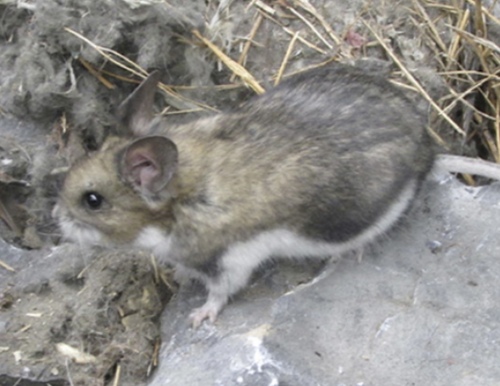
Dorsal fur is brownish-gray to ochraceous-gray, often with a darker mid-dorsal streak; ventral fur is whitish to pale gray, sometimes with a buffy wash. The eyes are moderately large and dark. Ears are rounded and moderately large. The tail is bicolored (darker above, paler below) and sparsely haired.
Size
Head-body length approximately 110–145 mm; tail length 90–130 mm (tail shorter than or subequal to body length); hindfoot approximately 22–28 mm.
Weight
Typically 35–75 g; adults commonly weigh around 45–60 g with some individual and seasonal variation.
Distinctive features
Loxodontomys micropus is distinguished from sympatric Phyllotis species by its larger, more robust body, proportionally shorter hindlimbs, and less conspicuous ear size relative to head length. It lacks the very large, prominent ears of leaf-eared mice (Phyllotis). Its molar teeth have a characteristic loxodont (oblique ridge) pattern that gives the genus its name.
Differences between males and females
Sexual dimorphism is minimal; males and females are similar in size and coloration, though males may average slightly larger. No striking secondary sexual characteristics are known.
Behaviour and diet of the Southern Pericote
Largely solitary outside of the breeding season, as is typical of sigmodontine rodents. Individuals maintain home ranges that may overlap between sexes. No evidence of complex social hierarchies.
When it is active
Primarily nocturnal and possibly crepuscular. Activity peaks occur during the first hours after sunset and before sunrise, consistent with avoiding diurnal avian predators.
Diet
Omnivorous, with a diet based primarily on seeds, fruits, and plant material (including fungi and green vegetation), supplemented by invertebrates (insects, larvae). Seed caching behavior may occur, contributing to local seed dispersal.
How it feeds and hunts
Forages on the ground and occasionally in low vegetation, using olfaction and whiskers to locate food items under leaf litter and among rocks. Opportunistically captures invertebrates encountered during foraging.
Communication
Communication likely involves ultrasonic vocalizations, scent marking via urine and glandular secretions, and vibrissae-based tactile signals. Auditory and olfactory cues are presumed to play major roles in mate attraction and territory demarcation.
Interactions with other species
Predators include Andean owls (e.g., Bubo magellanicus), diurnal raptors, Andean foxes (Lycalopex culpaeus), and Patagonian weasels (Lyncodon patagonicus). It likely competes with other sympatric sigmodontine rodents (e.g., Abrothrix species, Oligoryzomys) for food and shelter. May serve as an intermediate host for parasites shared with other rodents.
Role in its ecosystem
Functions as a secondary consumer and prey species within Andean forest and shrubland food webs. As a seed hoarder, it may contribute modestly to seed dispersal of Nothofagus and other plant species. It is an important prey item for numerous Andean predators.
Reproduction and lifecycle
Breeding is seasonal, typically concentrated in austral spring and summer (October–March), coinciding with peak food availability. Gestation is estimated at approximately 21–25 days (typical for phyllotines). Litter sizes range from 2 to 5 pups.
Raising the young
As in other sigmodontines, the female provides primary parental care; pups are altricial at birth and are nursed in a nest constructed in a burrow or rocky crevice. Weaning occurs at approximately 3–4 weeks of age.
Maturity and lifespan
Sexual maturity is likely reached at 2–3 months of age, consistent with other phyllotine rodents. Wild lifespan is estimated at 1–2 years; captive individuals of related species have lived up to 3 years.
Taxonomy and naming of the Southern Pericote
Classification
Mammalia > Rodentia > Cricetidae (Sigmodontinae, tribe Phyllotini) > Loxodontomys > Loxodontomys micropus
Subspecies
Loxodontomys micropus micropus (Waterhouse, 1837) is the nominotypical form; some older literature recognized additional forms but no firmly validated subspecies are currently accepted.
Scientific synonyms
Originally described as Mus micropus Waterhouse, 1837; subsequently placed in Phyllotis, Reithrodon, and Eligmodontia before Osgood established Loxodontomys in 1947. Synonym includes Phyllotis micropus.
What research says
Recent studies
The description of a closely related new species, Loxodontomys pikumche (Spotorno et al., 2013) from central Chile, clarified the generic boundaries of Loxodontomys and highlighted that L. micropus sensu stricto is restricted to more southern latitudes. Phylogenomic analyses of Phyllotini tribe continue to refine the phylogenetic placement of the genus.
Genome and DNA
The diploid chromosome number (2n) has been reported as 64 in some sources, consistent with other members of Phyllotini; however, comprehensive karyotypic and genomic data specifically for this species remain limited.
Compared with similar species
Loxodontomys micropus is most closely related to L. pikumche, from which it differs in geographic range, body size, and minor morphological characters. It is broadly similar in appearance to Phyllotis darwini and P. xanthopygus but is larger and has shorter hindlimbs, lacking the highly enlarged ears that characterize leaf-eared mice.
The Southern Pericote and people
The genus name Loxodontomys means 'oblique-toothed mouse' in Greek, referring to the distinctive diagonal ridges on its molars — a name it coincidentally shares in spirit with Loxodonta, the genus of African elephants. Specimens of this species were among the many small mammals collected by Charles Darwin during the voyage of HMS Beagle (1831–1836), making it one of the historically significant Patagonian rodents in natural history. Despite its common name 'pericote,' a term used locally for various large Andean mice, L. micropus (meaning 'small-footed') was named for its proportionally short hindlimbs compared to its body size.
Where and how to see it
Best observed at night in Nothofagus forest edges and rocky shrublands within Nahuel Huapi or Lanín National Parks (Argentina) during austral spring and summer (October–February). Using a headlamp or spotlight near rocky outcrops and forest clearings increases chances of sighting. Small mammal trapping surveys by researchers most frequently document its presence.
Risks to humans
No notable direct risk to humans. As with all wild rodents in South America, there is a theoretical risk of hantavirus exposure through contact with droppings or nesting material; standard precautions when handling wild rodents are recommended.
Countries where the Southern Pericote is recorded
The 2 countries named in the range description of its IUCN Red List assessment.
Questions about the Southern Pericote
Where does the Southern Pericote live?
The Southern Pericote is recorded in Argentina and Chile across South America. These countries come from the range description of its IUCN Red List assessment, and they are what place the species on the interactive map.
Is the Southern Pericote endangered?
The IUCN Red List assesses the Southern Pericote as Least Concern. The species is widespread and abundant enough not to qualify for any threatened category. It does not mean the species is safe forever, only that nothing in the current data raises an alarm.
How many are left in the wild?
No formal global population estimate exists. This figure comes from the species assessment on the IUCN Red List; population estimates for wild mammals are ranges, not counts, and are revised at each assessment.
What habitat does the Southern Pericote live in?
Primary habitats include temperate Nothofagus (southern beech) forests, Andean and pre-Andean shrublands (matorral), rocky outcrops, and grasslands with dense ground cover.
What is the scientific name of the Southern Pericote?
The Southern Pericote is Loxodontomys micropus, in the family Cricetidae, order Rodentia.
Other species in the genus Loxodontomys
Other species in the family Cricetidae
Species that share its range
Sources
Conservation status, range description and population estimate come from the IUCN Red List assessment for Loxodontomys micropus. Countries are derived from that range description, not from a mapped country list. Last refreshed on .
The distribution map is drawn from the IUCN Red List spatial data compiled in 2008. IUCN (International Union for Conservation of Nature)