
Azara's Grass Mouse
Akodon azarae
Red List assessment
Least Concernon the IUCN Red List
- EXExtinct
- EWExtinct in the Wild
- CRCritically Endangered
- ENEndangered
- VUVulnerable
- NTNear Threatened
- LCLeast Concern
The Azara's Grass Mouse is recorded in 4 countries across South America. The IUCN Red List assesses the Azara's Grass Mouse as Least Concern. No precise global estimate exists; local densities vary from fewer than 10 to over 200 individuals per hectare depending on season and habitat.
- Family
- Cricetidae
- Order
- Rodentia
- Genus
- Akodon
- Countries recorded
- 4
- Continents
- South America
- Red List category
- Least Concern
- Data updated
- August 9, 2026
What is the Azara's Grass Mouse?
Azara's Grass Mouse is a small, terrestrial sigmodontine rodent endemic to the temperate grasslands and agro-ecosystems of the southern South American lowlands, particularly the Argentine Pampas. Named in honor of the Spanish naturalist Félix de Azara (1746–1821), who pioneered natural history surveys in the Río de la Plata region, it is one of the most abundant small mammals in its range. It thrives in both natural grasslands and heavily modified agricultural landscapes, making it ecologically and epidemiologically significant. Its abundance and accessibility have made it a model organism for population ecology, reproductive biology, and zoonotic disease research in South America.
Where does the Azara's Grass Mouse live?
Primarily Argentina (Pampas region, Buenos Aires, Santa Fe, Córdoba, Entre Ríos, La Pampa provinces) and Uruguay; marginally in southern Brazil and Paraguay
Core range spans the Argentine Pampas from Buenos Aires, La Pampa, Santa Fe, Córdoba, and Entre Ríos provinces westward to the Espinal ecoregion; extends into Uruguay and marginally into Rio Grande do Sul (southern Brazil) and extreme southern Paraguay. Largely absent from Patagonia and montane Andean regions.
Altitude and depth
Primarily a lowland species, occurring from sea level to approximately 500 m a.s.l. across the flat to gently rolling Pampas terrain; rarely recorded above 700 m.
Seasonal movements
Does not hibernate; year-round active. Population densities fluctuate markedly with season and rainfall, typically peaking in autumn (March–May) following summer breeding pulses and crashing in winter. Breeding activity declines sharply during cold austral winter months (June–August).
Habitat of the Azara's Grass Mouse
Strongly associated with temperate grasslands (Pampas), moist meadows, riparian margins, roadsides, and field edges within cereal and soybean agricultural mosaics. It tolerates significant habitat disturbance and is frequently the dominant small mammal in crop fields and fallow land. It avoids dense closed-canopy forest but exploits shrubby ecotones.
Adaptations to its environment
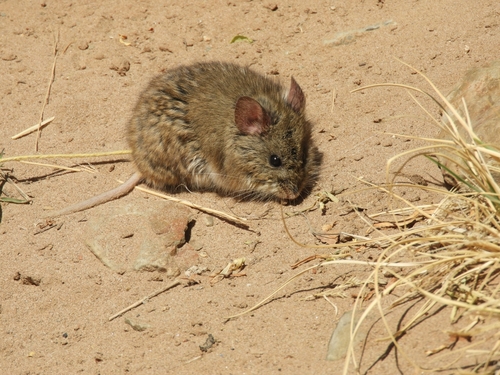
Generalist foraging strategy and dietary flexibility allow exploitation of diverse food resources across seasons. Its relatively short gestation and rapid sexual maturity enable fast population recovery after crashes. Cryptic brownish pelage provides camouflage in dry grass. Tolerance of disturbed and agricultural habitats represents a key behavioral-ecological adaptation absent in many congeners.
Conservation status and numbers
Least Concern (LC) on the IUCN Red List (assessed 2016). The species has a wide distribution, large and apparently stable population, and demonstrates resilience to, and even benefit from, agricultural land conversion. No significant range-wide decline has been documented.
Estimated population
No precise global estimate exists; local densities vary from fewer than 10 to over 200 individuals per hectare depending on season and habitat. The population trend is considered stable overall, with agricultural expansion likely maintaining or increasing total numbers.
What threatens the Azara's Grass Mouse?
Intensive use of rodenticides in agricultural settings poses localized mortality risks. Extreme weather events (flooding in the Pampas) can cause temporary population collapses. Predator community changes (loss of raptors, spread of invasive predators) may alter pressure dynamics. Long-term habitat homogenization through intensive monoculture could reduce food diversity.
Diseases and parasites
Documented hosts of ectoparasites including fleas (Polygenis spp.), mites (Androlaelaps fahrenholzi), and ticks (Ixodes loricatus). Infected with intestinal helminths (Trichuris, Aspidodera, Stilestrongylus spp.) and protozoa. Investigated as a potential reservoir for hantaviruses and other arboviruses circulating in the Pampas, though epidemiological importance varies by locality.
What is being done to protect it?
No species-specific conservation programs are in place given its Least Concern status. It benefits indirectly from protected natural grassland reserves (e.g., Reserva de Biosfera Parque Costero del Sur, Argentina) and general small mammal monitoring programs. It is intensively studied by Argentine research institutions (CONICET, Universidad de Buenos Aires).
Recommended actions
Continued long-term population monitoring to detect density trends linked to agricultural intensification. Restricting broad-spectrum rodenticide use in favor of targeted pest management. Preservation of native grassland patches within agricultural matrices to maintain genetic connectivity and predator-prey dynamics.
What the Azara's Grass Mouse looks like
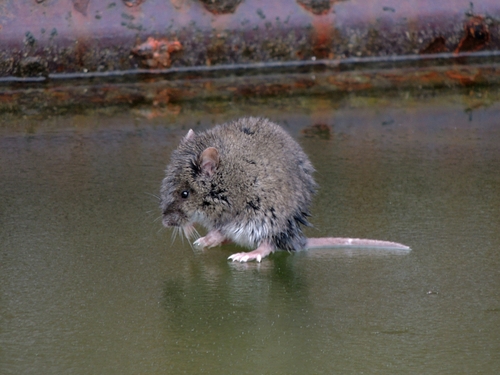
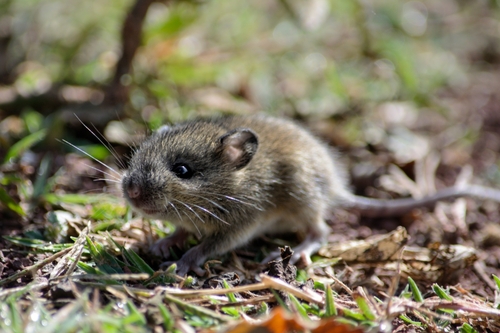
Dorsal pelage is grizzled dark brown to olive-brown with a mix of black-tipped guard hairs, giving a dull, earthy tone. The ventral surface is pale gray to buff-white with a poorly defined demarcation. The tail is bicolored (darker above, paler below), scantily haired, and relatively short. Eyes are small and dark; ears are rounded and moderately sized. The muzzle is blunt.
Size
Head-body length: 80–115 mm; tail length: 55–80 mm (tail distinctly shorter than body); hind foot: 18–22 mm; ear: 13–17 mm.
Weight
Typically 18–40 g; adults average around 25–30 g. Males are slightly heavier than females on average.
Distinctive features
Distinguished from the sympatric Akodon dolores and A. molinae by pelage tone, cranial morphometry (shorter rostrum, broader interorbital region), and karyotype. Compared to Calomys species (also common in Pampas agroecosystems), it lacks the distinctly paler flanks and has a proportionally shorter tail. Its robust, slightly stocky build separates it from the slender Oligoryzomys species with which it co-occurs.
Differences between males and females
Sexual dimorphism is subtle; males average slightly larger and heavier than females. Notably, fertile XY females (phenotypically indistinguishable from XX females) occur naturally in some populations, a remarkable documented exception to standard mammalian sex determination.
Behaviour and diet of the Azara's Grass Mouse
Predominantly solitary outside of the breeding season, with adults maintaining individual home ranges of 0.1–0.5 ha that overlap moderately. Males exhibit greater range expansion during the breeding season. No evidence of stable social groups or cooperative behaviors; aggression between adults is common in captivity.
When it is active
Primarily nocturnal to crepuscular, with peak activity in the first hours after sunset and before sunrise. Some diurnal foraging occurs in cooler weather or when population density is high. Activity is reduced during very cold nights in winter.
Diet
Omnivorous generalist. Diet includes seeds (grasses, forbs, crop grains), green plant material, fungi, and invertebrates (insects, earthworms, larvae). Proportional intake of animal protein increases during reproduction. In agricultural fields, it exploits cereal grains (wheat, maize, sorghum) extensively.
How it feeds and hunts
Forages opportunistically on the ground surface and in shallow runways through grass. Detects invertebrates by olfaction and tactile whisker use; captures them with quick pounces. Seeds are located by smell and often cached short distances from foraging sites.
Communication
Uses ultrasonic vocalizations (beyond human hearing range) for mother-pup and mate communication. Scent marking via urine and flank glands demarcates home range boundaries. Tactile nose-to-nose and flank contact occurs during reproductive encounters. Threat postures and teeth chattering signal aggressive intent.
Interactions with other species
A key prey item for the Barn Owl (Tyto alba), which is the primary avian predator, as well as for Long-eared Owls, Chimango Caracaras, snakes (Bothrops alternatus, Philodryas spp.), weasels (Galictis cuja), and domestic cats. Competes for seeds and invertebrates with Calomys laucha, C. musculinus, and Oligoryzomys flavescens. Hosts ectoparasites and endoparasites shared across rodent communities.
Reproduction and lifecycle
Breeding is seasonal, concentrated from September to April (austral spring through autumn), with 2–4 litters per year possible under favorable conditions. Gestation lasts approximately 23 days. Litter size ranges from 2 to 8 pups (modal 4–5). Weaning occurs at approximately 15–18 days.
Raising the young
Altricial young are born hairless and blind in a grass-lined nest built by the female in shallow burrows or dense vegetation. The female alone provides all parental care, nursing and thermoregulating the pups. Males play no role in pup rearing. Young disperse within 4–6 weeks of birth.
Maturity and lifespan
Sexual maturity is reached at approximately 30–60 days of age, exceptionally early even among small rodents. Lifespan in the wild rarely exceeds 12–18 months due to high predation pressure; individuals may survive up to 3 years in captivity.
Taxonomy and naming of the Azara's Grass Mouse
Classification
Mammalia > Rodentia > Cricetidae (subfamily Sigmodontinae) > Akodon > Akodon azarae (Fischer, 1829)
Subspecies
Taxonomic revisions have recurrently split or synonymized populations; no firmly validated subspecies are currently recognized, though some historical treatments distinguished A. a. azarae and A. a. bibianae. Populations formerly placed here have since been elevated to distinct species (e.g., Akodon dolores).
Scientific synonyms
Mus azarae Fischer, 1829 (original description); Mus obscurus Waterhouse, 1837; Akodon (Abrothrix) obscurus; various synonyms reflect extensive 19th-century revisional history.
What research says
Recent studies
Population ecology studies in the Pampas agroecosystem (e.g., Busch et al., Suárez et al.) have detailed density fluctuations in relation to rainfall, crop cycles, and predator abundance. Genomic studies have further characterized the XY female mechanism and its evolutionary persistence. Recent parasitological surveys have assessed its role in maintaining arthropod-borne pathogen cycles.
Genome and DNA
Karyotype: 2n = 38, FN = 38 (all acrocentric autosomes in most populations). Remarkably, fertile XY females occur naturally in this species — a well-documented anomaly in which a Y-chromosome-bearing individual develops into a phenotypically and functionally normal female, studied extensively by Bianchi and colleagues. This makes A. azarae a model system for mammalian sex-determination research.
Compared with similar species
Within genus Akodon, A. azarae is most similar morphologically to A. dolores and A. molinae, from which it was historically confused and requires karyotyping or molecular data for definitive identification. It is less fossorial and larger than A. iniscatus. Ecologically, it fills a niche similar to the European Field Mouse (Apodemus sylvaticus) — a common, agricultural-edge omnivore — though it belongs to the entirely unrelated New World radiation of Sigmodontinae.
The Azara's Grass Mouse and people
1) Azara's Grass Mouse is one of the very few mammal species in which fully fertile XY females occur naturally and regularly, challenging the classical mammalian sex-determination paradigm. 2) Its populations can irrupt to extraordinary densities (exceeding 200 individuals/ha) following bumper grain harvests, temporarily overwhelming local predators. 3) Despite being named after Félix de Azara, the Spanish naturalist never formally described it — the name was assigned in his honor by the German naturalist Johann Baptist von Spix's colleague J.B. Fischer in 1829, based on Azara's detailed field notes.
Where and how to see it
Best observed at night in the Argentine Pampas during autumn (March–May) when populations peak, using headlamps or live-trapping transects along field borders and riparian grasslands around Buenos Aires province. The Reserva de Biosfera Parque Costero del Sur and the environs of La Plata are particularly productive sites. It is bold enough to be frequently captured in Sherman live-traps baited with oats or seeds.
Risks to humans
Low direct risk; capable of biting if handled without gloves. Potential indirect risk as a rodent host in areas with circulating hantaviruses or other zoonotic pathogens in agricultural settings; standard rodent-handling precautions (gloves, mask) are advisable for field researchers.
Human uses
Widely used as a model organism in South American rodent ecology, reproductive biology, and sex-chromosome research. Occasionally considered a minor agricultural pest in cereal-growing areas of the Pampas. No use in traditional medicine or commercial trade is documented.
Countries where the Azara's Grass Mouse is recorded
The 4 countries named in the range description of its IUCN Red List assessment.
Questions about the Azara's Grass Mouse
Where does the Azara's Grass Mouse live?
The Azara's Grass Mouse is recorded in Argentina, Brazil, Paraguay and Uruguay across South America. These countries come from the range description of its IUCN Red List assessment, and they are what place the species on the interactive map.
Is the Azara's Grass Mouse endangered?
The IUCN Red List assesses the Azara's Grass Mouse as Least Concern. The species is widespread and abundant enough not to qualify for any threatened category. It does not mean the species is safe forever, only that nothing in the current data raises an alarm.
How many are left in the wild?
No precise global estimate exists; local densities vary from fewer than 10 to over 200 individuals per hectare depending on season and habitat. This figure comes from the species assessment on the IUCN Red List; population estimates for wild mammals are ranges, not counts, and are revised at each assessment.
What habitat does the Azara's Grass Mouse live in?
Strongly associated with temperate grasslands (Pampas), moist meadows, riparian margins, roadsides, and field edges within cereal and soybean agricultural mosaics.
What is the scientific name of the Azara's Grass Mouse?
The Azara's Grass Mouse is Akodon azarae, in the family Cricetidae, order Rodentia.
Other species in the genus Akodon

Other species in the family Cricetidae
Sources
Conservation status, range description and population estimate come from the IUCN Red List assessment for Akodon azarae. Countries are derived from that range description, not from a mapped country list. Last refreshed on .
The distribution map is drawn from the IUCN Red List spatial data compiled in 2008. IUCN (International Union for Conservation of Nature)