
Atlantic Titi
Callicebus personatus
Red List assessment
Vulnerableon the IUCN Red List
- EXExtinct
- EWExtinct in the Wild
- CRCritically Endangered
- ENEndangered
- VUVulnerable
- NTNear Threatened
- LCLeast Concern
The Atlantic Titi is recorded in one country, Brazil across South America. The IUCN Red List assesses the Atlantic Titi as Vulnerable. Exact population numbers are not well documented, but the overall trend is declining due to continued Atlantic Forest loss, with remaining habitat covering less than 10% of its original extent
- Family
- Pitheciidae
- Order
- Primates
- Genus
- Callicebus
- Countries recorded
- 1
- Continents
- South America
- Red List category
- Vulnerable
- Data updated
- August 9, 2026
What is the Atlantic Titi?
The Atlantic Titi is a small, arboreal New World monkey endemic to Brazil's highly fragmented Atlantic Forest. It is notable for its monogamous pair bonds, distinctive facial mask, and characteristic tail-twining behavior between partners. This species plays an important ecological role as a seed disperser in its forest habitat, but its survival is increasingly threatened by habitat loss.
Where does the Atlantic Titi live?
Southeastern Brazil, primarily in the Atlantic Forest biome of Minas Gerais, Espírito Santo, Rio de Janeiro and São Paulo states
Endemic to southeastern Brazil, found in fragmented pockets of the Atlantic Forest across Minas Gerais, Espírito Santo, and parts of Rio de Janeiro and São Paulo states
Altitude and depth
Sea level up to approximately 1000-1200 meters
Seasonal movements
No true migration or hibernation; some seasonal variation in fruit availability influences ranging behavior and diet composition throughout the year
Habitat of the Atlantic Titi
Primarily inhabits primary and secondary lowland to montane Atlantic Forest, including semi-deciduous and evergreen rainforest; also found in forest fragments and edges adapted to human-altered landscapes
Adaptations to its environment
Possesses a prehensile-like tail (though not truly prehensile) used for balance and social bonding, strong grasping hands and feet for arboreal locomotion, and a specialized digestive system suited to a fruit-and-leaf diet; monogamous social structure helps defend small territories efficiently in fragmented habitat
Conservation status and numbers
Classified as Vulnerable (VU) by IUCN due to ongoing habitat loss and fragmentation across its range, with population declines linked to deforestation rates exceeding 30% over three generations in parts of its range
Estimated population
Exact population numbers are not well documented, but the overall trend is declining due to continued Atlantic Forest loss, with remaining habitat covering less than 10% of its original extent
What threatens the Atlantic Titi?
Habitat destruction from agriculture, urbanization, and logging; forest fragmentation isolating populations; illegal pet trade; and reduced genetic diversity due to small, isolated subpopulations
Diseases and parasites
Susceptible to various endoparasites (such as nematodes) and occasional viral infections common to New World primates, though specific studies are limited
What is being done to protect it?
Protected under Brazilian federal wildlife law; found within several protected areas including biological reserves and national parks in the Atlantic Forest biome; included in various regional conservation and reforestation initiatives
Recommended actions
Expand and connect protected forest fragments via biological corridors, strengthen anti-deforestation law enforcement, conduct population monitoring, and promote community-based conservation and habitat restoration programs
What the Atlantic Titi looks like
Fur is generally reddish-brown to grayish on the body with a distinctive dark facial mask around the eyes and muzzle; the tail is often bushier and may show a lighter or contrasting tip color
Size
Head-body length approximately 30-42 cm, with a non-prehensile tail adding an additional 40-50 cm
Weight
Adults typically weigh between 1.0 and 1.5 kg, with minimal difference between males and females
Distinctive features
Distinguished from closely related titi species by the specific coloration pattern of its facial mask, body fur tone, and geographic range within the Atlantic Forest
Behaviour and diet of the Atlantic Titi
Lives in small monogamous family groups typically consisting of a mated pair and their offspring, usually numbering 2-6 individuals; strong pair bonding is reinforced through tail-twining and mutual grooming
When it is active
Diurnal, active during daylight hours with peak activity in early morning and late afternoon; rests during midday heat
Diet
Omnivorous with a diet primarily composed of fruits, supplemented by leaves, flowers, seeds, and occasionally insects
How it feeds and hunts
Forages by moving through the forest canopy searching for ripe fruit and young leaves; insect consumption is opportunistic rather than active hunting
Communication
Communicates through loud, distinctive duet vocalizations between mated pairs used for territory defense and pair bonding, along with scent marking and physical displays like tail-twining
Interactions with other species
Faces predation from raptors, wild cats (such as ocelots), and snakes; may compete with other primate species for fruit resources but generally occupies a distinct ecological niche
Role in its ecosystem
Functions as an important seed disperser within the Atlantic Forest ecosystem, contributing to forest regeneration and plant diversity through its frugivorous diet
Reproduction and lifecycle
Breeding is generally non-seasonal or loosely seasonal, with gestation lasting approximately 4.5-5 months; typically a single offspring is born per pregnancy
Raising the young
The father plays a significant role in infant care, carrying the young for most of the day and only transferring the infant to the mother for nursing; weaning occurs at around 4-5 months of age
Maturity and lifespan
Reaches sexual maturity around 2-3 years of age; lifespan in the wild is estimated at 12-15 years, while captive individuals may live longer with proper care
Taxonomy and naming of the Atlantic Titi
Classification
Class Mammalia > Order Primates > Family Pitheciidae > Genus Callicebus > Species Callicebus personatus
Subspecies
Historically several subspecies were recognized (e.g., C. p. personatus, C. p. nigrifrons, C. p. melanochir) but recent taxonomic revisions have elevated most of these to full species status, leaving Callicebus personatus sensu stricto restricted to a smaller range in Minas Gerais/Espírito Santo
Scientific synonyms
Formerly included populations now classified as separate species such as Callicebus nigrifrons and Callicebus melanochir; also referenced in older literature as Callithrix personata
What research says
Recent studies
Recent taxonomic and genetic studies have led to significant revisions within the Callicebus genus, splitting former subspecies into distinct species, which has implications for conservation status assessments
Genome and DNA
Diploid chromosome number reported as 2n=48 in some Callicebus species studies; specific genomic research on C. personatus remains limited
Compared with similar species
Similar to other titi monkeys such as Callicebus nigrifrons and Callicebus melanochir, but distinguished by facial mask coloration and specific geographic distribution within the fragmented Atlantic Forest
The Atlantic Titi and people
Mated pairs often intertwine their tails while sitting together, a behavior thought to strengthen pair bonds; titis are known for their loud dawn choruses that can be heard echoing through the forest to mark territory.
Where and how to see it
Best observed in protected Atlantic Forest reserves in Minas Gerais or Espírito Santo during early morning hours when pairs are most vocal and active; patience and knowledge of local duet calls greatly aid location
Risks to humans
No notable risk to humans
Human uses
Historically captured for the illegal pet trade, though this practice is now illegal and discouraged; the species holds ecotourism value in some protected Atlantic Forest areas
Countries where the Atlantic Titi is recorded
The 1 countries named in the range description of its IUCN Red List assessment.
Questions about the Atlantic Titi
Where does the Atlantic Titi live?
The Atlantic Titi is recorded in Brazil across South America. These countries come from the range description of its IUCN Red List assessment, and they are what place the species on the interactive map.
Is the Atlantic Titi endangered?
Yes. The IUCN Red List assesses the Atlantic Titi as Vulnerable, one of the three threatened categories. The species faces a high risk of extinction in the wild. It is the first of the three threatened categories: numbers are falling, the range is shrinking, or the population is small enough that a single bad event could do lasting damage.
How many are left in the wild?
Exact population numbers are not well documented, but the overall trend is declining due to continued Atlantic Forest loss, with remaining habitat covering less than 10% of its original extent This figure comes from the species assessment on the IUCN Red List; population estimates for wild mammals are ranges, not counts, and are revised at each assessment.
What habitat does the Atlantic Titi live in?
Primarily inhabits primary and secondary lowland to montane Atlantic Forest, including semi-deciduous and evergreen rainforest; also found in forest fragments and edges adapted to human-altered landscapes
What is the scientific name of the Atlantic Titi?
The Atlantic Titi is Callicebus personatus, in the family Pitheciidae, order Primates.
Other species in the genus Callicebus
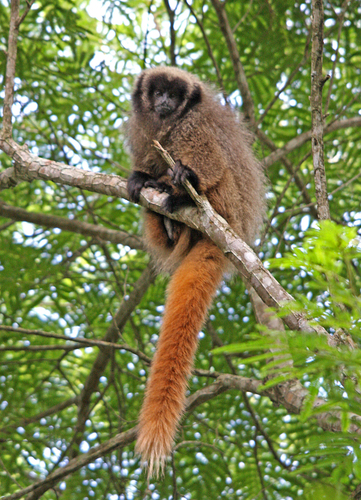
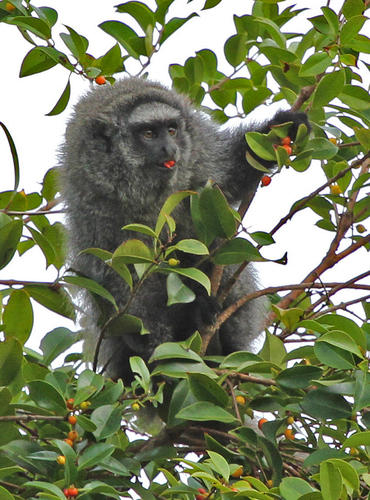
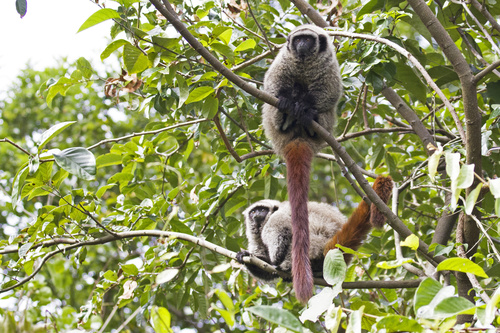

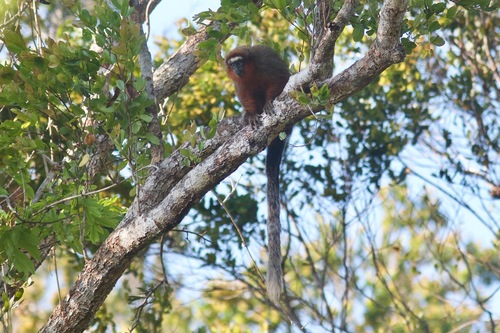
Other species in the family Pitheciidae
Species that share its range

Sources
Conservation status, range description and population estimate come from the IUCN Red List assessment for Callicebus personatus. Countries are derived from that range description, not from a mapped country list. Last refreshed on .
The distribution map is drawn from the IUCN Red List spatial data compiled in 2008. Biodiversitas Brazil