
South American Fur Seal
Arctocephalus australis
Red List assessment
Least Concernon the IUCN Red List
- EXExtinct
- EWExtinct in the Wild
- CRCritically Endangered
- ENEndangered
- VUVulnerable
- NTNear Threatened
- LCLeast Concern
The South American Fur Seal is recorded in 6 countries across South America. The IUCN Red List assesses the South American Fur Seal as Least Concern. Estimated global population of approximately 250,000–300,000 individuals, with the Falkland Islands hosting approximately 30,000–40,000 and Uruguay holding a major breeding aggregation of several tens of thousands.
- Family
- Otariidae
- Order
- Carnivora
- Genus
- Arctocephalus
- Countries recorded
- 6
- Continents
- South America
- Red List category
- Least Concern
- Data updated
- August 9, 2026
What is the South American Fur Seal?
The South American Fur Seal is a medium-sized eared seal (family Otariidae) inhabiting the rocky coastlines and offshore waters of South America, from the sub-Antarctic to the tropics. It was among the most heavily harvested fur-bearing mammals in history, with millions killed during the 18th and 19th centuries, and has since partially recovered. It exhibits strong sexual dimorphism, a complex polygynous social structure, and remarkable diving capabilities, making it a subject of significant ecological and behavioral research. As a major marine predator along both Atlantic and Pacific coasts of South America, it plays a key role in regulating populations of fish and squid.
Where does the South American Fur Seal live?
Coastlines of South America from Peru and southern Brazil southward through Chile, Argentina, Uruguay, and Tierra del Fuego to Cape Horn; also the Falkland Islands (Malvinas).
Distributed along both the Pacific and Atlantic coasts of South America: on the Pacific from Peru (~10°S) through Chile to Cape Horn; on the Atlantic from southern Brazil (~28°S) through Uruguay, Argentina, and Tierra del Fuego. The Falkland Islands (Malvinas) host one of the largest concentrations. Key breeding colonies are located on Lobos Island (Uruguay), Peninsula Valdés (Argentina), Isla de Lobos (Uruguay), and multiple sites throughout the Falkland Islands.
Altitude and depth
Coastal species occurring from sea level on land to open pelagic zones offshore. Typical foraging dives range from 20 to 170 m depth; maximum recorded dives exceed 200 m, with dive durations of up to 7–8 minutes.
Seasonal movements
Breeding occurs during the austral summer (November–January). Males arrive at rookeries first in late October to establish territories; females arrive weeks later to pup. No long-distance seasonal migrations are performed, but individuals disperse more widely at sea during the non-breeding winter months (March–September), taking advantage of expanding prey availability.
Habitat of the South American Fur Seal
Rocky coastlines, sea cliffs, boulder beaches, and offshore islands for hauling out and breeding. Open coastal and oceanic waters for foraging, preferring cold, highly productive systems influenced by the Humboldt Current (Pacific) and the Falkland/Malvinas Current (Atlantic). Occasionally uses sandy beaches and cave entrances.
Adaptations to its environment
Dense, double-layered pelage (coarse guard hairs over a thick, insulating underfur) provides exceptional thermal protection in cold sub-Antarctic waters. Fore flippers are long and paddle-like, enabling highly efficient underwater propulsion. Countercurrent heat exchange systems in the flippers minimize heat loss in cold water. Diving physiology includes elevated blood-oxygen capacity, pronounced diving bradycardia, and selective peripheral vasoconstriction. Highly sensitive vibrissae detect hydrodynamic trails of prey in low-visibility conditions.
Conservation status and numbers
Listed as Least Concern (LC) on the IUCN Red List. Although the species was severely reduced by commercial sealing and populations have recovered significantly, regional subpopulations face ongoing pressures from bycatch and climate variability, requiring continued monitoring. Some local populations are declining.
Estimated population
Estimated global population of approximately 250,000–300,000 individuals, with the Falkland Islands hosting approximately 30,000–40,000 and Uruguay holding a major breeding aggregation of several tens of thousands. The overall population trend is considered stable to slowly recovering in most areas, though Peruvian populations fluctuate strongly with ENSO cycles.
What threatens the South American Fur Seal?
Incidental bycatch in gillnet, trawl, and longline fisheries is the most significant ongoing threat. Entanglement in discarded fishing gear and marine plastic debris causes direct mortality. Competition with expanding commercial fisheries for anchovy, sardine, and hake reduces prey availability. El Niño Southern Oscillation (ENSO) events disrupt prey distribution, causing pup starvation and increased adult mortality. Historical commercial sealing eliminated most colonies; illegal hunting persists at a low level in some areas. Coastal development and pollution (including oil spills) affect nearshore habitats.
Diseases and parasites
Susceptible to helminth parasites including intestinal nematodes (Contracaecum spp., Anisakis spp.) and hookworms (Uncinaria spp.); the latter cause substantial pup mortality through intestinal hemorrhage. External parasites include sucking lice (Antarctophthirus microchir). Bacterial pathogens including Leptospira spp. (leptospirosis) have been documented. Morbillivirus (related to phocine and canine distemper viruses) has been detected. Exposure to Toxoplasma gondii has been recorded, with the pathogen entering marine systems via freshwater runoff.
What is being done to protect it?
Protected under national legislation across all range states (Argentina, Chile, Peru, Uruguay, and Brazil), with regulated or prohibited hunting. Listed on CITES Appendix II, restricting international commercial trade in specimens and products. Key breeding colonies are within or adjacent to marine protected areas, including the Peninsula Valdés World Heritage Site (Argentina) and various Falkland Islands conservation zones. Bycatch mitigation programs and fisheries regulations are being implemented in some countries.
Recommended actions
Expansion and strict enforcement of marine protected areas encompassing breeding colonies and critical foraging grounds. Mandatory implementation of bycatch mitigation gear (e.g., acoustic pingers, modified net configurations) in artisanal and industrial fisheries. Enhanced population monitoring, particularly in Peru and southern Brazil where baseline data are incomplete. Aggressive reduction of marine plastic pollution and enforcement of marine debris regulations. Dedicated assessment of climate change impacts on prey availability and adaptive management of fisheries to buffer against ENSO-driven declines.
What the South American Fur Seal looks like
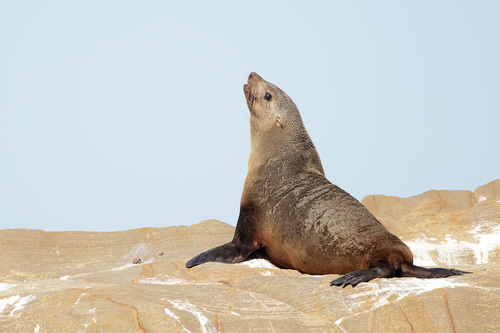
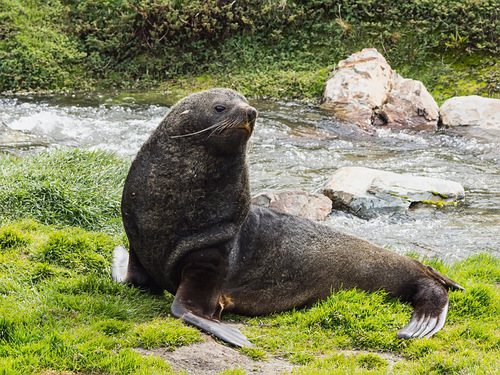
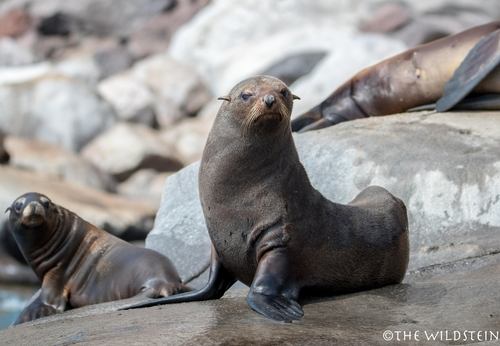
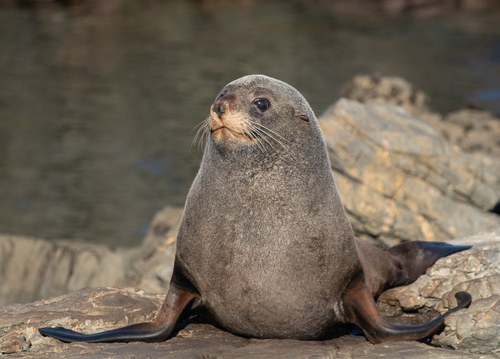
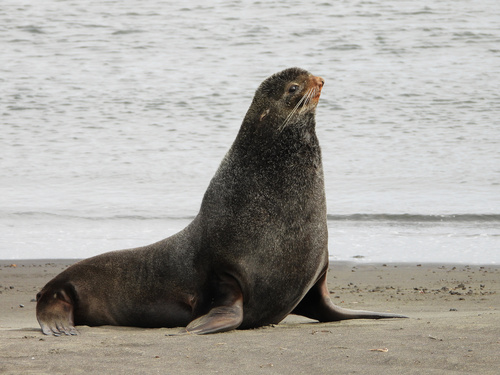
Adults are dark grayish-brown to blackish dorsally, with lighter, often reddish-brown to tawny coloring on the underside, particularly on the chest and belly. The face is pointed and elongated with a distinct muzzle, and external ear pinnae are visible. Males develop a thick, coarser-textured mane of longer fur on the neck and shoulders with advancing age. Pups are born with a blackish natal coat that molts after 4–6 weeks to a silvery-gray juvenile pelage.
Size
Males: 1.5–1.9 m total body length; females: 1.2–1.4 m. Fore flippers are disproportionately long relative to body length, as in all otariids. Newborn pups measure approximately 60–70 cm at birth.
Weight
Males: 150–200 kg; females: 30–60 kg. Pronounced sexual dimorphism means males can be 3–5 times heavier than females. Newborn pups weigh approximately 3–5 kg.
Distinctive features
Distinguished from the syntopic South American Sea Lion (Otaria flavescens) by its notably smaller size, sharply pointed muzzle, softer and denser fur, and more prominent external ear pinnae. Males lack the spectacular blond mane of male Otaria. Males of the Subantarctic Fur Seal (A. tropicalis) are immediately distinguishable by their vivid orange-cream chest and face. The Antarctic Fur Seal (A. gazella) overlaps marginally in range and is very similar but tends to breed primarily on remote sub-Antarctic islands rather than continental coasts.
Differences between males and females
Highly pronounced. Males are 3–5 times heavier and roughly 30–50 cm longer than females. Adult males develop a robust, muscular neck and a prominent mane of coarser fur, giving them a bulkier, more imposing profile. Females are distinctly more slender and gracile, with finer-textured fur and no mane. The degree of dimorphism is consistent with the species' highly polygynous mating system.
Behaviour and diet of the South American Fur Seal
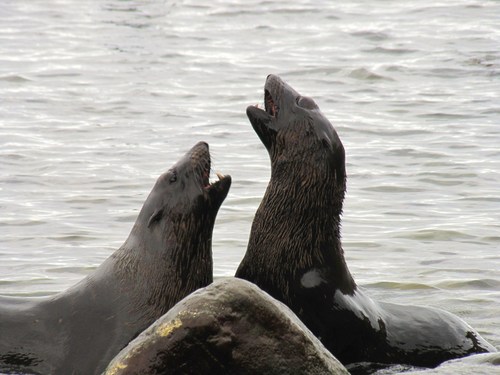
Gregarious and intensely colonial during the breeding season, forming dense rookeries on rocky shores and offshore islands. Dominant bulls control harems of approximately 5–15 females, enforcing exclusive mating access. Male hierarchy is established through elaborate threat displays (head-raising, open-mouth lunging, loud vocalizations) and direct physical combat. Outside the breeding season, individuals are more solitary or form loose, non-territorial aggregations at sea and on haul-out sites.
When it is active
Primarily diurnal on land; foraging at sea can occur throughout the day and night. Nocturnal diving is common, likely exploiting the vertical migration of prey (squid, small fish) toward the surface at night. On warm days, individuals thermoregulate by entering the water or seeking shade among rocks, as overheating on land is a significant physiological risk.
Diet
Carnivorous. Diet consists primarily of small pelagic and demersal fish (Peruvian anchovy Engraulis ringens, sardines Sardinops spp., hake Merluccius spp., mackerel), squid (various loliginid and ommastrephid species), and octopus, with crustaceans taken opportunistically. Diet composition varies considerably by geographic region, season, sex, and prey availability. Pups are exclusively nursed on highly caloric milk until weaning.
How it feeds and hunts
Pursues prey underwater using powerful strokes of the long fore flippers, capable of rapid directional changes. Typical foraging dives last 2–5 minutes at 20–100 m depth, with deeper, longer dives for more elusive prey. Uses highly sensitive vibrissae to detect hydrodynamic disturbances created by moving prey in dark or turbid water. Exploits the deep scattering layer, diving deeper during the day and shallower at night as prey ascend. Foraging is generally solitary, though loose aggregations around prey patches are observed.
Communication
Vocalizations are essential for mother-pup recognition, with each pair developing a unique acoustic signature used for reunion after foraging trips. Males emit loud, repetitive barks, grunts, and growls to advertise territory and intimidate rivals during the breeding season. Threat and submission postures (open-mouth display, head-raising, body orientation) are used in agonistic encounters. Tactile communication (nuzzling, flipper contact) reinforces the mother-pup bond. Olfaction plays an important supplementary role in individual recognition.
Interactions with other species
Natural predators include killer whales (Orcinus orca) in open water and sharks, particularly the great white shark (Carcharodon carcharias), which ambushes individuals near coastal approaches. Pups on beaches may be threatened by attacks from South American sea lions and suffer harassment from kelp gulls (Larus dominicanus) seeking placentas and weak individuals. Competes directly with the South American sea lion and with commercial fishing fleets for fish and squid resources. Haul-out sites are sometimes shared with elephant seals and cormorants.
Role in its ecosystem
Functions as a significant meso-predator in South American coastal and pelagic marine ecosystems, regulating populations of small pelagic fish and squid. Contributes to nutrient cycling by depositing guano on breeding beaches, locally enriching terrestrial vegetation. Serves as prey for apex predators (killer whales, large sharks), linking pelagic, demersal, and coastal food webs. Acts as a sentinel species for monitoring ecosystem health and prey availability in the Humboldt and Falkland/Malvinas Current systems.
Reproduction and lifecycle
Breeding season runs from November to January (austral summer). Males establish and defend territories from late October. Females give birth to a single pup 7–10 days after arriving at the rookery; estrus follows within 5–7 days of parturition, and mating occurs immediately thereafter. Total gestation lasts approximately 11.75 months, incorporating a facultative delayed implantation period of 3.5–4 months, which synchronizes births annually. Twinning is exceedingly rare.
Raising the young
Females provide all post-natal care; males contribute nothing beyond sperm. The mother nurses the pup intensively during the first week, then establishes an alternating routine of foraging trips at sea (lasting 1–5 days) and nursing bouts onshore. Mother-pup pairs maintain their bond through individually distinctive vocal signatures; reunions involve mutual calling, approach, and olfactory confirmation. Pups are weaned between 8 and 12 months of age, though extended nursing beyond one year has been recorded. Juveniles congregate in crèches while mothers forage.
Maturity and lifespan
Females reach sexual maturity at 3–4 years of age but often do not reproduce successfully until slightly older. Males are physically sexually mature at 6–8 years but typically cannot successfully hold a breeding territory until 9–12 years due to intense male competition. Maximum recorded longevity in the wild is approximately 25–30 years; captive individuals reach similar ages.
Taxonomy and naming of the South American Fur Seal
Classification
Mammalia > Carnivora > Otariidae > Arctocephalus > Arctocephalus australis
Subspecies
Some authorities recognize two subspecies: Arctocephalus australis australis (nominate, throughout most of the range) and Arctocephalus australis gracilis (sometimes applied to Peruvian/Ecuadorian populations), though the validity of gracilis is disputed and not universally accepted by current taxonomic authorities.
Scientific synonyms
Phoca australis Zimmermann, 1783 (original description); Arctocephalus nigrescens (Gray, 1850); Arctophoca australis.
What research says
Recent studies
Biologging studies using GPS and time-depth recorders have revealed pronounced sexual segregation in foraging zones, with males exploiting more offshore, benthic habitats and females conducting shallower, coastal dives. Stable isotope analyses of vibrissae and blood have documented dietary shifts associated with ENSO events in Peruvian populations, with sharp declines in anchovy consumption during El Niño years. Recent survey work in the Falkland Islands has refined population estimates and identified previously undocumented small breeding colonies.
Genome and DNA
Diploid chromosome number is 2n = 36, consistent across otariid pinnipeds. Mitochondrial and nuclear DNA phylogenetic studies confirm A. australis as a member of a clade with A. gazella and A. tropicalis. Some level of genetic differentiation between Atlantic and Pacific coast populations has been identified, suggesting limited gene flow across the southern tip of South America.
Compared with similar species
Most closely related to the Antarctic Fur Seal (A. gazella) and Subantarctic Fur Seal (A. tropicalis), together forming a well-supported Southern Hemisphere clade within Arctocephalus. Unlike A. gazella, which breeds primarily on remote sub-Antarctic islands (South Georgia, Kerguelen), A. australis breeds along continental coasts and accessible island systems. The Galápagos Fur Seal (A. galapagoensis) is a smaller insular relative restricted to the Galápagos archipelago. Compared to the South American Sea Lion (Otaria flavescens), A. australis is considerably smaller, has finer and denser fur, a more pointed snout, and a more agile body form adapted for deeper, more active foraging.
The South American Fur Seal and people
Despite weighing up to 200 kg, adult males can move with surprising speed and agility on land by 'crutching' on their flexible flippers, covering short distances faster than a sprinting human. Females can suspend the development of a fertilized embryo for up to four months through delayed implantation, a remarkable physiological mechanism that ensures all births occur during the optimal austral summer season regardless of when mating occurred. The ultra-dense underfur of this species — estimated at over 300,000 hairs per square centimeter — was so extraordinarily prized by furriers that hunting pressure nearly drove the entire species to extinction within roughly 150 years of European contact.
Where and how to see it
The Falkland Islands (Malvinas) offer exceptional, relatively undisturbed viewing at sites such as Sea Lion Island, Volunteer Point, and Bleaker Island, especially from November to February during the breeding season. In Uruguay, the Cabo Polonio National Park and Lobos Island (accessible by boat) provide reliable year-round sightings. Peninsula Valdés in Patagonian Argentina (a UNESCO World Heritage Site) hosts accessible colonies alongside elephant seals and right whales. Early morning visits to rocky beaches during breeding season offer the richest behavioral observations: territorial male battles, newborn pups, and nursing mothers.
Risks to humans
Generally tolerant of calm human presence at a respectful distance but should never be approached closely. Males during the breeding season are highly territorial and may charge without warning, and their bite is powerful enough to cause serious lacerations requiring medical attention. Visitors should never position themselves between any individual and its escape route to the sea. No venom; disease transmission to humans is theoretically possible but rarely documented.
Human uses
Exploited intensively from the late 18th to early 20th centuries by commercial sealers for their extraordinarily dense and prized underfur (sold as 'sealskin' for fashionable garments), blubber oil (used for lamps and industrial lubrication), and meat. Indigenous peoples of southern South America hunted them sustainably for millennia as a critical subsistence resource. Commercial sealing is now strictly prohibited or tightly regulated across the entire range. Today the species is economically important as a charismatic ecotourism attraction in the Falkland Islands, Patagonia, and Uruguay, generating significant revenue through wildlife tourism.
Myths and legends
The indigenous Yamana (Yaghan) and Kawésqar peoples of Tierra del Fuego and the Fuegian archipelago depended on South American Fur Seals for food, warm waterproof clothing made from the pelts, lamp oil rendered from blubber, and tools fashioned from bones and sinew, making the animal a cornerstone of their material culture and spiritual worldview for thousands of years. Hunting was embedded in ritual practices centered on respecting the animals and maintaining reciprocal relationships with the sea. The accounts of European explorers and sealers describing rookeries of millions of fur seals along the South American coast contributed to the myth of boundless natural abundance in the southern seas, fueling the destructive commercial sealing era that followed.
Countries where the South American Fur Seal is recorded
The 6 countries named in the range description of its IUCN Red List assessment.
Questions about the South American Fur Seal
Where does the South American Fur Seal live?
The South American Fur Seal is recorded in Argentina, Brazil, Chile, Falkland Islands and Peru, among 6 countries in total across South America. These countries come from the range description of its IUCN Red List assessment, and they are what place the species on the interactive map.
Is the South American Fur Seal endangered?
The IUCN Red List assesses the South American Fur Seal as Least Concern. The species is widespread and abundant enough not to qualify for any threatened category. It does not mean the species is safe forever, only that nothing in the current data raises an alarm.
How many are left in the wild?
Estimated global population of approximately 250,000–300,000 individuals, with the Falkland Islands hosting approximately 30,000–40,000 and Uruguay holding a major breeding aggregation of several tens of thousands. This figure comes from the species assessment on the IUCN Red List; population estimates for wild mammals are ranges, not counts, and are revised at each assessment.
What habitat does the South American Fur Seal live in?
Rocky coastlines, sea cliffs, boulder beaches, and offshore islands for hauling out and breeding.
What is the scientific name of the South American Fur Seal?
The South American Fur Seal is Arctocephalus australis, in the family Otariidae, order Carnivora.
Other species in the genus Arctocephalus
Other species in the family Otariidae
Species that share its range
Sources
Conservation status, range description and population estimate come from the IUCN Red List assessment for Arctocephalus australis. Countries are derived from that range description, not from a mapped country list. Last refreshed on .
The distribution map is drawn from the IUCN Red List spatial data compiled in 2016. Susana Cardenas