
Galápagos Fur Seal
Arctocephalus galapagoensis
Red List assessment
Endangeredon the IUCN Red List
- EXExtinct
- EWExtinct in the Wild
- CRCritically Endangered
- ENEndangered
- VUVulnerable
- NTNear Threatened
- LCLeast Concern
The Galápagos Fur Seal is recorded in 2 countries across South America. The IUCN Red List assesses the Galápagos Fur Seal as Endangered. Estimated at approximately 10,000–15,000 individuals, with a fluctuating and overall declining trend.
- Family
- Otariidae
- Order
- Carnivora
- Genus
- Arctocephalus
- Countries recorded
- 2
- Continents
- South America
- Red List category
- Endangered
- Data updated
- August 9, 2026
What is the Galápagos Fur Seal?
The Galápagos Fur Seal is the smallest of all fur seals and is entirely endemic to the Galápagos Islands, Ecuador. It is remarkable for its disproportionately large eyes — the largest relative to body size of any pinniped — an adaptation for nocturnal foraging in rocky coastal waters. Unlike most marine mammals in equatorial regions, it thrives on the cool, nutrient-rich currents brought by the Humboldt Current and its upwellings. It is listed as Endangered, with its population highly vulnerable to El Niño events that disrupt its prey base.
Where does the Galápagos Fur Seal live?
Endemic to the Galápagos Islands, Ecuador (Pacific Ocean)
Strictly endemic to the Galápagos Archipelago, Ecuador. Major concentrations are found on Fernandina, Isabela, Santiago, and Pinta islands, but the species is present throughout the archipelago. Rarely recorded as vagrants off the coasts of Ecuador and Peru.
Altitude and depth
Foraging dives are typically shallow, averaging 25–75 m depth, with maximum recorded dives reaching around 169 m. Terrestrial presence is at sea level, on rocky coastlines from 0–20 m elevation.
Seasonal movements
No long-distance migrations are undertaken. Breeding season peaks between August and November (Southern Hemisphere winter). During strong El Niño events, animals may range further offshore in search of prey, and breeding success drops dramatically.
Habitat of the Galápagos Fur Seal
Rocky, shaded lava coastlines and boulder fields are preferred terrestrial habitats, where animals seek shade from the intense equatorial sun. Aquatic foraging occurs in cool nearshore and shelf waters influenced by the Cromwell and Humboldt upwellings. Colonies are typically found on the western and northern islands where cooler water temperatures support higher fish and cephalopod abundance.
Adaptations to its environment
The species has evolved exceptionally large eyes to enable efficient nocturnal and crepuscular foraging in dim coastal waters. Its thick double-layered fur provides thermal insulation in the relatively cool upwelling waters. Behaviorally, it rests in shaded rocky alcoves during the hottest parts of the day to avoid heat stress in the equatorial climate. Females have a remarkable ability to fast for extended periods during El Niño events while continuing to nurse pups.
Conservation status and numbers
Endangered (EN) on the IUCN Red List (assessed 2015). The classification reflects a suspected population decline exceeding 30% over three generations, driven primarily by the increasing frequency and intensity of El Niño Southern Oscillation (ENSO) events, which cause severe prey depletion. The small, restricted range of the species further heightens its vulnerability.
Estimated population
Estimated at approximately 10,000–15,000 individuals, with a fluctuating and overall declining trend. Population counts are highly variable, collapsing by 50% or more during major El Niño years (e.g., 1982–83, 1997–98, 2015–16) and partially recovering during La Niña periods.
What threatens the Galápagos Fur Seal?
El Niño events are the most severe recurring threat, drastically reducing prey availability and causing mass pup mortality and adult starvation. Climate change is expected to increase ENSO frequency and intensity. Additional threats include entanglement in fishing gear (bycatch), competition with artisanal fisheries, introduced terrestrial predators (feral dogs and cats) attacking pups, marine pollution, and disturbance by unregulated ecotourism.
Diseases and parasites
Susceptible to leptospirosis and morbillivirus infections (similar to canine distemper), which can cause localized mortality events. External parasites include seal lice (Antarctophthirus sp.) and ticks. Internal parasites include nematodes and cestodes in the gastrointestinal tract. Hookworm (Uncinaria) infestations can be particularly harmful to young pups.
What is being done to protect it?
The species benefits from full protection within the Galápagos National Park (established 1959) and the Galápagos Marine Reserve (established 1998, ~133,000 km²), one of the world's largest marine protected areas. Ecuador's wildlife law prohibits hunting and harassment. The Charles Darwin Research Station in Puerto Ayora conducts ongoing population monitoring and research. The Galápagos Conservancy and WWF support conservation programs on the islands.
Recommended actions
Priority actions include continued eradication of introduced predators (dogs, cats) from key breeding islands, strict enforcement of fishing exclusion zones around colonies, development of climate-resilient prey management plans, expansion of monitoring programs using satellite tagging and photographic ID, and strengthening international fishing regulations to reduce bycatch in adjacent EEZ waters.
What the Galápagos Fur Seal looks like
Dorsal pelage is dark grayish-brown to nearly black when wet, appearing more gray-brown when dry. The ventral surface is slightly paler, often yellowish-tan. The face is blunt and rounded with a short muzzle, prominent whiskers (vibrissae), and very conspicuous large, dark eyes. Fore-flippers are long relative to body size. Males develop a pronounced mane of coarser guard hairs around the neck and shoulders.
Size
Males: 150–160 cm total body length. Females: 120–130 cm. One of the smallest otariids; notably smaller than its closest relative, the South American Fur Seal.
Weight
Strong sexual dimorphism in mass: males 60–80 kg; females 27–33 kg. Pups weigh approximately 3–4 kg at birth.
Distinctive features
Distinguished from the sympatric Galápagos Sea Lion (Zalophus wollebaeki) by its smaller size, darker and more uniform brown-black fur, proportionally larger eyes, smaller and more pointed head, and preference for shaded rocky habitats rather than open sandy beaches. Compared to the South American Fur Seal (Arctocephalus australis), it is smaller, darker, and lacks the more grizzled facial coloration.
Differences between males and females
Strongly sexually dimorphic: males are approximately twice the weight of females and up to 30% longer. Males develop a distinctive thick mane of coarser fur on the neck and shoulders, used in intraspecific display and combat. Females and juveniles are more slender and uniformly colored.
Behaviour and diet of the Galápagos Fur Seal
Colonial breeder during the reproductive season; adult males are strongly territorial and defend small patches of rocky shoreline containing groups of females (harems of 3–12 females). Outside the breeding season, the species is more gregarious and less territorial, resting in loose mixed-sex aggregations. Young males form bachelor groups on the periphery of colonies.
When it is active
Predominantly nocturnal and crepuscular in its foraging behavior, departing for sea at dusk and returning before dawn — an unusual trait among pinnipeds, likely driven by the need to avoid heat stress and possibly to exploit vertically migrating prey. During the day, animals haul out and rest in shaded lava shelters.
Diet
Carnivorous; diet consists primarily of small mesopelagic fish (especially lanternfish, Myctophidae) and cephalopods (squid and octopus). Occasionally takes crustaceans. Prey composition shifts during El Niño events when preferred prey becomes scarce and animals may take lower-quality food items.
How it feeds and hunts
Forages nocturnally in coastal and pelagic waters, exploiting the diel vertical migration of mesopelagic prey that rise toward the surface at night. Uses its large eyes and sensitive vibrissae to detect prey in low-light conditions. Pursuit diving is the primary technique, with dives typically lasting 2–4 minutes.
Communication
Uses a range of vocalizations for mother-pup recognition, territorial defense, and social interaction. Adult males produce loud, bark-like roars and threat vocalizations to deter rival males. Mothers and pups exchange high-pitched bleating calls for individual recognition. Scent marking plays a role in territory establishment by males. Body posturing (open-mouth displays, flipper slapping) is used during intraspecific contests.
Interactions with other species
Natural marine predators include the Galápagos shark (Carcharhinus galapagensis) and occasionally orca (Orcinus orca). On land, pups may be attacked by feral dogs and Galápagos hawks (Buteo galapagoensis). The species co-occurs and competes for rocky haul-out space with the larger Galápagos Sea Lion. It hosts ectoparasites including lice (Antarctophthirus) and various internal helminths.
Role in its ecosystem
As a mid-trophic level predator, the Galápagos Fur Seal plays an important role in the Galápagos marine ecosystem by regulating populations of mesopelagic fish and cephalopods. Its carcasses provide significant nutrient inputs to terrestrial scavengers. Colony sites enrich coastal soils with guano and organic matter, influencing local intertidal ecology.
Reproduction and lifecycle
Breeding season runs from August to November. Males establish territories in July–August; dominant bulls mate with multiple females. Females give birth to a single pup (rarely twins) after a gestation of approximately 11–12 months (including a period of delayed implantation of about 3 months). Pups are born with a dark black natal coat.
Raising the young
Maternal care is extended and intensive. Mothers nurse pups for an average of 2–3 years, though weaning can extend to 3 years or more in poor prey years — one of the longest nursing periods of any pinniped. Mothers alternate between foraging trips at sea (1–2 days) and nursing bouts onshore, recognizing their pup among hundreds using vocalizations and scent. Males take no part in pup rearing.
Maturity and lifespan
Females reach sexual maturity at 3–4 years but may not breed successfully until older. Males reach physical maturity at 7–10 years and typically do not hold territories until then. Lifespan in the wild is estimated at 15–20+ years for females; males generally have shorter lifespans due to the energetic costs and injuries of territorial competition.
Taxonomy and naming of the Galápagos Fur Seal
Classification
Mammalia > Carnivora > Otariidae > Arctocephalus > Arctocephalus galapagoensis
Scientific synonyms
Formerly considered a subspecies: Arctocephalus australis galapagoensis (Peters, 1866). Some older literature places it within the broader South American fur seal complex.
What research says
Recent studies
Recent studies using satellite telemetry have detailed the species' nocturnal foraging behavior and its dramatic shifts in diving depth and duration during El Niño events. Population genomics work published in the 2010s–2020s has assessed genetic diversity, revealing low heterozygosity consistent with island endemism and historical population bottlenecks. Research has also documented the long-term impacts of the 2015–16 El Niño on pup survival and colony structure.
Genome and DNA
The diploid chromosome number is 2n = 36, consistent with other Arctocephalus species. Phylogeographic studies using mitochondrial DNA confirm it as a distinct monophyletic species closely related to A. australis, from which it diverged relatively recently following colonization of the Galápagos.
Compared with similar species
The Galápagos Fur Seal is most closely related to the South American Fur Seal (Arctocephalus australis), from which it likely colonized the Galápagos. It is considerably smaller and darker than A. australis and is the only Arctocephalus species inhabiting equatorial waters. Unlike the sympatric Galápagos Sea Lion (Zalophus wollebaeki), which is a larger, diurnal species with a preference for sandy beaches, the Galápagos Fur Seal is smaller, nocturnally active, and strongly associated with rocky lava habitats.
The Galápagos Fur Seal and people
The Galápagos Fur Seal has the largest eyes relative to body size of any pinniped on Earth, an extraordinary adaptation for hunting in darkness. Mother fur seals can find and identify their own pup among hundreds of identical-looking pups in a noisy, crowded colony using nothing but scent and a unique vocal 'signature call' — a mammalian bond as reliable as a fingerprint. Due to the intense equatorial heat, individuals spend their daylight hours tucked into cool, shaded lava tunnels and overhangs, behaving more like cave-dwelling animals than typical beach-loving seals.
Where and how to see it
The best locations to observe this species are the rocky western shores of Isabela and Fernandina Islands, and James Bay on Santiago Island. Dawn and dusk are optimal observation times, as animals are most active transitioning between foraging and resting. The Galápagos National Park regulates visitor access to colonies; guided tours departing from Puerto Ayora (Santa Cruz Island) or Puerto Villamil (Isabela) frequently include fur seal observation sites. Snorkeling near rocky outcrops often yields close underwater encounters with curious, playful individuals.
Risks to humans
Generally poses no significant risk to humans. However, males defending territories during the breeding season (August–November) can be aggressive and deliver powerful bites; visitors should maintain a safe distance of at least 2 meters as mandated by Galápagos National Park regulations. Bites, though rare, can cause serious wounds and carry infection risk.
Human uses
The species is fully protected and has no current legal commercial uses. Historically, like most fur seals, it was hunted for its pelt by sealers in the 18th and 19th centuries, contributing to a significant historical population decline. Today, it is an important component of the Galápagos ecotourism industry, generating substantial revenue for Ecuador and providing justification for the preservation of marine protected areas.
Myths and legends
The Galápagos Islands were historically referred to as 'Las Islas Encantadas' (the Enchanted Islands) by Spanish sailors, partly because of the seemingly fearless and curious behavior of its wildlife, including the fur seals and sea lions. However, no specific myths or legends are directly associated with the Galápagos Fur Seal in indigenous or colonial traditions, as the islands were uninhabited before European discovery.
Countries where the Galápagos Fur Seal is recorded
The 2 countries named in the range description of its IUCN Red List assessment.
Questions about the Galápagos Fur Seal
Where does the Galápagos Fur Seal live?
The Galápagos Fur Seal is recorded in Ecuador and Peru across South America. These countries come from the range description of its IUCN Red List assessment, and they are what place the species on the interactive map.
Is the Galápagos Fur Seal endangered?
Yes. The IUCN Red List assesses the Galápagos Fur Seal as Endangered, one of the three threatened categories. The species faces a very high risk of extinction in the wild — a step below Critically Endangered, but still on a trajectory that ends badly without intervention.
How many are left in the wild?
Estimated at approximately 10,000–15,000 individuals, with a fluctuating and overall declining trend. This figure comes from the species assessment on the IUCN Red List; population estimates for wild mammals are ranges, not counts, and are revised at each assessment.
What habitat does the Galápagos Fur Seal live in?
Rocky, shaded lava coastlines and boulder fields are preferred terrestrial habitats, where animals seek shade from the intense equatorial sun.
What is the scientific name of the Galápagos Fur Seal?
The Galápagos Fur Seal is Arctocephalus galapagoensis, in the family Otariidae, order Carnivora.
Other species in the genus Arctocephalus
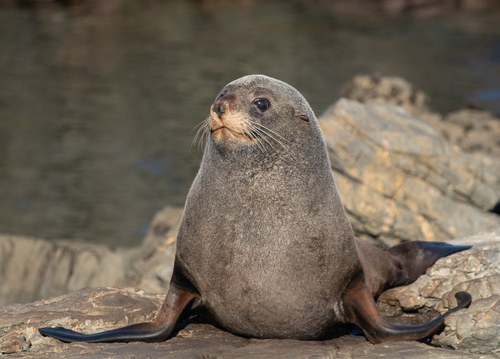
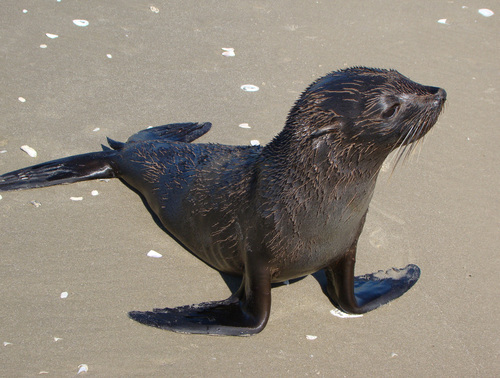
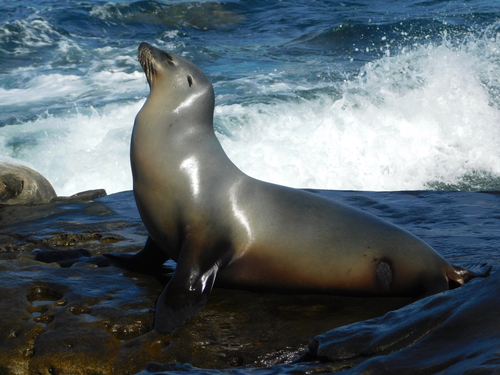
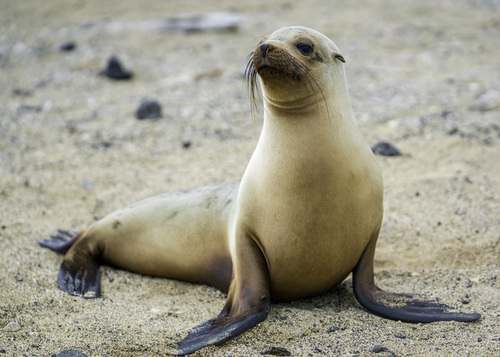
Other species in the family Otariidae
Species that share its range
Sources
Conservation status, range description and population estimate come from the IUCN Red List assessment for Arctocephalus galapagoensis. Countries are derived from that range description, not from a mapped country list. Last refreshed on .
The distribution map is drawn from the IUCN Red List spatial data compiled in 2025. Fritz Trillmich