
Subantarctic Fur Seal
Arctocephalus tropicalis
Red List assessment
Least Concernon the IUCN Red List
- EXExtinct
- EWExtinct in the Wild
- CRCritically Endangered
- ENEndangered
- VUVulnerable
- NTNear Threatened
- LCLeast Concern
The Subantarctic Fur Seal is recorded in 4 countries across Africa, South America and Oceania. The IUCN Red List assesses the Subantarctic Fur Seal as Least Concern. Estimated at approximately 300,000–400,000 individuals globally.
- Family
- Otariidae
- Order
- Carnivora
- Genus
- Arctocephalus
- Countries recorded
- 4
- Continents
- Africa, South America and Oceania
- Red List category
- Least Concern
- Data updated
- August 9, 2026
What is the Subantarctic Fur Seal?
The Subantarctic Fur Seal is a medium-sized eared seal (family Otariidae) breeding primarily on remote oceanic islands across the subantarctic and subtropical Southern Ocean. It is immediately recognizable by the vivid orange-yellow coloration on the chest, throat, and face of adult males, contrasting sharply with a dark grayish-brown dorsal coat. The species was driven to near-extinction by commercial sealers in the 18th and 19th centuries but has staged a remarkable recovery and now numbers in the hundreds of thousands. It is notable for occupying the most northerly breeding range of any Southern Ocean fur seal.
Where does the Subantarctic Fur Seal live?
Subantarctic and subtropical islands of the South Atlantic and southern Indian Oceans: Amsterdam Island, Gough Island, Tristan da Cunha, Prince Edward Islands, Crozet Islands, Macquarie Island; vagrants reach South America, Uruguay, and South Africa.
Major breeding colonies at Amsterdam Island and Saint Paul Island (French Southern and Antarctic Lands — TAAF), Gough Island and Tristan da Cunha (British Overseas Territory, South Atlantic), Prince Edward Islands (South Africa), and Crozet Islands (TAAF). Smaller numbers breed at Macquarie Island (Australia). Non-breeding vagrants regularly appear on coasts of South Africa, southern South America (including Uruguay and Argentina), southern Australia, and occasionally even Heard Island.
Altitude and depth
Terrestrial haul-outs occur at sea level on rocky and sandy shores. Foraging dives typically reach 50–200 m depth, with maximum recorded depths exceeding 380 m. Most foraging occurs in the mesopelagic zone, coinciding with the nighttime vertical migration of prey.
Seasonal movements
Strongly seasonal: breeding aggregations form from late October through January (austral summer). Males arrive 3–4 weeks before females to compete for territories. Outside the breeding season, both sexes disperse widely at sea and may undertake extensive foraging migrations of several thousand kilometers from breeding sites.
Habitat of the Subantarctic Fur Seal
Rocky coastlines, boulder-strewn shores, and sandy beaches of remote oceanic and subantarctic islands for breeding, pupping, and resting. At sea, individuals range widely across pelagic and mesopelagic zones of the Southern Ocean and southern subtropical waters. On land, adults favor sheltered areas with vegetation for shade and thermoregulation during the breeding season.
Adaptations to its environment
Dense, waterproof underfur overlaid by longer guard hairs provides exceptional thermal insulation in cold subantarctic seas; this same pelage made the species a target for commercial hunters. A layer of subcutaneous blubber supplements thermoregulation and serves as an energy reserve during prolonged fasting on land. Powerful foreflippers enable efficient swimming up to 20 km/h. Highly sensitive vibrissae (whiskers) detect hydrodynamic trails and water movements for hunting in low-light or dark mesopelagic environments.
Conservation status and numbers
Least Concern (LC) on the IUCN Red List. The global population is large, has recovered substantially since the cessation of commercial harvesting in the early 20th century, and is considered stable to slowly increasing. No current threats are causing population-level declines sufficient to warrant a higher threat category.
Estimated population
Estimated at approximately 300,000–400,000 individuals globally. Population trend is increasing or stable, representing one of the most significant recoveries of any pinniped species following commercial overexploitation.
What threatens the Subantarctic Fur Seal?
Accidental entanglement and bycatch in longline and trawl fisheries operating in the Southern Ocean is the primary modern threat. Climate change is shifting sea surface temperatures and prey distribution around the Antarctic Convergence, with potential long-term impacts on food availability. Invasive rodents (rats and mice) on some breeding islands can cause pup mortality. Historically, industrial commercial sealing reduced populations catastrophically during the 18th–19th centuries.
Diseases and parasites
Hookworms (Uncinaria spp.) are one of the leading causes of pup mortality, causing severe hemorrhagic enteritis in neonates before they develop resistance. Lungworms (Parafilaroides spp.) and various intestinal helminths infect adults. Bacterial infections including leptospirosis and brucellosis have been documented. Marine debris entanglement can result in chronic injuries and secondary infections. Calicivirus and morbillivirus infections have been detected in related otariids.
What is being done to protect it?
Main breeding sites benefit from strict protection: Amsterdam and Saint Paul Islands are within the TAAF Natural Reserve, a UNESCO World Heritage Site. Gough and Inaccessible Islands are a UNESCO World Heritage Site managed by the UK. The species is covered by CCAMLR (Convention on the Conservation of Antarctic Marine Living Resources) regulations governing Southern Ocean fisheries. Long-term population monitoring programs operate at Amsterdam Island, Gough Island, and Prince Edward Islands.
Recommended actions
Continued long-term monitoring of all major breeding colonies. Strengthening bycatch mitigation measures — particularly the use of seabird and pinniped exclusion devices in longline fisheries — across the Southern Ocean. Active invasive rodent eradication programs on key island breeding sites. Investment in research on climate change impacts on mesopelagic prey communities that the species depends upon. Expansion and enforcement of marine protected areas around critical foraging zones.
What the Subantarctic Fur Seal looks like
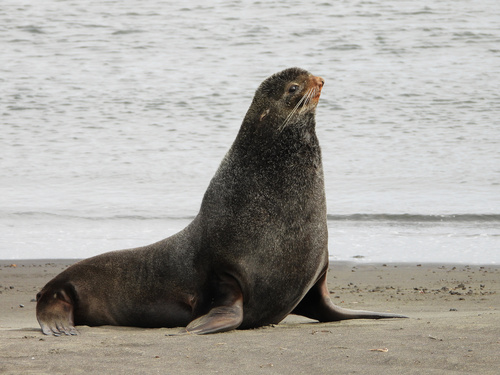
Adult males are dark grayish-brown to blackish-brown on the back and flanks, with a conspicuous orange-yellow to cream coloration on the chest, belly, throat, and lower face. Older males develop a thick mane of coarser, longer guard hairs around the neck and a pronounced dorsal crest on the head. Females and subadults are silver-gray to pale brown dorsally and cream to light orange-buff ventrally. The pointed muzzle is shorter than in many other fur seals, giving a slightly rounded facial profile.
Size
Adult males: 150–200 cm total body length. Adult females: 120–150 cm total body length.
Weight
Adult males: 90–165 kg. Adult females: 40–70 kg. Pronounced sexual size dimorphism, with males 2–3 times heavier than females.
Distinctive features
The vivid orange-yellow facial and chest coloration is the most distinctive feature of this species and immediately separates it from nearly all other Arctocephalus species. The Antarctic Fur Seal (A. gazella) is the most similar species in body form, but lacks the orange facial markings and has a more uniformly gray-brown coloration. The forehead crest in adult males is also more pronounced in A. tropicalis than in A. gazella.
Differences between males and females
Strongly dimorphic: males are 2–3 times heavier and considerably longer than females. Males develop an imposing mane, a pronounced head crest, and much more vivid orange-yellow facial coloration compared to the more cryptically colored females and juveniles. The skull and neck musculature of males are heavily reinforced for combat.
Behaviour and diet of the Subantarctic Fur Seal
Polygynous and highly colonial during the breeding season. Dominant males establish and aggressively defend compact territories on rookeries, each securing access to multiple females (harems of typically 5–25 females). Intense male-male combat occurs during territory establishment. Outside the breeding season, individuals are largely solitary at sea. Non-territorial males and juveniles form loose bachelor aggregations on the periphery of breeding colonies.
When it is active
Primarily crepuscular to nocturnal at sea, foraging during the nighttime vertical migration of mesopelagic prey toward the surface. On land during the breeding season, males are active throughout the day defending territories, while females alternate between nursing pups and resting.
Diet
Carnivore feeding primarily on mesopelagic fish — especially myctophid lanternfishes (family Myctophidae) — and cephalopods (squid and octopus). Crustaceans are consumed in smaller quantities. Diet composition varies seasonally and by colony location; fish tend to dominate at Amsterdam Island, while squid may be more important elsewhere.
How it feeds and hunts
Active pursuit diver hunting in open water, targeting prey at mesopelagic depths (50–200 m) during nighttime vertical migrations. Uses highly sensitive vibrissae to detect hydrodynamic disturbances and the bioluminescence of lanternfishes in darkness. Prey are caught with the teeth and swallowed whole underwater. Lactating females undertake foraging trips of 5–15 days duration alternated with brief nursing bouts onshore.
Communication
Rich vocal repertoire including territorial barks and threat roars from males, female attraction calls, and distinctive mother–pup contact calls that enable rapid individual recognition in crowded rookeries. Postural and gestural displays — including open-mouth threats, head-bobbing, and lateral body presentations — are used during male territorial disputes to avoid costly physical confrontation. Olfactory communication through scent glands may contribute to individual and reproductive state recognition.
Interactions with other species
Primary predators are killer whales (Orcinus orca) and great white sharks (Carcharodon carcharias), which prey on individuals during coastal approaches and departures. Leopard seals (Hydrurga leptonoides) may occasionally take pups at sea. Skuas (Catharacta spp.) and giant petrels harass young pups near the colony edge. At Macquarie Island, the species co-occurs with Antarctic Fur Seals (A. gazella) and documented hybridization between the two species has been genetically confirmed. Endoparasites include hookworms (Uncinaria spp.) and lungworms; ectoparasites include lice and ticks.
Role in its ecosystem
Significant mesopredator linking mesopelagic prey communities (myctophid fish, squid) to upper-trophic-level predators such as large sharks and killer whales. Dense breeding colonies contribute substantially to local terrestrial nutrient cycling through the deposition of guano, carcasses, and organic matter, influencing island plant communities. As a highly mobile wide-ranging predator, the species integrates energy across vast stretches of the Southern Ocean.
Reproduction and lifecycle
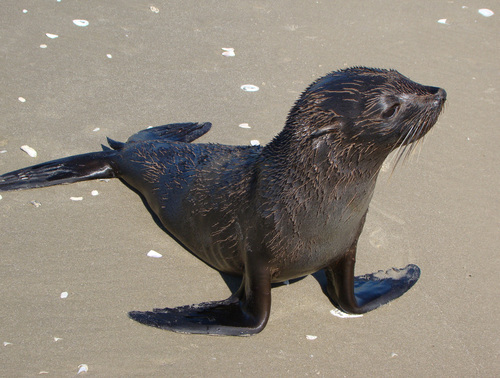
The breeding season extends from November to January. Females give birth to a single pup within 1–2 days of arriving at the rookery and come into estrus again 7–8 days postpartum. Total gestation lasts approximately 11.5–12 months, including a period of embryonic diapause (delayed implantation) of 3–4 months following fertilization. Newborn pups weigh approximately 4–5 kg and have a black lanugo coat.
Raising the young
Maternal care only — males invest no energy in pup-rearing after mating. Lactating females alternate between foraging trips at sea (typically 5–15 days) and nursing bouts onshore (1–5 days) for approximately 10–12 months until weaning. Females and pups develop individual vocal and olfactory signatures within days of birth to locate each other in densely packed, noisy colonies. Pups begin entering the water and learning to swim at 3–4 months of age.
Maturity and lifespan
Females reach sexual maturity at 4–6 years and begin breeding successfully around that age. Males are physiologically mature by 5–7 years but rarely achieve reproductive success until 8–12 years old due to intense competition with experienced dominant males. Maximum lifespan in the wild is approximately 20–25 years for females, somewhat shorter for males due to the physical toll of breeding-season competition and combat.
Taxonomy and naming of the Subantarctic Fur Seal
Classification
Mammalia > Carnivora > Otariidae > Arctocephalus > Arctocephalus tropicalis (Gray, 1872)
Scientific synonyms
Arctophoca tropicalis (Gray, 1872); occasionally treated as Arctocephalus australis tropicalis in older literature, though now considered a distinct species.
What research says
Recent studies
Satellite telemetry studies from Amsterdam Island have revealed that individuals undertake foraging migrations of up to 3,000–4,000 km, reaching productive frontal zones far from their breeding grounds. Stable isotope analyses have documented long-term shifts in diet composition at Amsterdam Island potentially linked to climate-driven changes in prey distribution. The confirmed hybridization with Antarctic Fur Seals at Macquarie Island has been studied as a natural model for understanding reproductive isolation and hybrid fitness in otariids.
Genome and DNA
Diploid chromosome number 2n = 36, consistent with other Otariidae. Mitochondrial DNA phylogeographic studies have revealed moderate genetic differentiation among island populations (e.g., Amsterdam Island versus Gough Island), suggesting limited but non-zero gene flow across the species' range. Genomic studies of hybridization with A. gazella at Macquarie Island have provided insights into natural interspecific gene flow in marine mammals.
Compared with similar species
Arctocephalus tropicalis is most closely related to the Antarctic Fur Seal (A. gazella), differing primarily in its distinctive orange-yellow facial markings, more northerly breeding range, and slightly more robust build in males. Compared to the South American Fur Seal (A. australis), A. tropicalis is more brightly colored, occupies oceanic island habitats rather than continental coasts, and has a more exclusively Southern Ocean foraging ecology. Within the genus, A. tropicalis occupies the most equatorward breeding range, while A. gazella is the most polar.
The Subantarctic Fur Seal and people
The dazzling orange-yellow chest and facial coloration of adult male Subantarctic Fur Seals is unique among all southern fur seals and allows instant identification even from a distance in mixed colonies. Despite being hunted to the brink of extinction for their prized dense underfur in the 1800s, the species has made a spectacular comeback and now numbers hundreds of thousands — one of marine conservation's greatest recoveries. Amsterdam Island, a tiny French volcanic outcrop smaller than Manhattan in the middle of the southern Indian Ocean, hosts what is thought to be the largest single breeding colony of this species on Earth, with tens of thousands of animals converging on its rocky shores each summer.
Where and how to see it
The most spectacular colonies are on Amsterdam Island and Gough Island, both extremely remote and access-restricted; visits typically require scientific or governmental authorization. Tristan da Cunha, accessible by occasional supply ship from South Africa, offers limited wildlife tourism opportunities where the species can be seen. Vagrants and non-breeding animals occasionally haul out on beaches along the South African coast (notably Cape Point and the West Coast) and on beaches in Uruguay and Argentina, especially during austral winter. The best time for observation at breeding sites is the austral summer (November–January) when colonies are at peak activity.
Risks to humans
Not inherently aggressive toward humans outside the breeding season. During pupping and breeding season, territorial bulls can charge rapidly and inflict deep, serious bites that also carry a significant risk of bacterial infection ('seal finger,' caused by Mycoplasma spp.). Observers should always maintain a safe distance of at least 10–15 m at colonies and avoid positioning themselves between a female and the sea. No venomous properties.
Human uses
Historically, the species was intensively harvested for its luxuriously dense underfur and rendered blubber oil by British, American, and French commercial sealers from the 1790s onward, causing near-total population collapse by the mid-19th century. Commercial sealing of this species has been prohibited for decades under national and international law. Today, the species is of value primarily for wildlife ecotourism at accessible sites and as a key subject of long-term scientific research on Southern Ocean ecology, foraging behavior, and climate change impacts.
Countries where the Subantarctic Fur Seal is recorded
The 4 countries named in the range description of its IUCN Red List assessment.
Questions about the Subantarctic Fur Seal
Where does the Subantarctic Fur Seal live?
The Subantarctic Fur Seal is recorded in Argentina, Australia, South Africa and Uruguay across Africa, South America and Oceania. These countries come from the range description of its IUCN Red List assessment, and they are what place the species on the interactive map.
Is the Subantarctic Fur Seal endangered?
The IUCN Red List assesses the Subantarctic Fur Seal as Least Concern. The species is widespread and abundant enough not to qualify for any threatened category. It does not mean the species is safe forever, only that nothing in the current data raises an alarm.
How many are left in the wild?
Estimated at approximately 300,000–400,000 individuals globally. This figure comes from the species assessment on the IUCN Red List; population estimates for wild mammals are ranges, not counts, and are revised at each assessment.
What habitat does the Subantarctic Fur Seal live in?
Rocky coastlines, boulder-strewn shores, and sandy beaches of remote oceanic and subantarctic islands for breeding, pupping, and resting.
What is the scientific name of the Subantarctic Fur Seal?
The Subantarctic Fur Seal is Arctocephalus tropicalis, in the family Otariidae, order Carnivora.
Other species in the genus Arctocephalus
Other species in the family Otariidae
Species that share its range
Sources
Conservation status, range description and population estimate come from the IUCN Red List assessment for Arctocephalus tropicalis. Countries are derived from that range description, not from a mapped country list. Last refreshed on .
The distribution map is drawn from the IUCN Red List spatial data compiled in 2015. Greg Hofmeyr