
Antarctic Fur Seal
Arctocephalus gazella
Red List assessment
Least Concernon the IUCN Red List
- EXExtinct
- EWExtinct in the Wild
- CRCritically Endangered
- ENEndangered
- VUVulnerable
- NTNear Threatened
- LCLeast Concern
The Antarctic Fur Seal is recorded in 5 countries across Africa, Asia, Europe, Oceania and Antarctica. The IUCN Red List assesses the Antarctic Fur Seal as Least Concern. Estimated at 3–5 million individuals globally, with approximately 4–5 million typically cited; the large majority (around 95%) breed on South Georgia, where estimates exceed 3 million animals.
- Family
- Otariidae
- Order
- Carnivora
- Genus
- Arctocephalus
- Countries recorded
- 5
- Continents
- Africa, Asia, Europe, Oceania and Antarctica
- Red List category
- Least Concern
- Data updated
- August 9, 2026
What is the Antarctic Fur Seal?
The Antarctic Fur Seal is a medium-to-large eared seal (family Otariidae) inhabiting the cold waters of the Southern Ocean and breeding almost exclusively on sub-Antarctic islands. It is one of the most numerous pinnipeds on Earth, with an estimated population of 3–5 million, representing a remarkable recovery from near-total extermination by commercial sealers in the 18th and 19th centuries. Distinguished from true seals by visible external ear pinnae and the ability to rotate its hind flippers forward for quadrupedal locomotion on land, it is supremely adapted for life at the interface of sea and rocky shoreline. It is ecologically pivotal in the Southern Ocean, consuming vast quantities of Antarctic krill and acting as prey for apex predators such as leopard seals and killer whales.
Where does the Antarctic Fur Seal live?
Sub-Antarctic and Antarctic islands, primarily South Georgia Island (British Overseas Territory); also Kerguelen Islands, Heard Island, South Sandwich Islands, South Orkney Islands, South Shetland Islands, Bouvet Island, Crozet Islands, Prince Edward Islands, and McDonald Island.
Approximately 95% of the global breeding population is concentrated on South Georgia (South Atlantic). Smaller but significant colonies exist at Kerguelen Islands (French Southern Territories), Heard and McDonald Islands (Australia), South Sandwich Islands, South Orkney Islands, South Shetland Islands (all British Overseas Territories/Antarctica), Bouvet Island (Norway), Crozet Islands, and Prince Edward Islands (South Africa). Non-breeding individuals range widely across the Southern Ocean and occasionally reach southern South America and southern Africa.
Altitude and depth
Breeding occurs at sea level on coastal shores. Foraging dives are typically 30–180 m deep, with a maximum recorded depth exceeding 200 m. Females foraging for Antarctic krill follow the diel vertical migration of prey, diving deeper during daytime and shallower at night.
Seasonal movements
Strongly seasonal. Adult males haul out at breeding beaches from late October onward to establish and defend territories. Pregnant females arrive in late November to give birth and mate. Pups are weaned by March–April, after which adults return to pelagic foraging grounds. The species undertakes long post-breeding migrations across the Southern Ocean, with some individuals traveling thousands of kilometers. Molting occurs after the breeding season.
Habitat of the Antarctic Fur Seal
During the breeding season, Antarctic Fur Seals occupy rocky beaches, grassy tussock slopes, and coastal terraces on remote sub-Antarctic islands, particularly those dominated by Poa flabellata tussock grass. At sea they inhabit open pelagic and shelf waters of the Southern Ocean, foraging in the Antarctic Polar Frontal Zone and southward to the pack ice edge. They show strong fidelity to natal beaches for breeding.
Adaptations to its environment
The species possesses an extraordinarily dense underfur (estimated 300,000 hairs per square centimeter), providing thermal insulation in frigid waters. Countercurrent heat exchange in the flippers prevents excessive heat loss. Physiological adaptations for diving include elevated myoglobin concentrations in muscles, a high blood volume, and a pronounced bradycardia response. On land, the ability to rotate hind flippers forward enables agile and rapid movement over rocky terrain. Males develop a thick muscular neck and a prominent mane for combat.
Conservation status and numbers
Least Concern (LC) on the IUCN Red List (assessed 2015). The population has recovered dramatically from near-extinction caused by commercial sealing, and no significant overall decline has been detected. However, climate-driven fluctuations in Antarctic krill availability linked to El Niño–Southern Oscillation (ENSO) events cause periodic localized breeding failures and concern researchers about long-term viability.
Estimated population
Estimated at 3–5 million individuals globally, with approximately 4–5 million typically cited; the large majority (around 95%) breed on South Georgia, where estimates exceed 3 million animals. The population trend is broadly stable to slowly increasing following centuries of recovery, though local populations at some sites fluctuate with ENSO-driven prey availability.
What threatens the Antarctic Fur Seal?
Climate change is the primary ongoing threat, as warming ocean temperatures and sea ice reduction decrease the abundance and availability of Antarctic krill (Euphausia superba), the species' main prey. Severe El Niño events have caused significant, if temporary, pup mortality and female condition decline at South Georgia. Incidental bycatch in longline and trawl fisheries poses a localized threat. Historical commercial sealing eliminated the species from much of its former range; some colonies have not recovered. Marine pollution and entanglement in lost fishing gear (ghost nets) affect individuals globally.
Diseases and parasites
Internal parasites include intestinal nematodes (Contracaecum osculatum, Pseudoterranova spp.) and acanthocephalans. External parasites include seal lice (Antarctophthirus spp.) and various mites. Hookworm (Uncinaria lucasi) can cause significant pup mortality in dense colonies. Bacterial and viral pathogens documented include caliciviruses (San Miguel Sea Lion Virus group) and poxvirus-like lesions. Morbillivirus and Brucella spp. have been detected serologically.
What is being done to protect it?
Protected under the 1972 Convention for the Conservation of Antarctic Seals (CCAS), which prohibits commercial sealing. The Antarctic Treaty System provides broader environmental protection across the Antarctic region. South Georgia is managed as a nature reserve by the Government of South Georgia & the South Sandwich Islands (GSGSSI), with strict wildlife regulations. Eradication of invasive reindeer from South Georgia (completed 2015) has restored critical tussock grass habitat. CCAMLR (Commission for the Conservation of Antarctic Marine Living Resources) regulates krill fisheries in the Southern Ocean.
Recommended actions
Strengthening krill fishery regulation under CCAMLR is the highest priority to ensure prey availability under climate pressure. Continued monitoring of population trends and breeding success at key colonies is essential for early detection of decline. Expansion of Marine Protected Areas (MPAs) in the Southern Ocean, especially the proposed East Antarctic and Weddell Sea MPAs, would benefit this species. Reducing longline and trawl bycatch through technical measures and mandatory use of mitigation devices is also recommended.
What the Antarctic Fur Seal looks like
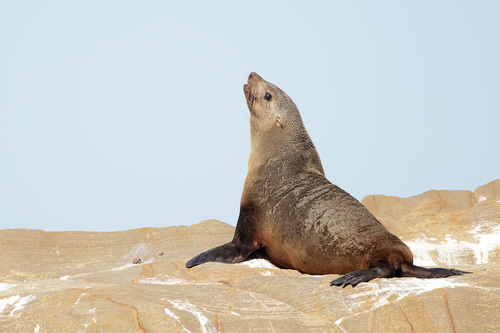
Adult males are dark grey-brown to nearly black dorsally, somewhat paler ventrally, with a coarser, mane-like ruff of longer guard hairs around the neck and shoulders. Females and subadults are grey-brown above and cream to pale grey below, with a lighter face and throat. Neonatal pups are born with a glossy black lanugo coat that is molted to a silver-grey pelage within two to three months. The muzzle is moderately pointed, vibrissae are long and pale, and the eyes are large and dark.
Size
Males: 1.7–2.1 m total body length. Females: 1.1–1.4 m. Significant sexual dimorphism in both length and mass. Fore flippers are long and powerful; the external ear pinnae measure approximately 3–4 cm.
Weight
Extreme sexual dimorphism. Adult males: 90–210 kg (average ~130–160 kg), reaching peak mass at the height of the breeding season. Adult females: 25–55 kg (average ~30–40 kg). Newborn pups weigh approximately 5–6 kg.
Distinctive features
Antarctic Fur Seals are most easily confused with the closely related Subantarctic Fur Seal (Arctocephalus tropicalis). A. gazella males lack the distinctive orange-cream chest and pale facial blaze of A. tropicalis males, and have a more elongated, pointed muzzle. Females of A. gazella are generally darker and lack the yellowish-orange chest coloration of female A. tropicalis. Both species may co-occur at some island sites (e.g., Bouvet, Crozet).
Differences between males and females
Extreme. Adult males are three to five times heavier than adult females and roughly 50% longer. Males develop a prominent mane of coarse guard hairs around the neck and shoulders, used in combat and display. The head and neck of males are massively muscled compared to females. Coloration also differs, with males being darker overall.
Behaviour and diet of the Antarctic Fur Seal
Strongly polygynous. During the breeding season, dominant males (bulls) establish and vigorously defend discrete territories on beaches, attempting to control access to groups of up to 20–50 females. Non-territorial males gather in bachelor areas on the periphery. Outside the breeding season, both sexes are largely solitary at sea. Females and pups form loose aggregations (rookeries) during the nursing period; individual mother-pup pairs maintain close contact within large, dense colonies numbering tens of thousands of animals.
When it is active
Broadly active at any hour, but foraging dives by females are predominantly nocturnal, tracking the diel vertical migration of Antarctic krill, which ascend toward the surface at night. Territorial males are active throughout the day defending breeding territories. Hauled-out individuals rest during warm midday hours.
Diet
Highly carnivorous. The primary prey is Antarctic krill (Euphausia superba), which can constitute the vast majority of the diet at South Georgia. Mesopelagic fish, especially myctophid lanternfishes (family Myctophidae), are the second most important prey category and become particularly important during krill scarcity (e.g., El Niño years). Squid and other cephalopods are also taken. Occasional predation on seabird chicks, including penguins, has been recorded.
How it feeds and hunts
Active pursuit diving. Females make repeated dive bouts, typically 30–200 m deep, following prey detected visually and possibly by sensitive vibrissae. Dives typically last 1–3 minutes. Females make foraging trips of 3–12 days at sea, alternating with brief returns to land to nurse pups. Krill are often captured during nocturnal ascent migrations, and lanternfish are hunted individually using their bioluminescence as a visual cue.
Communication
The pup attraction call and the reciprocal pup response are the primary acoustic communication system, enabling mothers and pups to find each other in dense, noisy rookeries. Males use a variety of vocalizations during territorial disputes, including loud, full-throated roars and guttural threat calls, combined with open-mouth threats, oblique stares, and direct charges. Females and pups also use scent for close-range individual recognition.
Interactions with other species
Primary natural predators include the leopard seal (Hydrurga leptonyx), which preys heavily on pups and juveniles near the water's edge, and killer whales (Orcinus orca). Large sharks may also take individuals at sea. The species is a major competitor of macaroni penguins (Eudyptes chrysolophus) and other seabirds for Antarctic krill at South Georgia. Historically, invasive reindeer on South Georgia degraded tussock grass breeding habitat until their eradication in 2015.
Role in its ecosystem
A key mesopredator and biological conduit in the Southern Ocean food web. Antarctic Fur Seals consume enormous quantities of Antarctic krill, making them a critical link between zooplankton production and apex predators (leopard seals, killer whales, large sharks). Their feces recycle nutrients onto island soils, enriching tussock grass and other vegetation used by nesting seabirds. At peak breeding populations on South Georgia, overgrazing of tussock grass by seals can cause localized coastal erosion.
Reproduction and lifecycle
Breeding season: November–January. Females give birth to a single pup within one to three days of arrival, typically in late November or early December. Post-partum estrus occurs 6–10 days after birth, and females mate with the territory-holding male. Gestation lasts approximately 11.5–12 months, including a delayed implantation (embryonic diapause) of about 3.5–4 months following fertilization. Pups are weaned at approximately 4 months of age (March–April). Twinning is exceptionally rare.
Raising the young
Maternal care only; males play no role in pup rearing. Females alternate nursing periods on shore (1–3 days) with foraging trips at sea (4–12 days), continuing until weaning at ~4 months. Mothers and pups recognize each other among thousands of animals by individually distinctive vocalizations (pup attraction calls) and olfactory cues. Pups consume only maternal milk during the nursing period; milk is exceptionally rich in fat (45–60% fat content) to support rapid growth.
Maturity and lifespan
Females reach sexual maturity at 3–4 years of age but may not breed successfully until age 4–5. Males mature at 3–4 years but do not hold breeding territories until age 7–10 due to intense male-male competition. Wild lifespan is typically up to 20–25 years for females and somewhat less for males, which face high energetic costs of territorial defense. Maximum recorded age approaches 30 years.
Taxonomy and naming of the Antarctic Fur Seal
Classification
Mammalia > Carnivora > Otariidae > Arctocephalus > Arctocephalus gazella (Peters, 1875)
Subspecies
No recognized subspecies. Arctocephalus gazella is a monotypic species, though genetic studies have identified some population-level differentiation between island colonies.
Scientific synonyms
Arctophoca gazella (Peters, 1875); formerly placed within a broader Arctocephalus grouping alongside Arctocephalus tropicalis by some 19th-century taxonomists. The species was named after HMS Gazelle, the German corvette whose crew collected the type specimen at Kerguelen Island.
What research says
Recent studies
Recent studies using bio-logging tags (GPS, time-depth recorders, accelerometers) have revealed the full three-dimensional foraging ecology of both sexes and the effects of ENSO-driven krill scarcity on female foraging effort and pup growth rates. Research published in the 2010s–2020s has documented spatial overlap with the commercial krill fishery as a potential emerging threat. Studies on the microbiome and epigenetics of pups have explored how early-life nutrition shapes adult fitness.
Genome and DNA
Karyotype: 2n = 36 chromosomes, consistent with other otariid pinnipeds. Population genetic studies using mitochondrial DNA and microsatellites have confirmed high genetic diversity at South Georgia and moderate differentiation between island populations, supporting the concept of philopatric natal site fidelity. Whole-genome sequencing has been used to study the historical bottleneck and subsequent recovery from commercial sealing.
Compared with similar species
Among the eight species in the genus Arctocephalus, A. gazella is the most closely related to the Subantarctic Fur Seal (A. tropicalis) and the two hybridize where their ranges overlap. Antarctic Fur Seals are generally larger and darker than A. tropicalis and inhabit colder, more southerly waters. Compared to the Northern Fur Seal (Callorhinus ursinus, a separate genus), A. gazella has a less pointed snout but similar polygynous breeding ecology. The Antarctic Fur Seal population recovery is considered one of the most dramatic in pinniped conservation history.
The Antarctic Fur Seal and people
By 1900, commercial sealers had reduced the South Georgia population to perhaps a few hundred individuals, yet the species has rebounded to millions — one of the greatest wildlife recoveries ever documented. A single dominant male Antarctic Fur Seal may successfully mate with 30–50 females in a single breeding season, but he must fast for the entire 1–2 month territorial period, losing up to 25% of his body mass. Mother fur seals can identify their own pup among tens of thousands of calling animals by voice alone, with an accuracy comparable to human speech recognition.
Where and how to see it
The best place in the world to observe Antarctic Fur Seals is South Georgia Island, particularly Bird Island and Salisbury Plain, accessible by expedition cruise ships from Ushuaia (Argentina) or Stanley (Falkland Islands). The optimal period is November through January, when breeding beaches are packed with territorial males, newborn pups, and lactating females. Observers should maintain a safe distance of at least 5 meters, as territorial males can be surprisingly fast and will charge intruders; caution is also warranted near water where leopard seals may be present.
Risks to humans
Adult males can be aggressive, particularly during the breeding season, and are capable of delivering severe bites and lacerations with their prominent canine teeth. Females will bite if cornered or if they perceive a threat to their pup. Zoonotic diseases (including Brucella spp.) have been detected in the species, so direct handling should be avoided without proper protective equipment. No venom. Risk to careful observers maintaining proper distance is low.
Human uses
Historically, Antarctic Fur Seals were slaughtered in the millions from the late 18th century onward for their dense underfur (used in luxury clothing) and blubber (rendered into oil for lamps and lubricants). By the mid-19th century the species was commercially extinct at most sites. Since protection began in the 20th century and was formalized under the CCAS (1972), there is no legal commercial exploitation. Today, the species supports a significant wildlife tourism industry through expedition cruises to South Georgia and other sub-Antarctic islands.
Myths and legends
The Antarctic Fur Seal inhabits one of the most remote and inhospitable regions on Earth, and thus features minimally in indigenous mythologies. Early European sealers and whalers regarded the seals almost purely as an economic resource, and the extraordinary slaughter of millions of animals left a grim historical legacy rather than a romantic or mythological one. The species' dramatic recovery is sometimes cited as a symbol of nature's resilience in contemporary environmental literature.
Countries where the Antarctic Fur Seal is recorded
The 5 countries named in the range description of its IUCN Red List assessment.
Questions about the Antarctic Fur Seal
Where does the Antarctic Fur Seal live?
The Antarctic Fur Seal is recorded in Antarctica, Australia, Georgia, Norway and South Africa across Africa, Asia, Europe, Oceania and Antarctica. These countries come from the range description of its IUCN Red List assessment, and they are what place the species on the interactive map.
Is the Antarctic Fur Seal endangered?
The IUCN Red List assesses the Antarctic Fur Seal as Least Concern. The species is widespread and abundant enough not to qualify for any threatened category. It does not mean the species is safe forever, only that nothing in the current data raises an alarm.
How many are left in the wild?
Estimated at 3–5 million individuals globally, with approximately 4–5 million typically cited; the large majority (around 95%) breed on South Georgia, where estimates exceed 3 million animals. This figure comes from the species assessment on the IUCN Red List; population estimates for wild mammals are ranges, not counts, and are revised at each assessment.
What habitat does the Antarctic Fur Seal live in?
During the breeding season, Antarctic Fur Seals occupy rocky beaches, grassy tussock slopes, and coastal terraces on remote sub-Antarctic islands, particularly those dominated by Poa flabellata tussock grass.
What is the scientific name of the Antarctic Fur Seal?
The Antarctic Fur Seal is Arctocephalus gazella, in the family Otariidae, order Carnivora.
Other species in the genus Arctocephalus
Other species in the family Otariidae
Species that share its range
Sources
Conservation status, range description and population estimate come from the IUCN Red List assessment for Arctocephalus gazella. Countries are derived from that range description, not from a mapped country list. Last refreshed on .
The distribution map is drawn from the IUCN Red List spatial data compiled in 2016. Greg Hofmeyr