
Sei Whale
Balaenoptera borealis
Red List assessment
Endangeredon the IUCN Red List
- EXExtinct
- EWExtinct in the Wild
- CRCritically Endangered
- ENEndangered
- VUVulnerable
- NTNear Threatened
- LCLeast Concern
The Sei Whale is recorded in 2 countries across Europe and South America. The IUCN Red List assesses the Sei Whale as Endangered. Global population estimated at around 50,000-80,000 individuals, though this is highly uncertain; overall trend considered to be slowly increasing or stable in some regions following the end of large-scale whaling.
- Family
- Balaenopteridae
- Order
- Cetartiodactyla
- Genus
- Balaenoptera
- Countries recorded
- 2
- Continents
- Europe and South America
- Red List category
- Endangered
- Data updated
- August 9, 2026
What is the Sei Whale?
The Sei Whale is the third-largest baleen whale species, a sleek and fast-swimming rorqual found in temperate and subpolar waters worldwide. It is known for being one of the fastest cetaceans, capable of short bursts up to 50 km/h. Despite its wide distribution, it remains one of the least studied large whales due to its offshore, pelagic habits.
Where does the Sei Whale live?
Found in all major oceans worldwide, with notable populations in the North Atlantic, North Pacific, and Southern Ocean; the given coordinates correspond to waters off Patagonia/Falkland Islands region in the South Atlantic.
Cosmopolitan distribution across the Atlantic, Pacific, and Southern Oceans, from subtropical to subpolar latitudes; notable concentrations near Nova Scotia, the North Pacific, Iceland, and the Southern Ocean including waters near Patagonia and the Falkland Islands.
Altitude and depth
Primarily surface to mid-water depths (0-300m), though capable of diving deeper; mostly feeds in upper water column.
Seasonal movements
Undertakes seasonal migrations between higher-latitude feeding grounds in summer and lower-latitude breeding grounds in winter, though exact migratory routes remain poorly documented for many populations.
Habitat of the Sei Whale
Primarily pelagic, inhabiting deep offshore continental shelf and slope waters; also found in temperate and subpolar oceanic zones, generally avoiding polar ice edges and tropical waters.
Adaptations to its environment
Streamlined body shape and powerful tail enable high-speed swimming for efficient long-distance travel and prey pursuit. Baleen plates are finer than other rorquals, allowing efficient filtering of small copepods and krill; blubber layer provides insulation in cooler waters.
Conservation status and numbers
Endangered (IUCN) due to severe historical depletion from 20th-century commercial whaling, which reduced populations by an estimated 80% or more; slow recovery is compounded by low reproductive rates and ongoing anthropogenic threats.
Estimated population
Global population estimated at around 50,000-80,000 individuals, though this is highly uncertain; overall trend considered to be slowly increasing or stable in some regions following the end of large-scale whaling.
What threatens the Sei Whale?
Ship strikes, entanglement in fishing gear, historical whaling legacy effects on population recovery, ocean noise pollution, and climate change affecting prey distribution.
Diseases and parasites
Known to host various parasites including whale lice (Cyamidae) and barnacles; susceptible to entanglement-related injuries and infections.
What is being done to protect it?
Protected under the International Whaling Commission moratorium since 1986; listed under CITES Appendix I and protected in many national waters; some regions have implemented shipping lane adjustments to reduce strikes.
Recommended actions
Continued monitoring of population trends, expanded ship-strike mitigation measures in high-traffic areas, further research into migratory patterns and critical habitats, and stronger international cooperation on fishing gear regulations.
What the Sei Whale looks like
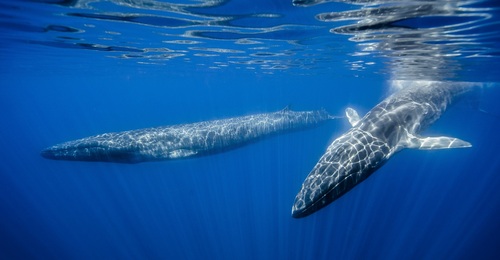
Dark bluish-gray to black dorsal coloration with a lighter underside, often with a mottled or scarred appearance from parasites (cyamid whale lice). Body is slender and streamlined with a single ridge on the head and a curved, falcate dorsal fin set relatively far forward.
Size
Adults typically range from 12 to 16 meters in length, with females slightly larger than males.
Weight
Weighs between 20 and 28 metric tons on average, with large individuals reaching up to 30 tons.
Distinctive features
Distinguished from similar rorquals like the Fin Whale by its more uniform coloration, single head ridge, and tall, curved dorsal fin that appears simultaneously with the blow when surfacing. Its blow is often less prominent than that of Blue or Fin whales.
Differences between males and females
Minimal sexual dimorphism; females are generally slightly longer than males, a common pattern among baleen whales.
Behaviour and diet of the Sei Whale
Typically solitary or found in small groups of 2-5 individuals, though larger temporary aggregations may form in productive feeding areas.
When it is active
Diurnal and nocturnal activity with no strict pattern; feeding and traveling occur throughout day and night depending on prey availability.
Diet
Primarily feeds on copepods, krill, and small schooling fish, with diet composition varying by region and season.
How it feeds and hunts
Uses both skimming (swimming through prey patches with mouth open) and gulping techniques; often feeds near the surface, exploiting dense patches of zooplankton.
Communication
Uses low-frequency vocalizations, including moans and pulses, likely for long-distance communication; less studied than other baleen whale species but believed to follow similar patterns to Fin and Blue whales.
Interactions with other species
Has few natural predators aside from occasional killer whale attacks on calves or weakened individuals; competes with other baleen whales for zooplankton resources in shared feeding grounds.
Role in its ecosystem
Plays a role as a mid-level consumer in marine food webs, helping regulate zooplankton populations and contributing to nutrient cycling through fecal plumes that fertilize phytoplankton growth.
Reproduction and lifecycle
Breeding occurs in winter in temperate waters; gestation lasts approximately 10-12 months, resulting in a single calf born every 2-3 years.
Raising the young
Calves are cared for exclusively by the mother, nursing for about 6-9 months before weaning; mother-calf bond is the primary social unit during this period.
Maturity and lifespan
Reaches sexual maturity around 8-10 years of age; lifespan in the wild is estimated at 50-70 years.
Taxonomy and naming of the Sei Whale
Classification
Class Mammalia > Order Cetartiodactyla (Cetacea) > Family Balaenopteridae > Genus Balaenoptera > Species Balaenoptera borealis
Subspecies
Two subspecies are sometimes recognized: Balaenoptera borealis borealis (Northern Hemisphere) and Balaenoptera borealis schlegelii (Southern Hemisphere), though this division is not universally accepted.
Scientific synonyms
Balaena borealis (original name given by Lesson, 1828)
What research says
Recent studies
Recent genetic and acoustic studies have helped clarify population structure and migratory connectivity between ocean basins, though much remains unknown about detailed movements and habitat use.
Genome and DNA
Diploid chromosome number of 44, similar to other Balaenopteridae species; genetic studies have been used to help distinguish population structure across ocean basins.
Compared with similar species
Similar in appearance to the Fin Whale but smaller and with a more uniformly colored body lacking the asymmetrical jaw coloration seen in Fin Whales; also resembles the Bryde's Whale but lacks the additional head ridges characteristic of that species.
The Sei Whale and people
The Sei Whale is named after the Norwegian word for pollock ('sei'), because the whales often appeared off Norway at the same time as pollock schools. It is one of the fastest baleen whales, capable of short bursts of speed rivaling some dolphins.
Where and how to see it
Best observed in offshore pelagic waters during summer feeding season in regions like the North Atlantic (Nova Scotia), North Pacific, and subantarctic waters; sightings are less predictable than coastal whale species due to its deep-water preference.
Risks to humans
No notable risk to humans; Sei Whales are non-aggressive and pose no direct threat, though large size warrants caution around vessels.
Human uses
Historically hunted extensively for oil and meat during 20th-century commercial whaling operations; today, primarily valued for scientific research and ecotourism rather than direct exploitation.
Countries where the Sei Whale is recorded
The 2 countries named in the range description of its IUCN Red List assessment.
Questions about the Sei Whale
Where does the Sei Whale live?
The Sei Whale is recorded in Falkland Islands and Iceland across Europe and South America. These countries come from the range description of its IUCN Red List assessment, and they are what place the species on the interactive map.
Is the Sei Whale endangered?
Yes. The IUCN Red List assesses the Sei Whale as Endangered, one of the three threatened categories. The species faces a very high risk of extinction in the wild — a step below Critically Endangered, but still on a trajectory that ends badly without intervention.
How many are left in the wild?
Global population estimated at around 50,000-80,000 individuals, though this is highly uncertain; overall trend considered to be slowly increasing or stable in some regions following the end of large-scale whaling. This figure comes from the species assessment on the IUCN Red List; population estimates for wild mammals are ranges, not counts, and are revised at each assessment.
What habitat does the Sei Whale live in?
Primarily pelagic, inhabiting deep offshore continental shelf and slope waters; also found in temperate and subpolar oceanic zones, generally avoiding polar ice edges and tropical waters.
What is the scientific name of the Sei Whale?
The Sei Whale is Balaenoptera borealis, in the family Balaenopteridae, order Cetartiodactyla.
Other species in the genus Balaenoptera
Other species in the family Balaenopteridae
Species that share its range
Sources
Conservation status, range description and population estimate come from the IUCN Red List assessment for Balaenoptera borealis. Countries are derived from that range description, not from a mapped country list. Last refreshed on .
The distribution map is drawn from the IUCN Red List spatial data compiled in 2012. IUCN (International Union for Conservation of Nature)