
Antarctic Minke Whale
Balaenoptera bonaerensis
Red List assessment
Near Threatenedon the IUCN Red List
- EXExtinct
- EWExtinct in the Wild
- CRCritically Endangered
- ENEndangered
- VUVulnerable
- NTNear Threatened
- LCLeast Concern
The Antarctic Minke Whale is recorded in 3 countries across Oceania and Antarctica. The IUCN Red List assesses the Antarctic Minke Whale as Near Threatened. Estimated at approximately 500,000 individuals in the Southern Ocean, though estimates vary; population trend considered relatively stable but historically depleted from whaling
- Family
- Balaenopteridae
- Order
- Cetartiodactyla
- Genus
- Balaenoptera
- Countries recorded
- 3
- Continents
- Oceania and Antarctica
- Red List category
- Near Threatened
- Data updated
- August 9, 2026
What is the Antarctic Minke Whale?
The Antarctic Minke Whale is a baleen whale species found predominantly in the Southern Hemisphere, especially in Antarctic waters during summer feeding season. It is one of the smallest baleen whales but remains an important krill predator in the Southern Ocean ecosystem. This species was only formally recognized as distinct from the common minke whale in 1998 based on genetic and morphological differences. It is notable for its extensive migrations between polar feeding grounds and warmer breeding areas.
Where does the Antarctic Minke Whale live?
Southern Ocean surrounding Antarctica, with seasonal migrations to tropical and subtropical waters including off Australia, New Zealand, South America, and Africa
Circumpolar distribution in the Southern Hemisphere, ranging from Antarctic waters (feeding grounds) to tropical waters off South America, Africa, Australia, and New Zealand (breeding grounds). Migration routes cover vast distances across ocean basins.
Altitude and depth
Primarily surface to mid-water depths, typically diving 100-300m, though capable of dives up to 500m when foraging for krill
Seasonal movements
Highly migratory species; spends austral summer (November-March) feeding in Antarctic waters near pack ice, then migrates to warmer tropical/subtropical waters during austral winter for breeding and calving
Habitat of the Antarctic Minke Whale
Pelagic marine environments ranging from Antarctic pack ice zones in summer to tropical and subtropical open ocean waters in winter for breeding. They are often found near ice edges and in areas with high krill concentration.
Adaptations to its environment
Thick blubber layer provides insulation against frigid Antarctic waters; streamlined body shape and powerful tail fluke enable efficient long-distance migration; baleen plates specifically adapted for filter-feeding on krill swarms.
Conservation status and numbers
Near Threatened (NT) according to IUCN, reflecting recovery from historical whaling pressure though some uncertainty remains about current population trends and impacts of climate change on Antarctic krill populations
Estimated population
Estimated at approximately 500,000 individuals in the Southern Ocean, though estimates vary; population trend considered relatively stable but historically depleted from whaling
What threatens the Antarctic Minke Whale?
Historical commercial whaling (including ongoing scientific/commercial whaling by Japan until 2019), climate change affecting krill availability and sea ice habitat, entanglement in fishing gear, and ship strikes
Diseases and parasites
Known to host various parasites including whale lice, barnacles, and internal parasites such as nematodes; susceptible to some viral and bacterial infections though comprehensive disease data is limited
What is being done to protect it?
Protected under the International Whaling Commission moratorium since 1986, though subject to controversial 'scientific whaling' programs; included in CITES Appendix I; protected within the Southern Ocean Whale Sanctuary
Recommended actions
Continued monitoring of population trends, protection of Antarctic krill fisheries to ensure adequate food supply, strengthened international enforcement against illegal or scientific whaling, and research into climate change impacts on Antarctic ecosystems
What the Antarctic Minke Whale looks like
Dark gray to black dorsal coloration with lighter, often white, ventral surface; sleek, streamlined body shape typical of rorqual whales with a pointed rostrum and small, curved dorsal fin set relatively far back on the body
Size
Body length typically ranges from 7-10 meters, with females slightly larger than males
Weight
Adult weight ranges from 5,000-9,000 kg (5-9 tonnes)
Distinctive features
Distinguished from the common minke whale by lack of white band on pectoral flippers, different baleen plate coloration (more uniformly grayish), and genetic markers; generally found in higher latitude Antarctic waters
Differences between males and females
Minimal sexual dimorphism; females are typically slightly larger than males, which is common among baleen whales
Behaviour and diet of the Antarctic Minke Whale
Generally solitary or found in small groups of 2-3 individuals, though larger aggregations of dozens to hundreds may form in productive feeding areas with abundant krill
When it is active
Diurnal and nocturnal activity patterns with feeding often occurring throughout day and night, particularly during peak krill availability in summer months
Diet
Primarily carnivorous, feeding almost exclusively on Antarctic krill (Euphausia superba), occasionally supplemented with small schooling fish and other zooplankton
How it feeds and hunts
Uses lunge-feeding technique, engulfing large volumes of water and krill-rich patches, then filtering krill through baleen plates by expelling water; may employ cooperative feeding strategies in dense krill swarms
Communication
Produces low-frequency vocalizations including distinctive 'bio-duck' sounds used for long-distance communication; body language and physical contact also play roles in social interaction
Interactions with other species
Killer whales (orcas) are the primary natural predator, particularly targeting calves; may compete with other baleen whales and krill-dependent predators like seals and penguins for food resources
Role in its ecosystem
Plays a significant role as a major consumer of Antarctic krill, helping regulate krill population dynamics and serving as an important link in the Southern Ocean food web between primary producers and higher trophic levels
Reproduction and lifecycle
Breeding occurs during austral winter in warmer waters; gestation period lasts approximately 10 months; typically gives birth to a single calf every 1-2 years
Raising the young
Calves are nursed by mothers for approximately 5-6 months on nutrient-rich milk; mother-calf bond is close during this period with calves accompanying mothers during migration to feeding grounds
Maturity and lifespan
Reaches sexual maturity around 6-8 years of age; lifespan in the wild is estimated at 30-50 years, with some individuals potentially living longer
Taxonomy and naming of the Antarctic Minke Whale
Classification
Mammalia > Cetartiodactyla > Balaenopteridae > Balaenoptera > Balaenoptera bonaerensis
Scientific synonyms
Formerly classified together with Balaenoptera acutorostrata as a single species; sometimes referred to as the 'southern minke whale'
What research says
Recent studies
Recent research has focused on population genetics, migration patterns using satellite tagging, and assessing impacts of climate change on Antarctic krill availability and whale foraging success
Genome and DNA
Genetic studies have confirmed distinct species status separate from the common minke whale based on mitochondrial DNA and nuclear genetic markers; chromosome number is 2n=44, typical for baleen whales
Compared with similar species
Similar in appearance to the common minke whale (Balaenoptera acutorostrata) but distinguished by genetic differences, lack of white flipper band, and more southerly Antarctic distribution; smaller than other rorquals like fin or blue whales
The Antarctic Minke Whale and people
Antarctic minke whales can consume up to 1 tonne of krill per day during peak feeding season; they were only formally recognized as a distinct species in 1998, having previously been considered the same species as northern minke whales; they are among the fastest baleen whales, capable of swimming at speeds up to 38 km/h.
Where and how to see it
Best observed during Antarctic cruise expeditions in austral summer (December-February) near the Antarctic Peninsula or pack ice edges where feeding aggregations occur; also occasionally sighted during migration off New Zealand and Australian coasts
Risks to humans
No notable risk to humans; these whales are not aggressive and pose no direct threat, though large size requires caution during close encounters with vessels
Human uses
Historically hunted for meat, oil, and baleen; continues to be subject to controversial scientific and commercial whaling primarily by Japan; also valued for ecotourism and whale-watching activities in the Southern Ocean
Countries where the Antarctic Minke Whale is recorded
The 3 countries named in the range description of its IUCN Red List assessment.
Questions about the Antarctic Minke Whale
Where does the Antarctic Minke Whale live?
The Antarctic Minke Whale is recorded in Antarctica, Australia and New Zealand across Oceania and Antarctica. These countries come from the range description of its IUCN Red List assessment, and they are what place the species on the interactive map.
Is the Antarctic Minke Whale endangered?
The IUCN Red List assesses the Antarctic Minke Whale as Near Threatened. The species does not qualify as threatened today, but it is close to the thresholds and likely to cross them soon. It is the category that most often changes at the next assessment.
How many are left in the wild?
Estimated at approximately 500,000 individuals in the Southern Ocean, though estimates vary; population trend considered relatively stable but historically depleted from whaling This figure comes from the species assessment on the IUCN Red List; population estimates for wild mammals are ranges, not counts, and are revised at each assessment.
What habitat does the Antarctic Minke Whale live in?
Pelagic marine environments ranging from Antarctic pack ice zones in summer to tropical and subtropical open ocean waters in winter for breeding.
What is the scientific name of the Antarctic Minke Whale?
The Antarctic Minke Whale is Balaenoptera bonaerensis, in the family Balaenopteridae, order Cetartiodactyla.
Other species in the genus Balaenoptera
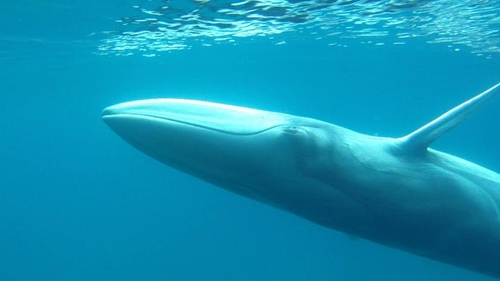
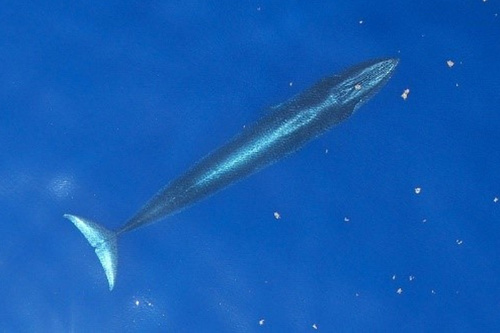
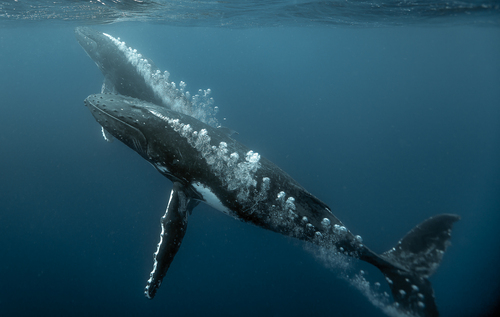
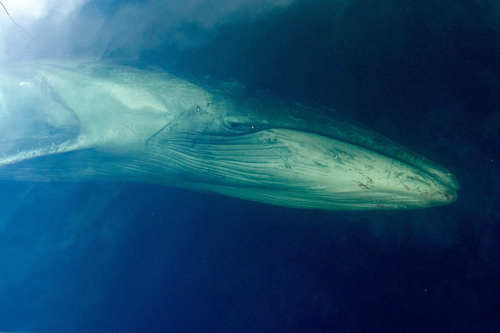
Other species in the family Balaenopteridae
Species that share its range

Sources
Conservation status, range description and population estimate come from the IUCN Red List assessment for Balaenoptera bonaerensis. Countries are derived from that range description, not from a mapped country list. Last refreshed on .
The distribution map is drawn from the IUCN Red List spatial data compiled in 2008. IUCN (International Union for Conservation of Nature)