
Bryde's Whale
Balaenoptera edeni
Red List assessment
Least Concernon the IUCN Red List
- EXExtinct
- EWExtinct in the Wild
- CRCritically Endangered
- ENEndangered
- VUVulnerable
- NTNear Threatened
- LCLeast Concern
The Bryde's Whale is recorded in 5 countries across Africa, Asia, North America and Oceania. The IUCN Red List assesses the Bryde's Whale as Least Concern. Global population estimated at approximately 90,000-100,000 individuals; trend considered stable, though data for some regional subpopulations remain limited.
- Family
- Balaenopteridae
- Order
- Cetartiodactyla
- Genus
- Balaenoptera
- Countries recorded
- 5
- Continents
- Africa, Asia, North America and Oceania
- Red List category
- Least Concern
- Data updated
- August 9, 2026
What is the Bryde's Whale?
Bryde's Whale is a medium-sized baleen whale found in warm temperate and tropical oceans worldwide, distinguished by three parallel ridges on its rostrum. Unlike many baleen whales, it does not undertake long migrations to polar feeding grounds, remaining in warmer waters year-round. It is notable for its adaptability, feeding on a wide variety of prey using diverse foraging techniques, including surface lunge-feeding.
Where does the Bryde's Whale live?
Warm temperate and tropical waters worldwide, including coastal regions of South Africa, the Gulf of Mexico, Southeast Asia, and the Pacific and Indian Oceans
Found circumglobally between approximately 40°N and 40°S, including the coasts of South Africa, the Gulf of Mexico, the Gulf of Thailand, Japan, Australia, and the eastern Pacific Ocean.
Altitude and depth
Primarily surface to mid-water depths, typically diving 10-300 meters while foraging
Seasonal movements
Unlike many baleen whales, Bryde's whales do not perform extensive seasonal migrations to polar regions, though some populations show localized seasonal movements tied to prey availability.
Habitat of the Bryde's Whale
Pelagic and coastal marine habitats in tropical to warm temperate waters, typically staying within waters warmer than 16°C; found both in open ocean and closer to continental shelves.
Adaptations to its environment
Streamlined body and baleen plates adapted for filter-feeding on small schooling fish and krill; ability to remain in warm waters year-round reduces energy expenditure compared to species that migrate to polar feeding grounds. Three distinct ridges on the rostrum aid in hydrodynamic efficiency.
Conservation status and numbers
Listed as Least Concern by the IUCN, as the species has a wide distribution and relatively stable population trends, though some regional populations face localized threats.
Estimated population
Global population estimated at approximately 90,000-100,000 individuals; trend considered stable, though data for some regional subpopulations remain limited.
What threatens the Bryde's Whale?
Ship strikes, entanglement in fishing gear, historical whaling, and habitat degradation from pollution and coastal development.
Diseases and parasites
Known to host various ectoparasites such as barnacles and whale lice, as well as internal parasites including nematodes; susceptibility to morbillivirus has been documented in some cetacean populations.
What is being done to protect it?
Protected under the International Whaling Commission moratorium on commercial whaling; included in CITES Appendix I; monitored within various marine protected areas globally.
Recommended actions
Continued monitoring of regional populations, mitigation of ship strike risks through shipping lane adjustments, reduction of bycatch through improved fishing gear regulations, and further genetic studies to clarify taxonomic status.
What the Bryde's Whale looks like
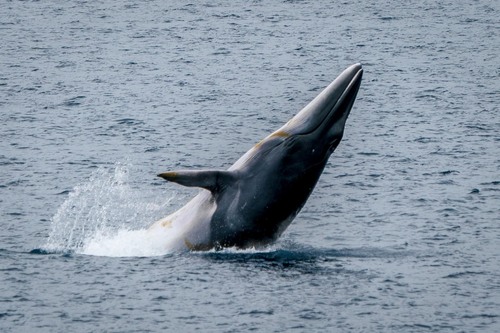
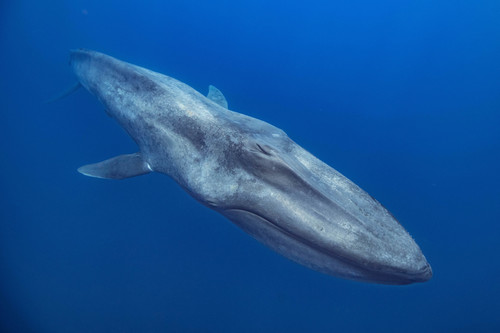
Dark grey to bluish-black dorsal coloration with a paler underside; sleek, streamlined body with a slightly curved dorsal fin located about two-thirds along the back. Baleen plates are dark grey to black.
Size
Body length typically ranges from 11 to 15 meters, with females slightly larger than males
Weight
Approximately 12,000 to 25,000 kg, with larger individuals reaching up to 20 tonnes
Distinctive features
Distinguished from similar rorquals by three parallel ridges on the top of the rostrum, as opposed to the single ridge found in fin and sei whales.
Differences between males and females
Minimal sexual dimorphism; females are generally slightly larger than males, a common trait among baleen whales.
Behaviour and diet of the Bryde's Whale
Generally solitary or found in small groups of two to three individuals, though larger aggregations may form in areas of high prey density.
When it is active
Diurnal and nocturnal activity patterns with feeding occurring throughout the day; known for unpredictable surfacing patterns compared to other rorquals.
Diet
Carnivorous, feeding on small schooling fish such as anchovies and sardines, as well as krill and other planktonic crustaceans.
How it feeds and hunts
Utilizes lunge-feeding at the surface, as well as bubble-net-like techniques in some populations; capable of quick directional changes to pursue mobile prey schools.
Communication
Communicates through low-frequency vocalizations, including moans and pulses, used for long-distance communication in the ocean.
Interactions with other species
Occasionally targeted by killer whales (Orcinus orca) as predators; may share feeding grounds with other baleen whale species and various seabirds that follow feeding aggregations.
Role in its ecosystem
Plays a role as a mid-to-upper trophic level predator, helping regulate populations of small schooling fish and krill, contributing to nutrient cycling through fecal plumes that support phytoplankton growth.
Reproduction and lifecycle
Breeding can occur year-round in some populations due to lack of strict migratory patterns; gestation lasts approximately 11-12 months, typically resulting in a single calf.
Raising the young
Calves are nursed for approximately 6-12 months and remain with their mothers during this period, learning foraging behaviors before becoming independent.
Maturity and lifespan
Sexual maturity reached at approximately 8-13 years; lifespan estimated at 40-50 years in the wild.
Taxonomy and naming of the Bryde's Whale
Classification
Mammalia > Cetartiodactyla > Balaenopteridae > Balaenoptera > B. edeni
Subspecies
Balaenoptera edeni edeni (offshore form) and Balaenoptera edeni brydei (coastal/inshore form) are often recognized, though taxonomy is still debated; some authorities treat the Eden's whale as a separate species (B. edeni sensu stricto).
Scientific synonyms
Balaenoptera brydei; previously confused with Balaenoptera physalus and Balaenoptera borealis due to morphological similarities
What research says
Recent studies
Recent genetic and acoustic studies have supported splitting Balaenoptera edeni into multiple species or subspecies, with ongoing research into population structure in the Gulf of Mexico and Southeast Asia.
Genome and DNA
Diploid chromosome number of 44, consistent with other rorqual whales; genetic studies have been used to help clarify taxonomic relationships between Bryde's and Eden's whale forms.
Compared with similar species
Similar in appearance to sei whales (Balaenoptera borealis) and fin whales (Balaenoptera physalus), but distinguished by smaller size, three rostral ridges instead of one, and preference for warmer waters.
The Bryde's Whale and people
Bryde's whales are one of the few baleen whale species that do not migrate to polar waters; they are named after Johan Bryde, a Norwegian consul who helped establish early whaling stations in South Africa; some populations have been observed exhibiting unique surface feeding behavior called 'lunge feeding' at unpredictable angles.
Where and how to see it
Best observed along the coasts of South Africa, the Gulf of Thailand, and the Gulf of Mexico, particularly during calm sea conditions when surface feeding behavior is more visible; whale-watching tours in Richards Bay, South Africa offer good opportunities.
Risks to humans
No notable risk to humans; the species is not aggressive and poses no direct threat, though boat collisions can be hazardous for both whales and vessels.
Human uses
Historically hunted for whale oil and meat during 20th-century whaling operations; today primarily valued for ecotourism through whale-watching activities.
Countries where the Bryde's Whale is recorded
The 5 countries named in the range description of its IUCN Red List assessment.
Questions about the Bryde's Whale
Where does the Bryde's Whale live?
The Bryde's Whale is recorded in Australia, Japan, Mexico, South Africa and Thailand across Africa, Asia, North America and Oceania. These countries come from the range description of its IUCN Red List assessment, and they are what place the species on the interactive map.
Is the Bryde's Whale endangered?
The IUCN Red List assesses the Bryde's Whale as Least Concern. The species is widespread and abundant enough not to qualify for any threatened category. It does not mean the species is safe forever, only that nothing in the current data raises an alarm.
How many are left in the wild?
Global population estimated at approximately 90,000-100,000 individuals; trend considered stable, though data for some regional subpopulations remain limited. This figure comes from the species assessment on the IUCN Red List; population estimates for wild mammals are ranges, not counts, and are revised at each assessment.
What habitat does the Bryde's Whale live in?
Pelagic and coastal marine habitats in tropical to warm temperate waters, typically staying within waters warmer than 16°C; found both in open ocean and closer to continental shelves.
What is the scientific name of the Bryde's Whale?
The Bryde's Whale is Balaenoptera edeni, in the family Balaenopteridae, order Cetartiodactyla.
Other species in the genus Balaenoptera
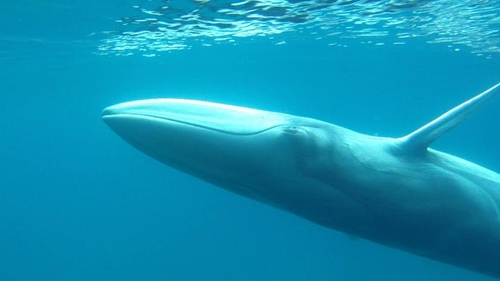
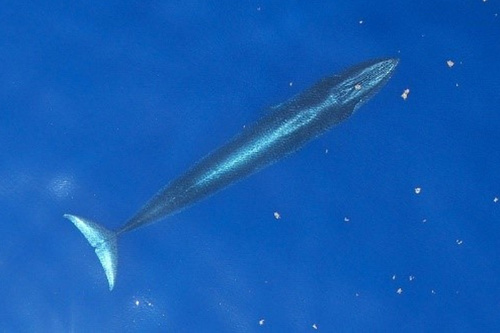
Other species in the family Balaenopteridae
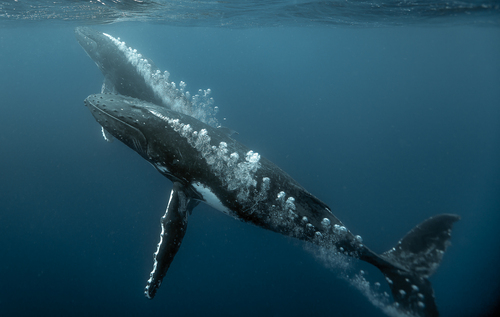
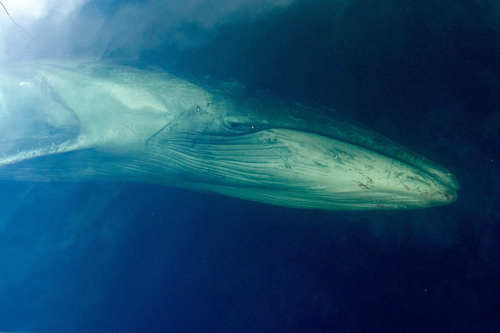
Species that share its range
Sources
Conservation status, range description and population estimate come from the IUCN Red List assessment for Balaenoptera edeni. Countries are derived from that range description, not from a mapped country list. Last refreshed on .
The distribution map is drawn from the IUCN Red List spatial data compiled in 2017. IUCN (International Union for Conservation of Nature)