
Blue Whale
Balaenoptera musculus
Red List assessment
Endangeredon the IUCN Red List
- EXExtinct
- EWExtinct in the Wild
- CRCritically Endangered
- ENEndangered
- VUVulnerable
- NTNear Threatened
- LCLeast Concern
The Blue Whale is recorded in 5 countries across Asia, Europe, South America and Antarctica. The IUCN Red List assesses the Blue Whale as Endangered. Estimated 10,000-25,000 individuals globally, with populations generally increasing or stable in some regions (e.g., Northeast Pacific) but slow to recover overall due to long generation times.
- Family
- Balaenopteridae
- Order
- Cetartiodactyla
- Genus
- Balaenoptera
- Countries recorded
- 5
- Continents
- Asia, Europe, South America and Antarctica
- Red List category
- Endangered
- Data updated
- August 9, 2026
What is the Blue Whale?
The Blue Whale is the largest animal known to have ever lived on Earth, reaching lengths of up to 30 meters. It inhabits all major oceans, migrating between cold feeding grounds and warmer breeding areas. Despite its enormous size, it feeds almost exclusively on tiny shrimp-like krill. Its population was decimated by industrial whaling in the 20th century, and it remains endangered today.
Where does the Blue Whale live?
Found in all oceans except the Arctic, with notable populations off Sri Lanka, California, Chile, Iceland, and Antarctica
Globally distributed in all oceans except the Arctic; major populations include the Northeast Pacific, North Atlantic, Antarctic/Southern Ocean, and Northern Indian Ocean (notably around Sri Lanka and the Maldives).
Altitude and depth
Primarily surface to 100m for feeding dives, though capable of diving to depths of 300-500m; typically found in pelagic waters over the continental shelf and slope.
Seasonal movements
Undertakes long seasonal migrations between high-latitude summer feeding grounds rich in krill and lower-latitude winter breeding/calving grounds, though some populations like those near Sri Lanka may be more resident.
Habitat of the Blue Whale
Pelagic, open ocean environments ranging from polar to tropical waters; often found near continental shelves, upwelling zones, and areas of high krill density.
Adaptations to its environment
Massive size and streamlined body reduce drag for efficient long-distance swimming; baleen plates allow filter-feeding on massive quantities of krill; thick blubber layer provides insulation and energy storage for migration.
Conservation status and numbers
Endangered (EN) according to IUCN, having declined by an estimated 70% or more from historical levels due to 20th-century commercial whaling; some subpopulations remain critically depleted.
Estimated population
Estimated 10,000-25,000 individuals globally, with populations generally increasing or stable in some regions (e.g., Northeast Pacific) but slow to recover overall due to long generation times.
What threatens the Blue Whale?
Ship strikes, entanglement in fishing gear, ocean noise pollution affecting communication, climate change altering krill distribution, and historical whaling impacts still affecting recovery.
Diseases and parasites
Known to host various ectoparasites such as barnacles and whale lice, as well as endoparasites including nematodes; can also be affected by skin lesions from unknown pathogens.
What is being done to protect it?
Protected under the International Whaling Commission moratorium since 1966, listed on CITES Appendix I, protected in numerous marine protected areas, and subject to shipping lane adjustments in high-traffic zones to reduce strikes.
Recommended actions
Continued enforcement of anti-whaling regulations, expansion of marine protected areas, mandatory ship speed reductions in whale habitats, reduction of fishing gear entanglement risk, and further research on population dynamics.
What the Blue Whale looks like
Mottled blue-gray skin with a long, streamlined body; a small dorsal fin set far back on the body; broad, flat rostrum; and 55-68 throat grooves that expand during feeding.
Size
Body length typically 24-30 meters, with females generally slightly larger than males; the longest recorded individual measured nearly 33 meters.
Weight
Typically weighs between 100,000-150,000 kg (100-150 tonnes), with the largest individuals potentially reaching up to 180 tonnes.
Distinctive features
Distinguished from other rorquals by its immense size, mottled blue-gray coloration, U-shaped head, and relatively small dorsal fin compared to body length.
Differences between males and females
Minimal external dimorphism, though females are typically slightly larger than males, an unusual trait among mammals.
Behaviour and diet of the Blue Whale
Generally solitary or found in small groups of 2-3 individuals, though loose aggregations can form in productive feeding areas.
When it is active
Diurnal and nocturnal activity with feeding occurring throughout the day and night, particularly during periods of high krill density.
Diet
Almost exclusively feeds on krill (small shrimp-like crustaceans), consuming up to 4 tonnes of krill per day during feeding season.
How it feeds and hunts
Uses lunge-feeding technique, engulfing large volumes of water and krill-rich prey, then filtering water out through baleen plates while retaining krill.
Communication
Produces some of the loudest and lowest-frequency sounds of any animal, including long, low-frequency moans and pulses used for long-distance communication, potentially spanning hundreds of kilometers.
Interactions with other species
Few natural predators aside from occasional orca attacks on calves or weakened individuals; competes indirectly with other baleen whales for krill resources.
Role in its ecosystem
Plays a significant role as a major consumer of krill, influencing marine food web dynamics, and contributes to nutrient cycling through fecal plumes that fertilize phytoplankton growth.
Reproduction and lifecycle
Breeding occurs mainly in winter in warmer waters; gestation lasts approximately 10-12 months, resulting in a single calf; calving interval is typically 2-3 years.
Raising the young
Calves are cared for solely by the mother, nursing on extremely fat-rich milk for 6-7 months before weaning, during which calves gain substantial body mass and length.
Maturity and lifespan
Sexual maturity is typically reached between 5-15 years of age; lifespan can exceed 80-90 years in the wild, based on earplug growth layer analysis.
Taxonomy and naming of the Blue Whale
Classification
Class Mammalia > Order Cetartiodactyla (Cetacea) > Family Balaenopteridae > Genus Balaenoptera > Species B. musculus
Subspecies
B. m. musculus (Northern Hemisphere), B. m. intermedia (Southern Ocean/Antarctic), B. m. brevicauda (Pygmy blue whale, Indian Ocean and South Pacific), and B. m. indica (Northern Indian Ocean, sometimes considered synonymous with brevicauda)
Scientific synonyms
Balaena musculus (Linnaeus, 1758), Sibbaldus musculus, Physalus musculus
What research says
Recent studies
Recent studies using satellite tagging and acoustic monitoring have revealed previously unknown feeding and breeding grounds, including a newly identified population in the Indian Ocean around the Chagos Archipelago.
Genome and DNA
Has 44 chromosomes (22 pairs); genomic studies have been used to trace population structure and historical demographic decline due to whaling.
Compared with similar species
Larger than the Fin Whale (Balaenoptera physalus), the second-largest rorqual, and distinguished by its mottled coloration and more robust body compared to the sleeker Fin Whale.
The Blue Whale and people
The Blue Whale's heart can weigh as much as a small car and its calls can be louder than a jet engine; a newborn calf can weigh as much as an adult elephant.
Where and how to see it
Best observed via whale-watching tours off the coast of Sri Lanka (Mirissa), California (Monterey Bay), or Chile (Gulf of Corcovado) during peak feeding seasons, typically from November to April depending on location.
Risks to humans
No notable risk to humans; Blue Whales are non-aggressive and pose no direct threat, though boat collisions can be dangerous for both whales and vessels.
Human uses
Historically hunted extensively for oil, meat, and baleen during the whaling era; today primarily valued for ecotourism and scientific research rather than direct exploitation.
Myths and legends
While not as prominent in ancient mythology as some other whales, the Blue Whale has become a modern symbol of ocean conservation and the fragility of marine ecosystems.
Countries where the Blue Whale is recorded
The 5 countries named in the range description of its IUCN Red List assessment.
Questions about the Blue Whale
Where does the Blue Whale live?
The Blue Whale is recorded in Antarctica, Chile, Iceland, Maldives and Sri Lanka across Asia, Europe, South America and Antarctica. These countries come from the range description of its IUCN Red List assessment, and they are what place the species on the interactive map.
Is the Blue Whale endangered?
Yes. The IUCN Red List assesses the Blue Whale as Endangered, one of the three threatened categories. The species faces a very high risk of extinction in the wild — a step below Critically Endangered, but still on a trajectory that ends badly without intervention.
How many are left in the wild?
Estimated 10,000-25,000 individuals globally, with populations generally increasing or stable in some regions (e.g., Northeast Pacific) but slow to recover overall due to long generation times. This figure comes from the species assessment on the IUCN Red List; population estimates for wild mammals are ranges, not counts, and are revised at each assessment.
What habitat does the Blue Whale live in?
Pelagic, open ocean environments ranging from polar to tropical waters; often found near continental shelves, upwelling zones, and areas of high krill density.
What is the scientific name of the Blue Whale?
The Blue Whale is Balaenoptera musculus, in the family Balaenopteridae, order Cetartiodactyla.
Other species in the genus Balaenoptera
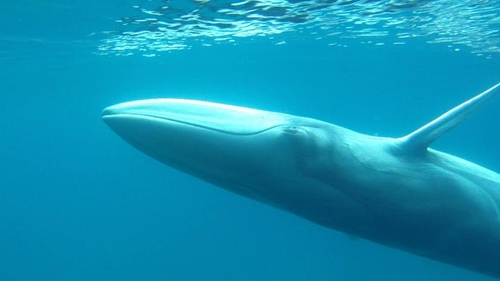
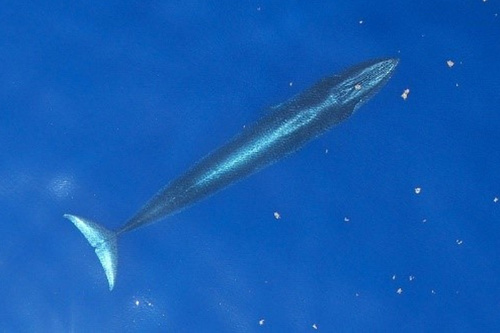
Other species in the family Balaenopteridae
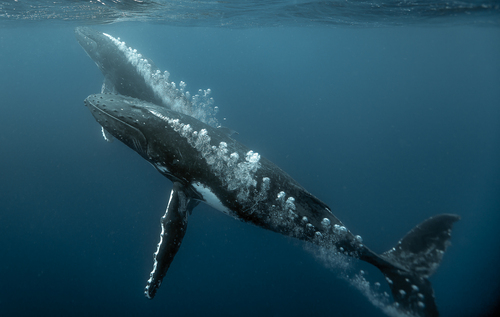
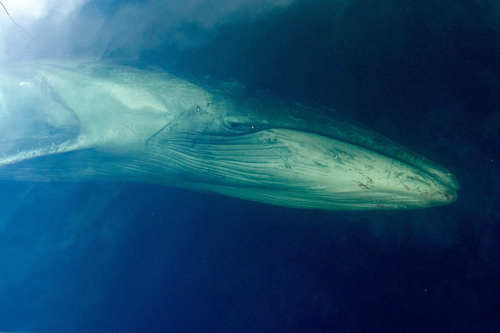
Species that share its range
Sources
Conservation status, range description and population estimate come from the IUCN Red List assessment for Balaenoptera musculus. Countries are derived from that range description, not from a mapped country list. Last refreshed on .
The distribution map is drawn from the IUCN Red List spatial data compiled in 2012. IUCN (International Union for Conservation of Nature)