
Grey Seal
Halichoerus grypus
Red List assessment
Least Concernon the IUCN Red List
- EXExtinct
- EWExtinct in the Wild
- CRCritically Endangered
- ENEndangered
- VUVulnerable
- NTNear Threatened
- LCLeast Concern
The Grey Seal is recorded in 9 countries across Europe and North America. The IUCN Red List assesses the Grey Seal as Least Concern. Approximately 400,000-500,000 individuals globally, with populations generally increasing or stable, particularly in the UK and Baltic regions.
- Family
- Phocidae
- Order
- Carnivora
- Genus
- Halichoerus
- Countries recorded
- 9
- Continents
- Europe and North America
- Red List category
- Least Concern
- Data updated
- August 9, 2026
What is the Grey Seal?
The Grey Seal is one of the largest pinnipeds found in the North Atlantic, known for its distinctive elongated 'horse-like' head profile. It inhabits rocky coastlines, sandbanks, and islands, breeding in large colonies. Remarkable for its size dimorphism and deep diving capability, it is a keystone marine predator in coastal ecosystems.
Where does the Grey Seal live?
North Atlantic coasts, including the United Kingdom, Ireland, Scandinavia, Baltic Sea, Iceland, and eastern Canada (Nova Scotia, Sable Island)
North Atlantic Ocean including the coasts of the United Kingdom, Ireland, Norway, Iceland, the Baltic Sea (Sweden, Finland, Estonia), and eastern Canada (Sable Island, Gulf of St. Lawrence) and the northeastern United States.
Altitude and depth
Dives typically range from 30-70m but can exceed 300m; spends most time in coastal shelf waters.
Seasonal movements
Breeding season occurs in autumn (UK/Atlantic populations, Sept-Dec) or late winter/spring (Baltic population, Feb-March); molting occurs annually in late winter/spring.
Habitat of the Grey Seal
Rocky shores, sandy beaches, offshore islands, and sandbanks used for breeding and molting; open ocean waters for foraging.
Adaptations to its environment
Thick blubber layer for insulation in cold waters, streamlined body for efficient swimming, and specialized vascular system for thermoregulation and deep diving; can slow heart rate during dives (bradycardia).
Conservation status and numbers
Least Concern (LC) according to IUCN, as populations have recovered significantly since legal protections were introduced in the 20th century after historic overhunting.
Estimated population
Approximately 400,000-500,000 individuals globally, with populations generally increasing or stable, particularly in the UK and Baltic regions.
What threatens the Grey Seal?
Historical hunting, bycatch in fishing gear, pollution (including PCBs), disease outbreaks (phocine distemper virus), and habitat disturbance from human activity.
Diseases and parasites
Susceptible to phocine distemper virus (PDV), various parasitic worms, and skin lesions; occasional outbreaks have caused significant mortality events.
What is being done to protect it?
Protected under various national laws (e.g., UK Conservation of Seals Act), EU Habitats Directive, and monitored through long-term population surveys; some culls are still permitted in certain regions to manage fishery conflicts.
Recommended actions
Continued monitoring of population health, reduction of bycatch through modified fishing gear, pollution control, and management of human-seal conflict in fishing areas.
What the Grey Seal looks like
Coat coloration varies widely from light grey to dark brown/black with distinctive blotches and spots; males tend to be darker with lighter patches, females lighter with dark spots.
Size
Males: 2.0-2.3m; Females: 1.6-2.0m in body length.
Weight
Males: 170-310 kg; Females: 100-190 kg.
Distinctive features
Distinguished from harbor seals by its larger size, longer straight/convex 'Roman nose' profile, and widely spaced nostrils that form a 'W' shape.
Differences between males and females
Significant sexual dimorphism: males are notably larger and heavier than females, with thicker necks, more pronounced 'Roman nose' profile, and darker coloring.
Behaviour and diet of the Grey Seal
Generally solitary at sea but highly social during breeding and molting seasons, forming large colonies on beaches with hundreds to thousands of individuals; males establish dominance hierarchies to access females.
When it is active
Diurnal and nocturnal activity patterns, with foraging trips occurring at various times; hauls out on land during breeding, molting, and resting periods.
Diet
Carnivorous, feeding primarily on a wide variety of fish including cod, herring, sand eels, flatfish, and occasionally cephalopods and crustaceans.
How it feeds and hunts
Solitary hunter using echolocation-like whisker sensitivity (vibrissae) to detect prey movements in murky water; dives to seafloor to forage benthic and pelagic fish.
Communication
Vocalizations include growls, grunts, and roars especially during breeding season for territorial and mating displays; also uses body posturing and scent for communication.
Interactions with other species
Natural predators include killer whales and occasionally large sharks; competes with other seal species and seabirds for fish resources; interacts with human fisheries.
Role in its ecosystem
Acts as an important mid-to-upper trophic level predator in coastal marine ecosystems, helping regulate fish populations and serving as prey for apex marine predators.
Reproduction and lifecycle
Breeding occurs once yearly with a gestation period of about 11 months (including delayed implantation); females give birth to a single pup per season.
Raising the young
Females provide intensive maternal care, nursing pups with extremely fat-rich milk for about 3 weeks before weaning; pups are left to fend for themselves shortly after weaning.
Maturity and lifespan
Sexual maturity reached around 3-5 years for females and 4-6 years for males; lifespan averages 25-35 years in the wild, occasionally longer in captivity.
Taxonomy and naming of the Grey Seal
Classification
Mammalia > Carnivora > Phocidae > Halichoerus > Halichoerus grypus
Subspecies
Three recognized populations/subspecies-level groups are often described: Halichoerus grypus grypus (Baltic Sea), Halichoerus grypus macrorhynchus (Atlantic), and Halichoerus grypus atlantica (Western Atlantic/Canada), though taxonomic status is debated.
Scientific synonyms
Phoca grypus (original name given by Fabricius, 1791)
What research says
Recent studies
Recent studies have used satellite tagging to reveal long-distance foraging trips and diving behavior, as well as genetic research clarifying population connectivity across the North Atlantic.
Genome and DNA
Diploid chromosome number of 32; genomic studies have been used to assess population structure and genetic diversity across Atlantic and Baltic populations.
Compared with similar species
Often compared to the Harbor Seal (Phoca vitulina), which is smaller with a more rounded head and V-shaped nostrils, whereas the Grey Seal has a longer snout and parallel nostrils.
The Grey Seal and people
Grey seal pups are born with a white lanugo coat that is shed after a few weeks; some individuals can dive to depths exceeding 300 meters; grey seals can hold their breath for up to an hour.
Where and how to see it
Best observed at breeding colonies in autumn (UK, Ireland) or late winter (Baltic Sea); popular sites include the Farne Islands (England), Donna Nook (England), and Sable Island (Canada).
Risks to humans
Generally low risk to humans, though seals can bite if threatened or approached too closely; caution advised during breeding season when adults are more aggressive.
Human uses
Historically hunted for meat, oil, and pelts; today primarily valued for ecotourism and scientific research rather than commercial exploitation.
Myths and legends
In Celtic folklore, grey seals are associated with 'selkies,' mythical creatures that can transform from seals into humans.
Countries where the Grey Seal is recorded
The 9 countries named in the range description of its IUCN Red List assessment.
Questions about the Grey Seal
Where does the Grey Seal live?
The Grey Seal is recorded in Canada, Estonia, Finland, Iceland and Ireland, among 9 countries in total across Europe and North America. These countries come from the range description of its IUCN Red List assessment, and they are what place the species on the interactive map.
Is the Grey Seal endangered?
The IUCN Red List assesses the Grey Seal as Least Concern. The species is widespread and abundant enough not to qualify for any threatened category. It does not mean the species is safe forever, only that nothing in the current data raises an alarm.
How many are left in the wild?
Approximately 400,000-500,000 individuals globally, with populations generally increasing or stable, particularly in the UK and Baltic regions. This figure comes from the species assessment on the IUCN Red List; population estimates for wild mammals are ranges, not counts, and are revised at each assessment.
What habitat does the Grey Seal live in?
Rocky shores, sandy beaches, offshore islands, and sandbanks used for breeding and molting; open ocean waters for foraging.
What is the scientific name of the Grey Seal?
The Grey Seal is Halichoerus grypus, in the family Phocidae, order Carnivora.
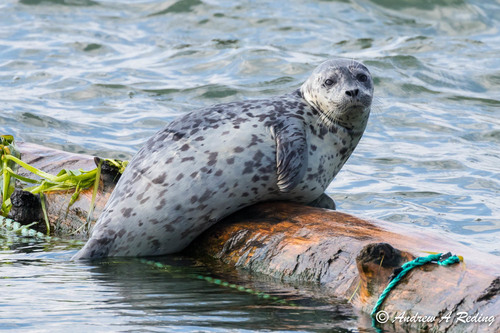
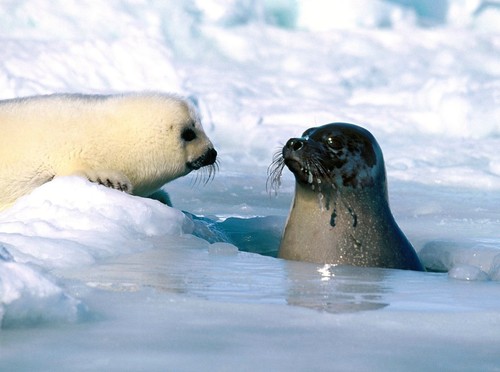
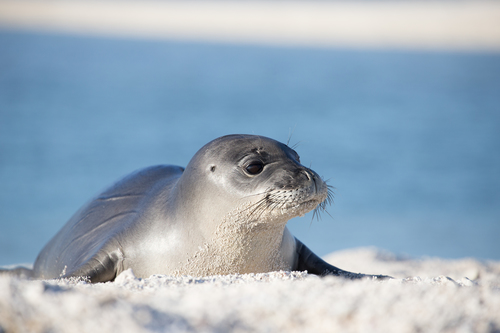
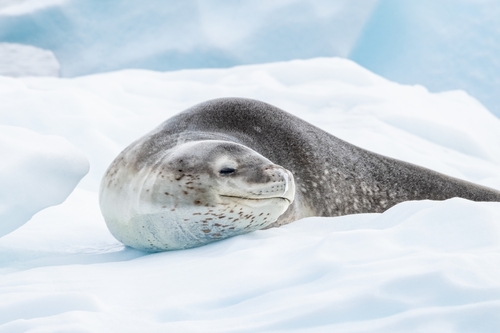
Other species in the family Phocidae
Species that share its range

Sources
Conservation status, range description and population estimate come from the IUCN Red List assessment for Halichoerus grypus. Countries are derived from that range description, not from a mapped country list. Last refreshed on .
The distribution map is drawn from the IUCN Red List spatial data compiled in 2025. Norwegian Polar Institute (NPI)