
Common Minke Whale
Balaenoptera acutorostrata
Red List assessment
Least Concernon the IUCN Red List
- EXExtinct
- EWExtinct in the Wild
- CRCritically Endangered
- ENEndangered
- VUVulnerable
- NTNear Threatened
- LCLeast Concern
The Common Minke Whale is recorded in 4 countries across Asia, Europe, Oceania and Antarctica. The IUCN Red List assesses the Common Minke Whale as Least Concern. Global population estimated at several hundred thousand individuals; considered stable to increasing in most regions, though some localized populations may be declining due to hunting pressure.
- Family
- Balaenopteridae
- Order
- Cetartiodactyla
- Genus
- Balaenoptera
- Countries recorded
- 4
- Continents
- Asia, Europe, Oceania and Antarctica
- Red List category
- Least Concern
- Data updated
- August 9, 2026
What is the Common Minke Whale?
The Common Minke Whale is the smallest of the baleen whales in the rorqual family, renowned for its sleek streamlined body and high-speed swimming ability. It inhabits nearly all oceans from tropical to polar waters, making it one of the most widely distributed cetaceans. Despite its small size relative to other rorquals, it is a fast and agile swimmer capable of bursts up to 30 km/h. This species has been extensively studied due to its historical significance in commercial whaling.
Where does the Common Minke Whale live?
Found in oceans worldwide, with major populations in the North Atlantic, North Pacific, and Southern Hemisphere including waters off Australia (Great Barrier Reef region), Antarctica, Scandinavia, and Japan.
Cosmopolitan distribution across all major oceans including the North Atlantic, North Pacific, and Southern Ocean; found near Scandinavia, Iceland, Japan, Korea, the eastern coast of North America, Antarctica, and Australian waters including the Great Barrier Reef.
Altitude and depth
Primarily surface to mid-water depths, typically diving 100-200m, with maximum recorded dives around 250m; mostly found in the upper water column while foraging.
Seasonal movements
Undertakes seasonal migrations between higher-latitude feeding grounds in summer and lower-latitude breeding/calving grounds in winter, though some populations show more residency than other rorquals.
Habitat of the Common Minke Whale
Inhabits open ocean (pelagic) environments as well as coastal waters, bays, and even enters estuaries occasionally. Found from tropical to polar/ice-edge waters, showing remarkable habitat flexibility compared to other rorquals.
Adaptations to its environment
Streamlined body shape and powerful tail fluke enable fast swimming to escape predators and pursue prey. Thick blubber layer provides insulation in cold polar waters, while baleen plates allow efficient filter-feeding on small schooling prey.
Conservation status and numbers
Listed as Least Concern by IUCN due to large global population size and wide distribution, though some regional populations face conservation concerns from continued hunting and bycatch.
Estimated population
Global population estimated at several hundred thousand individuals; considered stable to increasing in most regions, though some localized populations may be declining due to hunting pressure.
What threatens the Common Minke Whale?
Main threats include commercial and scientific whaling (particularly by Japan, Norway, and Iceland), entanglement in fishing gear, ship strikes, and increasing ocean noise pollution affecting communication.
Diseases and parasites
Known to host various ectoparasites such as whale lice (Cyamidae) and endoparasites including nematodes; also susceptible to viral and bacterial infections though extensive disease studies are limited.
What is being done to protect it?
Protected under the International Whaling Commission moratorium in most nations, though Japan, Norway, and Iceland continue limited hunts; also covered under CITES Appendix I and various national marine mammal protection laws.
Recommended actions
Strengthen international whaling regulations, reduce bycatch through modified fishing gear, mitigate ship strike risks through vessel speed restrictions, and continue population monitoring across regions.
What the Common Minke Whale looks like
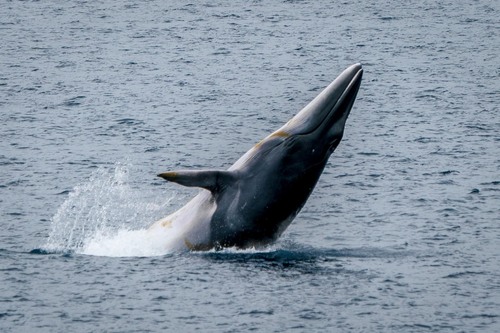
Dark gray to black dorsal coloration with a white or pale underside, featuring a distinctive white band on each flipper. The body is streamlined with a pointed, narrow snout and a small, sickle-shaped dorsal fin set relatively far back.
Size
Adults typically measure 7-10 meters in length, with females generally slightly larger than males.
Weight
Weighs approximately 4,000-9,000 kg (4-9 tonnes) as adults.
Distinctive features
Distinguished from other rorquals by its smaller size, pointed rostrum, and characteristic white flipper bands; the dorsal fin is more curved than in larger rorquals like the blue or fin whale.
Differences between males and females
Females are typically slightly larger than males, a common pattern among baleen whales, though external sexual differences are otherwise minimal and difficult to distinguish visually.
Behaviour and diet of the Common Minke Whale
Generally solitary or found in small groups of 2-3 individuals, though larger temporary aggregations may form in productive feeding areas with abundant prey.
When it is active
Active during both day and night, with feeding and traveling behaviors observed at various times; often surfaces briefly and dives without prolonged surface resting.
Diet
Carnivorous, feeding primarily on small schooling fish such as herring, capelin, and sand eels, as well as krill and other planktonic crustaceans depending on region.
How it feeds and hunts
Uses baleen plates to filter-feed by lunging through schools of prey, often employing bubble-net feeding techniques or coordinated group feeding strategies to concentrate fish.
Communication
Communicates through a variety of low-frequency vocalizations including pulse trains, grunts, and boings, particularly during breeding season; also uses body language such as breaching and fluke slaps.
Interactions with other species
Occasionally targeted by killer whales (orcas) as prey, particularly calves; may compete with other filter-feeding cetaceans for prey resources in shared feeding grounds.
Role in its ecosystem
Plays a role as a mid-level predator in marine food webs, helping regulate populations of small schooling fish and krill while itself serving as prey for apex predators like orcas.
Reproduction and lifecycle
Breeding occurs mostly in winter with gestation lasting approximately 10 months, resulting in a single calf; mating and calving grounds are typically in warmer, lower-latitude waters.
Raising the young
Calves are nursed by their mothers for approximately 4-6 months and rely on maternal care during this period before becoming independent; single-parent care is typical of baleen whales.
Maturity and lifespan
Reaches sexual maturity around 6-8 years of age; lifespan in the wild is estimated at 30-50 years, with some individuals potentially living longer.
Taxonomy and naming of the Common Minke Whale
Classification
Class Mammalia > Order Cetartiodactyla > Family Balaenopteridae > Genus Balaenoptera > Species Balaenoptera acutorostrata
Subspecies
Balaenoptera acutorostrata acutorostrata (North Atlantic and North Pacific populations) and Balaenoptera acutorostrata scammoni (North Pacific dwarf form), though taxonomy of subspecies remains debated among cetologists.
Scientific synonyms
Balaena rostrata, Balaenoptera minor, Balaenoptera davidsoni (historical synonym for Pacific form)
What research says
Recent studies
Recent research has focused on acoustic monitoring to track population movements and behavior, as well as genetic studies to assess population structure and the impacts of continued hunting on genetic diversity.
Genome and DNA
Has 44 chromosomes; genomic studies have been used to distinguish subspecies and populations, aiding in tracking illegal whaling and understanding evolutionary relationships within Balaenopteridae.
Compared with similar species
Similar in appearance to the Antarctic minke whale (Balaenoptera bonaerensis) but generally smaller and distinguished by flipper band patterns; both species are much smaller than other rorquals like the blue or fin whale.
The Common Minke Whale and people
Minke whales are among the fastest baleen whales, capable of short bursts of speed up to 30 km/h. They are known for their curious behavior around boats, sometimes approaching vessels closely, and their name 'minke' is believed to derive from a Norwegian whaler's name.
Where and how to see it
Best observed via whale-watching tours in regions like Iceland, Norway, and the eastern coast of North America during summer feeding months; look for their small blow and quick surfacing patterns near the coast.
Risks to humans
No notable risk to humans; minke whales are generally non-aggressive and pose no direct threat, though large size requires caution during close encounters with boats.
Human uses
Historically and currently hunted for meat in Japan, Norway, and Iceland; also valued in the past for oil and other byproducts, though modern use is largely limited to meat consumption in these countries.
Myths and legends
Minke whales feature in some Scandinavian and Japanese whaling folklore and traditions, often symbolizing the bounty of the sea in coastal whaling communities historically dependent on cetacean hunting.
Countries where the Common Minke Whale is recorded
The 4 countries named in the range description of its IUCN Red List assessment.
Questions about the Common Minke Whale
Where does the Common Minke Whale live?
The Common Minke Whale is recorded in Antarctica, Australia, Iceland and Japan across Asia, Europe, Oceania and Antarctica. These countries come from the range description of its IUCN Red List assessment, and they are what place the species on the interactive map.
Is the Common Minke Whale endangered?
The IUCN Red List assesses the Common Minke Whale as Least Concern. The species is widespread and abundant enough not to qualify for any threatened category. It does not mean the species is safe forever, only that nothing in the current data raises an alarm.
How many are left in the wild?
Global population estimated at several hundred thousand individuals; considered stable to increasing in most regions, though some localized populations may be declining due to hunting pressure. This figure comes from the species assessment on the IUCN Red List; population estimates for wild mammals are ranges, not counts, and are revised at each assessment.
What habitat does the Common Minke Whale live in?
Inhabits open ocean (pelagic) environments as well as coastal waters, bays, and even enters estuaries occasionally.
What is the scientific name of the Common Minke Whale?
The Common Minke Whale is Balaenoptera acutorostrata, in the family Balaenopteridae, order Cetartiodactyla.
Other species in the genus Balaenoptera
Other species in the family Balaenopteridae
Species that share its range


Sources
Conservation status, range description and population estimate come from the IUCN Red List assessment for Balaenoptera acutorostrata. Countries are derived from that range description, not from a mapped country list. Last refreshed on .
The distribution map is drawn from the IUCN Red List spatial data compiled in 2012. IUCN (International Union for Conservation of Nature)