
Bank Vole
Clethrionomys glareolus
Red List assessment
Least Concernon the IUCN Red List
- EXExtinct
- EWExtinct in the Wild
- CRCritically Endangered
- ENEndangered
- VUVulnerable
- NTNear Threatened
- LCLeast Concern
The Bank Vole is recorded in 5 countries across Europe. The IUCN Red List assesses the Bank Vole as Least Concern. Population numbers are very large and stable, likely in the tens of millions across Europe; considered one of the most common small mammals in its range.
- Family
- Cricetidae
- Order
- Rodentia
- Genus
- Myodes
- Countries recorded
- 5
- Continents
- Europe
- Red List category
- Least Concern
- Data updated
- August 9, 2026
What is the Bank Vole?
The Bank Vole is a small, reddish-brown rodent found throughout much of Europe, commonly inhabiting woodlands, hedgerows, and grassy banks. It is one of the most abundant small mammals in its range and plays a key ecological role as prey and seed disperser. Notable for its short tail and rounded body, it is often confused with other vole species but distinguished by its chestnut coloring and blunter snout.
Where does the Bank Vole live?
Widespread across Europe, from the UK and Ireland through France, Scandinavia, Central Europe, into Russia and parts of Asia Minor
Found across most of continental Europe from the Atlantic coast to the Ural Mountains, including the British Isles, Scandinavia, and parts of Russia and Asia Minor; absent from Iceland, most Mediterranean islands, and northern Scandinavia.
Altitude and depth
Typically found from sea level up to 2000m in mountainous regions such as the Alps, though most common at lower elevations.
Seasonal movements
No true hibernation; activity continues year-round but is reduced in winter with less breeding activity from October to March in temperate zones.
Habitat of the Bank Vole
Prefers deciduous and mixed woodlands with dense understory, hedgerows, scrubland, and grassy banks near water; also found in gardens and agricultural margins with sufficient cover.
Adaptations to its environment
Possesses strong digging claws for burrowing, a flexible diet allowing survival on limited food, and high reproductive rate to offset high predation pressure and short lifespan.
Conservation status and numbers
Listed as Least Concern by IUCN due to widespread distribution, large population size, and tolerance of varied habitats including disturbed and agricultural landscapes.
Estimated population
Population numbers are very large and stable, likely in the tens of millions across Europe; considered one of the most common small mammals in its range.
What threatens the Bank Vole?
Habitat fragmentation from agricultural intensification, loss of hedgerows and woodland edges, and pesticide use affecting food availability and health.
Diseases and parasites
Known carrier of hantavirus and can host various ectoparasites including fleas, ticks, and mites; also susceptible to endoparasitic worms.
What is being done to protect it?
No specific conservation programs targeted at this species due to its stable status; benefits indirectly from woodland and hedgerow conservation initiatives across Europe.
Recommended actions
Maintain hedgerow networks and woodland edge habitats in agricultural landscapes; monitor population trends as an indicator species for ecosystem health.
What the Bank Vole looks like
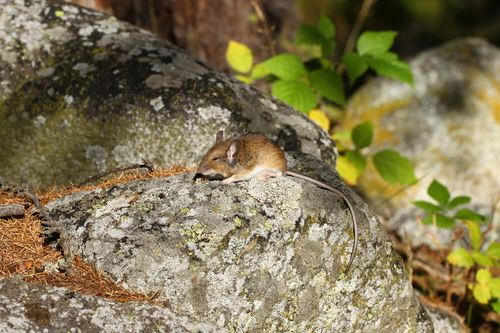
Chestnut-brown to reddish fur on the back with greyish-white underparts, a blunt rounded snout, small eyes and ears, and a relatively short tail compared to mice.
Size
Body length typically 8-12 cm, with a tail of 3-7 cm, making it noticeably shorter-tailed than many other vole species.
Weight
Adults typically weigh between 14-40 grams, with males slightly larger than females on average.
Distinctive features
Distinguished from field voles by its more reddish coloration and longer tail; differs from mice by its rounder body shape and shorter tail relative to body length.
Differences between males and females
Minimal sexual dimorphism; males are slightly larger and heavier than females but coloration is similar between sexes.
Behaviour and diet of the Bank Vole
Generally solitary or living in loose social groups; territorial especially among breeding females, though home ranges may overlap seasonally.
When it is active
Primarily active during dawn and dusk (crepuscular) but can show activity throughout the day and night, especially in areas with low predation pressure.
Diet
Omnivorous diet consisting mainly of seeds, fruits, fungi, roots, and green vegetation, supplemented occasionally with invertebrates like insects and larvae.
How it feeds and hunts
Forages on the ground and occasionally climbs low vegetation to access seeds and berries; uses caching behavior to store food for leaner periods.
Communication
Communicates through scent marking via glandular secretions, high-frequency vocalizations for alarm and mating, and tactile interactions during social encounters.
Interactions with other species
Important prey species for owls, foxes, weasels, and other predators; competes with wood mice and other small rodents for food and habitat resources.
Role in its ecosystem
Plays a significant role in seed dispersal and as a primary prey species supporting populations of many predators; also affects vegetation dynamics through seed predation and foraging.
Reproduction and lifecycle
Breeding season runs from April to October with gestation lasting about 18-20 days; females can produce multiple litters per year of 3-6 young each.
Raising the young
Females provide sole care for offspring, nursing them in nest burrows for about 18 days until weaning; young become independent shortly after weaning and reach sexual maturity within weeks.
Maturity and lifespan
Reaches sexual maturity at around 6-8 weeks of age; lifespan in the wild is typically less than 1.5 years due to high predation, though captive individuals can live up to 2-3 years.
Taxonomy and naming of the Bank Vole
Classification
Class Mammalia > Order Rodentia > Family Cricetidae > Genus Myodes (formerly Clethrionomys) > Species glareolus
Subspecies
Several subspecies recognized including M. g. glareolus (mainland Europe), M. g. skomerensis (Skomer Island, Wales), and M. g. erica (Isle of Raasay, Scotland); island populations often show distinct size and coloration.
Scientific synonyms
Clethrionomys glareolus (older generic name still widely used); Myodes glareolus (current accepted name in many taxonomies).
What research says
Recent studies
Recent research has focused on the species' role as a hantavirus reservoir and studies examining population cycles in relation to seed mast years in European forests.
Genome and DNA
Diploid chromosome number is 2n=56; has been used in various genetic studies examining rodent population genetics and hantavirus transmission dynamics.
Compared with similar species
Similar in size to the field vole (Microtus agrestis) but distinguished by warmer reddish-brown coloring and a proportionally longer tail; smaller and more colorful than water voles.
The Bank Vole and people
Bank voles can climb surprisingly well for a ground-dwelling rodent, sometimes venturing into low shrubs for food. Their populations can fluctuate dramatically based on beech and oak mast years, leading to boom-bust cycles that ripple through predator populations.
Where and how to see it
Best observed at dawn or dusk in woodland edges, hedgerows, or areas with dense ground cover; look for small burrow entrances and listen for rustling in leaf litter during quiet walks.
Risks to humans
Can carry hantavirus which may cause illness in humans through contact with urine or droppings, though direct transmission risk is low with normal outdoor activity.
Human uses
Not commercially utilized by humans, though it serves as an important research subject in ecological, genetic, and disease transmission studies.
Countries where the Bank Vole is recorded
The 5 countries named in the range description of its IUCN Red List assessment.
Questions about the Bank Vole
Where does the Bank Vole live?
The Bank Vole is recorded in France, Iceland, Ireland, Russia and United Kingdom across Europe. These countries come from the range description of its IUCN Red List assessment, and they are what place the species on the interactive map.
Is the Bank Vole endangered?
The IUCN Red List assesses the Bank Vole as Least Concern. The species is widespread and abundant enough not to qualify for any threatened category. It does not mean the species is safe forever, only that nothing in the current data raises an alarm.
How many are left in the wild?
Population numbers are very large and stable, likely in the tens of millions across Europe; considered one of the most common small mammals in its range. This figure comes from the species assessment on the IUCN Red List; population estimates for wild mammals are ranges, not counts, and are revised at each assessment.
What habitat does the Bank Vole live in?
Prefers deciduous and mixed woodlands with dense understory, hedgerows, scrubland, and grassy banks near water; also found in gardens and agricultural margins with sufficient cover.
What is the scientific name of the Bank Vole?
The Bank Vole is Clethrionomys glareolus, in the family Cricetidae, order Rodentia.
Other species in the family Cricetidae
Species that share its range

Sources
Conservation status, range description and population estimate come from the IUCN Red List assessment for Clethrionomys glareolus. Countries are derived from that range description, not from a mapped country list. Last refreshed on .
The distribution map is drawn from the IUCN Red List spatial data compiled in 2008. IUCN (International Union for Conservation of Nature)