
Seba's Short-tailed Bat
Carollia perspicillata
Red List assessment
Least Concernon the IUCN Red List
- EXExtinct
- EWExtinct in the Wild
- CRCritically Endangered
- ENEndangered
- VUVulnerable
- NTNear Threatened
- LCLeast Concern
The Seba's Short-tailed Bat is recorded in 16 countries across North America and South America. The IUCN Red List assesses the Seba's Short-tailed Bat as Least Concern. Population size is not precisely quantified but is considered large and stable across its extensive range; considered one of the most abundant bat species in the Neotropics.
- Family
- Phyllostomidae
- Order
- Chiroptera
- Genus
- Carollia
- Countries recorded
- 16
- Continents
- North America and South America
- Red List category
- Least Concern
- Data updated
- August 9, 2026
What is the Seba's Short-tailed Bat?
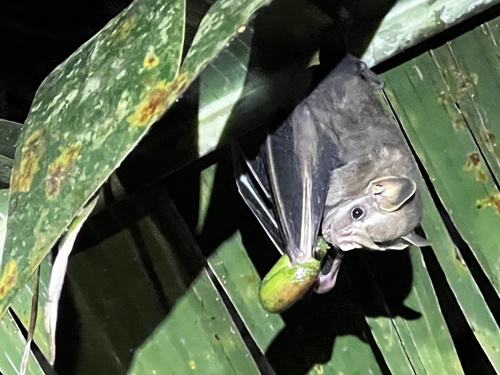
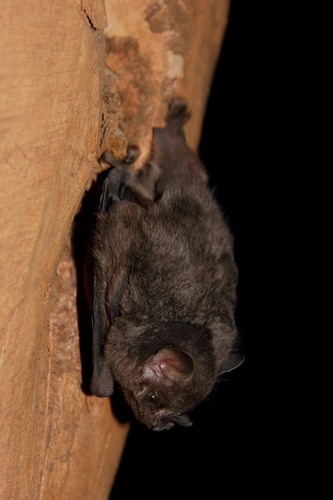
Seba's Short-tailed Bat is a small, common frugivorous bat found throughout Central and South America. It is one of the most abundant and well-studied bat species in the Neotropics due to its ecological importance as a seed disperser. This species is remarkable for its role in tropical forest regeneration, dispersing seeds of pioneer plants like Piper and Solanum. It roosts in caves, hollow trees, and human structures, often in large colonies.
Where does the Seba's Short-tailed Bat live?
Neotropical region including Mexico, Central America, and South America, including Trinidad and Tobago
Ranges from southern Mexico through Central America (Belize, Guatemala, Honduras, Nicaragua, Costa Rica, Panama) into South America, including Colombia, Venezuela, Ecuador, Peru, Bolivia, Brazil, Paraguay, Argentina, and the Caribbean islands of Trinidad and Tobago.
Altitude and depth
Typically found from sea level up to about 1,500-2,000 meters elevation, though most common in lowland areas below 1,000m.
Seasonal movements
No true hibernation or long-distance migration; however, reproductive activity and foraging patterns can shift seasonally in response to fruit availability during wet and dry seasons.
Habitat of the Seba's Short-tailed Bat
Found in a wide range of habitats including tropical lowland rainforest, secondary forest, forest edges, plantations, and disturbed areas. Highly adaptable to human-modified landscapes as long as fruit resources are available.
Adaptations to its environment
Possesses specialized dentition and digestive enzymes for processing fruit pulp efficiently. Echolocation and keen olfaction aid in locating ripe fruit in dense forest. Short tail and broad wings allow for agile flight in cluttered forest understory.
Conservation status and numbers
Listed as Least Concern (LC) by IUCN due to its wide distribution, large population size, tolerance of habitat disturbance, and lack of major range-wide threats.
Estimated population
Population size is not precisely quantified but is considered large and stable across its extensive range; considered one of the most abundant bat species in the Neotropics.
What threatens the Seba's Short-tailed Bat?
Localized threats include deforestation, cave disturbance by humans, pesticide use in agricultural areas, and roost destruction, though the species is generally resilient to habitat modification.
Diseases and parasites
Known to host various ectoparasites such as bat flies (Streblidae) and mites, and can carry viruses including coronaviruses and rabies, though transmission to humans is rare.
What is being done to protect it?
Protected under general wildlife laws in many range countries; benefits from protected areas and national parks throughout Central and South America that preserve tropical forest habitat.
Recommended actions
Continued protection of roosting caves from disturbance, maintenance of forest connectivity, and monitoring of pesticide impacts on insect and fruit resources.
What the Seba's Short-tailed Bat looks like
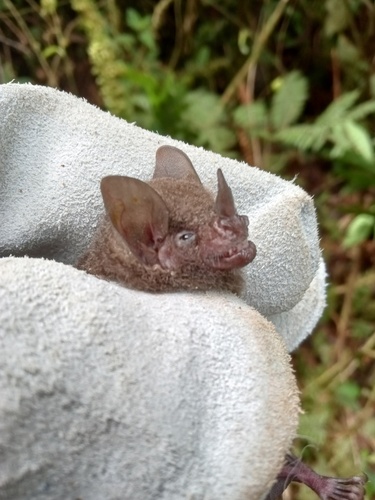
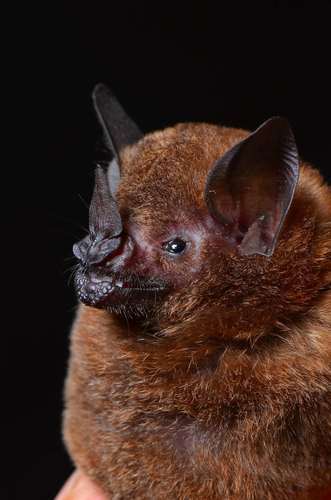
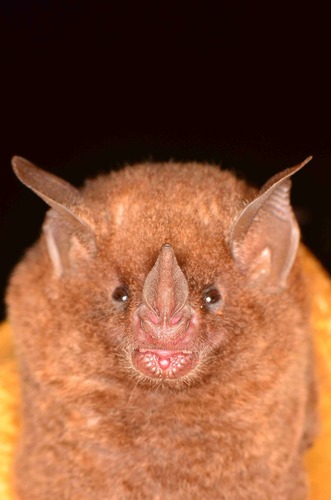
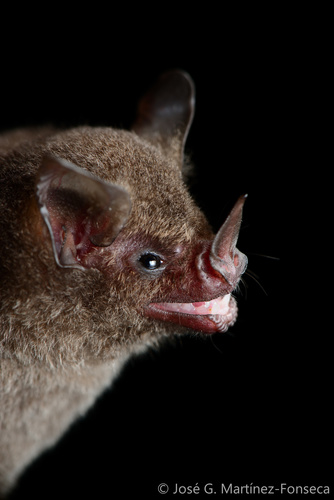
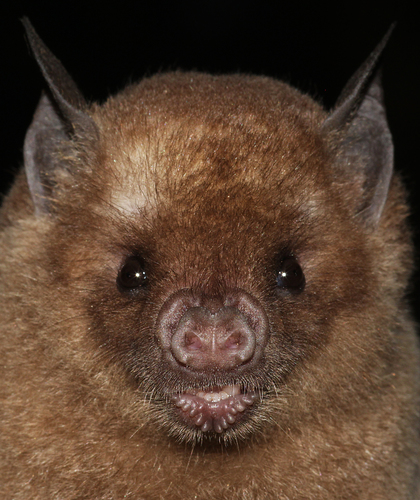
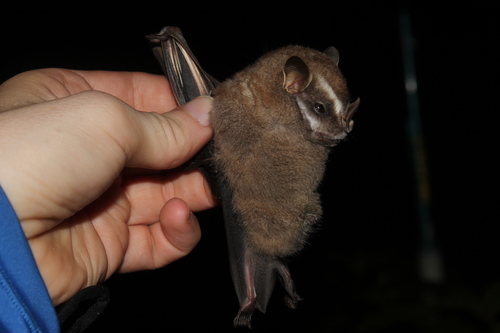
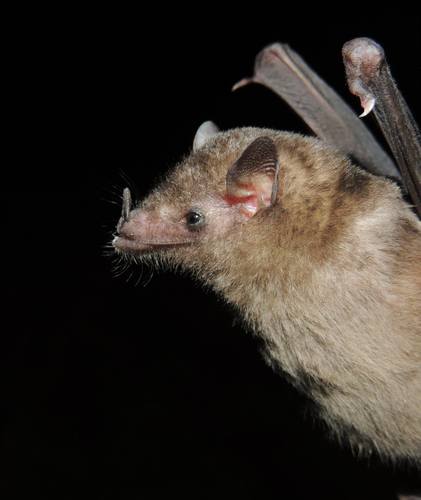
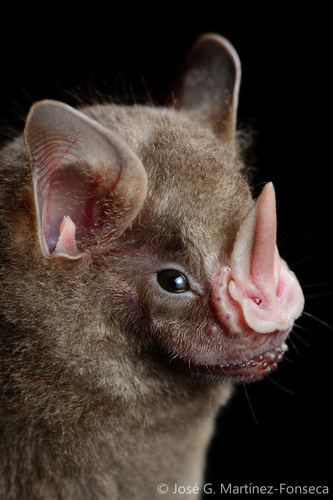
Fur is brown to grayish-brown on the dorsal side, lighter ventrally. Has a distinctive nose-leaf typical of phyllostomid bats, small eyes, and a short tail that is unusual among leaf-nosed bats.
Size
Forearm length ranges from 38-45 mm; body length approximately 50-60 mm with a very short tail of 5-10mm.
Weight
Typically weighs between 12-25 grams, with females sometimes slightly larger than males.
Distinctive features
Distinguished from related Carollia species by dental characteristics, size, and the shape of its nose-leaf; C. perspicillata is generally the largest species in its genus.
Differences between males and females
Minimal sexual dimorphism; females may be marginally larger than males but overall size difference is slight.
Behaviour and diet of the Seba's Short-tailed Bat
Highly social, roosting in colonies that can range from a few dozen to several thousand individuals in caves, hollow trees, or buildings, often with a harem-based social structure led by dominant males.
When it is active
Nocturnal, emerging at dusk to forage and returning to roosts before dawn; activity peaks in the first few hours after sunset.
Diet
Primarily frugivorous, favoring fruits of Piper (pepper plants) and Solanum species, but also consumes nectar, pollen, and occasional insects for protein.
How it feeds and hunts
Uses echolocation combined with olfaction to locate ripe fruit; forages by flying to fruiting plants and carrying fruit back to a roost to consume, aiding seed dispersal.
Communication
Communicates through echolocation calls, distress calls, and social vocalizations within roosts; also uses body contact and postural signals in social interactions.
Interactions with other species
Preyed upon by owls, snakes, and small carnivorous mammals; competes with other frugivorous bats for fruit resources but also coexists with many phyllostomid species in mixed roosts.
Role in its ecosystem
Plays a critical ecological role as a seed disperser for pioneer plant species, significantly contributing to tropical forest regeneration and secondary succession.
Reproduction and lifecycle
Breeding is often bimodal polyestrous, with two birth peaks per year corresponding to wet season fruit abundance; gestation lasts about 100-120 days, typically producing a single pup.
Raising the young
Females carry and nurse a single pup, which clings to the mother during early development; weaning occurs at around 30-40 days, with young becoming independent within a few months.
Maturity and lifespan
Reaches sexual maturity at around 6-12 months; lifespan in the wild is typically 5-10 years, with some individuals in captivity living longer.
Taxonomy and naming of the Seba's Short-tailed Bat
Classification
Class Mammalia > Order Chiroptera > Family Phyllostomidae > Genus Carollia > Species Carollia perspicillata
Subspecies
Several subspecies have been described, including Carollia perspicillata perspicillata (widespread), C. p. azteca (Mexico to Central America), and others, though taxonomy remains debated with some considered synonyms.
Scientific synonyms
Vampyrus perspicillatus (original combination by Linnaeus, 1758)
What research says
Recent studies
Recent studies have focused on its role in seed dispersal networks, viral surveillance (including coronavirus screening), and its use as a model species for studying flight physiology and sensory ecology in bats.
Genome and DNA
Diploid chromosome number is 2n=20; the species has been used in various genetic and phylogenetic studies within Phyllostomidae.
Compared with similar species
Similar to other Carollia species like C. brevicauda and C. castanea but is generally larger with distinct cranial and dental morphology; often co-occurs with these species in the same habitats.
The Seba's Short-tailed Bat and people
Seba's Short-tailed Bat can carry fruit up to its own body weight in flight; it is one of the most frequently studied bats in tropical ecology due to its abundance and ease of capture; some populations show trap-line foraging behavior, visiting the same fruiting plants repeatedly.
Where and how to see it
Best observed at dusk near fruiting Piper shrubs or forest edges in Central/South American tropical forests; mist-netting surveys by researchers often reveal high capture rates of this species in disturbed and undisturbed forest alike.
Risks to humans
Low risk to humans; bites are rare and typically only occur if the bat is handled, but as with all bats, caution should be taken due to potential disease transmission such as rabies.
Human uses
Not commonly used commercially, but the species is significant in scientific research on seed dispersal, echolocation, and virology studies related to zoonotic disease surveillance.
Countries where the Seba's Short-tailed Bat is recorded
The 16 countries named in the range description of its IUCN Red List assessment.
Questions about the Seba's Short-tailed Bat
Where does the Seba's Short-tailed Bat live?
The Seba's Short-tailed Bat is recorded in Argentina, Belize, Bolivia, Brazil and Colombia, among 16 countries in total across North America and South America. These countries come from the range description of its IUCN Red List assessment, and they are what place the species on the interactive map.
Is the Seba's Short-tailed Bat endangered?
The IUCN Red List assesses the Seba's Short-tailed Bat as Least Concern. The species is widespread and abundant enough not to qualify for any threatened category. It does not mean the species is safe forever, only that nothing in the current data raises an alarm.
How many are left in the wild?
Population size is not precisely quantified but is considered large and stable across its extensive range; considered one of the most abundant bat species in the Neotropics. This figure comes from the species assessment on the IUCN Red List; population estimates for wild mammals are ranges, not counts, and are revised at each assessment.
What habitat does the Seba's Short-tailed Bat live in?
Found in a wide range of habitats including tropical lowland rainforest, secondary forest, forest edges, plantations, and disturbed areas.
What is the scientific name of the Seba's Short-tailed Bat?
The Seba's Short-tailed Bat is Carollia perspicillata, in the family Phyllostomidae, order Chiroptera.
Other species in the genus Carollia


Other species in the family Phyllostomidae
Sources
Conservation status, range description and population estimate come from the IUCN Red List assessment for Carollia perspicillata. Countries are derived from that range description, not from a mapped country list. Last refreshed on .
The distribution map is drawn from the IUCN Red List spatial data compiled in 2008. IUCN (International Union for Conservation of Nature)