
Gray Short-tailed Bat
Carollia subrufa
Red List assessment
Least Concernon the IUCN Red List
- EXExtinct
- EWExtinct in the Wild
- CRCritically Endangered
- ENEndangered
- VUVulnerable
- NTNear Threatened
- LCLeast Concern
The Gray Short-tailed Bat is recorded in 9 countries across North America and South America. The IUCN Red List assesses the Gray Short-tailed Bat as Least Concern. No precise global population estimate exists, but the species is considered common and abundant within its range; population trend is presumed stable.
- Family
- Phyllostomidae
- Order
- Chiroptera
- Genus
- Carollia
- Countries recorded
- 9
- Continents
- North America and South America
- Red List category
- Least Concern
- Data updated
- August 9, 2026
What is the Gray Short-tailed Bat?
Carollia subrufa, the Gray Short-tailed Bat, is a small phyllostomid bat native to the tropical lowlands of Mexico and Central America. It is a common member of the frugivorous bat community in disturbed and forested habitats, playing a key role in seed dispersal. Its short tail and grayish-brown fur distinguish it subtly from closely related Carollia species. It is notable for its abundance in secondary growth and its ecological importance in tropical forest regeneration.
Where does the Gray Short-tailed Bat live?
Mexico, Central America (Guatemala, Belize, Honduras, El Salvador, Nicaragua, Costa Rica) and northwestern Colombia/Venezuela
Ranges from central and southern Mexico through Guatemala, Belize, Honduras, El Salvador, Nicaragua, and Costa Rica, with some records extending into northern Colombia and Venezuela.
Altitude and depth
Typically found from sea level up to about 1,500 meters elevation, mostly in lowland tropical zones.
Seasonal movements
No long-distance migration is known; some local seasonal movements may occur in relation to fruiting phenology of key food plants, particularly Piper species.
Habitat of the Gray Short-tailed Bat
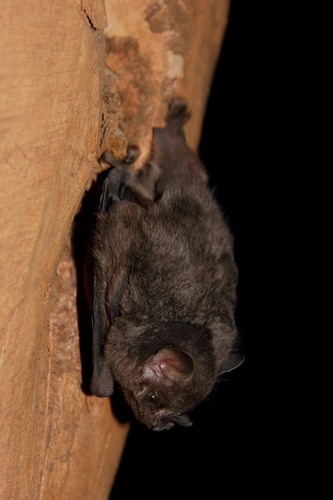
Found in tropical dry forest, deciduous and semi-deciduous forest, secondary growth, forest edges, and agricultural mosaics. It tolerates disturbed habitats well, often roosting in caves, hollow trees, culverts, and abandoned buildings.
Adaptations to its environment
Possesses a short uropatagium and tail adapted for maneuverable flight in dense vegetation, and specialized dentition and gut morphology for processing soft fruit pulp rapidly. Echolocation calls are adapted for cluttered forest environments, aiding navigation and foraging at night.
Conservation status and numbers
Listed as Least Concern (LC) by the IUCN due to its wide distribution, tolerance of habitat disturbance, and presumed large stable population. No significant range-wide population decline has been documented.
Estimated population
No precise global population estimate exists, but the species is considered common and abundant within its range; population trend is presumed stable.
What threatens the Gray Short-tailed Bat?
Localized threats include deforestation, agricultural expansion, and disturbance or destruction of roosting sites such as caves and old buildings. Pesticide use may also affect food plant availability.
Diseases and parasites
Known to host ectoparasites such as bat flies (Streblidae) and mites; may also carry certain bat-associated viruses, though no major disease outbreaks are documented.
What is being done to protect it?
Protected indirectly through general wildlife protection laws in range countries and by conservation of tropical dry forest reserves such as those in Mexico and Costa Rica. No species-specific conservation program is known.
Recommended actions
Continued protection of tropical dry forest habitats, preservation of roosting caves, and monitoring of population trends in agricultural landscapes are recommended to maintain stability.
What the Gray Short-tailed Bat looks like
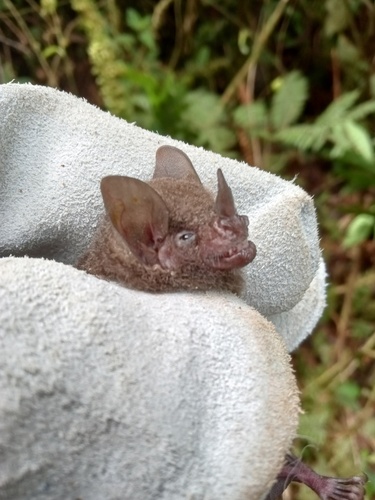
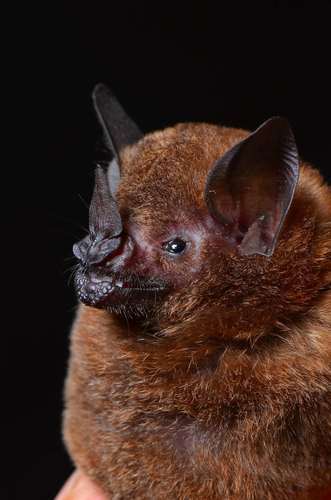
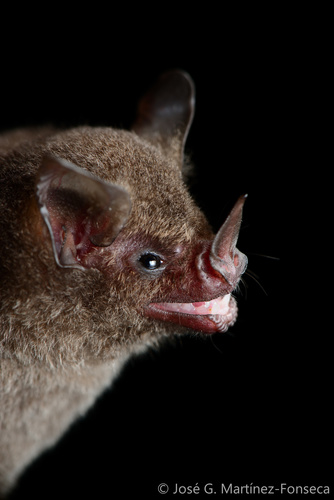
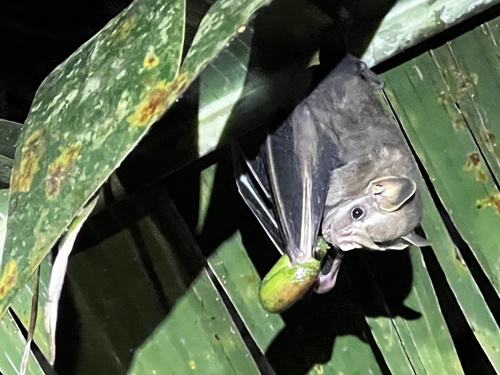
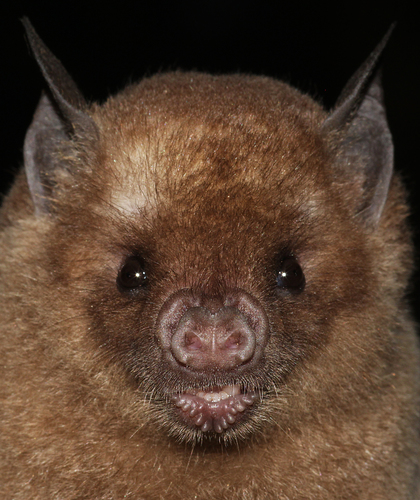
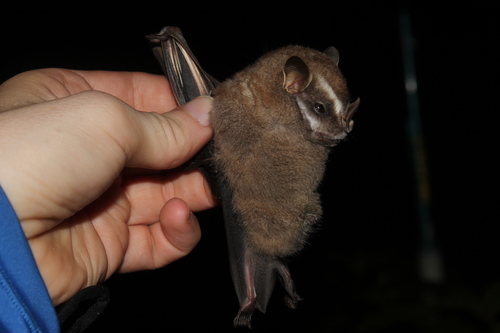
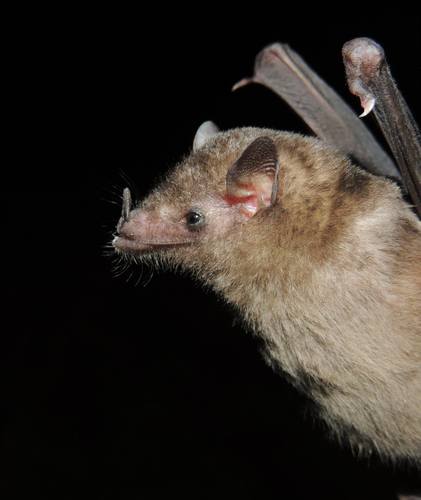
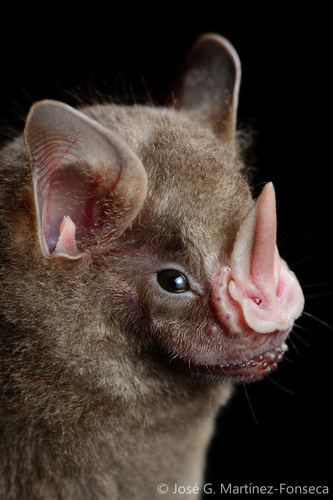
Fur is grayish-brown to grayish-buff, short and dense, with a paler underside. It has a short tail partially enclosed in the uropatagium, a distinctive nose-leaf typical of phyllostomids, and relatively large eyes for a bat.
Size
Body length approximately 5–6 cm; forearm length about 38–42 mm; wingspan approximately 30–35 cm.
Weight
Typically weighs between 12 and 18 grams, with little difference between sexes.
Distinctive features
Distinguished from other Carollia species by slightly smaller size, grayer fur coloration, and subtle differences in skull and dental morphology, particularly in the shape of the upper incisors.
Differences between males and females
Minimal sexual dimorphism; males and females are similar in size and coloration, though females may be marginally larger.
Behaviour and diet of the Gray Short-tailed Bat
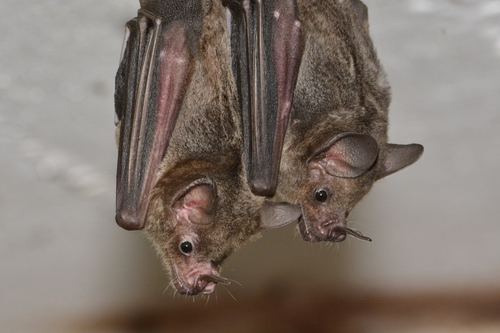
Highly social, roosting in groups ranging from a few individuals to several hundred in caves or hollow trees. Social structure includes stable groups with some polygynous mating behavior.
When it is active
Nocturnal, becoming active shortly after sunset and returning to roosts before dawn.
Diet
Primarily frugivorous, favoring fruits of Piper, Solanum, and Ficus species; occasionally consumes nectar, pollen, and insects.
How it feeds and hunts
Forages by flying through understory vegetation, locating ripe fruit via echolocation and olfaction, then carrying fruit to nearby roosts to feed.
Communication
Communicates through echolocation calls for navigation and social calls for group cohesion; scent cues may also play a role in roost recognition and mate attraction.
Interactions with other species
Preyed upon by owls, opossums, and snakes; competes with other frugivorous bats for fruit resources. Plays a mutualistic role with fruiting plants through seed dispersal.
Role in its ecosystem
Acts as an important seed disperser in tropical forest ecosystems, contributing to forest regeneration and plant diversity, particularly for pioneer plant species like Piper and Solanum.
Reproduction and lifecycle
Breeding may occur twice a year in some populations, with gestation lasting around 3–4 months; typically gives birth to a single pup per litter.
Raising the young
Females nurse and carry their single pup until it is capable of flight, usually providing care for several weeks postpartum; males do not participate in direct offspring care.
Maturity and lifespan
Sexual maturity is reached at around 6–12 months; lifespan in the wild is estimated at 5–10 years, potentially longer in captivity.
Taxonomy and naming of the Gray Short-tailed Bat
Classification
Mammalia > Chiroptera > Phyllostomidae > Carollia > Carollia subrufa
Scientific synonyms
Carollia subrufa has been treated as synonymous with some populations previously assigned to Carollia brevicauda in older literature; no widely recognized junior synonyms remain valid.
What research says
Recent studies
Recent phylogenetic studies have clarified the taxonomic boundaries between Carollia subrufa and closely related species such as C. sowelli and C. brevicauda using molecular data.
Genome and DNA
Diploid chromosome number reported as 2n=21 in some Carollia studies, though specific genomic studies on C. subrufa remain limited.
Compared with similar species
Similar to Carollia brevicauda and Carollia perspicillata but generally smaller and grayer, with subtle cranial differences used to separate species in the genus.
The Gray Short-tailed Bat and people
Despite its small size, this bat can consume more than its body weight in fruit each night; it also helps regenerate degraded tropical forests by dispersing pioneer plant seeds.
Where and how to see it
Best observed at dusk near fruiting Piper or Solanum shrubs in tropical dry forest regions of Mexico and Central America; use of bat detectors can help identify echolocation calls.
Risks to humans
No notable risk; like most bats, it should not be handled due to potential zoonotic disease transmission risk.
Countries where the Gray Short-tailed Bat is recorded
The 9 countries named in the range description of its IUCN Red List assessment.
Questions about the Gray Short-tailed Bat
Where does the Gray Short-tailed Bat live?
The Gray Short-tailed Bat is recorded in Belize, Colombia, Costa Rica, El Salvador and Guatemala, among 9 countries in total across North America and South America. These countries come from the range description of its IUCN Red List assessment, and they are what place the species on the interactive map.
Is the Gray Short-tailed Bat endangered?
The IUCN Red List assesses the Gray Short-tailed Bat as Least Concern. The species is widespread and abundant enough not to qualify for any threatened category. It does not mean the species is safe forever, only that nothing in the current data raises an alarm.
How many are left in the wild?
No precise global population estimate exists, but the species is considered common and abundant within its range; population trend is presumed stable. This figure comes from the species assessment on the IUCN Red List; population estimates for wild mammals are ranges, not counts, and are revised at each assessment.
What habitat does the Gray Short-tailed Bat live in?
Found in tropical dry forest, deciduous and semi-deciduous forest, secondary growth, forest edges, and agricultural mosaics.
What is the scientific name of the Gray Short-tailed Bat?
The Gray Short-tailed Bat is Carollia subrufa, in the family Phyllostomidae, order Chiroptera.
Other species in the genus Carollia


Other species in the family Phyllostomidae
Sources
Conservation status, range description and population estimate come from the IUCN Red List assessment for Carollia subrufa. Countries are derived from that range description, not from a mapped country list. Last refreshed on .
The distribution map is drawn from the IUCN Red List spatial data compiled in 2008. IUCN (International Union for Conservation of Nature)