
Red-flanked Duiker
Cephalophus rufilatus
Red List assessment
Least Concernon the IUCN Red List
- EXExtinct
- EWExtinct in the Wild
- CRCritically Endangered
- ENEndangered
- VUVulnerable
- NTNear Threatened
- LCLeast Concern
The Red-flanked Duiker is recorded in 13 countries across Africa. The IUCN Red List assesses the Red-flanked Duiker as Least Concern. No precise global population estimate exists, but the species is considered common in suitable habitat across its range; overall population trend is thought to be declining in areas of high hunting pressure, though stable elsewhere.
- Family
- Bovidae
- Order
- Artiodactyla
- Genus
- Cephalophus
- Countries recorded
- 13
- Continents
- Africa
- Red List category
- Least Concern
- Data updated
- August 9, 2026
What is the Red-flanked Duiker?
The Red-flanked Duiker is a small forest antelope native to the savanna-woodland mosaics of West and Central Africa. It is named for its reddish-chestnut flanks contrasting with a darker back and head. This species is remarkable for its adaptability to both dense thickets and more open wooded savanna, and for its secretive, solitary habits. It plays an important ecological role as a seed disperser in its habitat.
Where does the Red-flanked Duiker live?
West and Central Africa, from Senegal to Central African Republic and western Sudan/South Sudan
Ranges across the Sudano-Guinean savanna belt from Senegal and Gambia eastward through Guinea, Mali, Burkina Faso, Ghana, Nigeria, Cameroon, Chad, Central African Republic, to South Sudan and parts of western Sudan and Uganda.
Altitude and depth
Typically found at low to moderate elevations, generally below 1500m, though can occur up to around 2000m in some regions.
Seasonal movements
No long-distance migration; however, movement patterns may shift seasonally in response to water availability and food resources, with increased activity near water during dry seasons.
Habitat of the Red-flanked Duiker
Found in savanna woodland, gallery forests, forest-savanna mosaics, and thickets, often near water sources. It prefers areas with dense understory cover for concealment but can also use more open wooded grasslands.
Adaptations to its environment
Its small size and low-slung body allow it to move quickly and quietly through dense vegetation to escape predators. Reddish coloration provides camouflage in dappled light of woodland thickets, and a flexible diet allows exploitation of varied food sources across habitat types.
Conservation status and numbers
Listed as Least Concern by IUCN due to its wide distribution and presumed large population, though local declines occur due to hunting pressure and habitat loss in parts of its range.
Estimated population
No precise global population estimate exists, but the species is considered common in suitable habitat across its range; overall population trend is thought to be declining in areas of high hunting pressure, though stable elsewhere.
What threatens the Red-flanked Duiker?
Bushmeat hunting is the primary threat, along with habitat degradation from agricultural expansion, logging, and increasing human settlement in savanna-woodland areas.
Diseases and parasites
Susceptible to various ticks and internal parasites common to African bovids; can also be affected by diseases such as foot-and-mouth disease that circulate among wild and domestic ungulates.
What is being done to protect it?
Occurs in numerous protected areas across its range including national parks and reserves in West and Central Africa; benefits indirectly from broader anti-poaching and habitat protection initiatives targeting larger charismatic species.
Recommended actions
Strengthening enforcement against illegal bushmeat hunting, maintaining habitat connectivity between protected areas, and conducting population monitoring studies to better assess regional trends.
What the Red-flanked Duiker looks like
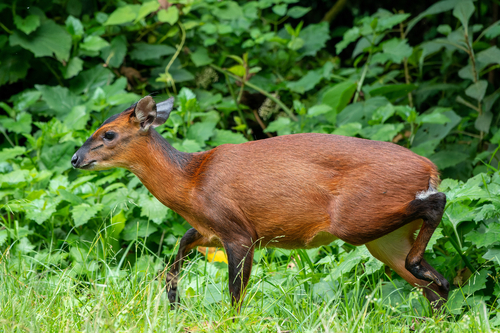
The coat is reddish-brown to chestnut on the flanks and hindquarters, transitioning to a grayish or blackish tone on the back and crown. The face often has a dark stripe, and the underparts are paler, sometimes whitish.
Size
Head-body length approximately 70-100 cm, with shoulder height of 30-40 cm.
Weight
Typically weighs between 9-14 kg, with females often slightly heavier than males.
Distinctive features
Distinguished from other duiker species by the striking contrast between its reddish flanks and darker dorsal coloring, along with relatively short, straight horns present in both sexes.
Differences between males and females
Both sexes bear short horns, though male horns tend to be slightly more robust; females are generally marginally larger in body size than males.
Behaviour and diet of the Red-flanked Duiker
Primarily solitary or found in monogamous pairs that maintain and defend a shared territory; family groups with a single offspring are also common.
When it is active
Primarily crepuscular and nocturnal, though some diurnal activity occurs, especially in undisturbed areas with lower predation or hunting pressure.
Diet
Herbivorous, feeding mainly on fallen fruits, leaves, shoots, flowers, and occasionally fungi; known to supplement diet opportunistically with small amounts of animal matter such as insects.
Communication
Communicates through scent marking via preorbital glands to establish territory boundaries, along with soft vocalizations and alarm whistles when threatened.
Interactions with other species
Preyed upon by leopards, pythons, eagles, and wild dogs; humans through hunting represent a major predatory pressure. Competes with other small ungulates for food resources in shared habitats.
Role in its ecosystem
Acts as an important seed disperser for various fruiting plants in savanna-woodland ecosystems, contributing to forest regeneration and habitat structure maintenance.
Reproduction and lifecycle
Breeding can occur year-round with possible peaks tied to rainfall patterns; gestation lasts approximately 7-7.5 months, typically resulting in a single offspring.
Raising the young
The mother provides primary care, nursing and hiding the calf in dense vegetation for the first weeks of life before it begins to accompany her more actively; weaning occurs after a few months.
Maturity and lifespan
Sexual maturity is reached at around 9-12 months of age; lifespan in the wild is typically 8-10 years, with captive individuals sometimes living up to 12-15 years.
Taxonomy and naming of the Red-flanked Duiker
Classification
Mammalia > Artiodactyla > Bovidae > Cephalophus > Cephalophus rufilatus
Subspecies
No widely recognized subspecies; some authors have proposed regional variants but taxonomy remains largely monotypic across its range.
Scientific synonyms
Cephalophorus rufilatus; occasionally listed under Cephalophus (Cephalophorus) rufilatus in older literature.
What research says
Recent studies
Recent studies have focused on bushmeat trade impacts on duiker populations across West Africa, using camera trap and genetic sampling methods to assess population density and connectivity.
Genome and DNA
Specific genome sequencing data for this species is limited, though it shares the typical bovid diploid chromosome number range studied in related Cephalophus species (around 2n=58-60 in some duikers).
Compared with similar species
Similar in size to other small forest duikers like the Blue Duiker, but distinguished by its more open habitat preference and distinctive reddish flank coloration compared to the more uniformly colored Blue Duiker.
The Red-flanked Duiker and people
Despite living in relatively open savanna habitats compared to many duiker relatives, it remains extremely shy and is rarely seen due to its secretive behavior. It can produce a sharp whistle-like alarm call when startled, and its name 'duiker' comes from the Afrikaans word for 'diver,' referencing its habit of diving into cover when disturbed.
Where and how to see it
Best observed during early morning or late evening near water sources in savanna-woodland reserves of West Africa; patience and quiet movement are essential due to the species' shy nature.
Risks to humans
No notable risk to humans.
Human uses
Widely hunted for bushmeat across its range, representing an important protein source for local communities; also occasionally kept in captivity for study or small-scale ecotourism display.
Myths and legends
In some West African cultures, duikers feature in folklore as clever, elusive trickster figures due to their evasive behavior in the wild.
Countries where the Red-flanked Duiker is recorded
The 13 countries named in the range description of its IUCN Red List assessment.
Questions about the Red-flanked Duiker
Where does the Red-flanked Duiker live?
The Red-flanked Duiker is recorded in Burkina Faso, Cameroon, Central African Republic, Chad and Gambia, among 13 countries in total across Africa. These countries come from the range description of its IUCN Red List assessment, and they are what place the species on the interactive map.
Is the Red-flanked Duiker endangered?
The IUCN Red List assesses the Red-flanked Duiker as Least Concern. The species is widespread and abundant enough not to qualify for any threatened category. It does not mean the species is safe forever, only that nothing in the current data raises an alarm.
How many are left in the wild?
No precise global population estimate exists, but the species is considered common in suitable habitat across its range; overall population trend is thought to be declining in areas of high hunting pressure, though stable elsewhere. This figure comes from the species assessment on the IUCN Red List; population estimates for wild mammals are ranges, not counts, and are revised at each assessment.
What habitat does the Red-flanked Duiker live in?
Found in savanna woodland, gallery forests, forest-savanna mosaics, and thickets, often near water sources.
What is the scientific name of the Red-flanked Duiker?
The Red-flanked Duiker is Cephalophus rufilatus, in the family Bovidae, order Artiodactyla.
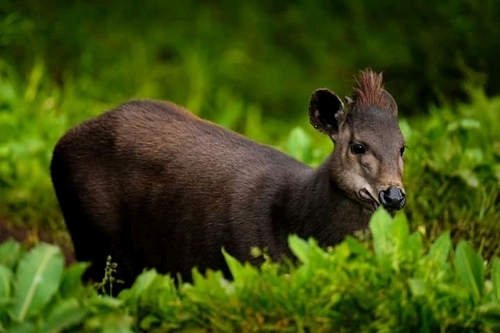
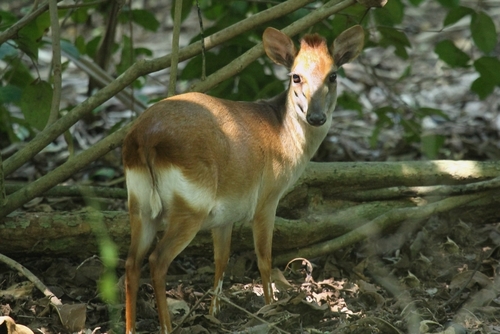
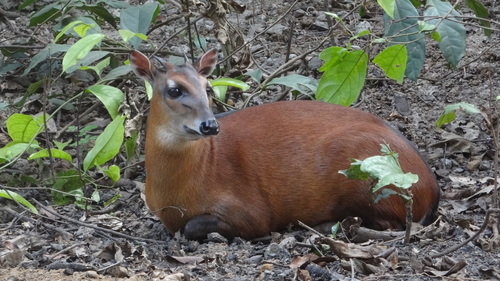
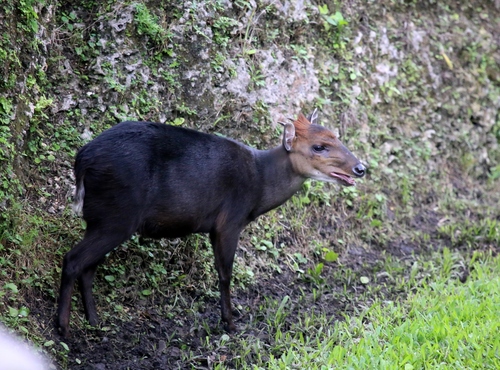
Other species in the genus Cephalophus
Other species in the family Bovidae
Sources
Conservation status, range description and population estimate come from the IUCN Red List assessment for Cephalophus rufilatus. Countries are derived from that range description, not from a mapped country list. Last refreshed on .
The distribution map is drawn from the IUCN Red List spatial data compiled in 2008. IUCN (International Union for Conservation of Nature)