
Arabian Oryx
Oryx leucoryx
Red List assessment
Vulnerableon the IUCN Red List
- EXExtinct
- EWExtinct in the Wild
- CRCritically Endangered
- ENEndangered
- VUVulnerable
- NTNear Threatened
- LCLeast Concern
The Arabian Oryx is recorded in 8 countries across Asia. The IUCN Red List assesses the Arabian Oryx as Vulnerable. Approximately 1,220 mature individuals in the wild as of recent assessments, with total population including captive and semi-captive herds exceeding 7,000-8,000 individuals; trend is increasing overall.
- Family
- Bovidae
- Order
- Artiodactyla
- Genus
- Oryx
- Countries recorded
- 8
- Continents
- Asia
- Red List category
- Vulnerable
- Data updated
- August 9, 2026
What is the Arabian Oryx?
The Arabian Oryx is a medium-sized antelope native to the deserts of the Arabian Peninsula, famous for being the first animal to be downgraded from 'Extinct in the Wild' to 'Vulnerable' through successful reintroduction efforts. It is remarkably adapted to extreme desert conditions, capable of surviving in some of the harshest environments on Earth. This species holds great cultural significance in Arab heritage and conservation history as a flagship success story.
Where does the Arabian Oryx live?
Arabian Peninsula, primarily Oman, Saudi Arabia, United Arab Emirates, Qatar, Israel, and Jordan (through reintroduction programs)
Historically ranged across the entire Arabian Peninsula from Iraq to Yemen. Currently found in reintroduced populations in Oman, Saudi Arabia, UAE, Qatar, Israel, and Jordan, with the largest wild populations in Saudi Arabia and Oman.
Altitude and depth
0-1000m, typically found in low-lying desert plains and plateaus
Seasonal movements
Historically nomadic, following seasonal rainfall patterns to access fresh vegetation; movements are less pronounced in managed reserve populations today
Habitat of the Arabian Oryx
Arid and hyper-arid desert environments including gravel plains, sand dunes, and semi-desert steppe with sparse vegetation. Prefers open desert landscapes with scattered shrubs and grasses that provide minimal but sufficient forage.
Adaptations to its environment
Exceptional water conservation abilities allowing survival without drinking water for weeks by extracting moisture from plants; white coat reflects solar radiation and reduces heat load; can tolerate body temperatures up to 46.5°C without ill effects; keen sense of smell to detect distant rainfall.
Conservation status and numbers
Vulnerable (VU) according to IUCN, an improvement from Extinct in the Wild status in 1972. Population has been increasing due to intensive reintroduction and protection programs, though the species remains dependent on continued conservation management.
Estimated population
Approximately 1,220 mature individuals in the wild as of recent assessments, with total population including captive and semi-captive herds exceeding 7,000-8,000 individuals; trend is increasing overall.
What threatens the Arabian Oryx?
Illegal hunting and poaching for horns and meat, habitat degradation from overgrazing by livestock, competition with domestic animals for scarce resources, and potential genetic bottleneck effects from small founder populations.
Diseases and parasites
Susceptible to various tick-borne diseases, gastrointestinal parasites, and foot-and-mouth disease; captive populations monitored for brucellosis and other livestock-transmissible diseases.
What is being done to protect it?
Operation Oryx in the 1960s established captive breeding herds; extensive reintroduction programs in protected areas like Oman's Arabian Oryx Sanctuary (former UNESCO site) and Saudi Arabia's Uruq Bani Ma'arid; strict anti-poaching laws and international CITES Appendix I protection.
Recommended actions
Strengthen anti-poaching enforcement and community engagement, expand genetic diversity through managed breeding exchanges between populations, secure additional protected habitat corridors, and continue population monitoring and disease surveillance.
What the Arabian Oryx looks like
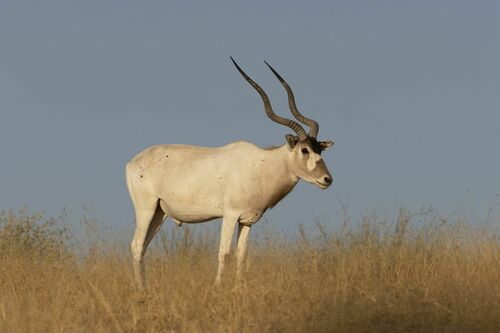
Striking pure white coat contrasts with dark brown or black markings on the face, legs, and belly; long, straight, ringed horns present in both sexes reaching 50-75 cm in length; sturdy build with a slightly humped shoulder.
Size
Shoulder height of 100-125 cm; body length approximately 140-170 cm
Weight
Males typically weigh 65-90 kg; females slightly lighter at 60-75 kg
Distinctive features
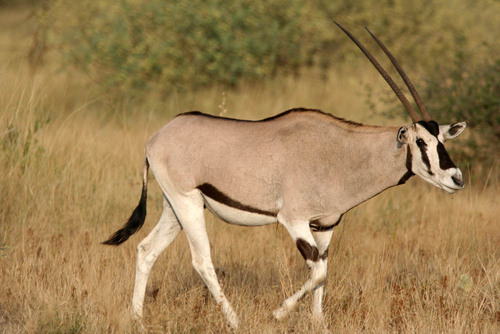
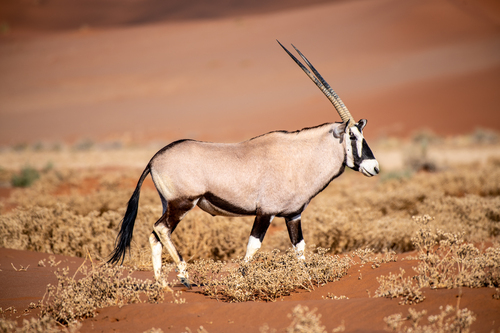
Distinguished from other oryx species by its almost entirely white body (versus the more marked coats of Gemsbok or Scimitar Oryx), nearly straight horns, and smaller overall size compared to the Gemsbok.
Differences between males and females
Minimal sexual dimorphism; both sexes possess horns, though male horns tend to be slightly thicker and more robust while females have marginally longer, more slender horns
Behaviour and diet of the Arabian Oryx
Highly social, living in mixed-sex herds of 2-30 individuals led by a dominant male; hierarchical social structure with dominance established through ritualized horn displays and sparring.
When it is active
Primarily crepuscular and nocturnal to avoid extreme daytime desert heat, though can be active during cooler daylight hours especially in winter months.
Diet
Herbivorous, feeding on desert grasses, herbs, succulent plants, tubers, and roots; capable of digging for underground water-storing plant parts during dry periods.
Communication
Uses visual displays including horn presentations and postural signals to establish dominance; scent marking via preorbital glands and dung piles to mark territory; low grunts and snorts for close-range communication.
Interactions with other species
Historically preyed upon by wolves and possibly cheetahs; competes with domestic livestock for limited desert forage; shares habitat with other desert specialists like sand gazelles with minimal direct competition.
Role in its ecosystem
Plays a role in desert ecosystem as a herbivore that shapes vegetation patterns through grazing; seed dispersal through digestion may contribute to plant distribution in arid landscapes.
Reproduction and lifecycle
Breeding can occur year-round but peaks after seasonal rains; gestation lasts approximately 240 days (8 months); typically single calf born, with females able to conceive again shortly after giving birth.
Raising the young
Calves are precocial and can stand within hours of birth; mothers hide calves in vegetation for the first few weeks while foraging nearby, then calves join the herd; weaning occurs around 3.5-4.5 months of age.
Maturity and lifespan
Sexual maturity reached at 2-3 years of age; lifespan averages 15-20 years in the wild, with captive individuals sometimes living up to 20-25 years under optimal care.
Taxonomy and naming of the Arabian Oryx
Classification
Class Mammalia > Order Artiodactyla > Family Bovidae > Genus Oryx > Species Oryx leucoryx
Scientific synonyms
Oryx beatrix (historical synonym used in older literature)
What research says
Recent studies
Recent research has focused on genomic diversity analysis across reintroduced populations to guide breeding management, as well as satellite tracking studies examining movement patterns and habitat use in Saudi Arabia's expanding protected areas.
Genome and DNA
Diploid chromosome number of 2n=58; genetic studies have been crucial for managing genetic diversity in the fragmented and reintroduced populations to avoid inbreeding depression.
Compared with similar species
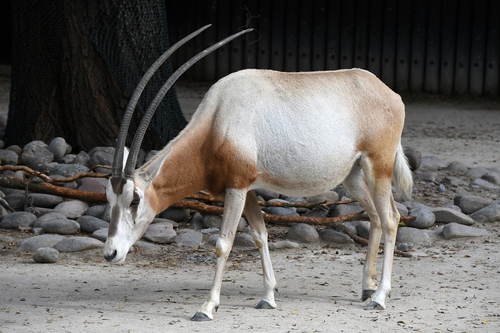
Smaller and almost entirely white compared to the larger, more grayish Gemsbok (Oryx gazella) of southern Africa; horns are straighter than the more curved horns of the Scimitar-horned Oryx (Oryx dammah), which is now extinct in the wild.
The Arabian Oryx and people
The Arabian Oryx may be the origin of the unicorn legend, as its two horns can appear as one when viewed in profile from certain angles; it was the first species ever to be reclassified from 'Extinct in the Wild' back to a lower threat category on the IUCN Red List.
Where and how to see it
Best observed in dedicated reserves such as Oman's Arabian Oryx Sanctuary, Saudi Arabia's Uruq Bani Ma'arid Protected Area, or UAE's Arabian Oryx Sanctuary in Dubai Desert Conservation Reserve; early morning or late afternoon during cooler months (October-April) offers optimal viewing opportunities.
Risks to humans
No notable risk to humans under normal circumstances; wild individuals are generally shy and avoid human contact, though captive or habituated animals could potentially cause injury with their horns if provoked.
Human uses
Historically hunted by Bedouin tribes for meat, hide, and horns; today primarily valued for ecotourism, conservation education, and as a national symbol in several Gulf countries, appearing on official emblems and currency in some nations.
Myths and legends
Widely believed to have inspired ancient unicorn myths due to its horn alignment when seen from the side; holds deep cultural significance in Arab Bedouin tradition as a symbol of desert survival and resilience, often featured in regional heraldry and folklore.
Countries where the Arabian Oryx is recorded
The 8 countries named in the range description of its IUCN Red List assessment.
Questions about the Arabian Oryx
Where does the Arabian Oryx live?
The Arabian Oryx is recorded in Iraq, Israel, Jordan, Oman and Qatar, among 8 countries in total across Asia. These countries come from the range description of its IUCN Red List assessment, and they are what place the species on the interactive map.
Is the Arabian Oryx endangered?
Yes. The IUCN Red List assesses the Arabian Oryx as Vulnerable, one of the three threatened categories. The species faces a high risk of extinction in the wild. It is the first of the three threatened categories: numbers are falling, the range is shrinking, or the population is small enough that a single bad event could do lasting damage.
How many are left in the wild?
Approximately 1,220 mature individuals in the wild as of recent assessments, with total population including captive and semi-captive herds exceeding 7,000-8,000 individuals; trend is increasing overall. This figure comes from the species assessment on the IUCN Red List; population estimates for wild mammals are ranges, not counts, and are revised at each assessment.
What habitat does the Arabian Oryx live in?
Arid and hyper-arid desert environments including gravel plains, sand dunes, and semi-desert steppe with sparse vegetation.
What is the scientific name of the Arabian Oryx?
The Arabian Oryx is Oryx leucoryx, in the family Bovidae, order Artiodactyla.
Other species in the genus Oryx
Other species in the family Bovidae
Species that share its range
Sources
Conservation status, range description and population estimate come from the IUCN Red List assessment for Oryx leucoryx. Countries are derived from that range description, not from a mapped country list. Last refreshed on .
The distribution map is drawn from the IUCN Red List spatial data compiled in 2017. IUCN (International Union for Conservation of Nature)