
Alpine Ibex
Capra ibex
Red List assessment
Least Concernon the IUCN Red List
- EXExtinct
- EWExtinct in the Wild
- CRCritically Endangered
- ENEndangered
- VUVulnerable
- NTNear Threatened
- LCLeast Concern
The Alpine Ibex is recorded in 6 countries across Europe. The IUCN Red List assesses the Alpine Ibex as Least Concern. Approximately 55,000-60,000 individuals across the Alps, with a stable to slightly increasing population trend as of recent surveys
- Family
- Bovidae
- Order
- Artiodactyla
- Genus
- Capra
- Countries recorded
- 6
- Continents
- Europe
- Red List category
- Least Concern
- Data updated
- August 9, 2026
What is the Alpine Ibex?
The Alpine ibex is a large wild goat species native to the mountainous terrain of the European Alps, renowned for its impressive curved horns and remarkable climbing abilities on near-vertical cliffs. Once nearly extinct, hunted to a single population of about 100 individuals in Italy's Gran Paradiso region in the early 19th century, it has since recovered dramatically through reintroduction programs across the Alps. This species is a symbol of successful wildlife conservation and Alpine biodiversity.
Where does the Alpine Ibex live?
European Alps, spanning Switzerland, Italy, France, Austria, Germany, and Slovenia
Native to the European Alps; reintroduced populations now exist throughout Switzerland, Italy, France, Austria, Germany, and Slovenia, with the largest populations in Switzerland and Italy's Gran Paradiso National Park.
Altitude and depth
1,600 to 3,200 meters, with seasonal movement to lower elevations (around 800m) during severe winters
Seasonal movements
Seasonal altitudinal migration occurs, with ibex moving to lower slopes in winter to avoid deep snow and returning to higher pastures in summer; no hibernation occurs as they remain active year-round.
Habitat of the Alpine Ibex
Alpine and subalpine rocky terrain, steep cliffs, scree slopes, and high-altitude meadows above the treeline. They prefer south-facing slopes in winter for reduced snow cover and better forage access.
Adaptations to its environment
Specialized hooves with hard outer rims and soft, grippy pads allow exceptional traction on steep rocky surfaces and even near-vertical dam walls. Their compact, muscular build and low center of gravity aid balance on precarious terrain, while a thick winter coat provides insulation against extreme cold.
Conservation status and numbers
Least Concern (LC) according to IUCN, reflecting a strong recovery from near-extinction through successful reintroduction and protection efforts since the early 20th century. Populations are now stable to increasing across most of their Alpine range.
Estimated population
Approximately 55,000-60,000 individuals across the Alps, with a stable to slightly increasing population trend as of recent surveys
What threatens the Alpine Ibex?
Climate change affecting snow patterns and forage availability, habitat fragmentation, competition with domestic livestock, disease transmission from domestic goats, and localized poaching remain ongoing concerns.
Diseases and parasites
Susceptible to brucellosis, sarcoptic mange, and various gastrointestinal parasites; disease transmission from domestic goats and sheep is a significant concern for wild population health management.
What is being done to protect it?
Extensive reintroduction programs since the 1900s have restored populations across the Alps; protected areas like Gran Paradiso National Park (Italy) and Swiss National Park provide core habitat. Legal protection exists in all Alpine countries, with ongoing genetic monitoring to maintain population health.
Recommended actions
Continue genetic diversity monitoring given founder effect from small original population, manage disease transmission risks from domestic livestock, protect habitat connectivity between fragmented populations, and monitor climate change impacts on alpine ecosystems.
What the Alpine Ibex looks like
Robust body with brownish-grey to dark brown coat that lightens in summer, short legs, and a distinctive beard in males. Both sexes have backward-curving ridged horns, though males' horns are dramatically larger, reaching up to 100 cm in length.
Size
Body length 120-160 cm, shoulder height 70-100 cm; males are notably larger than females
Weight
Males (bucks) weigh 60-120 kg; females (does) weigh 40-50 kg
Distinctive features
Distinguished from domestic goats and other wild caprids by the large, deeply ridged, scimitar-shaped horns in males and their specific Alpine habitat preference for extreme rocky terrain.
Differences between males and females
Pronounced sexual dimorphism: males are significantly larger with massive curved horns up to 100cm, while females have much smaller, thinner horns rarely exceeding 35cm; males also develop a beard and darker coat coloring.
Behaviour and diet of the Alpine Ibex
Highly social, forming sex-segregated groups outside the mating season; females and young form nursery groups of 5-20 individuals, while males form separate bachelor groups or remain solitary, joining females only during the autumn rut.
When it is active
Primarily diurnal, with peak activity during dawn and dusk (crepuscular tendencies); they rest and ruminate during midday, especially in warmer months.
Diet
Herbivorous, feeding on alpine grasses, herbs, mosses, lichens, and shrubs; diet shifts seasonally with grasses preferred in summer and woody browse, bark, and dried vegetation consumed in winter when snow covers pastures.
Communication
Communication includes visual displays such as horn presentations and dominance postures, especially during rutting season; vocalizations include alarm whistles and bleats between mothers and kids, alongside scent marking for territorial and reproductive signaling.
Interactions with other species
Natural predators include golden eagles (targeting young kids) and occasionally wolves and lynx in areas where these predators have returned; ibex share habitat with chamois and may compete for similar forage resources.
Role in its ecosystem
As grazers and browsers, ibex play a role in shaping alpine vegetation communities and nutrient cycling through grazing pressure; their presence also indirectly supports predator populations like golden eagles and reintroduced large carnivores.
Reproduction and lifecycle
Mating season (rut) occurs from December to January, with dominant males competing for access to females through horn-clashing displays; gestation lasts approximately 165-170 days, with females giving birth to a single kid (rarely twins) in May-June.
Raising the young
Females provide sole parental care, nursing kids for 3-5 months while teaching them to navigate treacherous terrain; kids can follow their mothers within hours of birth and are weaned by early autumn, though they remain with maternal groups for 1-2 years.
Maturity and lifespan
Sexual maturity reached at 18 months for females and 2-3 years for males (though social maturity for breeding success comes later); lifespan averages 15-17 years in the wild and up to 20 years in captivity.
Taxonomy and naming of the Alpine Ibex
Classification
Class Mammalia > Order Artiodactyla > Family Bovidae > Genus Capra > Species Capra ibex
Scientific synonyms
Capra ibex ibex (former nominate subspecies designation before taxonomic revision); historically sometimes classified with other Capra species as regional variants
What research says
Recent studies
Recent research has focused on climate change impacts on phenology and habitat shifts, genetic diversity assessment across reintroduced populations, and disease surveillance for brucellosis transmission risks between wild and domestic caprids.
Genome and DNA
Diploid chromosome number of 60 (2n=60); genetic studies have revealed low genetic diversity in some populations due to historical bottlenecks from near-extinction events, informing conservation management strategies.
Compared with similar species
Similar to the Iberian ibex (Capra pyrenaica) and other Capra species, but distinguished by larger body size, more robust horns, and specific Alpine habitat adaptation; differs from chamois (Rupicapra rupicapra) which are smaller with hook-shaped horns and different climbing strategies.
The Alpine Ibex and people
Alpine ibex can be seen scaling the near-vertical face of the Cingino Dam in Italy, seeking mineral salts embedded in the concrete. The entire modern population descends from roughly 100 surviving individuals in Gran Paradiso in the 1800s, making it one of conservation's most dramatic recovery stories.
Where and how to see it
Best observed in early morning or late afternoon during summer months (June-September) in protected areas like Gran Paradiso National Park (Italy) or Swiss National Park; binoculars are recommended as ibex often remain on distant rocky slopes.
Risks to humans
No notable risk to humans; ibex are generally shy and avoid human contact, though males can display aggressive behavior toward each other and occasionally show curiosity toward humans in habituated tourist areas.
Human uses
Historically hunted extensively for meat, hide, and horns believed to have medicinal properties, which nearly caused extinction; today, ibex serve significant ecotourism value in Alpine national parks and are subject to regulated conservation hunting in some regions to manage population density.
Myths and legends
In Alpine folklore, ibex horns were believed to possess magical and medicinal properties, leading to extensive historical hunting; various body parts were used in traditional remedies believed to cure ailments ranging from kidney stones to impotence.
Countries where the Alpine Ibex is recorded
The 6 countries named in the range description of its IUCN Red List assessment.
Questions about the Alpine Ibex
Where does the Alpine Ibex live?
The Alpine Ibex is recorded in Austria, France, Germany, Italy and Slovenia, among 6 countries in total across Europe. These countries come from the range description of its IUCN Red List assessment, and they are what place the species on the interactive map.
Is the Alpine Ibex endangered?
The IUCN Red List assesses the Alpine Ibex as Least Concern. The species is widespread and abundant enough not to qualify for any threatened category. It does not mean the species is safe forever, only that nothing in the current data raises an alarm.
How many are left in the wild?
Approximately 55,000-60,000 individuals across the Alps, with a stable to slightly increasing population trend as of recent surveys This figure comes from the species assessment on the IUCN Red List; population estimates for wild mammals are ranges, not counts, and are revised at each assessment.
What habitat does the Alpine Ibex live in?
Alpine and subalpine rocky terrain, steep cliffs, scree slopes, and high-altitude meadows above the treeline.
What is the scientific name of the Alpine Ibex?
The Alpine Ibex is Capra ibex, in the family Bovidae, order Artiodactyla.
Other species in the genus Capra
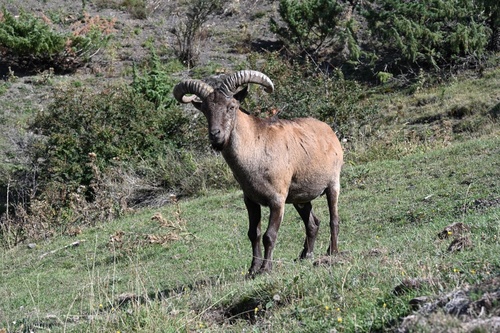
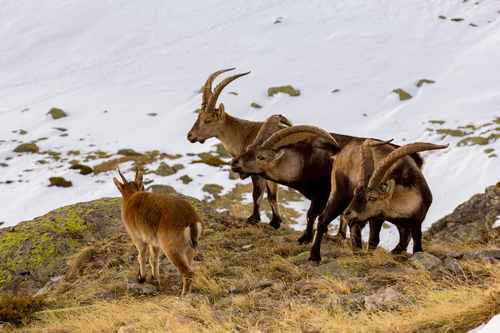
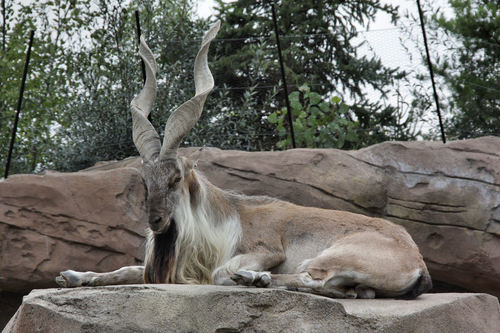
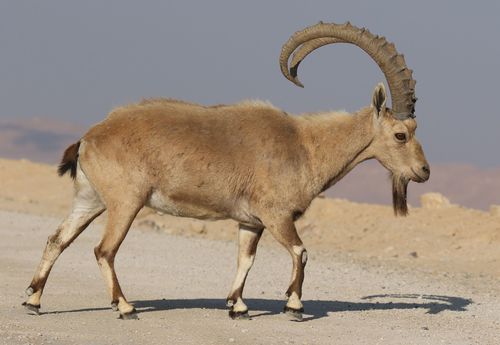
Other species in the family Bovidae
Sources
Conservation status, range description and population estimate come from the IUCN Red List assessment for Capra ibex. Countries are derived from that range description, not from a mapped country list. Last refreshed on .
The distribution map is drawn from the IUCN Red List spatial data compiled in 2024. Alpine Ibex European Specialist Group (GSE AIESG)