
Bay Duiker
Cephalophus dorsalis
Red List assessment
Near Threatenedon the IUCN Red List
- EXExtinct
- EWExtinct in the Wild
- CRCritically Endangered
- ENEndangered
- VUVulnerable
- NTNear Threatened
- LCLeast Concern
The Bay Duiker is recorded in 10 countries across Africa. The IUCN Red List assesses the Bay Duiker as Near Threatened. No precise global population estimate exists, but the species is considered common in intact forest habitats; overall trend is declining due to hunting pressure and deforestation.
- Family
- Bovidae
- Order
- Artiodactyla
- Genus
- Cephalophus
- Countries recorded
- 10
- Continents
- Africa
- Red List category
- Near Threatened
- Data updated
- August 9, 2026
What is the Bay Duiker?
The Bay Duiker is a small, secretive forest antelope native to the dense rainforests of West and Central Africa. It is named for its rich chestnut-red coat and the distinctive black dorsal stripe running from neck to tail. This shy, mostly solitary species plays an important ecological role as a seed disperser in tropical forest ecosystems. It is heavily hunted for bushmeat, making it one of the most economically important duiker species in African wildlife trade.
Where does the Bay Duiker live?
West and Central Africa, including Congo Basin countries such as Cameroon, Gabon, Republic of Congo, Democratic Republic of Congo, and coastal West African forests from Sierra Leone to Nigeria.
Ranges across the Guineo-Congolian forest block, from Sierra Leone and Guinea in West Africa through Liberia, Ivory Coast, Ghana, Nigeria, Cameroon, Gabon, Equatorial Guinea, Republic of Congo, and the Democratic Republic of Congo.
Altitude and depth
Typically found from sea level up to about 1,200 meters elevation in lowland and submontane forests.
Seasonal movements
No significant migration or hibernation; breeding can occur year-round, though births may peak with seasonal rainfall patterns affecting food availability.
Habitat of the Bay Duiker
Primarily found in lowland tropical rainforest, including primary and secondary forest, swamp forest, and forest edges with dense undergrowth. It favors areas with thick cover for concealment from predators and hunters.
Adaptations to its environment
Its compact, low-slung body and short legs allow it to move efficiently through dense undergrowth. Cryptic reddish coloration provides camouflage in the dim forest understory, while acute hearing and a habit of freezing or fleeing quickly help it avoid predators.
Conservation status and numbers
Listed as Near Threatened by IUCN due to ongoing population declines driven primarily by unsustainable bushmeat hunting and habitat loss across its range. Populations remain relatively widespread but are decreasing in heavily hunted areas.
Estimated population
No precise global population estimate exists, but the species is considered common in intact forest habitats; overall trend is declining due to hunting pressure and deforestation.
What threatens the Bay Duiker?
Major threats include intensive commercial bushmeat hunting, snaring, habitat destruction from logging, and forest conversion for agriculture and human settlement.
Diseases and parasites
Susceptible to various internal parasites such as nematodes and external parasites like ticks; specific disease studies are limited but likely share common ungulate parasite burdens.
What is being done to protect it?
Protected in numerous national parks and reserves across its range, including in Gabon, Cameroon, and the Congo Basin, with some countries regulating hunting through wildlife laws. CITES does not currently list this species, but bushmeat trade monitoring programs exist in several range states.
Recommended actions
Strengthening anti-poaching enforcement, promoting sustainable bushmeat management, expanding protected forest areas, and community-based conservation incentives are recommended to stabilize populations.
What the Bay Duiker looks like
The coat is a deep reddish-chestnut to bay color with a prominent black stripe running along the spine from the shoulders to the tail. The underparts are lighter, and the face often has darker facial markings with short, straight horns present in both sexes.
Size
Head-body length ranges from about 80-100 cm, with a shoulder height of approximately 40-50 cm.
Weight
Adults typically weigh between 14-24 kg, with males and females of similar size.
Distinctive features
Distinguished from other duiker species by its combination of deep bay/chestnut body color and bold black dorsal stripe, along with relatively short, sharp horns and a stocky, arched-back build typical of forest duikers.
Differences between males and females
Sexual dimorphism is minimal; both males and females possess horns of similar size, though females may be slightly larger in body mass.
Behaviour and diet of the Bay Duiker
Primarily solitary or found in monogamous pairs that maintain and defend a shared territory; not known to form larger social groups.
When it is active
Mainly nocturnal and crepuscular, being most active during dawn, dusk, and nighttime hours while resting in dense cover during the day.
Diet
Herbivorous and frugivorous, feeding mainly on fallen fruits, leaves, seeds, and fungi, occasionally supplemented with small invertebrates.
Communication
Communicates through scent marking via preorbital glands, along with body postures and occasional alarm snorts or bleats to signal danger.
Interactions with other species
Natural predators include leopards, large snakes such as pythons, and birds of prey targeting young; humans are the primary predator through hunting. It may share habitat with other duiker species with some ecological niche partitioning.
Role in its ecosystem
Acts as an important seed disperser for various forest fruiting trees, contributing to forest regeneration and plant diversity within the Congo Basin and West African rainforest ecosystems.
Reproduction and lifecycle
Breeding occurs year-round with no strict seasonality; gestation lasts approximately 7-8 months, typically resulting in a single calf per birth.
Raising the young
The mother provides sole parental care, nursing and protecting the calf, which remains hidden in vegetation for the first weeks before gradually accompanying her.
Maturity and lifespan
Sexual maturity is reached at around 9-12 months; lifespan in the wild is estimated at 10-12 years, with captive individuals sometimes living slightly longer.
Taxonomy and naming of the Bay Duiker
Classification
Class: Mammalia > Order: Artiodactyla > Family: Bovidae > Genus: Cephalophus > Species: Cephalophus dorsalis
Subspecies
Two subspecies are often recognized: Cephalophus dorsalis dorsalis (Central Africa) and Cephalophus dorsalis castaneus (West Africa), though taxonomic status is debated.
Scientific synonyms
Cephalophus castaneus (sometimes treated as a synonym or subspecies).
What research says
Recent studies
Recent camera-trap and genetic studies in Central African forests have focused on assessing bushmeat hunting impacts and population densities of the Bay Duiker as an indicator species for forest health.
Compared with similar species
Similar to the Black Duiker (Cephalophus niger) and Zebra Duiker (Cephalophus zebra) in size, but distinguished by its unique chestnut coloring and single dorsal stripe rather than multiple banding patterns.
The Bay Duiker and people
The Bay Duiker can leap and dash through dense forest cover with remarkable agility despite its small size. Its name 'duiker' comes from the Afrikaans word for 'diver,' referencing its habit of diving into thick vegetation to escape threats.
Where and how to see it
Best observed in undisturbed lowland rainforest reserves such as those in Gabon or Republic of Congo, using camera traps or quiet night walks with a guide, as the species is shy and rarely seen in daylight.
Risks to humans
No notable risk to humans; it is a non-aggressive small antelope with no venom or significant disease transmission risk to people.
Human uses
Widely hunted for bushmeat, representing a significant source of protein and income in rural Central and West African communities, though this drives unsustainable population declines.
Myths and legends
In some Central African cultures, duikers including the Bay Duiker feature in folklore as clever, elusive tricksters symbolizing cunning and evasiveness.
Countries where the Bay Duiker is recorded
The 10 countries named in the range description of its IUCN Red List assessment.
Questions about the Bay Duiker
Where does the Bay Duiker live?
The Bay Duiker is recorded in Cameroon, Democratic Republic of the Congo, Equatorial Guinea, Gabon and Ghana, among 10 countries in total across Africa. These countries come from the range description of its IUCN Red List assessment, and they are what place the species on the interactive map.
Is the Bay Duiker endangered?
The IUCN Red List assesses the Bay Duiker as Near Threatened. The species does not qualify as threatened today, but it is close to the thresholds and likely to cross them soon. It is the category that most often changes at the next assessment.
How many are left in the wild?
No precise global population estimate exists, but the species is considered common in intact forest habitats; overall trend is declining due to hunting pressure and deforestation. This figure comes from the species assessment on the IUCN Red List; population estimates for wild mammals are ranges, not counts, and are revised at each assessment.
What habitat does the Bay Duiker live in?
Primarily found in lowland tropical rainforest, including primary and secondary forest, swamp forest, and forest edges with dense undergrowth.
What is the scientific name of the Bay Duiker?
The Bay Duiker is Cephalophus dorsalis, in the family Bovidae, order Artiodactyla.
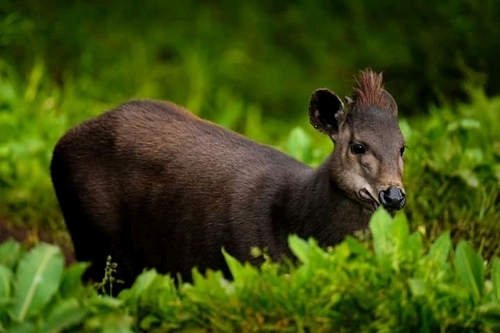
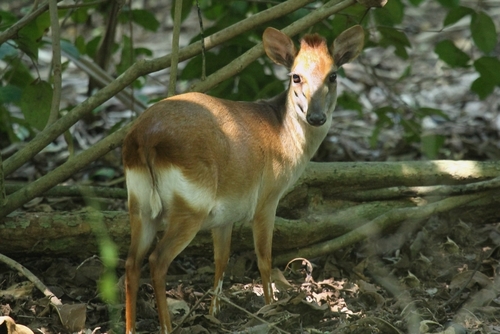
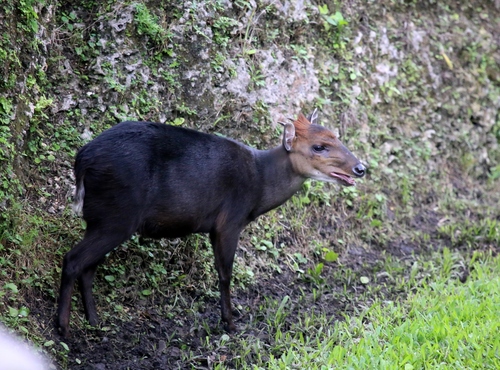
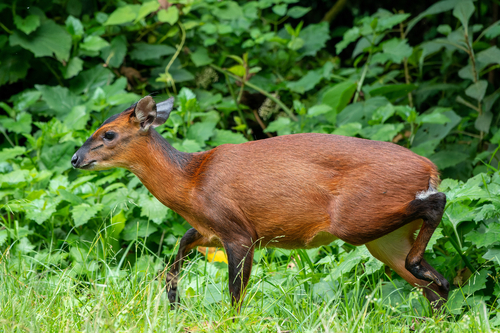
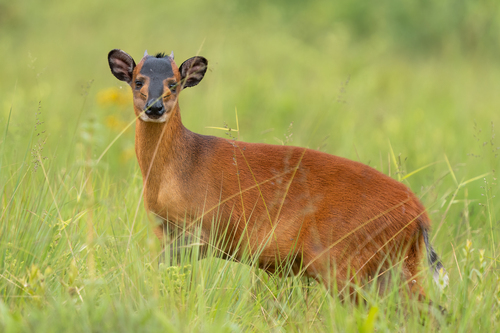
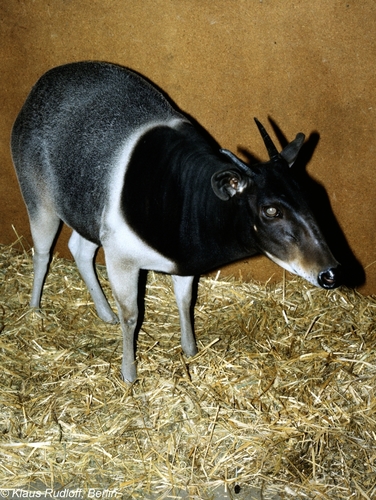
Other species in the genus Cephalophus
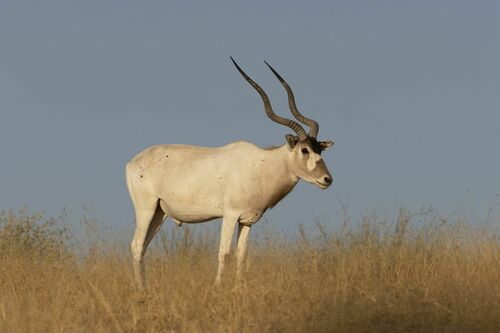
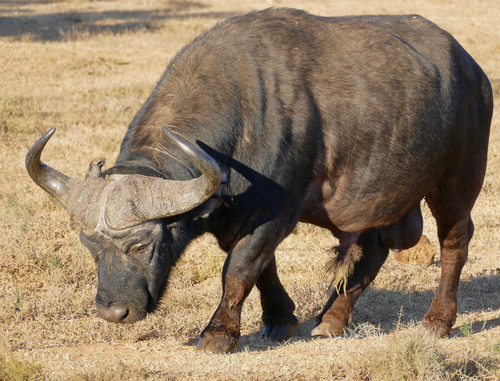
Other species in the family Bovidae
Sources
Conservation status, range description and population estimate come from the IUCN Red List assessment for Cephalophus dorsalis. Countries are derived from that range description, not from a mapped country list. Last refreshed on .
The distribution map is drawn from the IUCN Red List spatial data compiled in 2016. IUCN (International Union for Conservation of Nature)