
Black-fronted Duiker
Cephalophus nigrifrons
Red List assessment
Least Concernon the IUCN Red List
- EXExtinct
- EWExtinct in the Wild
- CRCritically Endangered
- ENEndangered
- VUVulnerable
- NTNear Threatened
- LCLeast Concern
The Black-fronted Duiker is recorded in 7 countries across Africa. The IUCN Red List assesses the Black-fronted Duiker as Least Concern. No precise global population estimate exists, but the species is considered relatively common within suitable forest habitat; overall trend is believed to be declining due to hunting and habitat loss
- Family
- Bovidae
- Order
- Artiodactyla
- Genus
- Cephalophus
- Countries recorded
- 7
- Continents
- Africa
- Red List category
- Least Concern
- Data updated
- August 9, 2026
What is the Black-fronted Duiker?
The Black-fronted Duiker is a small forest antelope native to the montane and lowland forests of Central Africa, distinguished by a striking black stripe running from its forehead to its nose. It is a shy, solitary forest dweller that plays an important role in seed dispersal within its ecosystem. Despite widespread hunting pressure across its range, it remains classified as Least Concern due to its adaptability and relatively wide distribution.
Where does the Black-fronted Duiker live?
Central Africa, primarily the Congo Basin region including Democratic Republic of Congo, Rwanda, Burundi, Uganda, and parts of Cameroon and the Central African Republic
Found across the Congo Basin including eastern DRC, Rwanda, Burundi, western Uganda, and extending into parts of Cameroon, Gabon, Republic of Congo, and Central African Republic
Altitude and depth
0-3000m, with populations found in both lowland forests and montane forests up to high elevations in the Albertine Rift region
Seasonal movements
No significant migratory behavior; activity patterns may shift slightly with rainfall seasons affecting fruit availability
Habitat of the Black-fronted Duiker
Primarily inhabits dense tropical and montane rainforests, including lowland evergreen forest, bamboo forest, and swamp forest edges; also found in secondary forest regrowth areas
Adaptations to its environment
Compact, low-slung body with arched back allows efficient movement through dense forest undergrowth; excellent camouflage coloration blends with forest shadows; keen senses of hearing and smell compensate for limited visibility in thick vegetation
Conservation status and numbers
Listed as Least Concern by IUCN due to its relatively wide distribution and stable populations in protected areas, though localized declines occur due to hunting pressure in unprotected regions
Estimated population
No precise global population estimate exists, but the species is considered relatively common within suitable forest habitat; overall trend is believed to be declining due to hunting and habitat loss
What threatens the Black-fronted Duiker?
Bushmeat hunting and snaring throughout its range, habitat loss from deforestation and agricultural expansion, and civil unrest in parts of its range limiting conservation monitoring
Diseases and parasites
Susceptible to various internal parasites including nematodes and external parasites like ticks; specific disease studies are limited
What is being done to protect it?
Protected within several national parks and reserves including Virunga National Park, Kahuzi-Biega National Park, and various forest reserves in Cameroon and Gabon; some countries have hunting regulations though enforcement varies
Recommended actions
Strengthen anti-poaching enforcement, expand protected area coverage, promote sustainable bushmeat alternatives for local communities, and conduct further population surveys to better assess status
What the Black-fronted Duiker looks like
Dark reddish-brown to chestnut coat with a distinctive black facial stripe running from forehead to muzzle; short straight horns present in both sexes; relatively short legs and a rounded back typical of forest duikers
Size
Shoulder height approximately 40-50 cm, body length around 70-90 cm
Weight
Typically weighs between 14-20 kg, with limited size difference between sexes
Distinctive features
The prominent black frontal stripe extending down the face is the key diagnostic feature distinguishing it from other duiker species with similar body forms
Differences between males and females
Minimal sexual dimorphism; both sexes bear horns, though females may have slightly smaller horns than males
Behaviour and diet of the Black-fronted Duiker
Generally solitary or found in monogamous pairs that maintain territories together; not known to form large herds
When it is active
Primarily diurnal to crepuscular, though can show activity at various times depending on hunting pressure and disturbance levels
Diet
Herbivorous, feeding mainly on fallen fruits, leaves, shoots, and fungi found on the forest floor; opportunistically may consume small invertebrates
Communication
Uses vocalizations including alarm snorts and bleats; scent marking via preorbital glands is important for territory demarcation and mate signaling
Interactions with other species
Preyed upon by leopards, large pythons, and eagles; humans are the primary predator through hunting; may share habitat with other duiker species with some ecological niche partitioning
Role in its ecosystem
Plays a significant role in forest ecology as a seed disperser for various fruiting plants, contributing to forest regeneration and plant diversity
Reproduction and lifecycle
Breeding can occur year-round with no strict seasonal pattern; gestation period is approximately 7-7.5 months, typically resulting in a single offspring
Raising the young
Young are hidden in vegetation shortly after birth and visited periodically by the mother for nursing, a common strategy among forest duikers to avoid predation; weaning occurs over several months
Maturity and lifespan
Sexual maturity reached around 9-12 months; lifespan in the wild is estimated at 10-12 years, potentially longer in captivity
Taxonomy and naming of the Black-fronted Duiker
Classification
Class Mammalia > Order Artiodactyla > Family Bovidae > Genus Cephalophus > Species Cephalophus nigrifrons
Subspecies
Several subspecies recognized including C. n. nigrifrons (Congo Basin), C. n. hooki (Ruwenzori region), and C. n. kivuensis (Kivu region), though taxonomy remains debated among authorities
Scientific synonyms
Cephalophus melanorheus (occasionally used in older literature)
What research says
Recent studies
Recent camera trap studies in Albertine Rift forests have provided updated distribution and density estimates, highlighting the species' sensitivity to hunting pressure even in nominally protected areas
Compared with similar species
Similar in size and habits to other forest duikers like the Red Duiker (Cephalophus natalensis) and Weyns's Duiker, but distinguished by its unique black facial stripe not present in these related species
The Black-fronted Duiker and people
The black facial stripe gives this species its common name and makes it one of the more visually distinctive duikers; despite being a forest antelope, it can move remarkably fast through dense undergrowth when startled; it is one of the few duiker species found at higher montane elevations in the Albertine Rift.
Where and how to see it
Best observed in well-protected national parks like Kahuzi-Biega or Virunga during early morning or late afternoon; requires patience and quiet movement through forest trails as the species is shy and quick to flee
Risks to humans
No notable risk to humans
Human uses
Hunted extensively for bushmeat throughout its range; skin and horns sometimes used in local traditional crafts, though this is not a widespread commercial trade
Countries where the Black-fronted Duiker is recorded
The 7 countries named in the range description of its IUCN Red List assessment.
Questions about the Black-fronted Duiker
Where does the Black-fronted Duiker live?
The Black-fronted Duiker is recorded in Burundi, Cameroon, Central African Republic, Democratic Republic of the Congo and Gabon, among 7 countries in total across Africa. These countries come from the range description of its IUCN Red List assessment, and they are what place the species on the interactive map.
Is the Black-fronted Duiker endangered?
The IUCN Red List assesses the Black-fronted Duiker as Least Concern. The species is widespread and abundant enough not to qualify for any threatened category. It does not mean the species is safe forever, only that nothing in the current data raises an alarm.
How many are left in the wild?
No precise global population estimate exists, but the species is considered relatively common within suitable forest habitat; overall trend is believed to be declining due to hunting and habitat loss This figure comes from the species assessment on the IUCN Red List; population estimates for wild mammals are ranges, not counts, and are revised at each assessment.
What habitat does the Black-fronted Duiker live in?
Primarily inhabits dense tropical and montane rainforests, including lowland evergreen forest, bamboo forest, and swamp forest edges; also found in secondary forest regrowth areas
What is the scientific name of the Black-fronted Duiker?
The Black-fronted Duiker is Cephalophus nigrifrons, in the family Bovidae, order Artiodactyla.
Other species in the genus Cephalophus
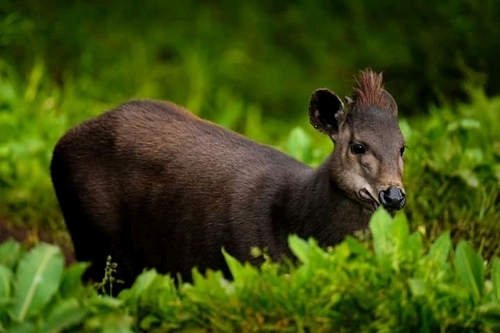
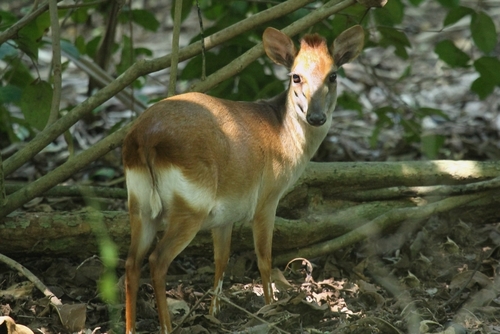
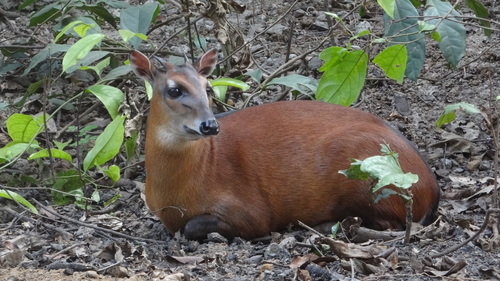
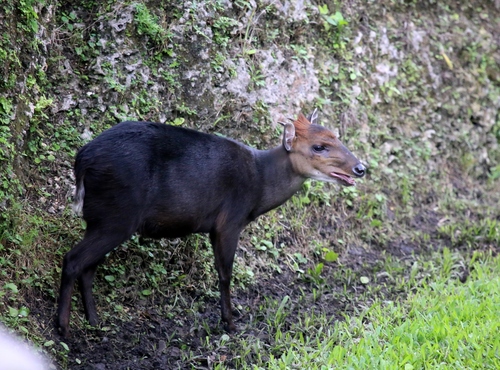
Other species in the family Bovidae
Sources
Conservation status, range description and population estimate come from the IUCN Red List assessment for Cephalophus nigrifrons. Countries are derived from that range description, not from a mapped country list. Last refreshed on .
The distribution map is drawn from the IUCN Red List spatial data compiled in 2016. IUCN (International Union for Conservation of Nature)