
Harvey's Duiker
Cephalophus harveyi
Red List assessment
Least Concernon the IUCN Red List
- EXExtinct
- EWExtinct in the Wild
- CRCritically Endangered
- ENEndangered
- VUVulnerable
- NTNear Threatened
- LCLeast Concern
The Harvey's Duiker is recorded in 3 countries across Africa. The IUCN Red List assesses the Harvey's Duiker as Least Concern. Population size is not precisely known but believed to be declining in parts of its range due to habitat degradation; considered locally common in protected forest areas
- Family
- Bovidae
- Order
- Artiodactyla
- Genus
- Cephalophus
- Countries recorded
- 3
- Continents
- Africa
- Red List category
- Least Concern
- Data updated
- August 9, 2026
What is the Harvey's Duiker?
Harvey's Duiker is a small forest-dwelling antelope native to East Africa, closely related to the red duiker group. It inhabits montane and coastal forests where its reddish-brown coat provides excellent camouflage among leaf litter and shadows. This shy, secretive species is rarely seen due to its elusive nature and dense habitat preference. It plays an important role in forest ecosystems as a seed disperser.
Where does the Harvey's Duiker live?
East Africa, primarily Kenya, Tanzania, and Malawi
Found in fragmented populations across Kenya (coastal and highland forests), Tanzania (including Eastern Arc Mountains and coastal forests), and parts of Malawi. Its range is patchy due to forest fragmentation.
Altitude and depth
0-3000m, though most commonly found between 300-2000m in montane and coastal forest zones
Habitat of the Harvey's Duiker
Primarily found in montane forests, coastal forests, and dense woodland thickets with good understory cover. Prefers areas with thick vegetation for concealment and a mix of open and closed canopy for foraging.
Adaptations to its environment
Small compact body size allows easy movement through dense understory vegetation. Reddish coat provides camouflage in dappled forest light, while acute hearing and a low crouching gait help avoid predators in thick cover.
Conservation status and numbers
Listed as Least Concern by IUCN, though populations are experiencing localized declines due to habitat loss and hunting pressure. The species remains relatively widespread across its range despite fragmentation.
Estimated population
Population size is not precisely known but believed to be declining in parts of its range due to habitat degradation; considered locally common in protected forest areas
What threatens the Harvey's Duiker?
Habitat loss from deforestation and agricultural expansion, bushmeat hunting and snaring, and forest fragmentation limiting gene flow between populations.
Diseases and parasites
Susceptible to various ticks and internal parasites common to forest ungulates; specific disease studies are limited
What is being done to protect it?
Protected within several national parks and forest reserves in Kenya and Tanzania, including parts of the Eastern Arc Mountains conservation initiatives. Some populations benefit from community-based forest management programs.
Recommended actions
Strengthen anti-poaching and anti-snaring enforcement, protect and connect remaining forest fragments through corridors, and conduct population surveys to better assess conservation status.
What the Harvey's Duiker looks like
Rich reddish-brown to chestnut coat, darker along the back with a lighter underside. Has small, straight horns present in both sexes, large dark eyes, and a compact rounded body typical of forest duikers.
Size
Shoulder height approximately 40-45 cm, body length around 70-100 cm
Weight
12-20 kg, with limited sexual size difference
Distinctive features
Distinguished from similar red duikers by subtle coloration differences and specific skull/horn morphology; closely resembles the Natal red duiker but occupies a more northerly range.
Differences between males and females
Minimal sexual dimorphism; both males and females possess short horns, though females may be slightly larger in some populations
Behaviour and diet of the Harvey's Duiker
Primarily solitary or found in monogamous pairs that maintain territories together. Rarely observed in larger groups.
When it is active
Crepuscular and nocturnal, with peak activity during dawn and dusk hours to avoid predators and heat
Diet
Herbivorous, feeding on fallen fruits, leaves, shoots, flowers, and fungi found in the forest understory. Diet varies seasonally based on fruit availability.
Communication
Uses scent marking via preorbital glands to mark territory, along with soft vocalizations and body postures for communication with mates and offspring.
Interactions with other species
Preyed upon by leopards, pythons, and birds of prey; may compete with other small forest antelopes for food resources. Its seed dispersal activity benefits forest plant regeneration.
Role in its ecosystem
Functions as an important seed disperser in forest ecosystems, helping maintain plant diversity through consumption and excretion of fruit seeds across its habitat.
Reproduction and lifecycle
Breeding can occur year-round with possible peaks tied to food availability; gestation lasts approximately 4 months, typically resulting in a single offspring.
Raising the young
Females provide primary care, nursing and protecting the calf which remains hidden in vegetation for the first few weeks of life. Weaning occurs after a few months, with young becoming independent by 6 months.
Maturity and lifespan
Sexual maturity reached around 9-12 months; lifespan in the wild is approximately 10-12 years, potentially longer in captivity
Taxonomy and naming of the Harvey's Duiker
Classification
Class Mammalia > Order Artiodactyla > Family Bovidae > Genus Cephalophus > Species Cephalophus harveyi
Scientific synonyms
Formerly considered a subspecies of Cephalophus natalensis (Natal red duiker); sometimes listed as Cephalophus harveyi harveyi
What research says
Recent studies
Recent genetic studies have helped clarify taxonomic relationships within the red duiker complex, supporting the distinct species status of C. harveyi separate from C. natalensis
Compared with similar species
Closely resembles the Natal red duiker (Cephalophus natalensis) but occupies a more northern range in East Africa; both species share similar body size, coloration, and forest habitat preferences but are geographically separated.
The Harvey's Duiker and people
Harvey's Duiker can survive for extended periods without drinking water, obtaining sufficient moisture from its fruit-rich diet. Despite its small size, it can leap surprisingly high to escape predators. Its name honors British zoologist William Harvey.
Where and how to see it
Best observed in early morning or late evening in protected forest reserves such as Arabuko-Sokoke Forest in Kenya or Eastern Arc Mountain forests in Tanzania. Patience and quiet movement are essential due to the species' shy, secretive nature.
Risks to humans
No notable risk
Human uses
Hunted locally for bushmeat in parts of its range, though this is largely unsustainable and illegal in protected areas
Countries where the Harvey's Duiker is recorded
The 3 countries named in the range description of its IUCN Red List assessment.
Questions about the Harvey's Duiker
Where does the Harvey's Duiker live?
The Harvey's Duiker is recorded in Kenya, Malawi and Tanzania across Africa. These countries come from the range description of its IUCN Red List assessment, and they are what place the species on the interactive map.
Is the Harvey's Duiker endangered?
The IUCN Red List assesses the Harvey's Duiker as Least Concern. The species is widespread and abundant enough not to qualify for any threatened category. It does not mean the species is safe forever, only that nothing in the current data raises an alarm.
How many are left in the wild?
Population size is not precisely known but believed to be declining in parts of its range due to habitat degradation; considered locally common in protected forest areas This figure comes from the species assessment on the IUCN Red List; population estimates for wild mammals are ranges, not counts, and are revised at each assessment.
What habitat does the Harvey's Duiker live in?
Primarily found in montane forests, coastal forests, and dense woodland thickets with good understory cover.
What is the scientific name of the Harvey's Duiker?
The Harvey's Duiker is Cephalophus harveyi, in the family Bovidae, order Artiodactyla.
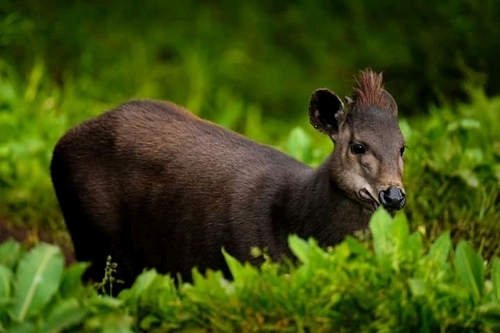
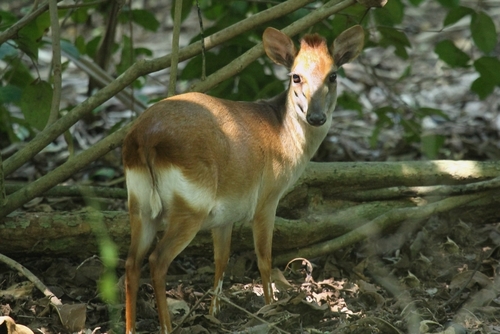
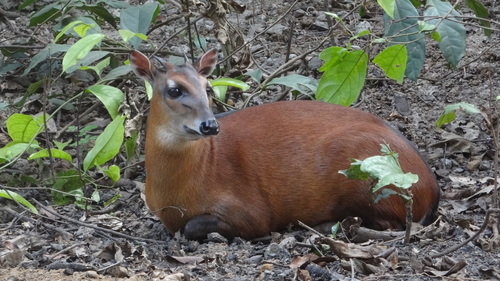
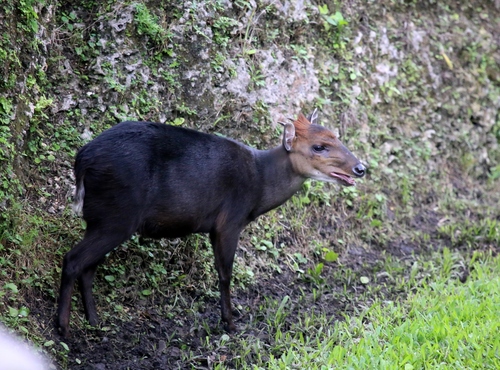
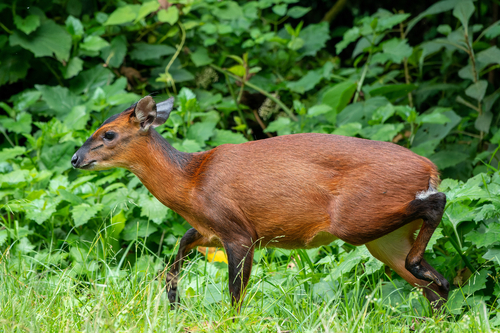
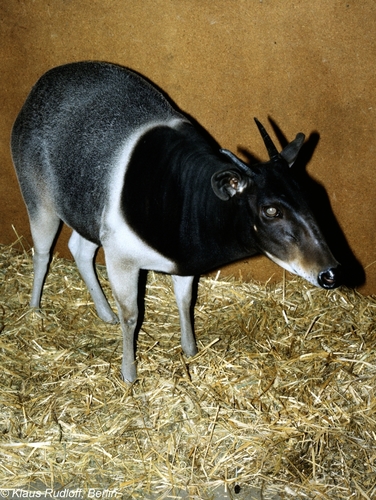
Other species in the genus Cephalophus
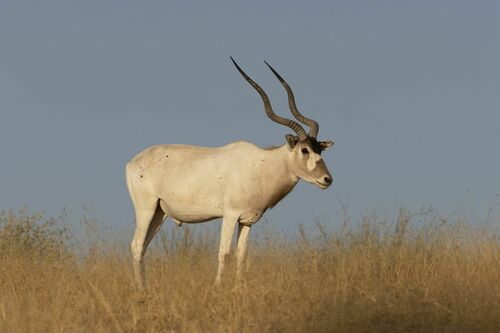
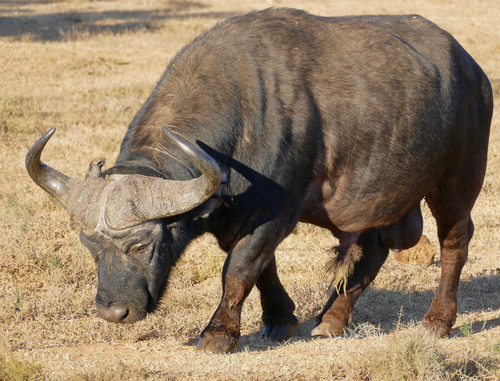
Other species in the family Bovidae
Sources
Conservation status, range description and population estimate come from the IUCN Red List assessment for Cephalophus harveyi. Countries are derived from that range description, not from a mapped country list. Last refreshed on .
The distribution map is drawn from the IUCN Red List spatial data compiled in 2016. IUCN (International Union for Conservation of Nature)