
Phayre's Squirrel
Callosciurus phayrei
Red List assessment
Least Concernon the IUCN Red List
- EXExtinct
- EWExtinct in the Wild
- CRCritically Endangered
- ENEndangered
- VUVulnerable
- NTNear Threatened
- LCLeast Concern
The Phayre's Squirrel is recorded in 3 countries across Asia. The IUCN Red List assesses the Phayre's Squirrel as Least Concern. No precise global population estimate exists, but the species is considered common within suitable habitat; overall population trend is believed to be stable to slightly declining due to habitat loss.
- Family
- Sciuridae
- Order
- Rodentia
- Genus
- Callosciurus
- Countries recorded
- 3
- Continents
- Asia
- Red List category
- Least Concern
- Data updated
- August 9, 2026
What is the Phayre's Squirrel?
Phayre's Squirrel is a medium-sized tree squirrel native to the forests of Southeast Asia, particularly Myanmar and adjacent regions of India and China. It is part of the diverse Callosciurus genus, known for colorful oriental squirrels. The species is notable for its adaptability to various forest types and its role in forest ecosystems as a seed disperser.
Where does the Phayre's Squirrel live?
Northeastern India, Myanmar, and southwestern China (Yunnan)
Found in northeastern India (Manipur, Mizoram), throughout Myanmar, and into southwestern Yunnan province in China. The range extends across hilly and forested terrain in this tri-border region of Southeast Asia.
Altitude and depth
Typically found from lowlands up to approximately 1500-2000 meters elevation.
Seasonal movements
No true hibernation or long-distance migration; activity may vary slightly with monsoon seasons affecting food availability and breeding timing.
Habitat of the Phayre's Squirrel
Inhabits tropical and subtropical evergreen and semi-evergreen forests, as well as secondary forests and forest edges. Also found in bamboo groves and mixed deciduous forests at various elevations.
Adaptations to its environment
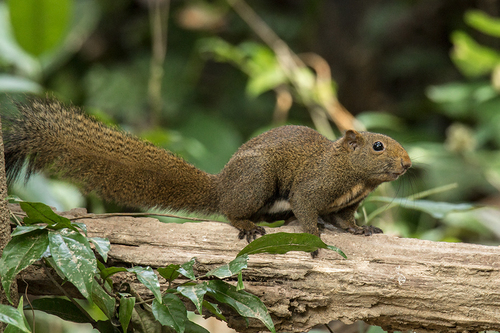
Possesses sharp curved claws and strong hind limbs for arboreal locomotion and climbing. Its coloration provides camouflage against predators in the forest canopy, and its bushy tail aids in balance while navigating tree branches.
Conservation status and numbers
Listed as Least Concern (LC) by IUCN due to its relatively wide distribution and presumed stable population, though localized threats from habitat loss exist in parts of its range.
Estimated population
No precise global population estimate exists, but the species is considered common within suitable habitat; overall population trend is believed to be stable to slightly declining due to habitat loss.
What threatens the Phayre's Squirrel?
Primary threats include deforestation for agriculture and logging, habitat fragmentation, and potential hunting pressure in some areas for food or pet trade.
Diseases and parasites
Susceptible to common rodent ectoparasites such as fleas and mites, along with potential endoparasitic infections, though specific studies on this species are limited.
What is being done to protect it?
Protected within various national parks and wildlife sanctuaries across its range in India, Myanmar, and China; benefits indirectly from broader forest conservation initiatives in the region.
Recommended actions
Continued monitoring of population trends, protection of remaining forest habitat, and research into subspecies taxonomy and distribution limits to inform targeted conservation planning.
What the Phayre's Squirrel looks like
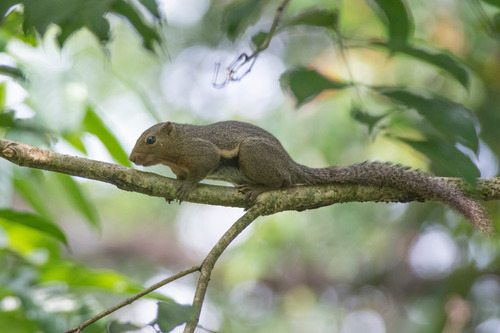
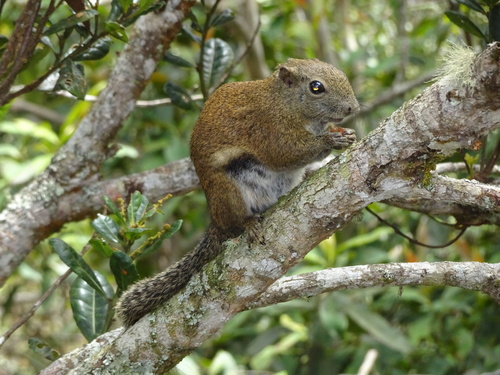
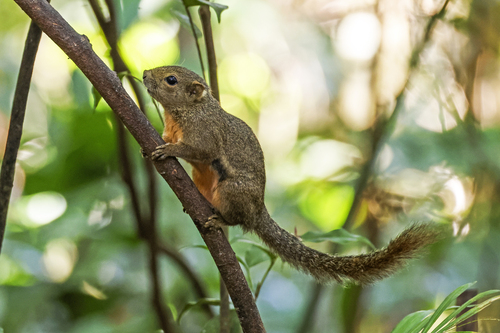
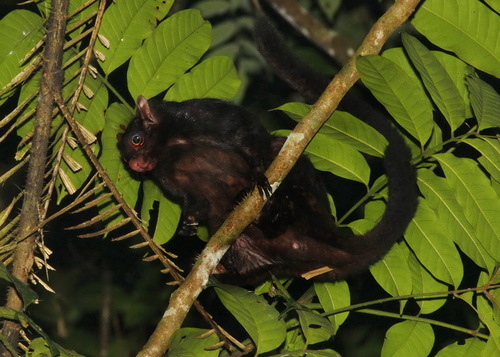
Fur coloration varies by subspecies and region but generally includes shades of olive-brown, grayish, or reddish-brown on the back, with paler underparts. The tail is bushy and often shows banding or grizzled coloration.
Size
Head-body length approximately 20-25 cm, with a tail of similar or slightly greater length (20-25 cm).
Weight
Typically weighs between 300-450 grams, with no significant difference reported between sexes.
Distinctive features
Distinguished from closely related Callosciurus species by subtle differences in fur coloration patterns, particularly on the flanks and tail, though field identification can be challenging due to regional variation.
Behaviour and diet of the Phayre's Squirrel
Generally solitary or found in loose associations; territorial behavior is common, especially among males defending feeding areas or nesting sites.
When it is active
Primarily diurnal, with peak activity during early morning and late afternoon hours when foraging for food in the tree canopy.
Diet
Omnivorous diet consisting mainly of fruits, seeds, nuts, and flowers, supplemented occasionally with insects, bird eggs, or bark.
How it feeds and hunts
Forages by climbing through tree canopies and along branches, using keen eyesight and dexterous paws to locate and manipulate food items; opportunistically raids bird nests for eggs.
Communication
Communicates through vocalizations such as chattering and alarm calls, along with scent marking and tail-flicking displays to signal territory or alertness.
Interactions with other species
Preyed upon by raptors, snakes, and small carnivorous mammals; competes with other arboreal squirrels and birds for fruit and seed resources within shared forest habitats.
Role in its ecosystem
Plays an important ecological role as a seed disperser, contributing to forest regeneration by caching and inadvertently spreading seeds of various tree species.
Reproduction and lifecycle
Breeding likely occurs multiple times per year, with gestation lasting approximately 40-45 days typical of Callosciurus species; litters usually consist of 2-3 young.
Raising the young
Females build nests (dreys) in tree hollows or dense branches and provide sole parental care, nursing and protecting young until weaning at around 6-8 weeks of age.
Maturity and lifespan
Sexual maturity is typically reached around 1 year of age; lifespan in the wild is estimated at 5-6 years, potentially longer (up to 10 years) in captivity.
Taxonomy and naming of the Phayre's Squirrel
Classification
Mammalia > Rodentia > Sciuridae > Callosciurus > Callosciurus phayrei
Subspecies
Several subspecies have been described, including C. p. phayrei and C. p. yunnanensis, distinguished mainly by fur coloration and geographic range in Myanmar and Yunnan, though taxonomy remains debated among some authorities.
Scientific synonyms
Sciurus phayrei (original combination by Blyth, 1856)
What research says
Recent studies
Recent taxonomic studies have focused on clarifying subspecies boundaries and phylogenetic relationships within the Callosciurus genus using molecular data, though Phayre's Squirrel specifically has received limited dedicated research attention.
Compared with similar species
Closely resembles other Callosciurus species such as the Pallas's Squirrel (Callosciurus erythraeus) and Grey-bellied Squirrel (Callosciurus caniceps), differing mainly in subtle coat coloration and geographic range rather than overall body plan.
The Phayre's Squirrel and people
Phayre's Squirrel was named after Sir Arthur Purves Phayre, a British colonial official and naturalist in Burma during the 19th century. Like many Callosciurus species, it can display striking color variation even within the same population, making precise field identification tricky for researchers.
Where and how to see it
Best observed during early morning hours in forested areas of Myanmar or northeastern India, particularly in protected reserves; patience and quiet movement through canopy-level habitat increase chances of sighting.
Risks to humans
No notable risk to humans; the species is not aggressive and poses no significant disease transmission concerns under normal circumstances.
Human uses
Not extensively used commercially, though it may occasionally be captured for local pet trade or hunted opportunistically for subsistence in some rural areas within its range.
Countries where the Phayre's Squirrel is recorded
The 3 countries named in the range description of its IUCN Red List assessment.
Questions about the Phayre's Squirrel
Where does the Phayre's Squirrel live?
The Phayre's Squirrel is recorded in China, India and Myanmar across Asia. These countries come from the range description of its IUCN Red List assessment, and they are what place the species on the interactive map.
Is the Phayre's Squirrel endangered?
The IUCN Red List assesses the Phayre's Squirrel as Least Concern. The species is widespread and abundant enough not to qualify for any threatened category. It does not mean the species is safe forever, only that nothing in the current data raises an alarm.
How many are left in the wild?
No precise global population estimate exists, but the species is considered common within suitable habitat; overall population trend is believed to be stable to slightly declining due to habitat loss. This figure comes from the species assessment on the IUCN Red List; population estimates for wild mammals are ranges, not counts, and are revised at each assessment.
What habitat does the Phayre's Squirrel live in?
Inhabits tropical and subtropical evergreen and semi-evergreen forests, as well as secondary forests and forest edges.
What is the scientific name of the Phayre's Squirrel?
The Phayre's Squirrel is Callosciurus phayrei, in the family Sciuridae, order Rodentia.
Other species in the genus Callosciurus
Other species in the family Sciuridae
Sources
Conservation status, range description and population estimate come from the IUCN Red List assessment for Callosciurus phayrei. Countries are derived from that range description, not from a mapped country list. Last refreshed on .
The distribution map is drawn from the IUCN Red List spatial data compiled in 2008. IUCN (International Union for Conservation of Nature)