
Eurasian Red Squirrel
Sciurus vulgaris
Red List assessment
Least Concernon the IUCN Red List
- EXExtinct
- EWExtinct in the Wild
- CRCritically Endangered
- ENEndangered
- VUVulnerable
- NTNear Threatened
- LCLeast Concern
The Eurasian Red Squirrel is recorded in 4 countries across Asia and Europe. The IUCN Red List assesses the Eurasian Red Squirrel as Least Concern. The global population is estimated in the millions and considered stable overall, though UK populations have dropped to fewer than 300,000 individuals and continue to decline.
- Family
- Sciuridae
- Order
- Rodentia
- Genus
- Sciurus
- Countries recorded
- 4
- Continents
- Asia and Europe
- Red List category
- Least Concern
- Data updated
- August 9, 2026
What is the Eurasian Red Squirrel?
The Eurasian red squirrel is a small arboreal rodent native to the forests of Europe and Asia, known for its bushy tail and reddish coat that can vary widely in color. It plays a key ecological role as a seed disperser and is a culturally iconic species across its range. Populations in the UK have declined sharply due to competition with the introduced grey squirrel, making it a conservation concern regionally despite being classified as Least Concern globally.
Where does the Eurasian Red Squirrel live?
Widespread across Europe and northern Asia, including the United Kingdom, Scandinavia, Central Europe, Russia, and parts of Siberia and East Asia.
Ranges across most of Europe from the British Isles and Iberian Peninsula to Scandinavia, extending eastward through Russia into Siberia, Mongolia, and parts of northern China and the Korean Peninsula.
Altitude and depth
Found from sea level up to approximately 2000 meters in mountainous regions such as the Alps and Pyrenees.
Seasonal movements
Does not hibernate but reduces activity significantly during harsh winter months, relying on cached food stores; molts twice yearly with a thicker winter coat and prominent ear tufts.
Habitat of the Eurasian Red Squirrel
Primarily found in coniferous, deciduous, and mixed woodlands, with a preference for mature forests offering abundant seed-bearing trees like spruce, pine, and hazel. Also inhabits parks and gardens in some urban and suburban areas.
Adaptations to its environment
Sharp curved claws and strong hind legs enable agile climbing and leaping between tree branches. A bushy tail aids balance, acts as a rudder while jumping, and provides insulation during cold weather.
Conservation status and numbers
Listed as Least Concern globally by the IUCN due to its wide distribution and stable overall population, though it faces significant regional declines, particularly in the United Kingdom and Ireland.
Estimated population
The global population is estimated in the millions and considered stable overall, though UK populations have dropped to fewer than 300,000 individuals and continue to decline.
What threatens the Eurasian Red Squirrel?
Competition and disease transmission (squirrelpox virus) from the introduced grey squirrel, habitat fragmentation, deforestation, and road mortality are the main threats, especially in Western Europe.
Diseases and parasites
Susceptible to squirrelpox virus (often fatal, primarily transmitted by grey squirrels), as well as mites, fleas, and intestinal parasites.
What is being done to protect it?
Conservation programs include protected woodland reserves, grey squirrel control initiatives in the UK, red squirrel reintroduction projects, and legal protection under wildlife acts in several European countries.
Recommended actions
Priority actions include controlling invasive grey squirrel populations, preserving and connecting fragmented woodland habitats, and continued monitoring of squirrelpox virus spread.
What the Eurasian Red Squirrel looks like
Coat color is highly variable, ranging from bright red to dark brown or nearly black, with a paler underside; ear tufts are prominent, especially in winter. The tail is long, bushy, and often lighter in color than the body.
Size
Body length typically ranges from 19 to 23 cm, with an additional tail length of 15 to 20 cm.
Weight
Adults typically weigh between 250 and 340 grams, with minimal difference between males and females.
Distinctive features
Distinguished from the introduced grey squirrel by its smaller size, reddish fur, and characteristic ear tufts, which grey squirrels lack.
Differences between males and females
Minimal sexual dimorphism; males and females are similar in size and coloration.
Behaviour and diet of the Eurasian Red Squirrel
Generally solitary outside of breeding season, though home ranges may overlap and squirrels can tolerate nearby conspecifics, particularly where food is abundant.
When it is active
Diurnal, being most active during early morning and late afternoon, with rest periods around midday.
Diet
Omnivorous but primarily feeds on tree seeds and nuts such as hazelnuts, acorns, and conifer seeds, supplemented with fungi, buds, shoots, and occasionally bird eggs or insects.
How it feeds and hunts
Forages by searching tree canopies and forest floor for seeds and nuts, and caches surplus food in scattered ground stores (scatter-hoarding) for retrieval during lean periods.
Communication
Communicates through vocal chattering and foot-stamping to signal alarm, as well as tail-flicking and scent marking to establish territory and convey reproductive status.
Interactions with other species
Predators include birds of prey such as goshawks, along with pine martens, foxes, and domestic cats; competes directly with the invasive grey squirrel for food and habitat.
Role in its ecosystem
Acts as an important seed disperser and forest regenerator through its scatter-hoarding behavior, inadvertently planting many tree seeds that are never retrieved.
Reproduction and lifecycle
Breeding occurs typically twice a year, in early spring and mid-summer, with a gestation period of about 38 days and litters averaging 2 to 4 kits.
Raising the young
Females alone care for the young in a nest called a drey, nursing them for about 8 weeks until weaning, after which juveniles become independent.
Maturity and lifespan
Reaches sexual maturity around 10 to 12 months of age; typically lives 3 to 5 years in the wild, though captive individuals can live up to 7 years or more.
Taxonomy and naming of the Eurasian Red Squirrel
Classification
Class Mammalia > Order Rodentia > Family Sciuridae > Genus Sciurus > Species Sciurus vulgaris
Subspecies
Over 20 subspecies recognized, including S. v. vulgaris (mainland Europe), S. v. leucourus (British Isles), S. v. fuscoater (Central Europe), and S. v. mantchuricus (East Asia), differing mainly in coat color and geographic range.
Scientific synonyms
Sciurus vulgaris has few taxonomic synonyms; historically some regional populations were described under separate names later synonymized, such as Sciurus russicus.
What research says
Recent studies
Recent research has focused on the genetic resilience of red squirrel populations to squirrelpox and on the effectiveness of grey squirrel control programs in aiding red squirrel recovery in the UK.
Genome and DNA
The species has a diploid chromosome number of 2n=40; genetic studies have documented regional population differentiation across Europe due to habitat fragmentation.
Compared with similar species
Compared to the invasive Eastern grey squirrel (Sciurus carolinensis), the red squirrel is smaller, more arboreal, and less adaptable to disturbed habitats, contributing to its competitive disadvantage.
The Eurasian Red Squirrel and people
Red squirrels can descend trees head-first thanks to flexible ankle joints; they may bury thousands of nuts each autumn but forget the location of many, aiding forest regeneration; and their ear tufts grow longest in winter, giving them a distinctive festive appearance.
Where and how to see it
Best observed in early morning within mature coniferous or mixed woodlands in Scotland, Scandinavia, or the Alps, particularly in areas free of grey squirrels; patience and quiet movement improve chances of sightings.
Risks to humans
No notable risk to humans; bites may occur only if handled, but the species poses no venom or significant disease threat to people.
Human uses
Historically hunted for fur in parts of Europe and Russia, though this practice has significantly declined; today the species is primarily valued for ecotourism and its cultural symbolism.
Myths and legends
In Norse mythology, a red squirrel named Ratatoskr is said to run along the World Tree Yggdrasil, carrying messages between an eagle at the top and a serpent at its roots.
Countries where the Eurasian Red Squirrel is recorded
The 4 countries named in the range description of its IUCN Red List assessment.
Questions about the Eurasian Red Squirrel
Where does the Eurasian Red Squirrel live?
The Eurasian Red Squirrel is recorded in China, Mongolia, Russia and United Kingdom across Asia and Europe. These countries come from the range description of its IUCN Red List assessment, and they are what place the species on the interactive map.
Is the Eurasian Red Squirrel endangered?
The IUCN Red List assesses the Eurasian Red Squirrel as Least Concern. The species is widespread and abundant enough not to qualify for any threatened category. It does not mean the species is safe forever, only that nothing in the current data raises an alarm.
How many are left in the wild?
The global population is estimated in the millions and considered stable overall, though UK populations have dropped to fewer than 300,000 individuals and continue to decline. This figure comes from the species assessment on the IUCN Red List; population estimates for wild mammals are ranges, not counts, and are revised at each assessment.
What habitat does the Eurasian Red Squirrel live in?
Primarily found in coniferous, deciduous, and mixed woodlands, with a preference for mature forests offering abundant seed-bearing trees like spruce, pine, and hazel.
What is the scientific name of the Eurasian Red Squirrel?
The Eurasian Red Squirrel is Sciurus vulgaris, in the family Sciuridae, order Rodentia.
Other species in the genus Sciurus
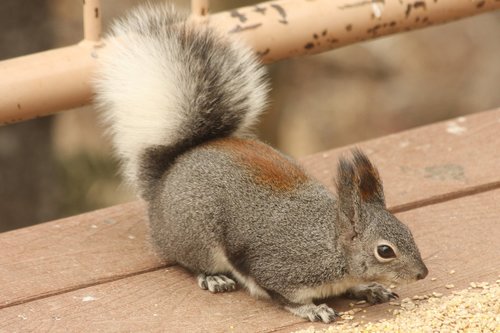
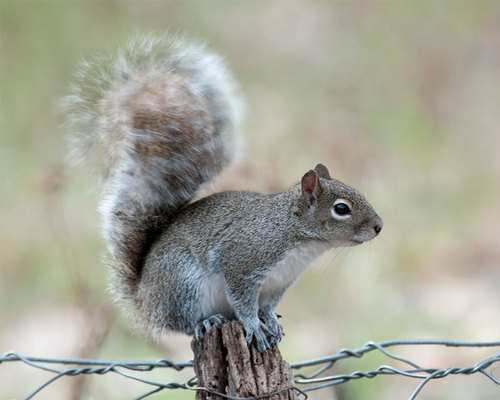
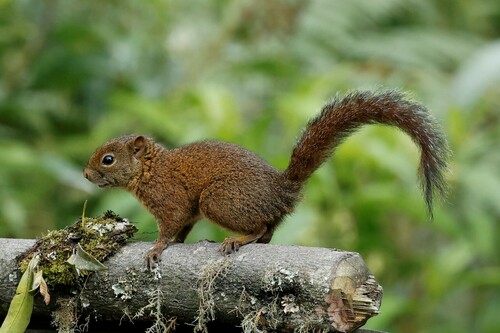
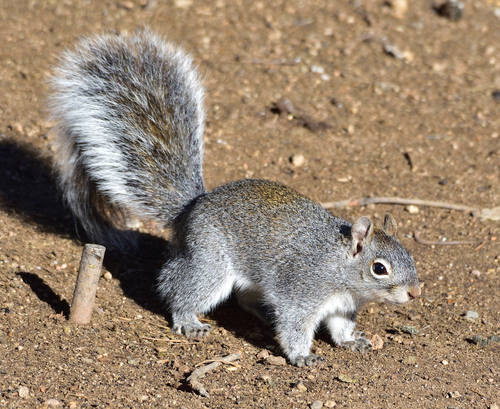
Other species in the family Sciuridae
Sources
Conservation status, range description and population estimate come from the IUCN Red List assessment for Sciurus vulgaris. Countries are derived from that range description, not from a mapped country list. Last refreshed on .
The distribution map is drawn from the IUCN Red List spatial data compiled in 2023. IUCN SSC Small Mammal Specialist Group