
Black-tailed Prairie Dog
Cynomys ludovicianus
Red List assessment
Least Concernon the IUCN Red List
- EXExtinct
- EWExtinct in the Wild
- CRCritically Endangered
- ENEndangered
- VUVulnerable
- NTNear Threatened
- LCLeast Concern
The Black-tailed Prairie Dog is recorded in 3 countries across North America. The IUCN Red List assesses the Black-tailed Prairie Dog as Least Concern. Estimated at several million individuals across fragmented colonies, though this represents a small fraction of historical numbers; overall trend considered stable to locally declining depending on region.
- Family
- Sciuridae
- Order
- Rodentia
- Genus
- Cynomys
- Countries recorded
- 3
- Continents
- North America
- Red List category
- Least Concern
- Data updated
- August 9, 2026
What is the Black-tailed Prairie Dog?
The Black-tailed Prairie Dog is a highly social, burrowing rodent native to the grasslands of central North America. It is renowned for constructing extensive underground colonies called 'towns' that can historically span hundreds of square kilometers and house complex social structures. As a keystone species, it dramatically shapes grassland ecosystems and supports numerous other species through its burrowing and grazing activities.
Where does the Black-tailed Prairie Dog live?
Great Plains of North America, primarily the United States, with smaller populations in southern Canada and northern Mexico
Historically ranged across the Great Plains from southern Saskatchewan and Manitoba in Canada, through Montana, the Dakotas, Wyoming, Nebraska, Colorado, Kansas, Oklahoma, Texas, New Mexico, and marginally into Arizona, down into northern Mexico (Chihuahua, Sonora). Range has been drastically reduced from historical extent.
Altitude and depth
Typically found at elevations ranging from 600 to 2100 meters above sea level
Seasonal movements
No true hibernation, but individuals reduce activity and may enter short torpor bouts during severe winter weather; breeding is seasonal, occurring once per year in late winter to early spring
Habitat of the Black-tailed Prairie Dog
Shortgrass and mixed-grass prairies, semi-arid grasslands, and open plains with well-drained soils suitable for burrowing. Prefers areas with short vegetation that allows visual detection of predators.
Adaptations to its environment
Complex burrow systems with multiple entrances provide thermoregulation, predator escape, and protection from fire; keen eyesight and upright 'sentinel' posture aid predator detection; strong claws and reduced ears facilitate digging.
Conservation status and numbers
Least Concern (LC) according to IUCN, though the species has experienced significant historical decline (estimated 95-98% reduction from historic range and numbers) due to habitat loss, poisoning campaigns, and disease; populations remain fragmented.
Estimated population
Estimated at several million individuals across fragmented colonies, though this represents a small fraction of historical numbers; overall trend considered stable to locally declining depending on region.
What threatens the Black-tailed Prairie Dog?
Habitat conversion to agriculture, sylvatic plague (introduced flea-borne disease), historical and ongoing poisoning/shooting as agricultural pest control, and fragmentation of remaining prairie habitat.
Diseases and parasites
Highly susceptible to sylvatic plague (Yersinia pestis), transmitted by fleas, which can cause catastrophic colony die-offs; also hosts various flea and tick species.
What is being done to protect it?
Protected in some U.S. states with regulated hunting; reintroduction programs support endangered black-footed ferret recovery; some populations occur in protected areas like national grasslands and parks; plague management programs including flea control.
Recommended actions
Expand protected grassland habitat, implement broader plague management, reduce recreational shooting pressure, and promote landowner incentive programs for coexistence with agricultural interests.
What the Black-tailed Prairie Dog looks like
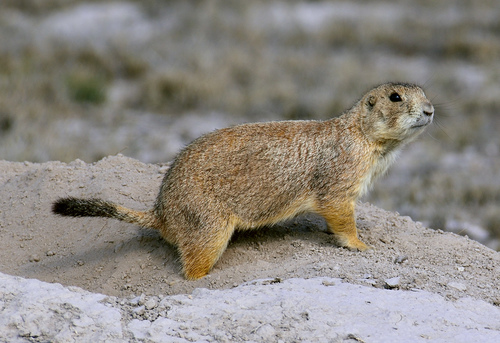
Yellowish-brown to tan fur with lighter underparts, small rounded ears, short legs, and a distinctive black-tipped tail that gives the species its name. Body is stocky and well-adapted for a semi-fossorial lifestyle.
Size
Body length typically 28-33 cm, with an additional tail length of 7-10 cm
Weight
Adults typically weigh between 0.5 and 1.5 kg, with males generally slightly larger than females
Distinctive features
Distinguished from other prairie dog species primarily by its black-tipped tail (versus white-tipped in white-tailed prairie dogs) and lack of hibernation behavior.
Differences between males and females
Minimal sexual dimorphism; males are slightly larger and heavier than females, particularly noticeable during breeding season
Behaviour and diet of the Black-tailed Prairie Dog
Highly social, living in large colonies called 'towns' organized into smaller family units called 'coteries' consisting of one male, several females, and their offspring. Towns can contain hundreds to thousands of individuals with complex communication systems.
When it is active
Strictly diurnal, most active during daylight hours with peak activity in early morning and late afternoon
Diet
Primarily herbivorous, feeding on grasses, forbs, and other low-growing vegetation; will also consume insects opportunistically, especially during periods of food scarcity
Communication
Complex vocal communication including distinct alarm calls ('barks') that can convey information about predator type, size, and speed; also uses scent marking, body postures, and a distinctive 'jump-yip' display for social bonding and territory assertion.
Interactions with other species
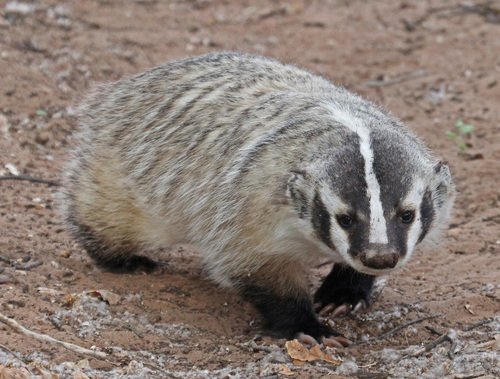
Critical prey species for black-footed ferrets, golden eagles, hawks, coyotes, and badgers; burrows provide shelter for burrowing owls, snakes, and numerous invertebrates, making prairie dogs a foundational keystone species in grassland ecosystems.
Role in its ecosystem
Functions as a keystone species and ecosystem engineer, with burrowing activity increasing soil aeration and water infiltration, grazing patterns promoting plant diversity, and burrow systems providing habitat for numerous other species including the endangered black-footed ferret.
Reproduction and lifecycle
Breeding occurs once annually in late winter (January-March); gestation lasts approximately 33-38 days, producing litters of 3-8 pups (average 3-4) born underground in nesting chambers
Raising the young
Females provide primary care, nursing pups for about 6 weeks before they emerge from burrows; young remain with family coterie for extended periods, receiving protection and social learning from multiple adult relatives.
Maturity and lifespan
Sexual maturity typically reached at 2-3 years of age; average lifespan in the wild is 3-5 years, though captive individuals can live up to 8 years.
Taxonomy and naming of the Black-tailed Prairie Dog
Classification
Class Mammalia > Order Rodentia > Family Sciuridae > Genus Cynomys > Species Cynomys ludovicianus
Subspecies
No widely recognized subspecies; the species is generally considered monotypic, though some regional variation exists across its range including peripheral populations in Arizona and New Mexico
Scientific synonyms
Arctomys ludoviciana (original combination by Ord, 1815)
What research says
Recent studies
Recent research has focused on plague ecology and vaccine development for colony protection, as well as studies on the sophisticated referential alarm call system, which some researchers argue represents one of the most complex vocal communication systems among non-primate mammals.
Genome and DNA
Diploid chromosome number is 2n=50; genetic studies have been used to assess population connectivity and inform conservation genetics across fragmented habitat.
Compared with similar species
Similar to the white-tailed prairie dog (Cynomys leucurus) but distinguished by black tail tip, lack of hibernation, and more complex social 'coterie' structure; generally more social and colonial than the closely related Gunnison's prairie dog (Cynomys gunnisoni).
The Black-tailed Prairie Dog and people
Prairie dogs have one of the most sophisticated alarm call systems studied in mammals, capable of describing predator size, shape, and even color of clothing worn by humans approaching. Their historic 'towns' were so vast that one documented Texas colony was estimated to cover 65,000 square kilometers and house 400 million individuals.
Where and how to see it
Best observed early morning or late afternoon in protected prairie dog towns such as those in Badlands National Park, Wind Cave National Park, or various national grasslands; look for sentinel individuals standing upright near burrow entrances.
Risks to humans
Low direct risk to humans, though they can carry plague-infected fleas, making direct handling inadvisable; bites are rare and occur mainly if animals are cornered or handled.
Human uses
Historically hunted for fur and as pest control targets; increasingly valued for ecotourism in protected areas and studied extensively in ecological and behavioral research programs.
Myths and legends
Historically viewed by many ranchers as agricultural pests linked to livestock injury from burrow holes, leading to widespread extermination campaigns; some Native American cultures viewed them as important components of prairie ecology and included them in traditional ecological knowledge.
Countries where the Black-tailed Prairie Dog is recorded
The 3 countries named in the range description of its IUCN Red List assessment.
Questions about the Black-tailed Prairie Dog
Where does the Black-tailed Prairie Dog live?
The Black-tailed Prairie Dog is recorded in Canada, Mexico and United States across North America. These countries come from the range description of its IUCN Red List assessment, and they are what place the species on the interactive map.
Is the Black-tailed Prairie Dog endangered?
The IUCN Red List assesses the Black-tailed Prairie Dog as Least Concern. The species is widespread and abundant enough not to qualify for any threatened category. It does not mean the species is safe forever, only that nothing in the current data raises an alarm.
How many are left in the wild?
Estimated at several million individuals across fragmented colonies, though this represents a small fraction of historical numbers; overall trend considered stable to locally declining depending on region. This figure comes from the species assessment on the IUCN Red List; population estimates for wild mammals are ranges, not counts, and are revised at each assessment.
What habitat does the Black-tailed Prairie Dog live in?
Shortgrass and mixed-grass prairies, semi-arid grasslands, and open plains with well-drained soils suitable for burrowing.
What is the scientific name of the Black-tailed Prairie Dog?
The Black-tailed Prairie Dog is Cynomys ludovicianus, in the family Sciuridae, order Rodentia.
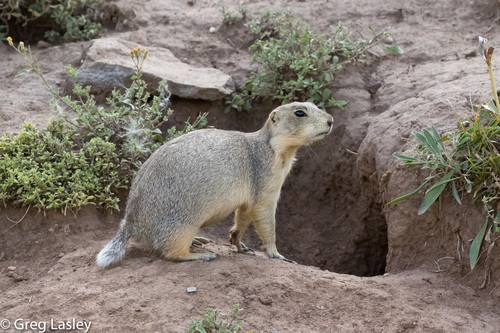
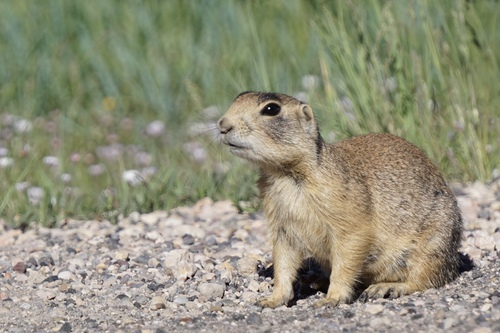
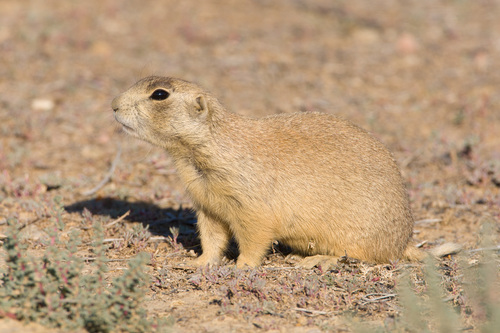
Other species in the genus Cynomys
Other species in the family Sciuridae
Species that share its range
Sources
Conservation status, range description and population estimate come from the IUCN Red List assessment for Cynomys ludovicianus. Countries are derived from that range description, not from a mapped country list. Last refreshed on .
The distribution map is drawn from the IUCN Red List spatial data compiled in 2008. IUCN (International Union for Conservation of Nature)